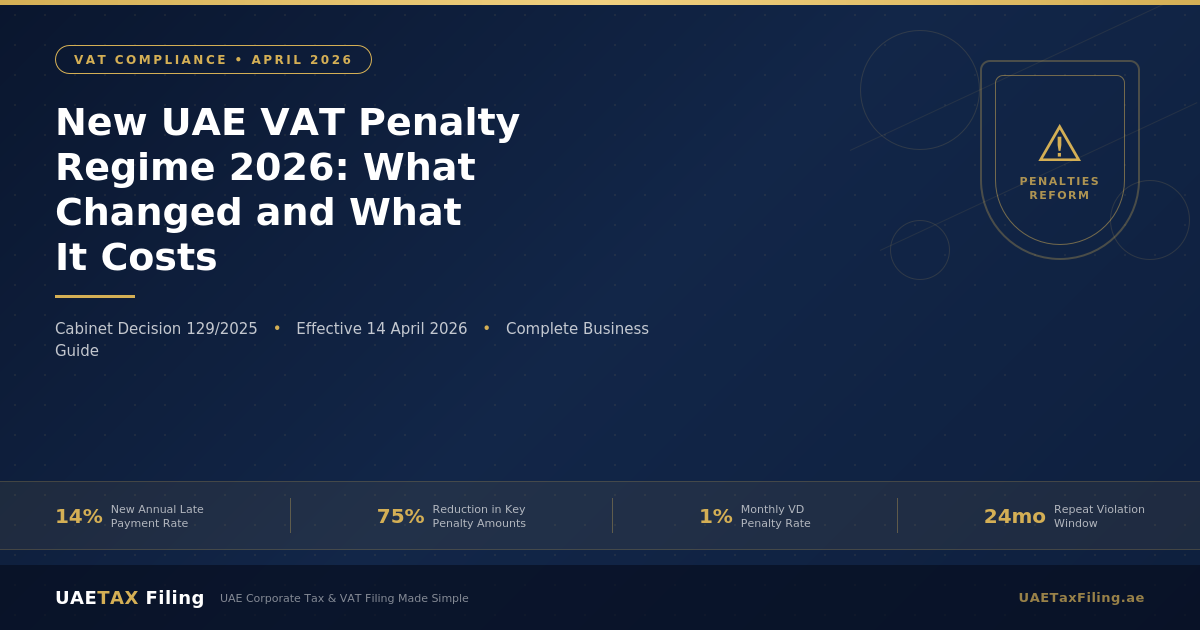
On 14 April 2026, the way the Federal Tax Authority penalises VAT violations in the UAE changes completely. Cabinet Decision No. 129 of 2025 replaces the penalty framework that has governed VAT and Excise Tax compliance since January 2022, introducing a simplified, non compounding structure that aligns penalties across all federal tax types. For UAE businesses that have spent years managing the compounding late payment calculations under the old regime, this is a significant shift in how non compliance costs are determined and, critically, in how quickly those costs accumulate.
The reform is not just a reduction in fines. It represents a philosophical change in how the FTA approaches enforcement. The new regime rewards businesses that identify errors early and file voluntary disclosures before an audit begins. It introduces a consistent 24 month window for repeat violations instead of blanket escalating penalties. And it replaces the old compounding late payment structure (2% immediate plus 4% monthly, capped at 300%) with a straightforward 14% annual rate calculated monthly. If your business is registered for VAT in the UAE, you must understand these changes before they take effect. For a broader overview of all regulatory changes happening this year, see our complete guide to UAE tax changes in 2026.
This article breaks down every penalty that has changed under Cabinet Decision 129/2025, explains how the new calculations work with real examples, covers the penalties that remain unchanged, and provides a preparation checklist your business can use before the 14 April enforcement date. Whether you operate a mainland LLC, a free zone entity, or a freelance business, understanding the new cost of non compliance is now part of responsible tax management.
Book Your Free VAT Compliance Consultation
1. Why the UAE Overhauled Its VAT Penalty Framework
The UAE introduced VAT in January 2018, and the original penalty provisions under Cabinet Decision No. 40 of 2017 were designed for a tax system still in its early stages. When Cabinet Decision No. 108 of 2021 updated those provisions in January 2022, the changes brought higher penalties intended to encourage compliance across an expanding base of registered businesses. However, the 2021 framework created complexity. Late payment penalties compounded aggressively, voluntary disclosure fines were structured in stepped percentage bands from 5% to 50%, and the calculations were difficult for businesses (and their accountants) to model accurately.
By 2025, the tax environment in the UAE looked fundamentally different. Corporate tax had been operational since June 2023 under its own penalty framework (Cabinet Decision No. 75 of 2023), and the government recognised that having separate penalty logic for VAT, Excise Tax, and Corporate Tax created confusion. As PwC Middle East noted in their November 2025 analysis, the new decision replaces the compounding penalty system with a non compounding structure, reducing complexity and making penalties easier to calculate. The Ministry of Finance published Cabinet Decision 129 on 9 October 2025, with the FTA formally releasing the text on 10 November 2025. The six month transition window before the 14 April 2026 effective date mirrors the approach used for the 2021 penalty reform, giving businesses time to update their compliance processes, retrain their finance teams, and recalibrate their ERP systems. For businesses that need professional VAT return filing support, the transition period is the right time to bring in expert help.
2. The Big Changes: Penalties That Dropped Significantly
Several of the most impactful penalty reductions under the new regime affect violations that commonly trip up UAE businesses. Here is a detailed breakdown of the penalties that have changed and what each one now costs.
Late Payment of Payable Tax
This is the change that will affect the largest number of businesses. Under the old regime, a missed VAT payment triggered an immediate 2% penalty on the outstanding balance, followed by a 4% monthly charge that compounded each month the balance remained unpaid. Over time, penalties could accumulate to as much as 300% of the original unpaid tax. Under the new framework, the late payment penalty is a flat 14% per annum, applied monthly on the unpaid balance. That works out to approximately 1.17% per month, a fraction of the old 4% compounding rate. The calculation is now consistent with how Corporate Tax late payment penalties work under Cabinet Decision 75/2023, creating a unified approach across all federal taxes. For a business that owes AED 100,000 in VAT and pays six months late, the penalty under the old system would have been AED 2,000 (immediate) plus approximately AED 24,000 (4% x 6 months) for a total of AED 26,000. Under the new system, the same delay costs approximately AED 7,000. That is a reduction of over 70%.
Failure to Submit Records in Arabic
Under the old regime, failing to maintain or submit tax records in Arabic attracted a flat AED 20,000 penalty. Cabinet Decision 129 reduces this to AED 5,000, a 75% reduction. This change is particularly relevant for businesses with international ownership structures where financial records are primarily maintained in English. While the obligation to maintain Arabic language records remains, the cost of a first time failure is now significantly lower. That said, it is worth noting that the FTA has not relaxed the underlying requirement. Businesses still need to maintain Arabic records, and the reduced penalty should not be treated as permission to ignore this obligation. Our accounting and bookkeeping services include Arabic language record maintenance for clients who need this support.
Failure to Inform FTA of Changes to Tax Record
When a business changes its address, trade name, legal structure, or other details recorded with the FTA, it must notify the authority within the prescribed timeframe. Under the old rules, the penalty was AED 5,000 for a first offence and AED 10,000 for a repeat. The new framework reduces this to AED 1,000 for a first violation and AED 5,000 if the same violation is repeated within 24 months. This is one of several areas where the 24 month repeat violation window has been introduced, giving businesses a clear and defined timeframe for demonstrating compliance improvement.
Failure to Notify Appointment of Legal Representative
When a taxpayer appoints a legal representative for tax purposes, they must notify the FTA. The old penalty for failing to do so was AED 10,000. Under Cabinet Decision 129, this drops to AED 1,000, a 90% reduction. While this is a less common violation, the reduction reflects the broader principle of the reform: lower penalties for administrative oversights, with higher consequences reserved for repeat and material non compliance.
Incorrect Tax Return Submission
Filing a VAT return with errors previously attracted a penalty of AED 1,000 for a first offence and AED 2,000 for a repeat within 24 months. The new penalty is AED 500 for a first violation. More importantly, the penalty can now be waived entirely if the taxpayer corrects the return before the original due date, or if the taxpayer submits a voluntary disclosure that does not change the amount of tax due. This is a meaningful change because it encourages businesses to review and correct their filings proactively. If you catch a data entry error or misclassification and fix it before the deadline passes, there is no financial consequence. For guidance on getting your quarterly submissions right the first time, see our upcoming guide on how to file your quarterly VAT return without errors.
3. Voluntary Disclosure Penalties: A Complete Restructure
The voluntary disclosure penalty is where the new regime introduces its most nuanced changes. Under the old framework, voluntary disclosure penalties were calculated using stepped fixed percentage bands based on how many years had passed since the error occurred. If a business discovered an error and filed a voluntary disclosure within one year of the original due date, the penalty was 5% of the tax difference. Between one and two years, it jumped to 10%. Between two and three years, 20%. Between three and four years, 30%. And between four and five years, 40%. If the FTA had already issued an audit notification before the disclosure was filed, the penalty spiked to a fixed 50% plus 4% monthly additions.
Cabinet Decision 129 replaces this entire structure with a simple formula: 1% per month of the tax difference, calculated from the original due date until the date of the voluntary disclosure filing. There are no fixed percentage bands. There are no jumps between years. The penalty grows linearly at 1% per month, which means a disclosure filed 12 months after the due date incurs a 12% penalty, one filed at 24 months incurs 24%, and one filed at 36 months incurs 36%.
For short term corrections (errors discovered and disclosed within a few months), the new system may result in a slightly higher penalty than the old 5% flat rate. However, for longer term corrections, the old system imposed steep jumps (from 5% to 10%, then 20%, 30%, 40%), whereas the new system grows steadily. The real advantage is predictability. Businesses can now calculate their exact penalty exposure before deciding to file a voluntary disclosure, which was far more difficult under the stepped band system. For a deeper understanding of how voluntary disclosures work and when they save you money, read our upcoming article on voluntary disclosure in the UAE.
Penalty After Audit Notification
If the FTA sends an audit notification before the taxpayer submits a voluntary disclosure, a fixed penalty of 15% of the tax difference is added on top of the 1% monthly charge. Under the old regime, this fixed penalty was 50%, plus 4% monthly additions. Alvarez and Marsal illustrated this with a clear example in their November 2025 analysis: for a tax difference of AED 100,000 with an audit assessment 29 months after the original due date and no voluntary disclosure filed, the old system produced a total penalty of AED 166,000. Under the new framework, the same scenario costs AED 44,000. That represents a reduction of approximately 73%.
The gap between filing a voluntary disclosure and waiting for an audit is now exactly 15% of the tax difference. For that same AED 100,000 error corrected at 29 months, a voluntary disclosure costs AED 29,000 (1% x 29 months), while an audit costs AED 44,000 (AED 15,000 fixed plus AED 29,000 variable). Filing the disclosure saves AED 15,000. This design is intentional: the FTA wants businesses to come forward voluntarily. If your business has historical VAT errors that have not been corrected, now is the time to act. Our corporate tax services team also works with voluntary disclosure cases across all tax types.
4. Penalties That Remain Unchanged
Not every penalty has been reduced. Several core compliance obligations carry the same fines they did before, and in some cases, the FTA has maintained higher penalties to signal the seriousness of these violations.
Late VAT Registration remains at AED 10,000. The FTA has consistently treated registration deadlines as non negotiable, and the continued AED 10,000 penalty for failing to register within 30 days of crossing the AED 375,000 mandatory threshold confirms that position. Businesses approaching this threshold should register proactively rather than risk missing the window.
Late Deregistration penalties are also unchanged at AED 1,000 for a first offence, plus AED 1,000 per month of continued non compliance, up to a maximum of AED 10,000. When a business no longer meets the conditions for VAT registration, it must apply for deregistration within 20 business days.
Late VAT Return Filing continues to attract AED 1,000 for a first offence and AED 2,000 for a repeat within 24 months. While this penalty has not increased, it is worth remembering that a late filing can also trigger late payment penalties if the VAT liability has not been settled by the due date. Filing and payment are separate obligations, and each carries its own consequences.
Failure to Issue Tax Invoices or Tax Credit Notes remains at AED 5,000 per missing document. With the UAE's mandatory e invoicing framework set to begin rolling out from July 2026, the importance of proper invoice issuance is only increasing. Businesses should ensure their invoicing systems are producing compliant documents for every taxable supply.
Failure to Display Prices Inclusive of VAT remains at AED 15,000. This applies to all consumer facing businesses that must display VAT inclusive pricing. Restaurants, retailers, and service providers should verify their pricing displays are compliant.
Designated Zone Violations remain at AED 50,000 or 50% of the unpaid tax, whichever is higher. Free zone businesses operating within designated zones should review their compliance with the specific transfer and documentation requirements that apply.
5. The 24 Month Repeat Violation Window
One of the most important structural changes in Cabinet Decision 129 is the introduction of a consistent 24 month repeat violation window across multiple penalty categories. Under the old regime, some penalties simply doubled for any repeat, regardless of when the previous violation occurred. The new framework defines a repeat violation as one that occurs within 24 months of the last offence. If a business is penalised for a record keeping failure, for example, and the same failure occurs 25 months later, the lower first offence penalty applies rather than the higher repeat rate.
This matters because it creates a clear path to resetting penalty exposure. Businesses that address the root cause of a violation and maintain compliance for 24 months effectively start fresh. The FTA is signalling that it values sustained improvement over indefinite punishment. However, the repeat penalties within the 24 month window can be steep. For failure to keep required records, for instance, the first offence is AED 10,000 and the repeat within 24 months is AED 20,000. Addressing compliance gaps after the first penalty is far less expensive than allowing the same issue to recur.
6. How the New Late Payment Calculation Works: Step by Step
The shift from the old compounding model to the new flat rate model is best understood through a direct comparison. Let us walk through a scenario.
Scenario: A business files its Q1 2026 VAT return on time (due 28 April 2026) but fails to pay the AED 200,000 VAT liability. The business finally pays on 28 October 2026, six months late.
Under the old regime (Cabinet Decision 108/2021): Day 1 after the due date, an immediate 2% penalty applies: AED 4,000. After 7 days, an additional 4% applies: AED 8,000. Then 4% compounds monthly for 6 months: approximately AED 48,000 in monthly charges. Total penalty: approximately AED 60,000 (30% of the original liability).
Under the new regime (Cabinet Decision 129/2025): The penalty is 14% per annum, applied monthly: AED 200,000 x 14% / 12 = AED 2,333 per month. Over 6 months: AED 14,000. Total penalty: AED 14,000 (7% of the original liability).
The difference is AED 46,000. That is a 77% reduction in penalty exposure for the same delay. For businesses managing cash flow pressures or experiencing temporary payment difficulties, the new structure is far more manageable. However, the FTA still expects payment on time. The 14% annual rate, while lower than before, still adds up. A full 12 month delay on AED 200,000 would cost AED 28,000 in penalties alone. If your business is struggling with VAT payment timing, our VAT compliance team can help you set up payment processes that prevent late penalties.
7. E Invoicing Penalties: A Separate Framework You Must Know
While Cabinet Decision 129 reforms the core VAT and Excise penalty regime, businesses also need to be aware of the separate penalty framework for e invoicing non compliance under Cabinet Resolution No. 106 of 2025. The UAE's mandatory e invoicing system launches on 1 July 2026 for the voluntary pilot, with mandatory phases starting in January 2027. The e invoicing penalties include: AED 5,000 per month for failing to appoint an accredited service provider or implement the e invoicing system on time. AED 100 per invoice for failing to issue or transmit an electronic invoice or credit note, capped at AED 5,000 per month. AED 1,000 per day for failing to report system failures or registration changes to the FTA.
These penalties sit alongside the existing AED 5,000 per document penalty for failure to issue tax invoices. The e invoicing framework adds a technology compliance layer on top of the existing obligation to issue invoices for every taxable supply. Businesses should be preparing for both the reformed penalty regime under Cabinet Decision 129 and the new e invoicing requirements simultaneously. For a complete walkthrough of the e invoicing timeline, technical requirements, and the nine MoF pre approved Accredited Service Providers, see our UAE e invoicing 2026 preparation guide.
8. What This Means for FTA Audit Exposure
The reformed penalty structure does not mean the FTA is going easy on enforcement. Quite the opposite. The Federal Tax Authority conducted 93,000 inspection visits in 2024, representing a 135% increase from the previous year. The FTA's Strategy 2023 to 2026 confirms that audits are risk driven and powered by digital analytics. The authority cross references VAT return data with corporate tax filings, customs declarations, and banking information to identify discrepancies. A business whose VAT returns report different revenue figures than its corporate tax return will attract attention.
The lower penalty structure under Cabinet Decision 129 should be understood as an incentive to comply voluntarily rather than as a signal that enforcement is weakening. Businesses that proactively correct errors through voluntary disclosures now face penalties that are a fraction of what they were before. Businesses that wait for an audit and are found to have underpaid tax face the additional 15% fixed penalty on top of the monthly charges. The FTA's message is clear: come forward before they come to you. For detailed preparation advice on what to expect and how to organise your records for an FTA review, see our upcoming article on FTA audits in 2026.
9. Your Pre 14 April Compliance Checklist
Businesses have until 14 April 2026 to prepare. Here is what your finance and tax team should be doing right now.
Review your historical VAT filings for errors or underpayments. If you identify any discrepancies, file a voluntary disclosure before the new regime takes effect. The monthly 1% calculation starts from the original due date, so earlier disclosure means lower penalties.
Recalculate your penalty exposure under the new framework. If your business has outstanding penalties or disputes with the FTA, the new rates may change your strategic position. Engage a professional tax consultant to assess whether a voluntary disclosure or reconsideration request makes financial sense.
Update your ERP and accounting systems to reflect the new penalty calculations. If your software includes penalty estimation or late payment tracking, the calculation logic will need to change from the old compounding model to the new 14% annual rate.
Train your finance team on the new rules. The people responsible for VAT return preparation, payment scheduling, and record keeping should understand the new penalty amounts, the 24 month repeat violation window, and the voluntary disclosure incentives.
Verify your Arabic language records are current. While the penalty for non compliance has dropped from AED 20,000 to AED 5,000, the obligation still exists. Use the transition period to bring your documentation into compliance. Our bookkeeping and accounting services cover bilingual record maintenance as part of ongoing engagements.
Confirm your tax registration details on the EmaraTax portal are accurate. Address changes, trade name updates, and legal representative appointments all carry penalties if not reported to the FTA. Checking and updating these details now is a zero cost step that eliminates unnecessary risk. For a full walkthrough of the portal, watch for our upcoming EmaraTax portal guide.
Set up payment reminders and automated triggers for VAT due dates. The FTA recommends that businesses initiate bank transfers several days before the 28th day deadline, as processing delays can result in late payments even when the transfer is initiated on time. VAT payment deadlines in the UAE are firm, and the FTA does not accept pending transfers as on time payment.
10. The Bigger Picture: What This Reform Signals
Cabinet Decision 129 is part of a coordinated overhaul of the UAE's entire tax administration framework. In 2025 alone, the government issued Federal Decree Law No. 16 of 2025 (amending the VAT Law), Federal Decree Law No. 17 of 2025 (amending the Tax Procedures Law), Cabinet Decision No. 106 of 2025 (e invoicing penalties), and this decision reforming administrative penalties. As DLA Piper observed in their December 2025 analysis, certain penalties remain unchanged, such as those related to timely tax registration and deregistration, indicating the FTA will maintain strict compliance discipline. Together, these reforms create a system where the rules are clearer, the calculations are simpler, and the consequences of non compliance are more predictable but still substantial.
The UAE is signalling to the global business community that its tax system is maturing. The move away from punitive, compounding penalties toward a proportional, behaviour driven enforcement model aligns with international best practices followed by OECD member countries. For the full scope of UAE taxation rules, the UAE Government Portal on taxation provides an overview of all federal tax obligations. For businesses operating in the UAE, this means that compliance is becoming less about avoiding extreme financial penalties and more about maintaining disciplined, ongoing processes. The businesses that benefit most from this reform are those that already take their VAT obligations seriously and use the lower penalty rates as breathing room for process improvement rather than as an excuse for complacency.
The FTA's enforcement capacity continues to grow. The combination of the 93,000 inspection visits in 2024, the upcoming e invoicing data feeds starting in mid 2026, and the cross referencing of VAT and corporate tax data means the authority has more visibility into business activity than ever before. Lower penalties do not mean lower risk of detection. They mean lower cost when you self correct. The real penalty for non compliance is not the fine itself; it is the business disruption, management distraction, and reputational impact of an FTA audit finding.
Frequently Asked Questions
What is Cabinet Decision 129 of 2025?
Cabinet Decision No. 129 of 2025 is a UAE government decision issued on 9 October 2025 that reforms the administrative penalty framework for violations of the Tax Procedures Law, the VAT Law, and the Excise Tax Law. It replaces the previous penalty provisions under Cabinet Decision No. 108 of 2021 and takes effect on 14 April 2026. The decision harmonises VAT and Excise Tax penalties with the Corporate Tax penalty structure, creating a unified approach across all federal taxes.
When do the new VAT penalties take effect?
The new penalties under Cabinet Decision 129 take effect on 14 April 2026. Any violation that occurs from that date forward will be subject to the new penalty framework. Violations that occurred before 14 April 2026 remain subject to the old penalties under Cabinet Decision 108/2021.
How much is the new late payment penalty?
The new late payment penalty is 14% per annum, calculated monthly on the outstanding tax balance. This replaces the old structure of 2% immediate plus 4% monthly compounding. For most businesses, this results in a significantly lower penalty for the same period of delay. The annual rate is applied proportionally each month, meaning the effective monthly rate is approximately 1.17%.
Has the VAT late registration penalty changed?
No. The late VAT registration penalty remains AED 10,000. The FTA has maintained the same penalty amount for businesses that fail to register within 30 days of crossing the AED 375,000 mandatory registration threshold. Registration deadlines continue to be strictly enforced.
What happens if I file a voluntary disclosure under the new regime?
Under the new regime, voluntary disclosure penalties are calculated at 1% per month of the tax difference, starting from the original due date until the disclosure is filed. There is no fixed penalty for a voluntary disclosure filed before an FTA audit notification. If the disclosure is filed after an audit notification, an additional fixed penalty of 15% of the tax difference applies. This structure strongly incentivises early disclosure.
Do the new penalties apply to Corporate Tax?
Cabinet Decision 129 specifically reforms penalties for VAT and Excise Tax violations. Corporate Tax penalties continue to be governed by Cabinet Decision No. 75 of 2023. However, the reform aligns the VAT and Excise penalty structure with the Corporate Tax framework, meaning the penalty logic (14% annual late payment rate, 1% monthly voluntary disclosure rate) is now consistent across all federal taxes. For more on Corporate Tax compliance, visit our corporate tax services page.
Can I request a reconsideration of penalties issued before April 2026?
Businesses can submit a reconsideration request through the EmaraTax portal for penalties they believe were imposed incorrectly. However, the new penalty rates under Cabinet Decision 129 do not retroactively apply to violations that occurred before 14 April 2026. If you have outstanding penalties from before this date, the old rates still apply unless the FTA provides specific transitional relief. Our team at UAE Tax Filing can assess whether a reconsideration request is appropriate for your situation. Contact us via WhatsApp or email at uaetaxfiling@gmail.com.
What are the e invoicing penalties?
E invoicing penalties are governed by a separate decision, Cabinet Resolution No. 106 of 2025. Penalties include AED 5,000 per month for failure to implement the e invoicing system, AED 100 per invoice for failure to issue electronic invoices (capped at AED 5,000 per month), and AED 1,000 per day for failure to report system failures. These penalties apply alongside the reformed VAT penalty framework under Cabinet Decision 129.
Conclusion: Lower Penalties, Higher Expectations
The reformed penalty regime under Cabinet Decision 129/2025 is a welcome development for UAE businesses. Lower fines for administrative errors, a simplified late payment calculation, and transparent voluntary disclosure incentives make compliance more predictable and less financially punishing when mistakes do occur. But the reform comes with a trade off. The FTA is expanding its audit capacity, rolling out mandatory e invoicing, and cross referencing data across tax types with increasing sophistication. The businesses that benefit from this reform are not those that take compliance less seriously. They are those that use the transition period to clean up historical errors, strengthen their internal processes, and ensure their records are accurate and complete.
If your business has not yet reviewed its VAT compliance in light of these changes, the time to act is now. Every day that passes between today and 14 April 2026 is a day you could use to file a voluntary disclosure at a lower penalty cost, update your records, or fix a process that has been producing errors. The new regime rewards early action. Do not wait for the FTA to act first.
For professional support with VAT compliance, voluntary disclosures, penalty reconsideration, or any aspect of UAE tax filing, contact the UAE Tax Filing team. We work with businesses across Dubai, Abu Dhabi, Sharjah, and all UAE free zones to ensure complete compliance with every FTA requirement.
Book Your Free VAT Penalty Review Consultation
Or reach us directly at uaetaxfiling@gmail.com or call/WhatsApp +971 58 562 2437.
Related Articles
Every UAE Tax Change Coming in 2026: A Complete Business Guide
UAE E Invoicing 2026: Complete Business Preparation Guide
How to File Your Quarterly VAT Return in the UAE Without Errors
FTA Audits in 2026: What to Expect and How to Prepare Your Business
Corporate Tax Penalties UAE: Updated Fines and How to Avoid Them
Voluntary Disclosure UAE: When It Saves You Money and When It Does Not
Disclaimer: This article is intended for general informational purposes only and does not constitute professional tax, legal, or financial advice. While every effort has been made to ensure accuracy based on publicly available sources at the time of writing, UAE tax laws and regulations are subject to change. Readers should not rely solely on this article for making tax decisions and are advised to consult with a qualified tax professional or the Federal Tax Authority (FTA) directly. UAE Tax Filing LLC accepts no responsibility for any actions taken or not taken based on the content of this article.