There is a number sitting on your VAT return called 'excess refundable tax' or 'credit balance.' For most UAE businesses, this number quietly grows quarter after quarter. Input VAT exceeds output VAT, the difference carries forward, and the credit accumulates. Some businesses have AED 50,000 sitting there. Some have AED 500,000. Some have millions. Almost all of them have never filed a refund claim, because the FTA's old rules let credits accumulate indefinitely and there was no deadline forcing action. UAE nationals building their own home use a separate scheme — see our guide to the new residence VAT refund.
That changed on January 1, 2026. Federal Decree-Law No. 16 of 2025 introduced a five-year limitation period on VAT refund claims. Credits older than five years from the end of the relevant tax period are no longer recoverable. As PwC's UAE tax summary documented, a one-year transitional window runs until December 31, 2026 for businesses to claim older credits before they expire permanently.
Our VAT credit expiration guide explained the WHEN: which credits expire, the timeline, and the urgency. This article explains the HOW: how to actually file VAT 311 on EmaraTax, what documentation the FTA expects, how long the process takes, what to do when the FTA asks questions, and how to avoid the audit risk that comes with claims filed in the final year of the limitation window. If you read Blog #9 and thought 'I should do something about this,' this is the article that tells you exactly what to do.
"Most UAE businesses have never filed a VAT refund claim. They treat the credit balance as theoretical money that will somehow become real one day. The 2026 deadline made it real in the opposite direction: file the claim and recover the cash, or watch the credit expire and lose the cash. There is no third option."
Jazim, CEO, UAE Tax Filing LLC
When a VAT Refund Is Worth Filing
Not every credit balance justifies a refund claim. The FTA process takes 4 to 6 weeks for standard claims and longer if the FTA has questions. The documentation requirements are significant. The audit risk is real, particularly for claims filed in the final year of the limitation window. Before you start the process, run a basic cost-benefit analysis.
Refund claims usually make sense when: the credit balance exceeds AED 25,000 (smaller balances may not justify the documentation effort), the credit is older than 18 months (so it cannot be naturally absorbed by future output VAT in the next few quarters), the business does not expect to generate enough future output VAT to absorb the credit through normal operations, the credit is approaching the 5-year expiration window, or the business needs the cash for working capital reasons.
Refund claims usually do not make sense when: the credit balance is small (under AED 25,000) and you expect to absorb it within 2-3 quarters, your business is rapidly growing and your future output VAT will exceed input VAT, your VAT records are incomplete and the documentation effort would exceed the refund value, or you have unfiled VAT returns or unresolved compliance issues that the refund process would expose to the FTA.
The break-even math: A refund claim with the help of a tax advisor typically costs AED 2,000 to AED 8,000 in professional fees, depending on complexity. For the claim to be financially worthwhile, the recoverable amount should comfortably exceed this cost. On a AED 50,000 credit, the net recovery after fees is AED 42,000 to AED 48,000. On a AED 500,000 credit, the net recovery is AED 492,000 to AED 498,000. The percentage cost decreases with claim size, which is why larger credits are almost always worth pursuing.
Step 1: Identify Your Eligible Credits
Open EmaraTax and pull every VAT return your business has filed since registration. For most businesses, this means quarterly returns going back to 2018 (when VAT was introduced) or whenever the business was registered. For each return, look at the 'net VAT due' line. Returns where this is negative (input VAT exceeded output VAT) generated credits. Add up the credit balance forward across all periods to get your current cumulative balance.
Cross-check this against the 'refundable balance' shown on your latest VAT return. The two should match. If they do not, there is a reconciliation issue that needs to be resolved before filing a refund claim. Common reasons for mismatches: returns that were amended after filing, voluntary disclosures that adjusted prior periods, and FTA assessments that modified the credit balance without updating subsequent returns.
Once you have the cumulative balance, break it down by tax period of origin. The 5-year limitation runs from the end of the relevant tax period, so a credit generated in Q1 2021 expires at the end of Q1 2026. As ClearTax's analysis explained, credits older than 5 years from the end of the relevant tax period are no longer refundable, but the transitional relief window allows businesses to claim credits from 2018-2020 by December 31, 2026. After that date, those older credits are permanently lost.
Priority order: Claim the oldest credits first. A credit from 2018 that you do not claim by December 31, 2026 disappears forever. A credit from 2024 has until 2029. Always file claims in age order, oldest first, to maximize what you can actually recover.
Step 2: Gather the Documentation the FTA Expects
This is where most refund claims fail. The FTA does not refund money based on the VAT return alone. The return shows that you reported the credit. The supporting documentation proves that the credit is real. The FTA expects you to be able to substantiate every input VAT amount claimed across the relevant periods.
Tax invoices for every input VAT claim. These are the original tax invoices from your suppliers showing the VAT amount charged. The invoices must comply with Article 65 of the VAT Executive Regulation: supplier name and TRN, buyer name and TRN, invoice date, sequential invoice number, description of supply, VAT rate and amount, total amount including VAT. An invoice missing any of these fields is not a valid tax invoice and the FTA can disallow the input VAT recovery.
Payment evidence for each invoice. Bank statements, transfer confirmations, or cheque images showing that you actually paid the supplier. The FTA cross-references invoices against payments. An invoice without corresponding payment evidence raises the question of whether the supply actually occurred. As our 9 mistakes article documented, the FTA's audit systems algorithmically cross-reference data sources, and refund claims trigger more aggressive cross-referencing than normal VAT returns.
Import declarations for goods imported. Customs declarations (Bayan documents) showing the VAT paid at import. For businesses claiming input VAT on imported goods, the customs declaration is the equivalent of a tax invoice. Without it, the import VAT is not recoverable.
Reverse charge documentation. Our reverse charge guide covered the changes effective January 1, 2026. For periods before that date, self-invoices for reverse charge transactions are required. For periods from January 1, 2026 onward, the supporting documentation (contracts, supplier invoices, payment evidence) replaces the self-invoice requirement. Either way, the documentation must exist.
Bank statements showing the credit balance evolution. Not strictly required, but extremely helpful. A clean trail showing input VAT paid, output VAT collected, and the resulting credit balance gives the FTA confidence that your records are complete. The FTA is more likely to process claims quickly when the documentation tells a clear story.
The documentation gap risk: If you cannot produce the original tax invoice for an input VAT amount, that amount is not recoverable. Claiming it anyway risks the entire refund being delayed, audited, or rejected. Be ruthless about excluding amounts you cannot fully substantiate. A AED 30,000 refund that goes through cleanly is better than a AED 35,000 refund that triggers an FTA audit because AED 5,000 of the claim cannot be supported.
Documentation is the make-or-break step in any VAT refund claim. Our accounting team reviews your historical VAT returns, identifies recoverable credits, gathers supporting documentation, and excludes amounts that would create audit risk. Message us on WhatsApp.
Step 3: File VAT 311 on EmaraTax
VAT 311 is the official refund application form on the EmaraTax portal. The form is accessed by logging into EmaraTax with your TRN credentials, navigating to the VAT services section, selecting 'VAT Refund Request,' and choosing the appropriate refund type. As the FTA's VAT refund service confirms, the form must be submitted electronically through the portal. Paper submissions are not accepted.
The VAT 311 fields you must complete
Refund period. The tax period or periods for which you are claiming the refund. You can submit a single claim covering multiple periods, but the FTA generally prefers separate claims for each period to simplify review. For older credits approaching the 5-year limitation, file each year separately so that any audit on one year does not delay the others.
Refundable amount. The exact AED amount you are claiming. This must reconcile with the credit balance shown on your VAT returns for the relevant periods. Any discrepancy between the claim amount and the return data will trigger an FTA query.
Bank details. The UAE bank account where you want the refund deposited. The account must be in the name of the business entity (not the owner personally) and must match the bank account on file with the FTA. If your bank account has changed since your last VAT return, update it on EmaraTax before filing the refund claim, otherwise the deposit will fail.
Reason for the refund. A free-text explanation of why you are claiming the refund. Be specific: 'Excess input VAT accumulated during fit-out and equipment purchase phase from Q1 2021 to Q3 2022, exceeding output VAT during business setup period.' Avoid vague statements like 'credit balance has built up.' The reason field is the FTA's first opportunity to understand your case, and a clear explanation reduces the likelihood of follow-up queries.
Supporting documents upload. EmaraTax allows you to attach supporting documentation to the claim. Upload everything from Step 2: tax invoices (organized by period), payment evidence, import declarations, and a summary spreadsheet showing the calculation of the refund amount. The portal accepts PDF, JPG, and Excel formats. Keep file sizes manageable (under 10 MB per file). For very large refund claims with hundreds of supporting documents, organize them into archived folders (one per quarter) and upload as compressed files.
Declaration. Tick the box confirming that the information is accurate and complete. This is a legal declaration. False or incomplete information can be treated as a tax violation under the new penalty regime, with administrative penalties on top of any disallowed refund.
Submission and confirmation
Once you have completed all fields and uploaded all documents, submit the form. EmaraTax generates a reference number for your claim. Save this reference number. You will need it for any subsequent communication with the FTA about the claim, and you will need it to track the status of the claim through the EmaraTax portal.
The FTA sends an email confirmation that the claim has been received. This email is not approval of the refund. It is acknowledgment that the FTA has the claim and will begin processing it. The actual approval (or query) comes later, typically within 4 to 6 weeks for standard claims.
Step 4: The FTA Review (4 to 6 Weeks)
Once submitted, your claim enters the FTA's review queue. The standard processing time is 4 to 6 weeks, but this can extend significantly for large or complex claims, claims for older periods, or claims that trigger queries. During this period, three things can happen.
Outcome 1: The FTA approves the claim and processes the refund. This is the best outcome and it happens for clean claims with complete documentation. You receive an email notification confirming approval, and the refund is deposited into your registered bank account within 5 to 10 business days of approval. For most businesses, the entire process from submission to bank deposit takes 6 to 8 weeks.
Outcome 2: The FTA requests additional information. The FTA may ask for clarifications, additional supporting documents, or a written explanation of specific transactions. These queries arrive through EmaraTax as messages on your account. The standard response window is 5 to 10 business days. Failure to respond within the window can lead to rejection of the claim. As Kayrouz & Associates noted, the FTA's enhanced audit powers from January 1, 2026 give them broader authority to scrutinize refund claims, particularly for older credits.
Outcome 3: The FTA initiates an audit. For larger claims or claims with documentation gaps, the FTA may decide to audit the underlying VAT returns before approving the refund. An audit means a formal review of your VAT records for the relevant periods, potentially extending to your full books of account. As our FTA audit guide explained, audits can take weeks or months to complete, and the refund is held in suspension until the audit concludes. If the audit finds errors, the refund can be reduced, delayed, or denied entirely, and additional penalties may apply.
The end-of-window audit risk: As JAXA documented, the FTA has explicit power under the 2026 amendments to audit refund claims filed in the final year of the limitation window. This is by design: the FTA wants to ensure that last-minute refund claims for old credits are not abusive. If you wait until December 2026 to claim 2018-2020 credits, expect heightened scrutiny. Filing earlier (Q2 or Q3 2026) reduces this risk significantly.
Step 5: Receive the Refund or Use the Offset
Once approved, the refund is paid into your registered UAE bank account within 5 to 10 business days. The deposit appears as 'FTA REFUND' or similar wording on your bank statement. Reconcile the deposit against your claim immediately to confirm the amount matches. Any discrepancy between the claimed amount and the deposited amount should trigger a follow-up query to the FTA through EmaraTax.
Alternative: offset against future liabilities. Instead of receiving a cash refund, you can elect to keep the credit on your account and offset it against future output VAT obligations. This is useful if you expect significant output VAT in the next few quarters and would otherwise need to make payments to the FTA. The offset is applied automatically on your next VAT return: instead of paying AED X to the FTA, you reduce the credit balance by AED X. The disadvantage is that you do not get the cash, and the credit is still subject to the 5-year limitation from the original tax period.
Once the refund is received, update your accounting records. The credit balance on your IFRS financial statements must be reduced by the refunded amount. Your VAT control account should show the refund as a debit (cash received) and the corresponding reduction in the credit balance liability. If your bookkeeping is not properly maintained, this is a good moment to engage an accounting service to clean up the records.
From identifying eligible credits to filing VAT 311 to handling FTA queries, our VAT team manages the entire refund process for clients. We handle the documentation, submit through EmaraTax, respond to queries, and ensure the cash reaches your account. Talk to us on WhatsApp.
Three Common Refund Scenarios With AED Math
Scenario 1: The Fit-Out Credit (AED 180,000)
A new restaurant opened in Q3 2021. During fit-out and pre-opening, the business paid AED 180,000 in input VAT on construction, equipment, kitchen installation, and furniture. The first year of operations (Q4 2021 through Q3 2022) generated only AED 60,000 in output VAT, leaving a credit balance of AED 120,000. The business carried this balance forward, expecting to absorb it through future output VAT. By 2026, the credit had been partially absorbed but AED 90,000 remained.
The relevant tax period is Q3 2021 (when the input VAT was originally paid). The 5-year limitation expires at the end of Q3 2026. The business must file VAT 311 by September 30, 2026 to recover the AED 90,000. After Q3 2026, that credit is permanently lost. Filing in Q2 2026 with proper documentation results in a full refund within 8 weeks. Filing in September 2026 risks audit scrutiny and possible refund delay or rejection.
Scenario 2: The Export Business Credit (AED 350,000)
An e-commerce business sells primarily to international customers. Exports of goods are zero-rated for VAT (the supply is zero-rated, but input VAT on related expenses remains recoverable). The business pays input VAT on warehouse rent, packaging, fulfillment services, and platform fees, but collects almost no output VAT because most sales are zero-rated exports. Over three years, the credit balance accumulated to AED 350,000.
This is a structural credit position, not a temporary one. The business will continue accumulating credits as long as exports dominate the revenue mix. The right approach is not a one-time refund but a recurring refund process: file VAT 311 every 6 to 12 months to recover the accumulated credit, rather than letting it build up indefinitely. The first refund (covering older credits) requires documentation back to the earliest claim period. Subsequent refunds are simpler because the documentation only covers the recent periods.
Scenario 3: The Closed Business Credit (AED 45,000)
A consultancy ceased operations in 2023 but did not formally deregister from VAT until 2025. The final VAT return showed a credit balance of AED 45,000 from input VAT on office rent, software subscriptions, and equipment that was never absorbed by output VAT (the business had stopped invoicing clients before deregistration). The owner assumed the credit was simply lost when the business closed.
It is not lost. The business can file VAT 311 for the credit even after deregistration, as long as the claim is within the 5-year limitation window. The deregistration does not extinguish prior period credits. The owner needs to access the EmaraTax account, file the refund claim using the historical TRN, and provide documentation for the input VAT amounts. The refund is paid to the bank account on file (which may need updating if the business account was closed). For closed businesses, this is often unexpected found money: AED 45,000 that the owner did not realize was recoverable.
What Triggers an Audit on a Refund Claim
Not every refund claim is audited. The FTA processes thousands of claims monthly and most go through without escalation. However, certain factors significantly increase the audit probability. Knowing what these are lets you avoid the obvious triggers.
Trigger 1: Claims for old credits filed late in the limitation window. A claim for 2018 credits filed in November 2026 will receive more scrutiny than the same claim filed in May 2026. The FTA's 2026 amendments explicitly give them authority to audit claims filed in the final year of the window, on the basis that last-minute claims carry higher risk of error or abuse. File early.
Trigger 2: Claim amount disproportionate to business activity. A small consultancy claiming a AED 500,000 refund will be flagged. The claim amount should be consistent with the scale of business activity. Refund claims that look unusually large relative to the business's total revenue trigger automatic review.
Trigger 3: Documentation gaps. Missing tax invoices, payment evidence that does not match invoice amounts, supplier TRNs that do not validate against the FTA database, or Bayan declarations missing from import VAT claims. The FTA's automated systems flag claims with documentation issues before a human reviewer sees them.
Trigger 4: Mismatched VAT-CT data. If your refund claim implies input VAT on expenses that do not match the expense levels reported on your CT return, the cross-system mismatch flags the claim. As our 9 mistakes article documented, VAT-CT data mismatches are the number one automated audit trigger across the FTA's systems.
Trigger 5: Recent voluntary disclosures or corrections. If you have recently filed a voluntary disclosure amending prior VAT returns, any subsequent refund claim covering those periods will be reviewed in the context of the VD. This is not necessarily bad (the VD shows you proactively corrected errors), but it does mean the FTA looks at your records more carefully.
How to Prevent VAT Credit Buildup Going Forward
Once you have recovered your historical credits, the question becomes: how do you avoid this situation in the future? Allowing credits to accumulate indefinitely is no longer safe under the 5-year limitation. The right approach is proactive credit management as part of your normal VAT compliance.
Review your credit balance every quarter when you file your VAT return. If the balance is growing and your business model is structurally credit-generating (exports, fit-out periods, capital-intensive expansions), file refund claims at least annually. If the balance is small and likely to be absorbed by future output VAT, monitor it but do not file. The decision is not binary: you can file partial refund claims for older portions of the credit while leaving newer credits to absorb naturally.
Consider whether your VAT registration approach is correct. If your business is consistently in credit position because most sales are zero-rated exports, the registration is doing what it should do (recovering input VAT on inputs to zero-rated supplies). If the credit position is the result of incorrect output VAT classification (charging zero-rated when standard-rated should apply), that is a compliance error that needs to be fixed before filing a refund claim. As our year-end planning guide covered, the VAT-CT reconciliation is part of every year-end review and surfaces classification errors before they become refund claim problems.
Refund claims are one-time recoveries. Proper VAT credit management is ongoing. We handle both: identifying refundable credits for one-time recovery, and managing your quarterly VAT returns to prevent future buildup. Start the conversation on WhatsApp.
Frequently Asked Questions
How long does the FTA take to process a VAT refund?
Standard claims are processed in 4 to 6 weeks. Larger or more complex claims, or claims that trigger queries, can take 8 to 12 weeks or longer. Once approved, the refund is deposited within 5 to 10 business days.
What is the deadline to claim VAT credits from 2018-2020?
December 31, 2026. This is the transitional relief window. Credits from these years that are not claimed by this date are permanently lost.
Can I claim a refund if my business has been deregistered from VAT?
Yes. Deregistration does not extinguish prior period credits. You can file VAT 311 using the historical TRN, as long as the claim is within the 5-year limitation window.
What documents do I need for a VAT refund claim?
Tax invoices for every input VAT amount, payment evidence (bank statements or transfer confirmations), import declarations for imported goods, reverse charge documentation for periods before 2026, and a summary calculation showing the refund amount.
Can I file a partial refund claim?
Yes. You can claim part of your credit balance and leave the rest to be absorbed by future output VAT or claimed in a future refund. This is often the right approach for credits with documentation gaps: claim the well-documented portion now, exclude the gaps.
What happens if the FTA audits my refund claim?
The refund is held in suspension until the audit concludes. If the audit finds the claim is correct, the refund is approved and paid. If errors are found, the refund can be reduced, delayed, or denied, and penalties may apply.
Is there a fee to file VAT 311?
No. The form itself is free to file on EmaraTax. The cost (if any) is professional fees if you engage a tax advisor to prepare the claim.
Can I get the refund in a foreign currency?
No. VAT refunds are paid in AED to a UAE bank account in the name of the business entity.
What if I cannot find the original tax invoices?
Without the original tax invoices, the corresponding input VAT is not recoverable. Contact your suppliers and request duplicate invoices. If the suppliers no longer exist or cannot provide duplicates, those amounts cannot be claimed.
Should I hire a tax advisor for a VAT refund claim?
For small claims (under AED 25,000) with clean documentation, you can file yourself. For larger claims, claims for older credits, or claims with any complexity, professional support significantly reduces audit risk and improves the likelihood of approval.
The Credit Is Yours. The Window Is Closing.
Every VAT credit on your account is money your business already paid. Recovering it through a refund claim is not a special privilege or a bureaucratic favor. It is the FTA returning your own money. The new 5-year limitation does not change that. It changes the deadline by which you have to ask for it back.
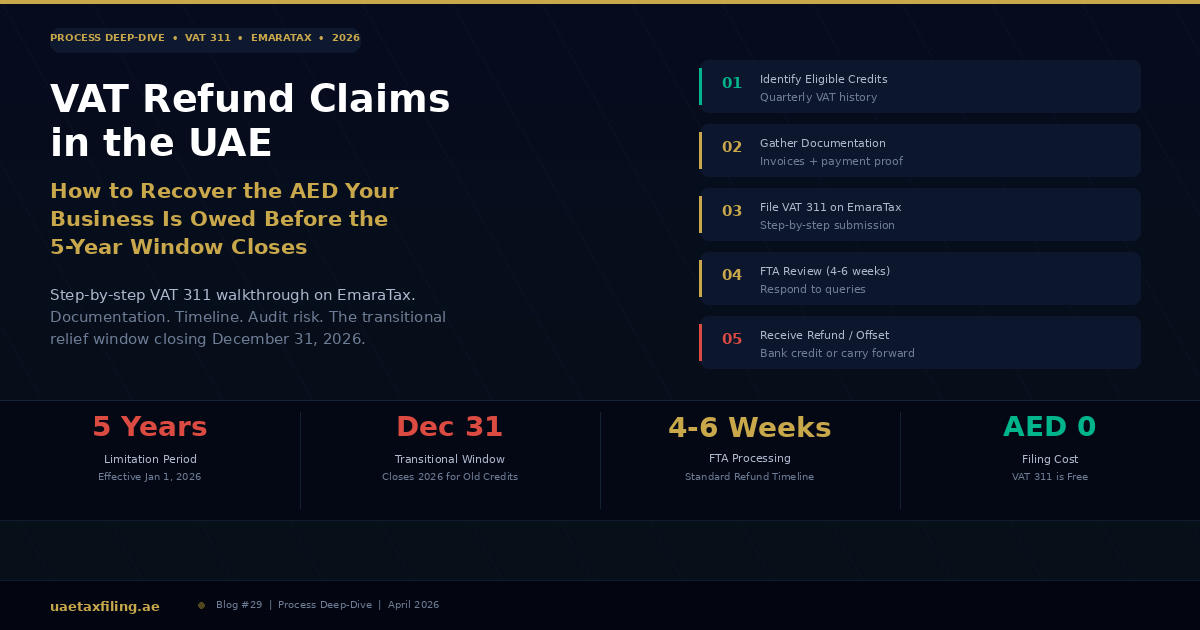
The five steps are clear: identify eligible credits, gather documentation, file VAT 311, manage the FTA review, and receive the refund. The timeline is 6 to 8 weeks for clean claims. The cost is professional fees on a sliding scale relative to the recovery amount. The risk is manageable for businesses with clean records and properly documented input VAT history.
The transitional window for 2018-2020 credits closes December 31, 2026. The 5-year limitation for newer credits is permanent. The longer you wait, the smaller the recoverable amount. File now.