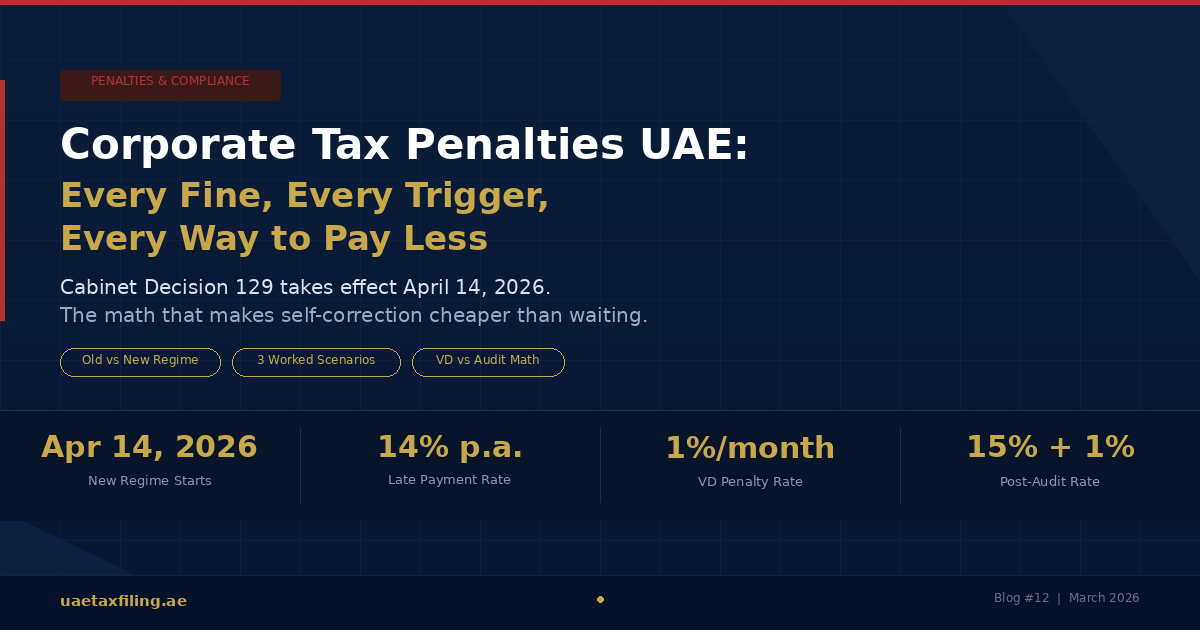
On April 14, 2026, the UAE's penalty framework changes for every tax-registered business in the country. Cabinet Decision No. 129 of 2025 replaces the old compounding penalty structure for VAT and Excise Tax with a simplified, non-compounding model that mirrors the corporate tax penalties introduced in 2023. The old regime, where late VAT payments could compound to 300% of the outstanding amount, is being retired. In its place: a flat 14% per annum late payment rate, a 1% per month voluntary disclosure rate, and a 15% fixed penalty for errors discovered by the FTA during an audit.
If those numbers look familiar, they should. Corporate tax penalties under Cabinet Decision No. 75 of 2023 have been operating on exactly this structure since August 2023. What Cabinet Decision 129 does is bring VAT and Excise Tax penalties into alignment with that same framework, creating a unified penalty logic across all three federal taxes for the first time.
For business owners, this alignment matters beyond the numbers themselves. The FTA now operates one procedural system across corporate tax, VAT, and excise. The same audit teams review all three. The same EmaraTax portal handles all filings, disclosures, and penalties. And as Alvarez & Marsal reported, the FTA conducted 93,000 inspection visits in 2024, a 135% increase from the previous year, with digital tools driving data-driven selection. The FTA is not short on capacity. It is short on patience for businesses that have not put their house in order.
This guide covers every corporate tax penalty a UAE business can face, the exact AED math for three common scenarios, and the single most important number in the entire framework: the difference between what a voluntary disclosure costs and what an FTA audit discovery costs for the same error. That difference is the reason this article exists.
If you read our VAT penalty regime guide last year, you already know the VAT side. This article focuses on corporate tax penalties specifically, including where the CT and VAT penalty systems interact and how one error in one tax can trigger an audit in the other.
Every Corporate Tax Penalty in One Place
The penalties below come from Cabinet Decision No. 75 of 2023 (the CT-specific penalty table) and Cabinet Decision No. 10 of 2024 (which added the AED 10,000 late registration penalty and its waiver mechanism). These penalties apply to violations of the Corporate Tax Law (Federal Decree-Law No. 47 of 2022) and the Tax Procedures Law as they relate to corporate tax obligations.
Violation | First Offence | Repeat (within 24 months)
Late corporate tax registration | AED 10,000 | N/A (one-time)
Late filing of CT return | AED 500/month (months 1-12) | AED 1,000/month (month 13+)
Late payment of corporate tax | 14% per annum, calculated monthly | Same rate, continues accruing
Incorrect tax return filed | AED 500 | AED 2,000
Failure to keep required records | AED 10,000 | AED 20,000
Failure to provide Arabic records | AED 5,000 | AED 5,000
Failure to notify FTA of record changes | AED 1,000 | AED 5,000
Late deregistration application | AED 1,000/month (max AED 10,000) | N/A
Failure to notify appointment of legal rep | AED 1,000 | AED 1,000
Failure to facilitate FTA audit | AED 20,000 | AED 20,000
Voluntary disclosure (before audit) | 1% per month of tax difference | Same rate
Failure to disclose / post-audit discovery | 15% fixed + 1% per month of tax difference | Same structure
Two entries on this table deserve special attention because they involve variable calculations, not fixed amounts. The late payment penalty (14% per annum) and the voluntary disclosure penalty (1% per month) are the two that accumulate over time and produce the largest total penalties for businesses that delay action. Everything else on the table is a fixed amount that hits once or twice and stops.
The AED 10,000 Late Registration Penalty (and How to Get It Waived)
The FTA announced a specific waiver initiative for the AED 10,000 late registration penalty. The mechanics are straightforward but the conditions are strict. Our full guide covers how to waive the late registration penalty, and how to reclaim it if you have already paid.
If you registered late for corporate tax and received the AED 10,000 penalty, you can get it waived or refunded by filing your first corporate tax return (or annual declaration for exempt persons) within seven months of the end of your first tax period. For a business with a December 31, 2024 year-end, that means filing the return by July 31, 2025. If you already paid the penalty, the AED 10,000 is credited to your EmaraTax account as a balance. You can apply it against future tax liabilities or request a withdrawal.
This waiver applies only to the first tax period. It does not extend to subsequent years. And it covers only the registration penalty, not any late filing or late payment penalties that may have accrued separately. If you have not yet registered for corporate tax, the message is clear: register now and file your first return within the seven-month window to avoid a AED 10,000 charge that is otherwise non-negotiable. This applies even if you plan to elect Small Business Relief and expect to owe zero tax. SBR does not exempt you from registration or filing.
The Three Penalties That Grow Over Time
Fixed penalties are painful but finite. A AED 10,000 record-keeping violation or a AED 500 incorrect return penalty is a one-time cost. The penalties that cause serious financial damage are the ones that accumulate month after month while the underlying issue remains uncorrected. There are three of them.
Late Filing: AED 500 Becoming AED 17,000
If you miss the corporate tax return deadline, the penalty is AED 500 for each month (or part of a month) the return remains unfiled, for the first 12 months. From month 13 onward, the rate doubles to AED 1,000 per month. There is no cap mentioned in the legislation.
For a business that files 18 months late, the total late filing penalty is AED 6,000 for the first 12 months (12 x AED 500) plus AED 6,000 for the next 6 months (6 x AED 1,000) = AED 12,000. A business that files two full years late pays AED 6,000 + AED 12,000 = AED 18,000 in late filing penalties alone, before any late payment penalties or other fines are added.
The filing deadline is nine months after the end of your tax period. For a December 31, 2025 year-end, the return is due September 30, 2026. Our CT filing guide walks through the full return process and schedule-by-schedule breakdown. Even one day late counts as a full month. There is no grace period.
Late Payment: 14% Per Annum, No Compounding
If corporate tax is not paid by the filing deadline, the FTA charges 14% per annum on the outstanding amount, calculated on a monthly basis. This is a flat rate. It does not compound. It simply accrues at roughly 1.17% per month on the unpaid balance.
For a business that owes AED 100,000 in corporate tax and pays six months late, the late payment penalty is approximately AED 7,000 (AED 100,000 x 14% x 6/12). Pay 12 months late and the penalty reaches AED 14,000. The rate is predictable, which is a deliberate design choice. The old VAT late payment regime involved compounding percentages that could reach 300% of the outstanding amount. The unified framework under Cabinet Decision 129 replaces that for VAT with this same 14% annual rate that CT already uses.
One critical detail that the FTA publicly warned about during the first CT filing season: bank transfers initiated on the deadline day may not process in time. If the payment clears the day after the deadline, the 14% clock starts ticking. The FTA recommended filing and paying at least two weeks before the deadline, and multiple tax practitioners echoed this warning based on cases they saw in September 2025.
Voluntary Disclosure vs Audit Discovery: The Number That Matters Most
This is the penalty calculation that every business owner in the UAE should have memorized. It is the single most important piece of math in the entire penalty framework, and it is the reason the FTA designed the system the way it did.
If you find an error and disclose it yourself (before the FTA audits you): The penalty is 1% per month of the tax difference, calculated from the original filing due date until the date you submit the voluntary disclosure on EmaraTax.
If the FTA finds the error during an audit (because you did not disclose it): The penalty is 15% of the tax difference as a fixed charge, plus 1% per month of the tax difference calculated from the original filing due date until the FTA issues its assessment. The 15% is additional to the monthly charge, not instead of it.
The gap between these two outcomes is enormous. For the same AED 50,000 error discovered eight months after the filing deadline:
| Voluntary Disclosure | FTA Audit Discovery
Tax difference | AED 50,000 | AED 50,000
Fixed penalty (15%) | AED 0 | AED 7,500
Monthly penalty (1% x 8 months) | AED 4,000 | AED 4,000
Total penalty | AED 4,000 | AED 11,500
Cost of waiting for audit |
| +AED 7,500 (188% more)
That AED 7,500 difference is the 15% fixed penalty that the FTA adds when it discovers the error rather than receiving your disclosure. And the longer the error sits uncorrected, the worse the gap gets because the monthly 1% continues accruing in both scenarios while the 15% remains fixed. At 24 months, the voluntary disclosure penalty on a AED 50,000 error is AED 12,000. The audit discovery penalty is AED 19,500. The gap widens to AED 7,500 but as a percentage of a higher total, the incentive to self-correct remains powerful at every time horizon.
As Lexology's analysis noted, this structure deliberately rewards proactive compliance. The FTA wants businesses to find and fix their own errors. The entire penalty architecture is designed to make that the cheapest option at every stage of the timeline.
Think your last CT return might have errors? Our corporate tax team reviews filed returns against source data, identifies discrepancies, and files voluntary disclosures before the FTA does it for you. The math is always cheaper on your side. Message us on WhatsApp.
Three Scenarios: What Penalties Actually Cost in Practice
Scenario 1: The Business That Filed Late and Paid Late
A Dubai-based trading company with a December 31, 2025 year-end. Filing deadline: September 30, 2026. The owner was overseas, the bookkeeper was overwhelmed, and the return was filed on January 15, 2027, three and a half months late. Corporate tax owed: AED 85,000. Payment was made on the same day the return was filed.
Late filing penalty: 4 months late (October, November, December, and part of January count as 4 full months at AED 500 each) = AED 2,000.
Late payment penalty: AED 85,000 x 14% per annum x 3.5 months / 12 = approximately AED 3,471.
Total penalty exposure: AED 5,471 in penalties on top of the AED 85,000 tax liability. The return was correct, so no voluntary disclosure penalty applies. But the company is now on the FTA's radar as a late filer, which increases its audit risk profile for future periods.
Scenario 2: The Business That Overclaimed Deductions and Self-Corrected
A Sharjah-based IT services company filed its 2024 CT return in August 2025. During a routine internal review in February 2026, the finance team discovered that AED 40,000 in personal expenses had been incorrectly classified as business deductions. The taxable income was understated by AED 40,000, meaning AED 3,600 in corporate tax (9% of AED 40,000) was underpaid.
The company files a voluntary disclosure on EmaraTax in February 2026, six months after the original filing deadline (which was September 30, 2025 for a June 30, 2025 year-end, or in this case August 2025 filing for a December 2024 year-end with a September 2025 deadline).
Tax difference: AED 3,600.
Voluntary disclosure penalty: 1% x 5 months x AED 3,600 = AED 180.
Total additional cost: AED 3,600 in underpaid tax + AED 180 in VD penalty = AED 3,780.
If the company had not self-corrected and the FTA found the same error during an audit 14 months after the deadline:
Audit discovery penalty: 15% x AED 3,600 = AED 540 fixed + 1% x 14 months x AED 3,600 = AED 504 monthly = AED 1,044 total penalty.
The voluntary disclosure saved AED 864. On a AED 3,600 error that may seem modest, but the proportional difference (83% more expensive via audit) applies at every scale. On a AED 360,000 error, the savings from self-correction would be AED 86,400.
Scenario 3: The Business That Never Filed At All
A freelance consultant operating under a Dubai freelance permit. Annual revenue AED 1.4 million. Taxable income AED 600,000. Corporate tax owed: AED 20,250 (first AED 375,000 at 0%, remaining AED 225,000 at 9%). The consultant was unaware of the corporate tax obligation and has not registered, not filed, and not paid anything.
Assume the first tax period ended December 31, 2024. It is now March 2026, approximately 18 months after year-end.
Late registration: AED 10,000 (potentially waivable if the return is filed within 7 months of the first tax period end, but in this case 18 months have passed, so the waiver condition is missed).
Late filing: The return is approximately 9 months late from the September 30, 2025 deadline. That is 6 months at AED 500 = AED 3,000 (month 6 of lateness in this example).
Late payment: AED 20,250 x 14% x 6/12 = approximately AED 1,418.
Total penalty exposure: AED 10,000 + AED 3,000 + AED 1,418 = AED 14,418 in penalties, plus the AED 20,250 in unpaid tax. Total liability: AED 34,668.
Every month the consultant delays, the filing penalty adds AED 500 and the late payment penalty adds approximately AED 236. By the time a full year has passed from the deadline, the penalty total reaches approximately AED 19,000. At two years: approximately AED 28,000. The penalties eventually exceed the original tax liability.
This is the scenario that catches freelancers and sole proprietors most frequently. Many do not realize they are taxable persons under the Corporate Tax Law. Our freelancer guide explains the AED 1 million turnover threshold and the registration obligation in detail.
What Actually Changes on April 14, 2026
There is a common misconception circulating in UAE business communities that Cabinet Decision 129 changes corporate tax penalties. It does not. Corporate tax penalties remain governed by Cabinet Decision No. 75 of 2023 and have not been amended. The penalty amounts and calculation methods in the table above have been in force since August 2023 and continue unchanged after April 14.
What Cabinet Decision 129 does is bring VAT and Excise Tax penalties into alignment with the corporate tax framework. As Mondaq's analysis explained, the Decision 75 framework for CT became the benchmark, and Decision 129 aligns the others to match it. This creates a unified penalty logic across all three federal taxes.
The practical changes from April 14 affect VAT and Excise Tax specifically:
VAT/Excise Penalty | Before April 14 (Old) | After April 14 (New)
Late payment | 2% immediate + 4%/month (up to 300%) | 14% per annum, monthly
Voluntary disclosure | Stepped: 5%-40% based on time bands | 1% per month of tax difference
Post-audit discovery | Up to 50% + monthly additions | 15% fixed + 1% per month
Arabic records failure | AED 20,000 | AED 5,000
Failure to notify changes | AED 5,000 first / AED 15,000 repeat | AED 1,000 first / AED 5,000 repeat
The reduction is significant across the board. The old VAT late payment structure could compound to 300% of the outstanding tax. The new 14% per annum rate is predictable and dramatically lower. The old voluntary disclosure bands (5% to 40% depending on time elapsed) made it expensive to correct old errors. The new 1% per month structure makes early correction cheap and transparent.
We covered the old VAT penalty regime in detail in our VAT penalty guide. That piece remains useful as a reference for understanding pre-April 14 exposures, but the new rates above are what apply from April 14 onward for all VAT and Excise matters.
The Cross-Tax Trigger: How a CT Error Opens a VAT Audit (and Vice Versa)
This is the section most penalty guides skip entirely, and it is arguably the most important compliance insight in this entire piece.
The FTA does not operate separate audit teams for corporate tax and VAT. The same authority, using the same EmaraTax data, reviews both. And as Alvarez & Marsal documented in their December 2025 analysis, the FTA's audit approach is integrated and data-driven. When the FTA opens an audit on one tax, it routinely cross-references filings from the other.
Here is how this plays out in practice:
Revenue mismatch. Your VAT returns show AED 2.5 million in taxable supplies for 2025. Your corporate tax return shows AED 2.1 million in revenue for the same period. The FTA sees both numbers. The AED 400,000 gap triggers a review. Maybe the difference is legitimate (timing differences between cash and accrual accounting, exempt supplies, or adjustments). But if it is not legitimate, the FTA now has grounds to audit both the VAT position and the CT position simultaneously. One discrepancy, two audits, penalties on both sides.
Deduction inconsistency. Your CT return claims AED 200,000 in consulting expenses as allowable deductions. Your VAT returns show no input VAT recovered on those expenses. If the consulting services were subject to VAT and you paid 5% on AED 200,000 (AED 10,000 in input VAT), why is there no input VAT claim? Either the deduction is inflated on the CT side (CT problem) or you failed to claim legitimate input VAT on the VAT side (VAT problem). The FTA will want to know which.
Free zone inconsistency. A Qualifying Free Zone Person reports qualifying income for the 0% CT rate but does not account for VAT correctly on transactions with mainland entities. The transfer pricing position on the CT return does not match the transaction values reported on VAT filings. This is the FTA's number one audit priority for free zone entities, and it involves both taxes simultaneously.
The practical takeaway: treat your CT return and your VAT filings as a single compliance picture. Reconcile revenue, expenses, and intercompany transactions across both before you file either one. The FTA already treats them as a single picture. Your compliance process should do the same.
How to File a Voluntary Disclosure on EmaraTax
If you have identified an error in a filed corporate tax return, the process for correcting it is built into EmaraTax. You do not need to contact the FTA first. You do not need approval. You file the disclosure, pay the difference, and the system calculates the penalty.
Log into EmaraTax with your TRN and credentials or UAE Pass. Go to the Corporate Tax module. Find the return for the period that contains the error. Select the voluntary disclosure option. The system will present the original figures and allow you to enter corrected amounts. The tax difference is calculated automatically. Submit the disclosure and pay the difference plus the penalty amount.
Two important procedural points:
Nil-impact errors no longer require a formal voluntary disclosure. Under the amended Tax Procedures Law (effective January 1, 2026), if your error does not change the tax due, you can correct it on your next return instead of filing a separate disclosure. This removes significant administrative burden for businesses that discover classification errors, formatting issues, or other mistakes that do not affect the final tax liability.
If you discover the error after receiving an audit notification, disclose anyway. The penalty is the same 15% plus 1% per month whether you disclose after the audit notice or the FTA completes the audit and finds it. But filing the disclosure demonstrates cooperation, which can influence the FTA's approach to subsequent audit queries and any discretionary penalty relief considerations.
Frequently Asked Questions
Does Cabinet Decision 129 change corporate tax penalties?
No. Corporate tax penalties remain under Cabinet Decision No. 75 of 2023, unchanged. Cabinet Decision 129 aligns VAT and Excise Tax penalties with the CT framework, creating a unified structure across all three taxes. The CT penalty amounts and rates have been stable since August 2023.
What is the penalty for filing a corporate tax return one day late?
AED 500. Any part of a month counts as a full month. There is no grace period. The penalty accrues from the first day after the deadline.
Can penalties be waived?
The AED 10,000 late registration penalty can be waived if the first CT return is filed within 7 months of the first tax period end. Other penalty waivers are at the FTA's discretion and typically require a formal reconsideration request with documented reasons. There is no automatic waiver for late filing or late payment.
What triggers an FTA audit?
The FTA uses data-driven selection based on risk indicators. Common triggers include revenue mismatches between VAT and CT filings, late or amended returns, large refund claims, free zone entities with mainland transactions, and businesses with significant related party transactions. Our FTA audit guide covers the full list of triggers and preparation steps.
Is the 14% late payment penalty compounding?
No. It is a flat 14% per annum, calculated monthly on the outstanding balance. This is one of the key improvements over the old VAT regime, where late payment penalties compounded and could reach up to 300% of the original amount.
What is the difference between a voluntary disclosure penalty and an audit penalty?
Voluntary disclosure before audit notification: 1% per month of the tax difference. Post-audit discovery: 15% fixed plus 1% per month. The 15% surcharge is the cost of waiting for the FTA to find the error instead of reporting it yourself.
Do I need a voluntary disclosure for every small error?
From January 1, 2026, errors that result in no change to the tax due can be corrected on the next tax return without a formal voluntary disclosure. Only errors that affect the tax payable amount require the VD process.
Can the FTA audit periods older than five years?
Generally, the standard audit limitation is five years from the end of the relevant tax period. However, if a refund application is filed in the fifth year, the FTA has an additional two years to audit that claim. And there is no limitation period for cases involving fraud or deliberate evasion.
What happens if I cannot pay the tax due by the deadline?
The 14% per annum late payment penalty starts accruing from the day after the deadline. There is no formal payment plan mechanism published by the FTA for corporate tax. File the return on time even if you cannot pay, so you at least avoid the late filing penalty on top of the late payment charge.
Are there criminal penalties for tax violations?
Yes. Under the Tax Procedures Law, intentional provision of false information, concealment of documents, or destruction of records can result in imprisonment and/or fines of up to AED 1 million. Administrative penalties (covered in this guide) are the FTA's first line of enforcement. Criminal prosecution is reserved for deliberate evasion and fraud.
The Math Always Favors Moving First
The entire UAE penalty framework is built on one principle: the earlier you act, the less you pay. Register before the deadline: AED 0. Register late but file within 7 months: AED 0 (waiver). Register late, miss the 7-month window: AED 10,000. File on time: AED 0. File one month late: AED 500. File 18 months late: AED 12,000. Find an error and disclose it: 1% per month. Wait for the FTA to find it: 15% plus 1% per month.
Every penalty line item rewards speed. And after April 14, 2026, this same logic applies uniformly across corporate tax, VAT, and excise. There is nowhere in the system where delay is cheaper than action.
If your last corporate tax return was filed in a rush, or if you suspect errors in your deduction claims, related party disclosures, or revenue figures, now is the time to review. Not after the FTA opens an inquiry. Not after the penalty clock has been running for 12 months. Now, while a voluntary disclosure costs 1% per month instead of 15% plus 1% per month.
Our corporate tax team reviews filed returns, identifies errors, and files voluntary disclosures at the lowest possible penalty cost. We also prepare businesses for their next filing deadline with audit-ready documentation. Reach out on WhatsApp or explore our VAT compliance, bookkeeping, and free zone tax services.