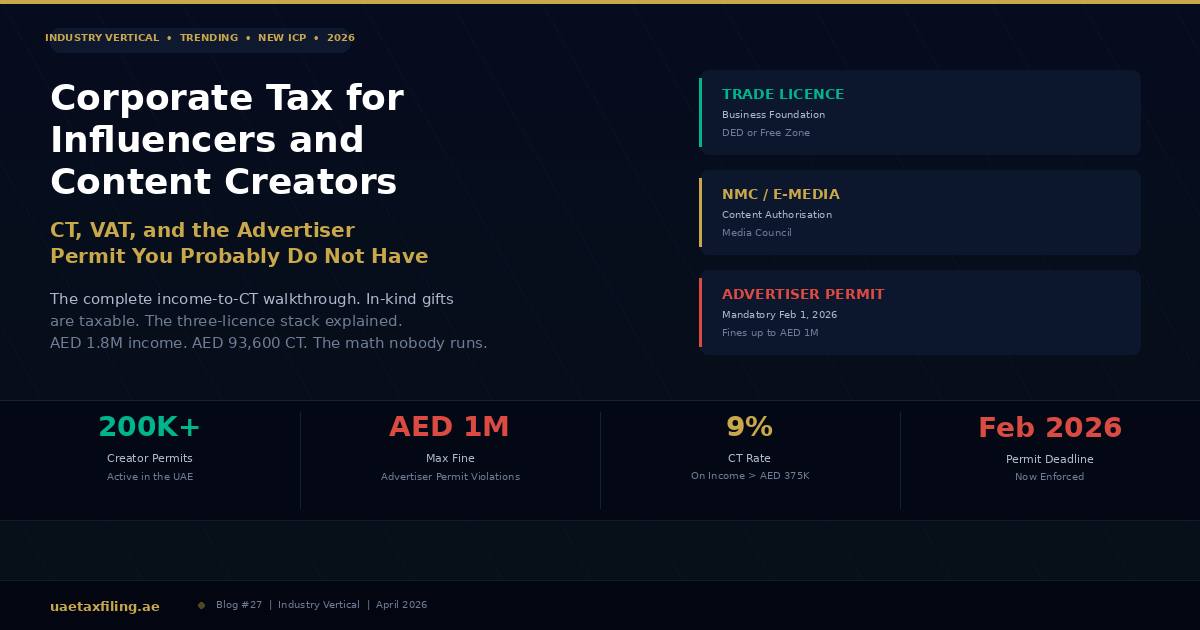
If you earn money from creating content in the UAE, you run a business. The FTA does not care whether that business operates from a studio in Business Bay or a ring light in your bedroom. Sponsored posts, affiliate commissions, brand ambassadorships, product placements, speaking fees, merchandise sales, and the free products and trips you receive in exchange for coverage are all income. And income above certain thresholds triggers three separate compliance obligations that most content creators either do not know about or are actively ignoring.
The first is corporate tax. If your annual business turnover exceeds AED 1 million (the threshold for natural persons conducting business), you must register with the FTA and file an annual CT return. The rate is 9% on taxable income above AED 375,000. As Flying Colour Tax confirmed, social media influencers are subject to corporate tax if their net business income exceeds AED 375,000 annually.
The second is VAT. If your taxable supplies exceed AED 375,000 in the previous 12 months, or you expect to exceed that threshold in the next 30 days, you must register for VAT and charge 5% on your services. Voluntary registration is available at AED 187,500.
The third is the Advertiser Permit. As of February 1, 2026, the UAE Media Council requires every person who publishes promotional content in the UAE to hold a valid Advertiser Permit. As Gulf News reported, the rule applies to all paid and unpaid promotions on social media, websites, blogs, and other digital platforms, regardless of follower count or whether compensation is involved. Fines for non-compliance can reach AED 1 million for serious violations.
This article bridges all three. Every competitor covers either the tax side or the permit side. Nobody bridges CT registration, VAT obligations, and the Advertiser Permit in one article, and nobody publishes the complete income-to-CT walkthrough with itemized deductions that shows a content creator exactly how much they owe.
"Influencers are the most under-registered business category in the UAE right now. They earn AED 1 million, AED 2 million, AED 5 million a year, and many have not registered for CT because nobody told them they had to. The FTA knows they exist. Instagram is public. YouTube revenue is traceable. The enforcement wave is coming, and it will be expensive for anyone who is not already registered."
Jazim, CEO, UAE Tax Filing LLC
The Three-Licence Stack Every Content Creator Needs
Most influencers know about the trade licence. Many have heard of the NMC licence. Almost none have the Advertiser Permit. All three are legally required to earn money from content in the UAE, and missing any one creates both media law and tax law exposure simultaneously.
Licence 1: The Trade Licence. This is your business foundation. It is issued by the Department of Economic Development (for mainland) or by a free zone authority (SHAMS, Meydan, IFZA, DMCC, and others). Without it, you have no legal entity, no right to invoice clients, no corporate bank account, and no basis for CT or VAT registration. Our freelancer guide covers the registration process and entity-type options. The trade licence activity description should include 'content creation,' 'digital marketing,' 'advertising services,' or similar wording that covers your actual activities. A licence for 'general trading' does not cover media activities and may create compliance issues with the Media Council.
Licence 2: The NMC / E-Media Licence. Issued by the National Media Council (now under the Ministry of Culture and Youth), this licence authorizes you to operate as a media entity. As RadiantBiz's guide explained, any individual who earns income from online content promotion must hold an appropriate media licence. The NMC licence confirms that your media activities are registered with the government. The cost ranges from AED 1,500 to AED 2,500 for individuals, and it is renewable annually. Some free zones bundle this with the trade licence in 'influencer packages,' but the two serve different legal functions.
Licence 3: The Advertiser Permit. This is the newest requirement and the one most creators are missing. As of February 1, 2026, the UAE Media Council requires every person who publishes promotional content to hold a valid Advertiser Permit, separate from the NMC licence. As Raes Associates documented, the permit applies to paid and unpaid promotions across all digital platforms. The application is online through the Media Council portal. The fee is waived for the first three years (2026 through 2028) for UAE residents and citizens, making the cost of compliance effectively zero. The cost of non-compliance, however, can reach AED 1 million for serious violations, with daily fines of AED 150 (capped at AED 3,000) for licence misuse or expiration.
The compliance gap: An influencer with a trade licence and NMC licence but no Advertiser Permit is operating legally as a business but illegally as an advertiser. An influencer with an Advertiser Permit but no CT registration is compliant with media law but non-compliant with tax law. You need all three. Missing one does not excuse the other two. As Homeland's legal analysis noted, the company benefiting from an unpermitted ad could also face consequences, meaning brands will increasingly require proof of all three licences before signing contracts.
Not sure which licences you have and which you are missing? Our corporate tax team checks your CT registration status on EmaraTax and advises on VAT thresholds. For the Advertiser Permit, apply through the UAE Media Council portal. WhatsApp us to start.
What Counts as Taxable Income for a Content Creator
The FTA's definition of taxable income for influencers is broader than most creators expect. It covers every form of compensation, whether received as cash, bank transfer, or goods and services. The FTA issued a specific information bulletin for social media influencers and artists confirming that all of the following are taxable.
Cash payments for sponsored content. This is the most straightforward category. A brand pays you AED 20,000 for an Instagram post. That is revenue. It goes on your CT return as income, and if you are VAT-registered, you charge 5% VAT on top (AED 21,000 total invoiced to the brand, AED 1,000 as output VAT payable to the FTA).
In-kind gifts and free products. This is where most creators get caught. If a brand sends you a phone worth AED 5,000 in exchange for a review, that phone is taxable income at its market value. The FTA bulletin explicitly states that 'the accepting of commodities in exchange for services is considered as consideration for the services.' As Flying Colour Tax confirmed, when the whole or a portion of the consideration is non-monetary, the supply's worth is the monetary component plus the market value of the non-monetary part. A free hotel stay worth AED 8,000, a designer outfit worth AED 12,000, a sponsored trip worth AED 25,000: all taxable at market value.
Affiliate commissions. Revenue earned through affiliate links (Amazon Associates, ShareASale, brand-specific affiliate programs, discount code commissions) is taxable income. These payments often come from overseas companies and are not subject to UAE VAT (they are outside the scope as an export of services), but they are subject to CT because the income is earned by a UAE-resident business.
Brand ambassadorships and retainers. Long-term partnerships where a brand pays a monthly or annual fee are standard employment-like income from a tax perspective, but they are treated as business income, not salary, because the influencer is an independent contractor, not an employee. The full retainer amount is revenue.
Merchandise sales. Influencers who sell branded merchandise (clothing, accessories, digital products, courses) are earning trading income. VAT applies at 5% on UAE sales. CT applies on the profit margin after cost of goods sold and operating expenses.
YouTube AdSense, TikTok Creator Fund, and platform payments. Revenue received directly from platforms is taxable business income. These payments are typically sourced from outside the UAE (Google pays from Ireland, TikTok from Singapore), but the income is earned by a UAE-resident person conducting business, making it subject to CT. VAT treatment depends on the place of supply rules, but the CT obligation is clear.
The Influencer Income Audit: From Gross Income to CT Payable
Nobody else publishes this math. Here is the complete walkthrough for a mid-tier UAE influencer.
Total Income: AED 1,800,000
Cash sponsorships and brand deals: AED 1,500,000. Free products and sponsored trips (at market value): AED 200,000. Affiliate commissions: AED 100,000. Total gross income: AED 1,800,000.
Deductible Business Expenses: AED 385,000
Our deductions guide covers the full list of what is deductible and what is not. For content creators, the most relevant deductible expenses are:
Camera, lighting, and production equipment: AED 50,000 (depreciated if > AED 5,000 per item, or expensed if below). Software subscriptions (editing tools, scheduling platforms, analytics): AED 15,000. Travel for content production: AED 80,000 (flights, hotels, and transport directly related to content shoots, not personal holidays repackaged as work trips). Studio or home office rent: AED 60,000 (if a dedicated space is used exclusively for content production; a portion of home rent can be allocated if documented). Agent or management commission: AED 180,000 (typically 10-20% of gross revenue, paid to talent agencies or managers). If the agent is a related party, the commission must comply with transfer pricing rules. Total deductible expenses: AED 385,000. Our outsourced accounting service tracks all categories separately for CT and VAT purposes.
Non-deductible expenses to watch for: Personal clothing (even if worn on camera, unless it is branded merchandise for resale), personal travel disguised as content trips (the FTA checks whether the trip produced published content), fines and penalties, personal phone bills (unless a separate business line), and entertainment expenses above the 50% cap. If you take a client to dinner and spend AED 2,000, only AED 1,000 is deductible.
Taxable Income and CT Payable
Total income: AED 1,800,000. Less deductible expenses: AED 385,000. Net taxable income: AED 1,415,000. Less AED 375,000 zero-rate band: AED 1,040,000 taxable at 9%. Corporate tax payable: AED 93,600. Filing deadline: 9 months after financial year-end (September 30 for calendar-year entities).
AED 93,600 is the CT cost of earning AED 1.8 million. That is an effective rate of 5.2% on total income, well below the headline 9% rate because of the AED 375,000 band and business expense deductions. Influencers who hear '9% tax' and panic are overstating their liability. Influencers who hear '0% tax in UAE' and ignore CT entirely are understating it by AED 93,600.
VAT for Content Creators: When You Must Register and What to Charge
VAT registration is mandatory when your taxable supplies exceed AED 375,000 in the previous 12 months or you expect to exceed that threshold in the next 30 days. At AED 1.8 million in revenue, the influencer in our scenario is well above the threshold and must be VAT-registered.
Once registered, you charge 5% VAT on services provided to UAE-based clients. A brand deal with a Dubai agency for AED 50,000 becomes AED 52,500 (AED 50,000 + AED 2,500 VAT). You collect the AED 2,500 and remit it to the FTA on your quarterly VAT return.
Services to clients outside the UAE are zero-rated. If a London-based brand hires you for content, the supply is an export of services and VAT is charged at 0%. You still report it on your VAT return, but no VAT is collected. This is significant for influencers with an international client base: a creator with 70% international clients has a much lower effective VAT collection rate than one with 100% UAE clients.
Input VAT recovery. Once VAT-registered, you can recover the 5% VAT you pay on business purchases: camera equipment, software subscriptions, studio rent, and other deductible expenses. On AED 385,000 in business expenses, the recoverable input VAT is approximately AED 19,250 (assuming most expenses are standard-rated). This offsets your output VAT liability, reducing the net amount you remit to the FTA. Our VAT filing guide covers the quarterly return process.
The VAT-CT revenue mismatch risk. Our 9 mistakes article covered this as the number one automated FTA audit trigger. Your total taxable supplies on your four quarterly VAT returns must reconcile with your total revenue on your CT return. For influencers, this is especially tricky because some income (affiliate commissions from overseas, platform payments from Google/TikTok) may be outside the scope of UAE VAT but fully within the scope of CT. The numbers will legitimately differ, but you need a documented reconciliation.
We handle CT registration, VAT filing, and the income classification that most influencer accountants get wrong. The in-kind valuation, the international client zero-rating, and the VAT-CT reconciliation all require specialist knowledge. WhatsApp us to get compliant.
The Advertiser Permit: What Changed on February 1, 2026
The Advertiser Permit is the third leg of the compliance stack and the one most creators are missing. It became mandatory on February 1, 2026 under Federal Media Law No. 55 of 2023. As Gulf News confirmed, the rule applies to all individuals (citizens, residents, and visitors) who create advertising content from within the UAE, regardless of whether they receive compensation.
The permit is separate from the NMC/e-media licence. You need both. The NMC licence is your business registration for media activities. The Advertiser Permit specifically authorizes you to publish promotional content. Think of it as the difference between having a restaurant licence (NMC) and having a food safety permit (Advertiser Permit). Both are required to operate.
Who needs it: Anyone who promotes products, services, or brands through social media, websites, blogs, podcasts, or any digital platform. This includes macro-influencers, micro-influencers, nano-influencers, vloggers, bloggers, gamers, fitness coaches, and anyone else earning income from promotional content. As Raes Associates documented, even unpaid promotions fall within scope if the content is promotional in nature.
Who is exempt: Individuals promoting only their own products or services through their personal accounts. Minors under 18 creating educational, cultural, sports, or awareness content. But the exemptions are narrow. If you promote a brand, even once, even for free, you are in scope.
How to get it: Apply online through the UAE Media Council portal. Submit passport copy, Emirates ID, UAE bank account IBAN, and sample content. For residents and citizens, the permit fee is waived for the first three years (2026-2028). Visiting creators must apply through an accredited UAE-based agency and receive a 3-month visitor permit, renewable once.
Penalties for non-compliance: AED 150 per day for expired or misused licence (capped at AED 3,000). AED 20,000 for licence misuse. Fines up to AED 1 million for serious violations. Account suspension or restriction by authorities. As Homeland's analysis documented, liability extends beyond the creator: the company benefiting from an unpermitted ad could also face consequences. Brands are already starting to require permit verification before signing influencer contracts.
Free Zone or Mainland: Which Structure Works for Content Creators?
Our free zone vs mainland comparison covers this decision in depth. For content creators specifically, the answer depends on where your clients are.
If 100% of your clients are outside the UAE: a free zone structure with QFZP status can deliver 0% CT on qualifying income. An influencer earning AED 3 million from international brands pays AED 0 in CT as a QFZP, compared to AED 236,250 on the mainland. The saving is massive, but it requires maintaining QFZP conditions: mandatory audit (AED 15,000-40,000/year), substance in the free zone, and zero mainland client income above the 5% de minimis threshold.
If you have any significant UAE client base: the mainland is almost certainly cheaper. Income from UAE brands is non-qualifying for QFZP purposes. A creator with 50% UAE clients in a free zone pays 9% CT on the non-qualifying half (with no AED 375,000 band on non-qualifying income), plus the mandatory audit cost, plus the disqualification risk. On the mainland, the same creator pays 9% on all income but gets the AED 375,000 band and skips the audit.
If your revenue is under AED 3 million: the mainland with Small Business Relief is the clear winner until December 2026. CT = AED 0. No audit. No income classification. The free zone adds compliance cost with no additional tax benefit. For most solo creators earning AED 500,000 to AED 2 million, SBR on the mainland is the most tax-efficient structure available anywhere in the UAE.
Record Keeping: What the FTA Expects From You
The UAE CT law requires seven years of record retention. For content creators, this means keeping: every brand contract and statement of work, every invoice issued (including for in-kind compensation with the market value documented), bank statements showing all payments received, proof of in-kind items received (photos, delivery confirmations, brand correspondence confirming the items and their retail value), receipts for every business expense claimed as a deduction, evidence that travel expenses were content-related (the published content itself is the best proof), and the working papers used to prepare your CT return.
The FTA's audit systems cross-reference publicly available information. Your Instagram shows a brand partnership. Your CT return should show the corresponding income. Your bank statement should show the corresponding payment (or your records should show the in-kind value). If any link in the chain is missing, the FTA will fill the gap with assumptions that favor the FTA, not you. Our year-end planning guide covers the month-by-month preparation timeline.
Five Mistakes Influencers Make That the FTA Will Catch
1. Not reporting in-kind income. The free phone, the free trip, the free wardrobe. If you received it in exchange for content, it is income at market value. The FTA will compare your publicly visible brand partnerships against your reported income. Missing items will be assessed, with penalties.
2. Deducting personal expenses as business costs. A vacation with two Instagram posts is not a business trip. A new outfit worn once on camera and then to brunch every weekend is not a business expense. The FTA applies a 'wholly and exclusively for business purposes' test. If the expense has a personal element, the personal portion is non-deductible.
3. Not registering for CT because 'there is no income tax in the UAE.' This is the most expensive misconception. There is no personal income tax. There is corporate tax on business income. Influencer income is business income. The AED 10,000 late registration penalty applies per entity.
4. Treating all income as salary and ignoring CT. If you operate through a company (LLC, free zone entity), the company earns the revenue and owes CT. If you operate as a natural person (sole proprietor), you owe CT if your business turnover exceeds AED 1 million. Either way, CT applies. The structure affects the threshold, not the obligation.
5. Having the Advertiser Permit but not CT registration, or vice versa. These are separate compliance systems administered by different authorities (Media Council vs FTA). Having one does not satisfy the other. The businesses that get audited are the ones with visible promotional activity (easily found on social media) but no CT registration (easily checked on EmaraTax). That gap is the audit trigger. Our 9 mistakes article covers the full list of CT errors the FTA catches.
We register influencers for corporate tax, prepare IFRS financials that properly account for in-kind income, file the CT return with correct deductions, and handle the quarterly VAT including international client zero-rating. The three-licence stack is your responsibility to obtain. The tax compliance is ours. WhatsApp us to get started.
Frequently Asked Questions
Do influencers pay tax in the UAE?
Yes. Influencers pay corporate tax (9% on taxable income above AED 375,000) and VAT (5% if taxable supplies exceed AED 375,000). There is no personal income tax, but influencer income is business income subject to CT.
What is the Advertiser Permit and do I need it?
The Advertiser Permit is a legal authorization from the UAE Media Council to publish promotional content. It became mandatory on February 1, 2026 for anyone creating advertising content in the UAE, regardless of follower count or compensation.
Are free products and gifts taxable?
Yes. The FTA considers in-kind compensation (free products, sponsored trips, gifted items) as taxable income at market value. You must report the retail value as revenue on your CT return.
How much tax does an influencer earning AED 1.8M pay?
Approximately AED 93,600 in corporate tax, after deducting AED 385,000 in business expenses and the AED 375,000 zero-rate band. The effective rate is about 5.2% of total income.
Can I use Small Business Relief as an influencer?
Yes, if you operate on the mainland and your revenue is under AED 3 million per tax period. SBR reduces CT to AED 0 until December 2026. It is not available to QFZPs in free zones.
Should I set up in a free zone or mainland?
If 100% of your clients are international, a free zone QFZP can deliver 0% CT. If you have UAE clients, the mainland is usually cheaper after audit and compliance costs. If your revenue is under AED 3M, mainland with SBR is the best option.
What expenses can I deduct as a content creator?
Equipment, software, content-related travel, studio rent, agent commissions, and other expenses incurred wholly and exclusively for business. Personal expenses, entertainment above 50%, and fines are non-deductible.
What is the penalty for not registering for CT?
AED 10,000 per entity. Late filing adds AED 500 (first offence) or AED 1,000 (subsequent). Late payment attracts 14% annual interest with no cap.
Do I need a trade licence, NMC licence, AND the Advertiser Permit?
Yes. All three are legally required to earn money from content creation in the UAE. The trade licence is your business registration. The NMC licence authorizes media activities. The Advertiser Permit authorizes promotional content specifically.
What happens if I have been earning income without CT registration?
Register immediately. The AED 10,000 penalty has already accrued. Then file a voluntary disclosure for any prior periods where CT was owed but not paid. The VD penalty (1% per month) is much lower than the post-audit penalty (15% + 1%/month). Our voluntary disclosure guide covers the process.
Your Content Is Public. Your Tax Obligations Should Not Be a Surprise.
The FTA does not need to investigate influencers. It just needs to scroll. Your brand partnerships are posted on Instagram. Your sponsorships are tagged on YouTube. Your affiliate links are in your bio. The gap between visible income and reported income is the gap that triggers audits, and for content creators who have been treating the UAE as a zero-tax environment, that gap is about to become very expensive.
The compliance path is straightforward: register for CT, register for VAT if above the threshold, get the Advertiser Permit, keep records of every income stream (including in-kind), deduct legitimate business expenses, and file on time. AED 93,600 in CT on AED 1.8 million in income is a 5.2% effective rate. That is still one of the lowest tax environments in the world for content creators. The cost of non-compliance is significantly higher than the cost of compliance.
Get the three licences. File the returns. Keep the receipts. That is the entire playbook.