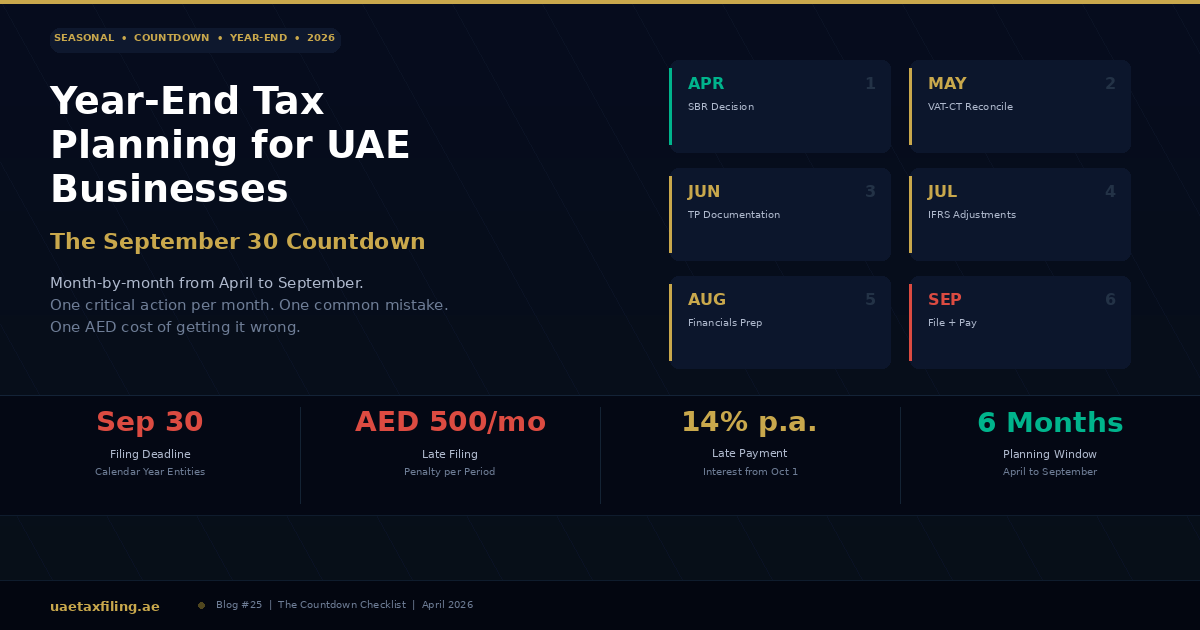
September 30, 2026 is a Wednesday. That is the corporate tax filing and payment deadline for every UAE business with a calendar-year financial period ending December 31, 2025. Nine months after your tax period ends, your CT return must be submitted on EmaraTax and your CT liability must be received by the FTA. Not initiated. Received.
That distinction matters. A wire transfer initiated on Wednesday, September 30 through most UAE banks settles on Thursday, October 1 or Friday, October 2. If the FTA receives your payment on October 1, you are one day late. Late payment interest at 14% per annum begins accruing from October 1, calculated monthly, with no cap. On a CT liability of AED 200,000, one month of late payment interest is AED 2,333. On AED 500,000, it is AED 5,833. That is the cost of processing your payment two days too late.
This article is not about how to file your return. Our complete EmaraTax walkthrough covers that step by step. This article is about the six months before you file: the planning, decisions, and actions that determine whether your September 30 filing is a formality or a crisis. Each month from April through September has one critical action, one common mistake that costs money, and the AED consequence of getting it wrong.
Our deadlines guide covers every CT deadline by entity type and financial year-end. This article assumes a calendar-year entity (January 1 to December 31, 2025 tax period, September 30, 2026 filing deadline), which applies to the majority of UAE businesses.
"The businesses that file on September 28 without stress are the ones that started planning in April. The businesses that file on September 30 at 11 PM with errors are the ones that treated tax as a last-minute task. Six months of planning eliminates the panic and usually reduces the CT bill."
Jazim, CEO, UAE Tax Filing LLC
April: The SBR Decision and the April 14 Penalty Regime Change
Critical action: Decide whether to elect Small Business Relief. This is the last year SBR is available. The relief expires for tax periods ending on or before December 31, 2026. If your revenue for the 2025 tax period (the return you are filing on September 30) was under AED 3 million, you are eligible. But eligibility does not mean SBR is automatically the right choice.
As our SBR analysis explained, electing SBR means your taxable income is treated as zero. No CT liability. But it also means no losses are recognized. If your business had a loss in 2025, that loss cannot be carried forward to offset profits in 2026 or later. For a business with AED 800,000 in losses, electing SBR destroys AED 72,000 in future CT savings (AED 800,000 x 9%). For a profitable business with AED 2 million revenue and AED 400,000 profit, SBR saves AED 2,250 in CT ((AED 400K minus AED 375K) x 9%). The decision depends entirely on whether your 2025 period was profitable or loss-making, and what your 2026 outlook is.
April math: If your 2025 revenue was under AED 3M and you were profitable, SBR saves you between AED 0 (if profit was under AED 375K, you owe nothing anyway) and AED 236,250 (if profit was exactly AED 3M). If you were loss-making, SBR costs you the future value of those losses. Model both scenarios before you file.
The April 14 penalty regime change. Cabinet Decision 129 of 2025 takes effect on April 14, 2026. The new penalty framework changes how voluntary disclosures are penalized: the old stepped-band system is replaced by 1% per month of the tax difference for VDs filed before an FTA audit notice, and 15% fixed plus 1% per month for post-audit corrections. If you have errors in your previously filed 2024 CT return (the first return most businesses filed), April is the month to file a voluntary disclosure. Every month you wait adds 1% to the penalty.
Common mistake: Waiting until September to decide on SBR. By then, the accounting work is rushed and the decision is made under pressure. Make the SBR decision in April, document the reasoning, and instruct your accountant to prepare the return accordingly. Cost of delay: rushed decisions lead to wrong elections, and wrong SBR elections are irrevocable for the tax period.
Not sure whether SBR is right for your 2025 return? Our corporate tax team models both scenarios (SBR vs standard filing) with your actual numbers and advises on the election before your return is prepared. Message us on WhatsApp.
May: VAT-CT Revenue Reconciliation
Critical action: Reconcile your total VAT taxable supplies against your CT revenue. The FTA's algorithmic audit systems cross-reference these two numbers. As Alvarez & Marsal documented, a mismatch between your VAT return revenue and your CT return revenue is the number one automated audit trigger. If the numbers do not reconcile, your file gets flagged before a human auditor ever sees it.
Pull your four quarterly VAT returns for the 2025 calendar year (Q1 January-March, Q2 April-June, Q3 July-September, Q4 October-December). Add up total taxable supplies across all four. This number should approximately equal your total revenue on the CT return, but it will not be identical because VAT and CT use different accounting bases. VAT reports supplies at the tax point (invoice or payment date, whichever is earlier). CT uses accrual accounting under IFRS, recognizing revenue when earned.
The common sources of legitimate variance: timing differences on long-term contracts (revenue recognized over time for CT but invoiced at milestones for VAT), unbilled revenue (accrued for CT but not yet invoiced for VAT), credit notes that reduce VAT supplies but may not reduce CT revenue in the same period, and advance payments (received and reported for VAT but deferred for CT). For e-commerce businesses using platforms like Amazon or Noon, the gross vs net revenue question also creates variance: VAT may be charged on the gross selling price while CT revenue is recorded net of platform commission.
May deliverable: A written reconciliation document showing the VAT total, the CT total, and a line-item explanation for every variance exceeding AED 10,000. File this with your CT working papers. If an FTA auditor asks why the numbers differ, you hand them the reconciliation instead of scrambling to explain.
Common mistake: Assuming the numbers should match exactly and forcing them to. They should not match exactly. They should reconcile with documented explanations. Forcing them to match means either your VAT returns or your CT return contain incorrect figures. Cost: the mismatch triggers an FTA audit, and every error discovered inside the audit attracts the post-audit penalty premium (15% fixed + 1%/month instead of the VD rate of 1%/month).
June: Transfer Pricing Documentation
Critical action: Finalize all related party transaction documentation. If your business transacted with any related party (entities under common ownership) or connected person (you, your spouse, your relatives, your co-directors) during the 2025 tax period, those transactions must be at arm's length and documented before you file the CT return. Not after. Before.
Our transfer pricing guide covers the five pricing methods and the disclosure thresholds. The disclosure form is submitted with your CT return. For businesses with revenue above AED 200 million or that are part of a multinational group with consolidated revenue above AED 3.15 billion, a master file and local file are also required. But even small businesses with any related party transaction must disclose it on Schedule 5 of the CT return.
June is the month to compile this because the documentation requires information from the full 2025 tax period: every intercompany invoice, every management fee, every loan balance and interest charge, every shared cost allocation. This is archival work that takes time if your records are not organized. Starting in September means finishing in October, which means your filing is late.
The most commonly missed related party transactions in UAE businesses: management fees between group companies (even informal ones), intercompany loans (even at 0% interest, the FTA may impute a market-rate interest), shared office costs allocated between entities, and owner salary or drawings that should be treated as a distribution rather than a deductible expense. For multi-entity structures considering whether their TP compliance would be simplified by consolidation, our tax group formation guide covers the 95% ownership threshold and the trade-offs.
June deliverable: A complete transfer pricing disclosure form ready to attach to Schedule 5 of the CT return. For each related party transaction: the parties involved, the nature of the transaction, the amount, the pricing method used, and the arm's length justification.
Common mistake: Treating related party loans at 0% interest as non-transactions. The FTA can impute a market-rate interest (currently around 5-7% in the UAE), which creates deemed income for the lending entity and a potential non-deductible expense for the borrowing entity. A AED 1 million intercompany loan at 0% could generate AED 50,000-70,000 in deemed income that was never reported. Cost: TP penalty exposure of up to AED 500,000 for failure to maintain documentation, plus additional CT on the deemed income, plus 14% p.a. interest from the original due date.
July: IFRS Adjustments and the Realisation Basis Election
Critical action: Calculate every adjustment between accounting profit and taxable income. The CT return starts from your accounting net profit per IFRS financial statements and then applies a series of adjustments to arrive at taxable income. These adjustments are where most calculation errors occur, because they require tax knowledge that goes beyond standard accounting.
The six adjustments that apply to the majority of UAE businesses: non-deductible expenses (fines, penalties, entertainment above 50%, personal expenses, donations to non-approved organizations) that must be added back to accounting profit, as covered in our deductions guide. Depreciation differences between accounting depreciation rates and the rates allowable for CT. Provisions that reduce accounting profit but are not yet allowable for CT (such as expected credit loss provisions under IFRS 9, warranty provisions, and restructuring provisions). Exempt income that must be excluded (such as qualifying dividends from participations meeting the threshold). Previously taxed income from prior periods. And the AED 375,000 zero-rate band, which is applied after all other adjustments.
The realisation basis election is the most complex decision in this month. If elected, unrealized gains and losses on assets and liabilities measured at fair value (such as investment property revaluations or financial instrument mark-to-market) are not recognized for CT purposes until the asset is disposed of or the liability is settled. This creates a permanent timing difference between accounting profit and taxable income. As PwC's incentives guide confirmed, the election is available but must be made consistently. If you did not elect the realisation basis on your first CT return, the default position applies (fair value gains are taxable immediately), and switching may not be permitted retroactively.
For real estate businesses, the realisation basis election is particularly significant because investment property revaluations under IAS 40 can generate large unrealized gains that would be immediately taxable without the election. A property portfolio that appreciated by AED 5 million in 2025 would create AED 450,000 in CT liability if the realisation basis was not elected, even though no property was sold and no cash was received.
July deliverable: A complete reconciliation from accounting net profit to taxable income, with each adjustment on a separate line item, supported by documentation. This reconciliation forms the basis of the CT return. If it is wrong, the return is wrong.
Common mistake: Submitting taxable income that equals accounting net profit with no adjustments. Every business has at least one adjustment (the AED 375,000 band itself). A return with zero adjustments signals to the FTA that the preparer does not understand the CT law. Cost: audit selection, followed by the FTA calculating your adjustments for you, at the post-audit penalty rate.
The IFRS-to-taxable-income reconciliation is the most technical step in the CT filing process. Our accounting team prepares this reconciliation as part of every CT engagement, with each adjustment documented and justified. Talk to us on WhatsApp.
August: Financial Statements and QFZP Compliance Check
Critical action: Finalize your IFRS financial statements and, if applicable, complete your QFZP audit. The CT return cannot be filed without completed financial statements. For mainland companies below AED 50 million revenue, these do not need to be audited, but they must be IFRS-compliant (either full IFRS, IFRS for SMEs, or cash basis for qualifying small businesses). For QFZPs claiming the 0% rate, audited financial statements are mandatory regardless of revenue.
August is your last realistic window to get the audit done. External auditors need 3-6 weeks depending on complexity. If you approach an auditor in September, you are competing with every other QFZP that procrastinated, and the auditor either rushes the work (lower quality, higher error risk) or cannot accommodate you at all (forcing a late filing).
For free zone companies, August is also the month to run your final QFZP compliance check. As Excellent Accountants' audit guide documented, the FTA's digital systems now cross-reference trade licence databases, VAT registrations, and CT filings to identify entities claiming 0% without supporting evidence. Review your income classification: what percentage of total revenue is qualifying income vs non-qualifying income? If non-qualifying income is approaching the 5% de minimis threshold (or AED 5 million, whichever is lower), you have a problem that must be addressed before year-end. Exceeding the threshold means losing QFZP status for the current year and the next four years. Our QFZP guide covers the classification rules and the five-year disqualification consequence.
Check your substance documentation: do you have contracts showing employees working in the free zone, tenancy agreements for your free zone office, utility bills, and payroll records? If any are missing, August is the time to gather them. An auditor will ask for these during the audit, and the FTA will ask for them during any subsequent review.
For businesses with VAT credit balances from 2021, this is also a critical month. The five-year limitation on VAT credit recovery means credits from 2021 tax periods are expiring in 2026. If you have unclaimed VAT credits, file the refund application (VAT 311) before the limitation window closes. Once it closes, the credit is gone permanently.
August deliverable: Completed IFRS financial statements (audited if QFZP or revenue > AED 50M). QFZP income classification final check. VAT credit expiration review. All documents ready for the September filing.
Common mistake: Approaching the auditor in September. The Big Four and mid-tier firms are fully booked by August for September 30 filings. Even smaller firms have limited capacity. Starting the audit process in August gives you a 4-week buffer. Starting in September gives you nothing. Cost: a late QFZP audit means either a late CT filing (AED 500 first offence, AED 1,000 each subsequent period, plus 14% interest on unpaid CT) or filing without the audit (which means you cannot claim the 0% rate, and your entire income is taxable at 9%).
September: File, Pay, and the Wire Transfer Timing Trap
Critical action: Submit the CT return on EmaraTax and ensure payment is received by the FTA before September 30. Not initiated. Received. This distinction is worth emphasizing because it is the single most expensive timing mistake in UAE corporate tax.
Our EmaraTax walkthrough covers the filing process schedule by schedule. The return has 8 schedules covering revenue, expenses, adjustments, elections, related party disclosures, and the final tax calculation. If you completed the April-through-August planning, the September filing is a data-entry exercise. If you skipped the planning, September is when every upstream error compounds into a crisis.
The wire transfer timing trap. September 30, 2026 is a Wednesday. UAE banks process outgoing wire transfers with settlement times that vary by bank, by the time of day the transfer is initiated, and by the receiving bank. A transfer initiated before the bank's cut-off time (typically 12:00-14:00 local time) on Wednesday, September 30 may settle on Thursday, October 1 or Friday, October 2. If the FTA's account receives the payment on October 1, the payment is one day late. Late payment interest at 14% per annum begins accruing from October 1.
The math on a one-day delay: on a CT liability of AED 200,000, one month of late payment interest (14% / 12) is AED 2,333. On AED 500,000, it is AED 5,833. On AED 1,000,000, it is AED 11,667. This is interest for being one day late because your bank processed the wire on Wednesday afternoon instead of Wednesday morning. The fix is simple: initiate the payment by Monday, September 28 or Tuesday, September 29 at the latest, giving the bank two full business days to process the transfer.
As Kayrouz & Associates reported, businesses should treat September 28 as the effective deadline, not September 30. The two-day buffer costs nothing. The one-day delay costs thousands.
Consider paying via direct debit through EmaraTax if your bank supports it. Direct debits from the EmaraTax portal are processed as same-day payments and avoid the wire transfer settlement delay. As Fastlane's corporate tax guide noted, with over 543,000 corporate tax registrations completed and 93,000 FTA inspections in 2024, the compliance infrastructure is fully operational and the FTA expects on-time payment, not best-effort payment. Confirm with your bank that the direct debit facility is active and that sufficient funds are available before September 28.
The September 30 penalty cascade. If you miss the deadline entirely, the penalties stack: AED 500 for first late filing (AED 1,000 for subsequent periods). Late payment interest at 14% per annum calculated monthly from October 1 with no cap. If the FTA discovers errors during a subsequent audit, the post-audit penalty is 15% of the tax difference plus 1% per month, compared to 1% per month if you had self-corrected via voluntary disclosure before the audit notice. Our penalties guide covers every scenario with worked AED examples.
We manage the entire April-to-September timeline for our clients: SBR decision modeling, VAT-CT reconciliation, TP documentation, IFRS adjustments, financial statements, QFZP audit coordination, EmaraTax filing, and payment timing. The September 30 deadline becomes a non-event when the planning starts in April. Start the conversation on WhatsApp.
The Last-Year SBR Question: 2026 Is the Final Window
Small Business Relief is available for tax periods ending on or before December 31, 2026. The return filed on September 30, 2026 covers the 2025 tax period, so SBR is still available. But the 2026 tax period (filed September 30, 2027) is the absolute last period where SBR can be elected. From 2027 onward, businesses under AED 3 million revenue will pay 9% CT on profits above AED 375,000 like everyone else.
This creates a strategic planning question that extends beyond September 30. If SBR is available for your 2025 return, should you elect it for 2026 as well? The answer depends on your growth trajectory. If your revenue is approaching AED 3 million and you expect to exceed it in 2027, the transition from AED 0 CT (SBR) to full 9% CT in one year is a cliff that should be planned for. If your revenue is stable at AED 1-2 million, you have two more years of SBR (2025 and 2026 periods) before the standard rate applies.
For startups that incorporated in 2024 or 2025, the first tax period may be longer than 12 months (up to 18 months for newly incorporated entities). If your first tax period spans, say, July 2024 to December 2025, and your total revenue across that 18-month period is under AED 3 million, SBR is available. But check: the AED 3 million threshold is measured per tax period, not annualized. An 18-month period with AED 2.8 million revenue qualifies, even though the annualized rate (AED 1.87 million) would suggest the business is well under the threshold.
The Reverse Charge Compliance Check You Should Not Skip
The reverse charge mechanism changes that took effect on January 1, 2026 affect your 2025 CT return if any of your Q4 2025 transactions involved imported services. The self-invoicing requirement was removed from January 1, 2026, but for transactions before that date, self-invoices should exist in your records. If they do not, your VAT input credit claim may be at risk during an audit, which creates a secondary CT exposure if the disallowed input VAT becomes a non-deductible expense.
Run a quick check in May or June: for every imported service in Q4 2025 (October-December), do you have a self-invoice on file? For transactions from January 2026 onward, do you have the alternative documentation (contracts, purchase orders, payment evidence) that replaced the self-invoice requirement? If documentation is missing, this is something to address in the VAT reconciliation before it becomes a CT return problem.
Frequently Asked Questions
When is the UAE corporate tax filing deadline for 2025?
September 30, 2026 for businesses with a calendar-year financial period (January 1 to December 31, 2025). The deadline is 9 months after the end of the tax period.
What happens if I file one day late?
Late filing penalty of AED 500 (first offence) or AED 1,000 (subsequent). Late payment interest at 14% per annum begins from October 1, calculated monthly, with no cap.
Should I elect Small Business Relief for my 2025 return?
If your revenue was under AED 3 million and you were profitable, SBR eliminates CT. But if you had losses, SBR destroys the loss carry-forward. Model both scenarios before deciding.
Why do my VAT totals not match my CT revenue?
Because VAT and CT use different accounting bases. VAT reports at the tax point (invoice or payment). CT uses IFRS accrual accounting. Legitimate timing differences must be documented in a reconciliation.
When should I start preparing for the September 30 deadline?
April. The SBR decision, VD filing, and planning work should begin 6 months before the deadline. Starting in September means every upstream step is rushed and error-prone.
What is the wire transfer timing trap?
September 30, 2026 is a Wednesday. Wire transfers initiated on Wednesday afternoon may settle on Thursday or Friday. If the FTA receives payment on October 1, it is late. Initiate payment by Monday, September 28.
Is 2026 the last year for Small Business Relief?
SBR applies to tax periods ending on or before December 31, 2026. The 2025 return (filed September 30, 2026) and the 2026 return (filed September 30, 2027) are both eligible. From 2027, SBR is no longer available.
Do I need audited financial statements?
Only if you are a QFZP claiming the 0% free zone rate, or if your revenue exceeds AED 50 million. All other businesses need IFRS-compliant financials but not necessarily audited ones.
What should I do if I find an error in my previously filed 2024 return?
File a voluntary disclosure on EmaraTax immediately. Under the April 14 penalty regime, the cost is 1% per month of the tax difference. Every month you wait adds 1% to the penalty.
Can I file my CT return before September 30?
Yes. There is no minimum waiting period. Filing early gives you time to review, correct errors, and ensure payment settles before the deadline.
Six Months. Six Actions. One Deadline.
April: the SBR decision and voluntary disclosure timing. May: the VAT-CT reconciliation. June: transfer pricing documentation. July: IFRS adjustments and the realisation basis. August: financial statements and the QFZP audit. September: file, pay, and avoid the wire transfer trap.
Each month has one action that, if completed on time, makes the next month simpler. Each month has one mistake that, if made, compounds into the following month. The businesses that treat September 30 as a six-month project file clean returns, pay the correct amount, and never hear from the FTA. The businesses that treat it as a one-week scramble file returns with errors, miss the payment window, and spend the following year dealing with penalty notices and audit requests.
The countdown starts in April. Start now.