Your corporate tax bill does not start with the FTA. It starts with your accounting records. Those records carry their own legal duty — our guide to record-keeping requirements covers what you must keep and for how long. The number you report as taxable income on your CT return flows directly from the net profit in your financial statements. If those statements are prepared under the wrong accounting standard, or if the adjustments from accounting profit to taxable income are incorrect, every number on your return is wrong. And the FTA will find it, because the first thing an FTA auditor checks is whether your financial statements comply with the accepted standards.
The FTA released two guides that govern this process: the Corporate Tax Guide on Accounting Standards (CTGACS1) and the Determination of Taxable Income Guide (CTGDTI1). Together they establish three things. First, the only accounting standards accepted for UAE corporate tax are IFRS and IFRS for SMEs. Second, your taxable income is not your accounting profit; it is your accounting profit after a series of mandatory adjustments. Third, several elections you make on your first CT return are irrevocable, meaning you cannot change them later.
This guide covers the complete path from financial statements to taxable income. Which accounting standard applies to your business (the three-tier system based on revenue). The six categories of adjustments that convert accounting profit into taxable income. The realisation basis election and when it helps. The opening balance sheet rules for businesses entering the CT regime for the first time. And the common errors that create mismatches between your VAT returns and your CT filing. These requirements are part of the broader 2026 tax changes reshaping compliance for every UAE business. If you have already read our deductions guide and our transfer pricing guide, this article provides the accounting foundation that both of those topics depend on.
Three Tiers: Which Accounting Standard Applies to Your Business
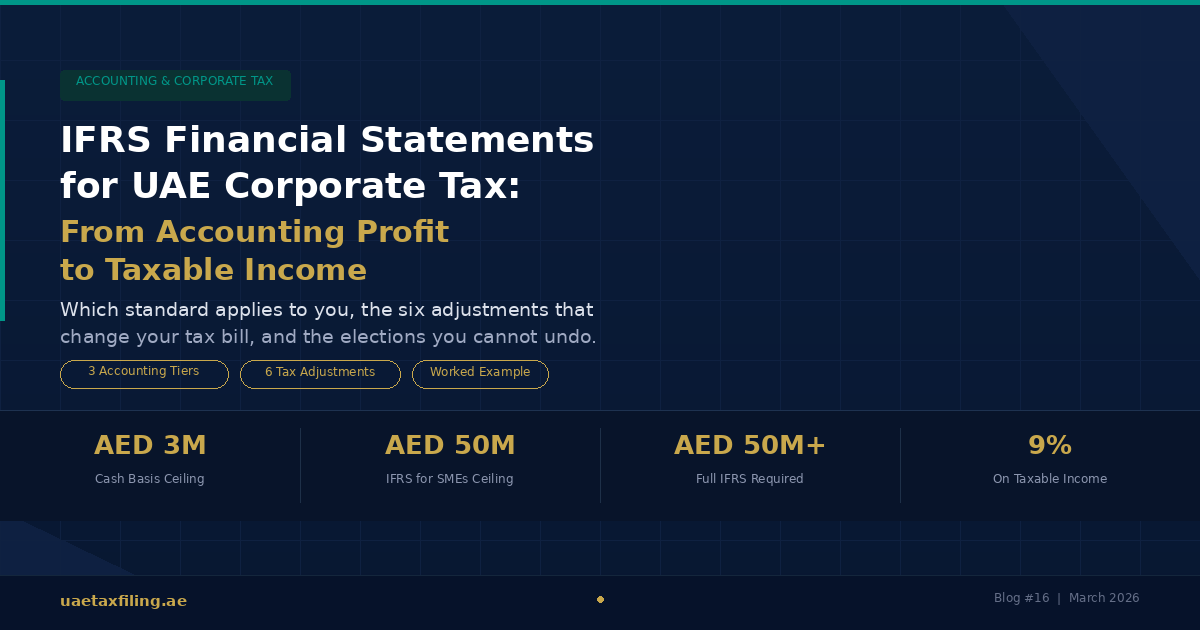
The UAE does not accept any accounting framework other than IFRS for corporate tax purposes. But within the IFRS family, three tiers exist, determined by your annual revenue. Choosing the wrong tier creates immediate compliance problems: your financial statements do not meet the FTA's requirements, your taxable income calculation starts from the wrong base, and your CT return is technically invalid.
Tier | Revenue Threshold | Accounting Standard | What It Means
1 | Up to AED 3 million | Cash basis of accounting | Record income when cash is received, expenses when cash is paid. Simplest method. Allowed by election only.
2 | Up to AED 50 million | IFRS for SMEs | Simplified version of full IFRS with fewer disclosures. Must use accrual basis. Revenue threshold assessed per tax period.
3 | Above AED 50 million | Full IFRS | Complete International Financial Reporting Standards. Full accrual basis with all disclosure requirements.
Tier 1: Cash Basis (Revenue up to AED 3 Million)
If your business revenue does not exceed AED 3 million in a tax period, you may elect to use cash basis accounting. Under this method, you record income when you receive payment and expenses when you pay them. There is no accrual of receivables or payables, no depreciation schedules, and no complex IFRS estimates. For very small businesses, this dramatically simplifies both the accounting and the tax calculation.
But cash basis comes with a critical limitation: if your revenue exceeds AED 3 million in any tax period, you must immediately switch to accrual basis (IFRS or IFRS for SMEs). This switch is not just a change of method; it requires restating your opening balances and recognizing all previously unrecorded accruals. Businesses approaching the AED 3 million threshold should start maintaining accrual records in parallel to avoid a disruptive transition.
Also note: if you elect Small Business Relief, you are treated as having zero taxable income. But SBR does not exempt you from maintaining proper records. You still need accounting records that support your revenue figure (to prove you qualify for SBR) and that are prepared under an accepted standard.
Tier 2: IFRS for SMEs (Revenue up to AED 50 Million)
The majority of UAE businesses fall into this tier. IFRS for SMEs is a self-contained standard published by the International Accounting Standards Board (IASB) specifically for private entities without public accountability. It covers the same topics as full IFRS but with reduced complexity: fewer disclosure requirements, simplified measurement rules, and less frequent revaluation obligations.
Key differences from full IFRS that affect your tax calculation: IFRS for SMEs generally requires less fair-value accounting, which means fewer unrealised gains and losses flow through your profit and loss statement. This can reduce the need for realisation basis elections (covered below). IFRS for SMEs has simpler rules for financial instruments, leases, and revenue recognition, which reduces the number of IFRS-to-tax adjustments you need to make.
The AED 50 million threshold is assessed per tax period. If your revenue crosses AED 50 million, you must move to full IFRS. Unlike the cash-to-accrual switch at AED 3 million, the transition from IFRS for SMEs to full IFRS is less operationally disruptive because both use the accrual basis. But the additional disclosure and measurement requirements under full IFRS require more sophisticated accounting processes and typically require engagement with a qualified audit firm.
Tier 3: Full IFRS (Revenue above AED 50 Million)
Full IFRS is the default standard for all UAE businesses. If you do not meet the revenue conditions for Tier 1 or Tier 2, you must use full IFRS. Full IFRS requires comprehensive fair-value measurement for many financial instruments, detailed revenue recognition under IFRS 15, right-of-use asset recognition under IFRS 16 (leases), and extensive disclosure notes.
For corporate tax purposes, businesses using full IFRS face the most adjustments between accounting profit and taxable income, because IFRS recognises many items (unrealised gains, lease adjustments, impairments, fair-value changes) that the CT Law treats differently. This is where the realisation basis election becomes most valuable.
The Six Adjustments from Accounting Profit to Taxable Income
Your CT return starts with one number: the accounting net profit (or loss) from your financial statements. PwC's UAE tax summary confirms that this figure is the starting point, and then six categories of adjustments are applied to arrive at taxable income. Understanding these adjustments is the difference between paying the right amount of tax and either overpaying (which costs you money) or underpaying (which costs you penalties).
The formula is: Taxable Income = Accounting Net Profit + Non-Deductible Expenses - Exempt Income +/- Unrealised Gain/Loss Adjustments +/- Transfer Pricing Adjustments +/- Other Adjustments (loss relief, elections)
Adjustment 1: Non-Deductible Expenses (Add Back)
Certain expenses that reduce your accounting profit are not allowed as deductions for CT purposes. You must add these back to arrive at taxable income. We covered these in detail in our deductions guide, but the key categories are:
Fines and penalties: Government fines (FTA penalties, traffic fines, regulatory penalties) are never deductible. Private contractual penalties may be deductible if incurred wholly for business purposes.
Entertainment expenses: Only 50% of entertainment, amusement, and recreation costs are deductible. The other 50% must be added back.
Donations: Charitable contributions are generally non-deductible unless made to a qualifying public benefit entity approved by the Cabinet.
Connected person payments above market value: If you pay your owner a salary above market rate, or pay above-market rent to a related party, the excess over market value is non-deductible. Our transfer pricing guide covers the arm's length requirements in detail.
Personal expenses: Any expense not incurred wholly and exclusively for business purposes is non-deductible. This includes personal use of company vehicles, personal travel booked through the business, and owner lifestyle expenses charged to the company.
Adjustment 2: Exempt Income (Deduct)
Certain income items included in your accounting profit are exempt from corporate tax and must be removed from taxable income:
Domestic dividends: Dividends received from UAE resident companies are exempt. No conditions apply for domestic dividends.
Foreign dividends and capital gains (Participation Exemption): Income from qualifying shareholdings (generally 5%+ ownership held for 12+ months) in foreign entities is exempt, provided the foreign entity is subject to tax at 9% or more in its jurisdiction. As Chambers & Partners confirmed, the participation exemption is one of the most significant reliefs for holding structures.
Foreign permanent establishment income: If your UAE company has a foreign branch (PE) that is taxed at 9%+ in the foreign jurisdiction, you can elect to exempt that branch's income from UAE CT.
Critical rule: expenses incurred to earn exempt income are themselves non-deductible. If you spend AED 50,000 on legal fees to acquire a qualifying shareholding that generates exempt dividends, that AED 50,000 cannot reduce your taxable income.
Adjustment 3: Unrealised Gains and Losses
Under full IFRS, many assets and liabilities are measured at fair value. When fair values change, the gain or loss flows through the profit and loss statement even though no transaction has occurred. An investment property that appreciates by AED 500,000 on paper creates AED 500,000 of accounting profit. But you have not sold the property. You have not received any cash. Should you pay 9% CT on a gain you have not realised?
The CT Law gives you a choice. You can elect to use the realisation basis, which means unrealised gains are excluded from taxable income (and unrealised losses are excluded from deductions) until the asset is actually disposed of. This election is made on your first CT return and is generally irrevocable.
Two options for the realisation basis election:
Option A: All assets and liabilities. Exclude all unrealised gains and losses from taxable income, regardless of whether they are held on capital account or revenue account.
Option B: Capital account only. Exclude unrealised gains and losses only on assets and liabilities held on capital account. Unrealised gains and losses on revenue account items continue to be included in taxable income.
For businesses holding investment properties, financial instruments at fair value, or long-term assets subject to impairment testing, this election can significantly change the timing of tax payments. A business with AED 2 million in unrealised investment gains avoids AED 180,000 in CT payments until those gains are actually realised through a sale.
Adjustment 4: Transfer Pricing Adjustments
If transactions with related parties and connected persons are not at arm's length, the FTA can adjust the transaction values to reflect market prices. These adjustments change your taxable income: upward adjustments (increasing taxable income because you undercharged a related party or overpaid a connected person) are applied directly. Downward adjustments (decreasing taxable income) require prior FTA approval.
For businesses making transfer pricing adjustments, the adjustment must be reflected in the taxable income calculation even if it is not recorded in the financial statements. This creates a permanent difference between your accounting profit and your taxable income that must be tracked and documented for every tax period.
Adjustment 5: Tax Loss Relief
If your business made a loss in a previous tax period, you can carry that loss forward to offset up to 75% of taxable income in future periods. Loss carry-forward is unlimited in duration (no expiry) but subject to a 50% ownership continuity test: if more than 50% of the ownership changes, the losses are forfeited unless the business continues in a similar manner.
Two warnings. First, if you elected Small Business Relief in a loss-making year, those losses are destroyed. SBR treats your income as zero, which means there is no loss to carry forward. Second, losses can only offset 75% of taxable income in any given period, not 100%. A business with AED 1 million in carried-forward losses and AED 800,000 in current-year taxable income can only offset AED 600,000 (75%), leaving AED 200,000 taxable at 9% (AED 18,000 in CT).
Adjustment 6: Other Elections and Reliefs
Several other adjustments may apply depending on your situation: the interest deduction limitation (net interest expense capped at the greater of AED 12 million or 30% of adjusted EBITDA), intra-group transfer relief (deferral of gains on asset transfers within a qualifying group), and business restructuring relief (deferral of gains on mergers and spin-offs). Each of these is documented in the FTA's Determination of Taxable Income Guide.
Not sure which accounting standard applies to your business, or whether your adjustments are correct? Our accounting team prepares IFRS-compliant financial statements and calculates taxable income for UAE businesses of all sizes. Message us on WhatsApp.
Worked Example: AED 2 Million Services Company
Consider a Dubai mainland LLC providing consulting services. Annual revenue of AED 2 million. The company uses IFRS for SMEs (revenue under AED 50 million). Here is the journey from accounting profit to taxable income and CT payable:
Item | AED | Reference
Accounting net profit (per financial statements) | 620,000 | Starting point
Add: FTA late filing penalty paid | +1,500 | Non-deductible
Add: Entertainment expenses (50% disallowed of AED 24,000) | +12,000 | 50% cap
Add: Owner personal travel charged to company | +8,000 | Non-deductible
Add: Owner salary excess above market value (AED 5,000/mo x 12) | +60,000 | Connected person adj.
Less: Dividend from UAE subsidiary | -40,000 | Exempt income
Less: Tax loss carried forward from prior year (75% of result) | -99,375 | 75% cap applies
Taxable income | 562,125 |
CT at 0% on first AED 375,000 | 0 |
CT at 9% on AED 187,125 (562,125 - 375,000) | 16,841 |
Corporate tax payable | 16,841 |
Without the adjustments, this company would have calculated CT on AED 620,000 of accounting profit, yielding AED 22,050 in tax. With correct adjustments, the actual CT payable is AED 16,841, a saving of AED 5,209. The difference comes from properly deducting exempt income and applying loss relief. But the non-deductible add-backs (AED 81,500) partially offset these savings. Getting the adjustments right matters in both directions.
Opening Balance Sheet: The Transitional Rules
When your business first becomes subject to corporate tax, the values of your assets and liabilities on the opening balance sheet of your first tax period form the baseline for all future CT calculations. The FTA's Accounting Standards Guide establishes several important rules for this transition:
Market value for immovable property: Real estate (land and buildings) on your opening balance sheet should be recorded at market value as at the start of your first tax period. The market value is determined by the relevant government authority (such as the Dubai Land Department) or by a qualified third-party valuer. This establishes the cost base for future capital gains calculations, meaning you are not taxed on appreciation that occurred before you were subject to CT.
Arm's length for related party balances: If your opening balance sheet includes intercompany loans, receivables, or other related party balances, these must reflect arm's length values. If they do not, adjustments may be required that affect your taxable income in subsequent periods.
Subsequent movements follow accounting treatment: Once the opening balance sheet is established, future movements in those items follow the normal accounting and CT treatment. For example, a provision recognized before you were subject to CT that is reversed after the CT start date is taxable income in the period of reversal.
Businesses that entered the CT regime in June 2023 and are filing their first or second return in 2026 must ensure their opening balance sheet was correctly prepared. Errors in the opening balance sheet carry forward indefinitely, affecting every future tax period. If your initial financial statements were prepared by a bookkeeper without CT awareness, it is worth having them reviewed now, before you file, rather than discovering the error during an FTA audit.
Audit Requirements: Who Needs Audited Financials
Not every business is required to have audited financial statements for CT purposes. But several situations make an audit either mandatory or strongly advisable:
Revenue above AED 50 million: Ministerial Decision No. 84 of 2025 requires audited financial statements for businesses at this threshold. The audit must be performed by a UAE-licensed auditor.
Qualifying Free Zone Persons: To maintain QFZP status and the 0% CT rate, free zone businesses must maintain audited financial statements. This applies regardless of revenue level. Even a free zone company with AED 500,000 in revenue needs audited financials if it wants the 0% rate. PwC's guidance on Tax Group financial statements further confirms that Tax Groups must prepare and maintain audited aggregated financial statements for each tax period starting on or after January 1, 2025.
Free zone authority requirements: Many free zones (DMCC, JAFZA, DAFZ, DIFC) independently require annual audited financials as part of license renewal, separate from CT requirements.
Practical recommendation: Even if you are not technically required to have audited financials, consider it an investment in audit readiness. The FTA can request your financial statements and supporting records at any time, and having an independent auditor's opinion strengthens your position if those records are challenged. For businesses preparing to file their first CT return in 2026, an audit now catches errors before the FTA does.
Seven Accounting Errors That Create Corporate Tax Problems
1. Using the wrong accounting standard. A company with AED 60 million in revenue using IFRS for SMEs instead of full IFRS. The FTA can reject the entire financial statement basis and require restatement.
2. Not making the realisation basis election. A holding company with AED 3 million in unrealised investment gains pays AED 270,000 in CT on paper profits that could have been deferred. The election is made on the first CT return and is irrevocable. Miss it, and you pay tax on unrealised gains permanently. Combined with late filing penalties and the new VAT penalty regime from April 2026, accounting errors quickly compound into six-figure exposure.
3. Recording net settlement instead of gross revenue (e-commerce sellers). As we covered in our e-commerce tax guide, Amazon and Noon sellers who record net bank deposits instead of gross sales understate both revenue and expenses. This creates a mismatch between VAT returns (which show gross supply values) and CT returns.
4. Failing to add back entertainment expenses. The 50% entertainment cap is one of the most commonly missed adjustments. A company with AED 100,000 in client entertainment that does not add back AED 50,000 understates taxable income by that amount.
5. Carrying forward losses while electing SBR. SBR treats taxable income as zero. There is no loss to carry forward. A startup with AED 200,000 in Year 1 losses that elects SBR in Year 1 destroys those losses. If the startup later grows past AED 3 million revenue, those losses are gone forever. Our SBR guide covers this trap in detail.
6. Not reconciling VAT and CT revenue. Your annual revenue for CT purposes should equal the sum of your four quarterly VAT return taxable supply figures (adjusted for timing differences). If they do not match, the FTA sees a discrepancy. This is one of the top audit triggers.
7. Ignoring the opening balance sheet. A business that entered the CT regime with a related party loan at a non-arm's length value, or real estate at historical cost instead of market value, carries an error that compounds with every tax period.
Frequently Asked Questions
Which accounting standard should my UAE business use?
It depends on your revenue. Up to AED 3 million: cash basis (by election). Up to AED 50 million: IFRS for SMEs. Above AED 50 million: full IFRS. These are the only standards accepted by the FTA for corporate tax purposes.
What is the difference between accounting profit and taxable income?
Accounting profit is your net profit per your financial statements. Taxable income is accounting profit after mandatory adjustments: adding back non-deductible expenses, removing exempt income, adjusting for unrealised gains/losses, applying transfer pricing corrections, and claiming loss relief. They are rarely the same number.
What is the realisation basis election?
It allows you to exclude unrealised gains and losses from taxable income until the asset is sold or disposed of. This is valuable for businesses holding investment property, financial instruments at fair value, or any assets subject to IFRS revaluation. The election is made on your first CT return and is generally irrevocable.
Can I switch from IFRS for SMEs to full IFRS voluntarily?
Yes. You can always choose to apply a more comprehensive standard. But you cannot switch down from full IFRS to IFRS for SMEs unless your revenue drops below AED 50 million. The FTA expects consistency in accounting standards across periods.
Do I need audited financial statements for corporate tax?
Audited financials are mandatory for businesses with revenue above AED 50 million, all QFZPs (regardless of revenue), and Tax Groups (from 2025 onwards). Many free zone authorities also require annual audits independently of CT requirements.
What happens if my VAT revenue does not match my CT revenue?
The FTA cross-references VAT and CT filings. If your total taxable supplies across four quarterly VAT returns do not reconcile with the revenue on your annual CT return, it triggers an inquiry or audit. Timing differences (accrual vs cash) should be documented and reconciled.
Can I use cash basis accounting if my revenue is over AED 3 million?
No. Once your revenue exceeds AED 3 million in any tax period, you must switch to accrual basis accounting under IFRS or IFRS for SMEs. The FTA may grant exceptions in extraordinary circumstances, but this requires direct approval.
How do I handle the opening balance sheet for my first CT return?
Immovable property should be at market value as at the start of your first tax period. Related party balances should be at arm's length values. All other items follow the normal IFRS measurement. Errors in the opening balance sheet affect every subsequent tax period.
What is the 75% loss relief cap?
Carried-forward tax losses can offset a maximum of 75% of taxable income in any given period. The remaining 25% is always taxable. This ensures the government always collects some CT even from businesses using prior-year losses.
Does my bookkeeper need to know about corporate tax adjustments?
Yes. The adjustments from accounting profit to taxable income should ideally be built into your accounting process, not calculated separately after the fact. A bookkeeper or accountant who understands both IFRS and the CT adjustment framework produces financial statements that flow directly into an accurate CT return without requiring rework.
Your Accounting Is Your Tax Return
Two businesses with identical revenue and identical expenses can pay different amounts of corporate tax. The difference comes down to accounting: which standard they use, how they handle unrealised gains, which elections they make on their first return, and whether the adjustments from accounting profit to taxable income are applied correctly.
The businesses that overpay are the ones that skip the realisation basis election, do not claim loss relief, and fail to remove exempt income. The businesses that underpay are the ones that forget to add back non-deductible expenses, record net settlements instead of gross revenue, and let connected person payments exceed market value without documentation.
The businesses that get it right are the ones whose accounting and corporate tax functions work as a single process, not two separate exercises done months apart by different people. The financial statements produce the taxable income. The adjustments are documented as they occur, not reconstructed under deadline pressure. And the first CT return gets the irrevocable elections right, because there is no second chance.
Our accounting services cover the full path from daily bookkeeping through IFRS-compliant financial statements to corporate tax calculation. We prepare financial statements under the correct standard for your revenue tier, calculate all six adjustment categories, and ensure your CT return matches your VAT filings. Get in touch on WhatsApp or explore our corporate tax services.