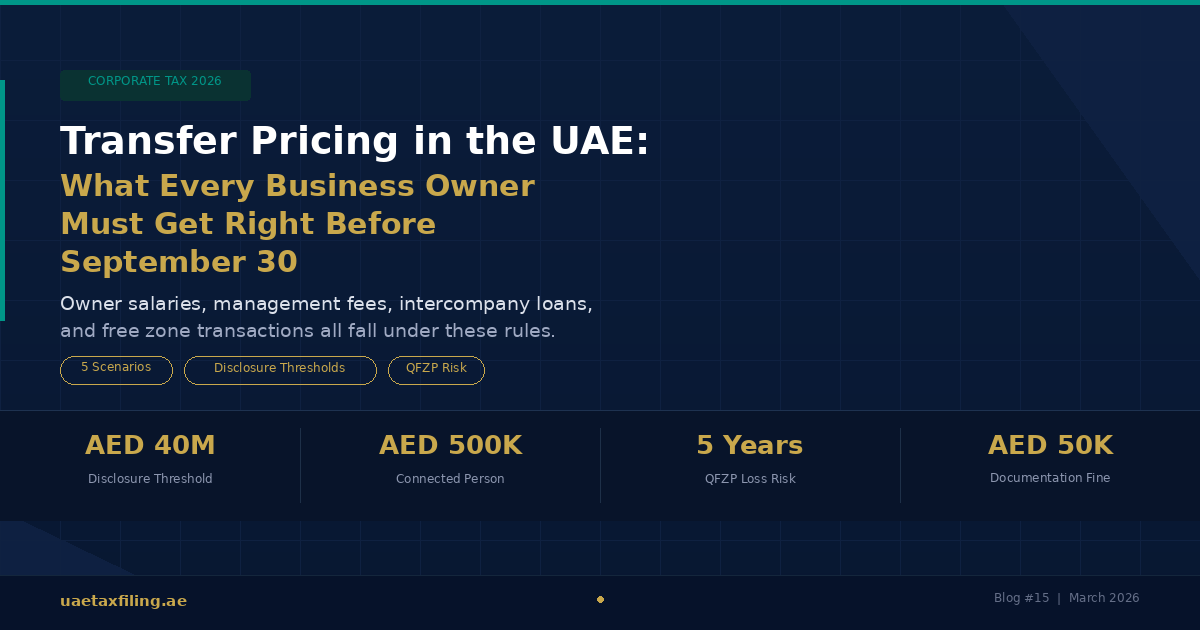
Transfer pricing used to be a topic reserved for multinationals with tax departments and global advisory firms. In the UAE, it now applies to every business that transacts with a related party or a connected person. And the definition of those terms is far wider than most business owners expect.
If you own 50% or more of two companies, those companies are related parties. If you pay yourself a salary as the owner of your LLC, you are a connected person of that LLC. If your free zone entity provides management services to your mainland entity, that is a controlled transaction. If you lend money to your own company at zero interest, the FTA considers that a transfer pricing issue. Every one of these arrangements requires arm's length pricing, and the first corporate tax returns with transfer pricing disclosures are due September 30, 2026 for calendar-year businesses.
The FTA is not treating this as a soft launch. The National reported in February 2026 that the new APA guide represents the 'first real map for transfer pricing' in the UAE, signaling that enforcement infrastructure is now in place. Alvarez & Marsal's deep-dive analysis confirmed that the TP disclosure form is integrated directly into the CT return on EmaraTax, meaning the FTA sees your related party data at the moment you file, not months later during an audit. And FTI Consulting's practical guide flagged multiple areas where ambiguity in the disclosure form creates traps for businesses filling it out for the first time.
This guide covers what transfer pricing actually means for UAE businesses in practical terms. Who qualifies as a related party and connected person (the definitions are broader than you think). What the arm's length principle requires. The five pricing methods the FTA accepts. The disclosure thresholds that trigger reporting. The documentation you must maintain. Five worked scenarios showing how common business arrangements create TP obligations. And the specific risk for free zone businesses: fail on transfer pricing compliance and you lose QFZP status for five years. If you have already read our free zone guide and our deductions guide, this article fills in the transfer pricing piece that connects both.
Related Parties and Connected Persons: The Definitions Are Wider Than You Think
The UAE Corporate Tax Law (Federal Decree-Law No. 47 of 2022, Articles 35 and 36) defines two categories of persons whose transactions with your business must meet the arm's length standard. As BDO's analysis noted, these definitions are broader than both the OECD guidelines and the IAS 24 accounting standard, which means your financial statement disclosures alone do not capture all the relationships the FTA cares about.
Related Parties (Article 35)
Two entities are related parties if one owns or controls 50% or more of the other, directly or indirectly, alone or jointly with its own related parties. Control is not limited to share ownership. It includes the ability to determine 50% or more of voting rights, board composition, or profit entitlement. Individuals related by up to the fourth degree of kinship (parents, grandparents, great-grandparents, siblings, first cousins, aunts, uncles, children, nieces, nephews, grandchildren, and step-relations) are related parties of each other.
Practical translation: If you and your brother each own a separate Dubai LLC, those two LLCs are related parties because you are connected within the fourth degree of kinship and collectively could have influence. If your wife owns a free zone company and you own a mainland company, those companies are related parties. If a holding company owns 60% of Company A and 80% of Company B, Companies A and B are related parties.
Connected Persons (Article 36)
A connected person is someone who has a direct relationship with the taxable entity through ownership, employment, or partnership. Specifically: the owners of the business, the directors, officers, and key management personnel (CEO, CFO, heads of departments), and the related parties of any of these individuals.
This is the definition that catches every SME in the UAE. If you are the sole owner of a Dubai LLC and you pay yourself a monthly salary of AED 40,000, that salary is a transaction with a connected person. It is only deductible for corporate tax purposes if it meets two conditions: it was incurred wholly and exclusively for the business, and the amount reflects what an unrelated person in a comparable role would earn in the market. If your salary exceeds market value, the excess is a non-deductible expense that increases your taxable income.
Criterion | Related Party | Connected Person
Legal basis | Article 35 CT Law | Article 36 CT Law
Relationship type | Ownership/control (50%+) or kinship (4th degree) | Owner, director, officer, KMP, or their relatives
Standard required | Arm's length price | Market value
Disclosure threshold | AED 40M aggregate, AED 4M per category | AED 500K per person (with related parties)
Documentation | Master File + Local File if revenue >= AED 200M | Substantiate market value of payment/benefit
Penalty for non-compliance | AED 50K incomplete docs + income adjustment | Deduction denied for excess above market value
The Arm's Length Principle: What the FTA Actually Expects
Article 34 of the Corporate Tax Law states that a transaction between related parties meets the arm's length standard if the result is consistent with what two independent, unrelated parties would have agreed to under comparable circumstances. This is the same principle used in over 120 countries and codified in the OECD Transfer Pricing Guidelines, which the UAE explicitly follows.
For business owners, the principle translates to a simple question: would an outsider accept the same deal? If you charge your related company AED 10,000 per month for management services, would an independent consultancy charge the same amount for the same scope of work? If you lend AED 500,000 to your related company at 0% interest, would a bank extend the same loan at the same rate? If the answer is no, the FTA can adjust the transaction to reflect what the arm's length price would have been, and your taxable income changes accordingly.
The FTA recognizes five transfer pricing methods to determine the arm's length price, aligned with the OECD guidelines. As KPMG's transfer pricing practice outlined, the choice of method depends on the type of transaction and the availability of comparable data:
Method | How It Works | Best For
Comparable Uncontrolled Price (CUP) | Compares the price in the controlled transaction directly to the price in a comparable uncontrolled transaction | Goods with active markets, commodity trading
Resale Price Method (RPM) | Starts from the resale price to an independent buyer and deducts an appropriate gross margin | Distribution arrangements
Cost Plus Method (CPM) | Starts from the costs incurred by the supplier and adds an appropriate markup | Manufacturing, routine services
Transactional Net Margin Method (TNMM) | Compares the net profit margin of the controlled transaction to comparable independent transactions | Complex services, intangibles
Profit Split Method (PSM) | Splits the combined profit from a transaction between related parties based on their relative contributions | Highly integrated operations, unique intangibles on both sides
For most UAE SMEs, the TNMM or Cost Plus method will be the most practical because they require benchmarking against publicly available financial data rather than finding identical transactions. The CUP method is the most direct but requires finding a truly comparable uncontrolled transaction, which is often difficult for services and intangibles.
Five Scenarios Every UAE Business Owner Should Recognize
Scenario 1: Owner Salary (Connected Person)
Setup: Ahmed is the sole owner and managing director of a Dubai mainland LLC. He pays himself a monthly salary of AED 60,000 (AED 720,000 per year). The company's annual revenue is AED 4 million.
TP issue: Ahmed is a connected person of his LLC. His salary is only deductible if it reflects the market value of his services. Market data for a managing director of a services company with AED 4 million revenue in Dubai suggests a range of AED 30,000 to AED 45,000 per month, depending on the industry.
FTA treatment: The FTA may allow a deduction of AED 45,000 per month (AED 540,000 per year) and disallow the excess AED 180,000. That AED 180,000 is added back to taxable income. At the 9% CT rate, Ahmed's company pays an additional AED 16,200 in corporate tax. Had Ahmed set his salary at AED 45,000, the company's tax position would have been AED 16,200 lower.
Disclosure: Ahmed's total compensation exceeds AED 500,000, so it must be disclosed in the connected persons schedule of the CT return. The company must also substantiate the market value with comparable salary data.
Scenario 2: Free Zone to Mainland Management Fees (QFZP Risk)
Setup: Sara owns a JAFZA free zone company (Company A) and a Dubai mainland LLC (Company B). Company A provides management and administrative services to Company B and charges AED 200,000 per year. Company A claims QFZP status and the 0% corporate tax rate.
TP issue: Companies A and B are related parties (Sara owns both). The AED 200,000 management fee must reflect the arm's length price for the services actually provided. If Company A's actual costs for providing those services are AED 80,000 and comparable independent service providers charge a 15% to 25% markup, the arm's length fee would be AED 92,000 to AED 100,000.
FTA treatment: The FTA can adjust the fee down to AED 100,000. Company B's deduction drops by AED 100,000, increasing its taxable income (and CT liability) by AED 9,000. Company A's qualifying income also changes, which could affect its QFZP calculations.
The real risk: If Company A fails to maintain adequate transfer pricing documentation for this transaction, it fails one of the conditions for QFZP status. Under Article 18 of the CT Law, losing QFZP status means the entity is taxed at 9% on its full income for the current year and the next four years. That is a five-year disqualification. For a free zone company with AED 2 million in annual profit, the difference between 0% and 9% is AED 180,000 per year, or AED 900,000 over the five-year penalty period. All because of how a management fee was priced and documented.
Scenario 3: Interest-Free Shareholder Loan
Setup: Khalid lends AED 2 million to his LLC at 0% interest. The loan has no fixed repayment date.
TP issue: Khalid is a connected person. A bank would not lend AED 2 million at 0% interest. The arm's length interest rate for a comparable loan in the UAE market (considering the borrower's credit profile, loan amount, and terms) might be 6% to 8% per year. At 7%, the imputed interest is AED 140,000 per year.
FTA treatment: The FTA can impute interest income of AED 140,000 to Khalid's company. This does not mean cash changes hands. It means the FTA treats the arrangement as if the company received a service (access to capital) worth AED 140,000 from Khalid. The company should have recorded an interest expense of AED 140,000 (deductible) and Khalid should have recorded interest income of AED 140,000 (taxable if his business income exceeds AED 1 million under the natural person rules). The interest expense may then hit the interest deduction limitation rules, creating a further compliance layer.
Scenario 4: Intercompany Goods Between Related Entities
Setup: A UAE holding company owns 70% of a manufacturing entity in Abu Dhabi and 60% of a distribution entity in Dubai. The manufacturer sells finished goods to the distributor at cost (AED 5 million per year). The distributor resells them to end customers for AED 8 million.
TP issue: Both entities are related parties. Selling at cost means all the profit sits with the distributor. An independent manufacturer would charge cost plus a markup (say 15% to 20% for routine manufacturing). The arm's length price would be AED 5.75 million to AED 6 million.
FTA treatment: The FTA can adjust the transfer price upward. The manufacturer's taxable income increases, and the distributor's decreases. If both entities are at 9%, the total group tax stays the same. But if one entity has SBR and the other does not, or one is a QFZP and the other is mainland, the price allocation directly affects which entity pays how much tax. This is exactly the profit-shifting risk that transfer pricing rules are designed to prevent.
Scenario 5: IP Licensing Between Group Companies
Setup: A UAE mainland company developed a software platform. It licenses the IP to a related free zone entity, which uses it to deliver SaaS services to international clients. The license fee is AED 50,000 per year.
TP issue: If the software generates AED 3 million in revenue for the free zone entity, a AED 50,000 royalty seems well below market rate. Comparable IP licensing arrangements typically involve royalties of 5% to 15% of revenue, depending on the IP's uniqueness and contribution to value creation. At 10%, the arm's length royalty would be AED 300,000.
FTA treatment: The FTA can adjust the royalty to AED 300,000. The mainland company's income increases by AED 250,000 (taxed at 9% = AED 22,500 additional CT). The free zone entity's deduction increases, potentially reducing its qualifying income. But more critically, if the free zone entity's pricing is not arm's length, this is another QFZP compliance failure that triggers the five-year disqualification.
Do any of these scenarios look familiar? Our corporate tax team reviews related party and connected person transactions, benchmarks them against market data, and prepares the documentation the FTA expects. Talk to us on WhatsApp.
Disclosure Thresholds: What Triggers Reporting in Your CT Return
The transfer pricing disclosure is not a separate filing. As Deloitte's analysis confirmed, the FTA integrated it directly into the corporate tax return on EmaraTax as a schedule. You complete it at the same time you file your CT return, within nine months of your financial year-end.
But not every business completes every section. The FTA uses materiality thresholds to focus reporting on significant transactions. Here is the complete threshold structure:
Obligation | Threshold | What You File | When
Related party schedule | Aggregate RP transactions > AED 40M | Disclose each category > AED 4M (goods, services, IP, interest, assets, liabilities) | With CT return (9 months after year-end)
Connected person schedule | Payment/benefit to single CP (+ their RPs) > AED 500K | Name, CT number, gross value, market value | With CT return
Master File + Local File | Revenue >= AED 200M OR part of MNE with >= AED 3.15B global revenue | Detailed TP documentation per OECD standards | Maintain ready; provide within 30 days of FTA request
Country-by-Country Report | MNE group with >= AED 3.15B global revenue | Jurisdictional breakdown of revenue, profit, tax, employees | 12 months after MNE fiscal year-end
APA (optional) | Controlled transactions >= AED 100M per tax period (indicator, not strict) | Application + annual APA declaration | AED 30K application fee; 3-5 year coverage
Critical point for SMEs: Even if you fall below every threshold in the table above, the arm's length requirement still applies to every related party and connected person transaction. The thresholds determine what you must formally disclose and document. They do not determine what must be priced correctly. A business with AED 5 million in related party transactions still must price them at arm's length. It just does not need to fill out the formal RP schedule in the CT return. But the FTA can still request documentation during an audit, and you have 30 days to produce it.
The QFZP Transfer Pricing Trap: Five Years of 9% Tax
This section deserves its own heading because the financial impact is so severe.
To qualify for the 0% corporate tax rate as a Qualifying Free Zone Person, your entity must meet several conditions. One of them is compliance with the arm's length principle for all transactions with related parties and connected persons. Another is maintaining appropriate transfer pricing documentation. BDO confirmed that meeting TP compliance is not optional for QFZPs; it is a mandatory qualifying condition.
If the FTA determines that your free zone entity failed to comply with transfer pricing rules, you lose QFZP status for the current tax period and the next four tax periods. That is five consecutive years at the 9% rate instead of 0%.
The math is punishing. Consider a free zone entity with AED 1.5 million in annual taxable income (above the AED 375,000 zero-rate band):
| With QFZP (0%) | Without QFZP (9%)
Taxable income | AED 1,500,000 | AED 1,500,000
CT on first AED 375,000 | AED 0 | AED 0
CT on AED 1,125,000 above threshold | AED 0 | AED 101,250
Annual CT liability | AED 0 | AED 101,250
Five-year total CT cost | AED 0 | AED 506,250
Over half a million dirhams in tax that would have been zero, triggered by a transfer pricing failure. And that is for a modestly profitable free zone entity. For a company with AED 5 million in qualifying income, the five-year cost exceeds AED 2 million.
As Baker McKenzie noted in their APA analysis, the new APA program is particularly relevant for free zone to mainland transactions because it allows QFZPs to get advance certainty from the FTA on their intercompany pricing. For businesses with significant free zone to mainland flows, the AED 30,000 APA application fee is negligible compared to the potential five-year disqualification cost.
The New APA Program: What It Means and Who Should Apply
On December 30, 2025, the FTA published the Corporate Tax Guide on Advance Pricing Agreements (CTGAPA1), formally launching the APA program in the UAE. An APA is a binding agreement between a taxpayer and the FTA that sets out how controlled transactions will be priced over a fixed period of three to five years.
The program launched in phases. Domestic transactions (between UAE entities) are already accepted for unilateral APAs as of December 30, 2025. Cross-border APAs will be launched later in 2026. The key parameters:
Transaction threshold: AED 100 million per tax period in aggregate controlled transaction value. The FTA clarified this is a materiality indicator, not an absolute barrier. Applications below this level may still be accepted based on complexity and tax risk.
Fees: AED 30,000 (non-refundable) for a new application. AED 15,000 for renewal.
Duration: Minimum three tax periods, maximum five. Only prospective periods are covered at this stage, so the earliest covered period would realistically start in 2027 or 2028 depending on when you apply.
Process: Pre-filing consultation with the FTA (via email to APA@tax.gov.ae), then formal application within two months of approval, then FTA evaluation including potential site visits, then negotiation and conclusion.
Who should consider it: UAE groups with significant domestic transactions between entities at different tax rates (mainland at 9% and free zone at 0%), groups with complex intercompany arrangements that are difficult to benchmark, and businesses that want audit certainty on their transfer pricing for the next three to five years. For most SMEs with straightforward owner-salary or single-entity arrangements, the APA process is unnecessary. Standard documentation and benchmarking is sufficient.
What to Do Before September 30, 2026
The September 30 deadline applies to businesses with a December 31 financial year-end. Your first CT return, including the transfer pricing disclosure, must be filed by this date. Here is the practical checklist:
1. Map every related party and connected person. Go through the definitions in Articles 35 and 36. Include family members who own businesses, companies where you hold 50%+ ownership, directors and officers, and their relatives. Most business owners discover related party relationships they had not considered. Our overview of 2026 tax changes covers the broader regulatory context these rules sit within.
2. List every transaction with each related party and connected person. Include management fees, service charges, goods transfers, loans (including interest-free ones), IP licenses, rent, salaries, bonuses, and benefits. Calculate the aggregate value.
3. Determine which disclosure thresholds you exceed. If your aggregate related party transactions exceed AED 40 million, prepare for the full RP schedule. If any connected person payment exceeds AED 500,000, prepare for the CP schedule. If your revenue exceeds AED 200 million, start preparing Master File and Local File documentation.
4. Benchmark each controlled transaction. For each transaction type, determine the arm's length price or market value using one of the five accepted methods. Owner salaries should be benchmarked against comparable market compensation data. Intercompany service fees should be priced at cost plus a market-rate markup. Loans should carry interest at rates comparable to what a bank would charge.
5. Document everything. Even if you are below the formal documentation thresholds, maintain records that explain why your pricing is arm's length. The FTA can request this documentation during an audit and gives you only 30 days to produce it. A simple memo for each transaction type, explaining the pricing rationale and the comparable data used, is the minimum.
6. Reconcile with your CT return. The transfer pricing adjustments (if any) must flow through to your taxable income calculation. Upward adjustments (increasing taxable income) are reported directly. Downward adjustments (decreasing taxable income) require prior FTA approval. Ensure your accounting records reflect the final arm's length positions before you close your financial statements. If intercompany services trigger the reverse charge mechanism for VAT purposes, those entries must also be consistent with the arm's length pricing used for CT. And your VAT return revenue figures must reconcile with your CT return.
7. If you are a QFZP, treat TP compliance as existential. Your free zone status depends on it. Document every related party transaction with the same rigor you would apply if an auditor were standing behind you. Because eventually, one will be.
Penalties for Getting Transfer Pricing Wrong
Transfer pricing non-compliance triggers multiple penalty layers:
Incomplete or missing documentation: AED 50,000 per tax period for failure to maintain adequate transfer pricing documentation when required.
Incorrect CT return: If your taxable income is wrong because transfer pricing adjustments were not applied, the standard penalty regime kicks in. Voluntary disclosure costs 1% per month of the tax difference. FTA audit discovery costs 15% of the tax difference plus 1% per month.
Income adjustment: The FTA can unilaterally adjust your taxable income to reflect arm's length pricing. Upward adjustments are applied directly. This means you pay more tax plus penalties on the underpaid amount.
QFZP disqualification: As covered above, failure to comply with TP rules as a free zone entity triggers a five-year loss of QFZP status.
Deduction denial: Payments to connected persons that exceed market value are denied as deductions entirely. The excess is added back to taxable income.
The combined effect of these penalties means transfer pricing errors are among the most expensive compliance failures under the UAE CT regime. A single incorrectly priced intercompany transaction can trigger documentation penalties, income adjustments, CT underpayment penalties, and potentially QFZP disqualification. All at once.
Frequently Asked Questions
Does transfer pricing apply to small businesses in the UAE?
Yes. The arm's length principle applies to every business that transacts with a related party or connected person, regardless of size. Even businesses that elect Small Business Relief must price related party transactions at arm's length. The formal disclosure thresholds (AED 40 million for RP, AED 500,000 for CP) determine what gets reported in your CT return, but the pricing requirement itself has no minimum threshold.
What is the AED 40 million disclosure threshold?
If the total value of all your transactions with all related parties (combined) exceeds AED 40 million in a tax period, you must complete the related party schedule in your CT return. Within that schedule, individual transaction categories (goods, services, IP, interest, assets, liabilities) exceeding AED 4 million must be disclosed separately.
My owner salary is AED 50,000 per month. Is that a transfer pricing issue?
Yes. As the owner, you are a connected person. Your salary must reflect the market value of the services you provide to the company. If AED 50,000 per month is within the market range for a comparable role, document it with salary benchmarking data. If it exceeds market value, the excess is a non-deductible expense.
I lend money to my own company. Do I need to charge interest?
Yes. A zero-interest loan between a connected person and a business entity is not at arm's length. The FTA can impute interest at the rate a bank would charge for a comparable loan. Document the loan terms and apply a market rate.
What happens if I lose QFZP status due to transfer pricing?
You are taxed at 9% on your full income for the current year and the next four years. After the five-year period, you may re-test your QFZP status. The financial impact runs into hundreds of thousands or millions of dirhams depending on your income level.
Do I need to submit my Master File and Local File with the CT return?
No. The Master File and Local File are not submitted with the return. They must be maintained and produced within 30 days if the FTA requests them. Only the disclosure form (the RP and CP schedules) is submitted with the CT return.
What is an Advance Pricing Agreement?
An APA is a binding agreement with the FTA on how specific controlled transactions will be priced over three to five years. It provides certainty and eliminates audit risk for covered transactions. Currently available for domestic transactions with a guideline threshold of AED 100 million per tax period.
Can the FTA adjust my transfer pricing even if I am below all thresholds?
Yes. The arm's length requirement applies universally. The FTA can review and adjust any related party or connected person transaction regardless of whether it fell above or below the disclosure thresholds. The thresholds only determine what must be formally reported in the CT return.
Do transfer pricing rules apply between members of a Tax Group?
Generally no, because a Tax Group is treated as a single taxpayer. Transactions within the group are eliminated on consolidation. However, exceptions apply if a group member has pre-grouping tax losses or claims foreign tax credits.
How do I benchmark my owner salary?
Use publicly available salary surveys for the UAE (Robert Half, Hays, Michael Page publish annual guides). Identify comparable roles by industry, company size, and responsibility level. Document the data source, the comparable range, and where your salary falls within it.
The First Filing Year Sets the Standard
Transfer pricing in the UAE is no longer theoretical. The first CT returns with TP disclosures are due in months. The APA program is live. The FTA's audit infrastructure is built. And the penalties, from AED 50,000 documentation fines to five-year QFZP disqualification, are severe enough that getting this wrong in year one creates problems that compound for years.
The business owners who will handle this smoothly are the ones who have already mapped their related party relationships, benchmarked their key transactions, and prepared documentation that can survive an FTA request. The ones who will pay the most are the ones who assume transfer pricing is something only multinationals worry about, until they receive the audit notice.
Start with the five scenarios in this guide. If any of them describes your situation, you have transfer pricing work to do before September 30.
Our corporate tax team handles transfer pricing documentation for UAE businesses of all sizes. From owner salary benchmarking and intercompany loan structuring to full Master File and Local File preparation, we ensure your related party transactions are arm's length and your CT return is audit-ready. Get in touch on WhatsApp or explore our accounting services and VAT compliance.