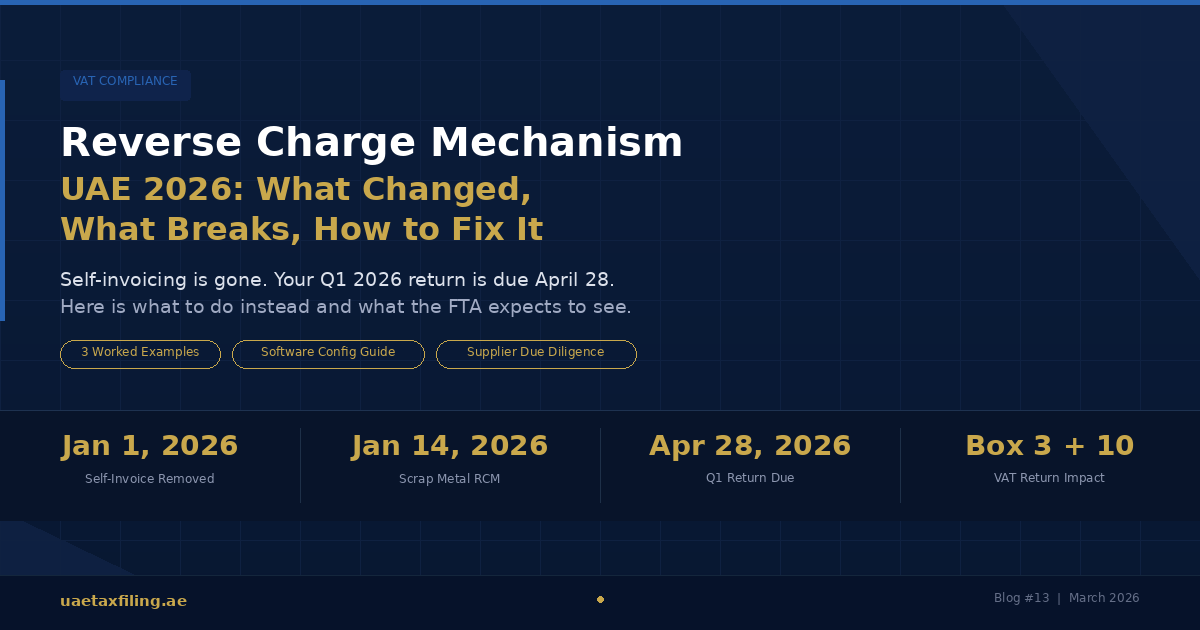
On January 1, 2026, the UAE quietly changed how every import-heavy business in the country accounts for VAT. The self-invoice requirement under the reverse charge mechanism was removed. Federal Decree-Law No. 16 of 2025 amended the VAT Law to eliminate the obligation to issue a tax invoice to yourself when importing goods or services for business purposes. Two weeks later, Cabinet Decision No. 153 of 2025 introduced a brand new domestic reverse charge for scrap metal trading between VAT-registered businesses, effective January 14.
The self-invoice removal sounds like a simplification. And in theory, it is. One less document to create for every imported service or cross-border purchase. But in practice, it has created a gap that many businesses have not filled. The self-invoice was the document that triggered the reverse charge accounting entry in most accounting software. It was the record that showed up during an FTA audit as proof that the business had correctly self-assessed VAT on an import. Without it, the question becomes: what does the FTA expect to see instead?
The answer, as DLA Piper's analysis explained in detail, is that businesses must now retain supporting documentation: the supplier's invoice, the underlying contract, customs declarations for goods, proof of payment, and delivery confirmations. The VAT obligation itself has not changed. You still account for output VAT on the reverse-charged supply (Box 3 of the VAT return) and claim input VAT on the same amount (Box 10), resulting in a net-zero or near-zero impact for businesses with full recovery rights. What changed is the paper trail.
And that paper trail matters enormously, because the same amendment gave the FTA explicit new powers to deny input VAT recovery where the recipient 'knew or should have known' that a supply was connected to tax evasion. This is not a theoretical concern. The FTA conducted 93,000 inspection visits in 2024, a 135% year-on-year increase. Reverse charge compliance is one of the most common audit focus areas because the errors are easy to detect: either the business self-assessed VAT on imports or it did not. There is no grey area.
Your Q1 2026 VAT return is due April 28. That return is the first one filed entirely under the new rules. If you read our overview of every UAE tax change in 2026, this article goes operational on the one that affects the widest number of businesses. This guide covers what the reverse charge mechanism is and who it applies to, what changed on January 1, what documentation to retain instead of self-invoices, how to update your accounting software, the new supplier due diligence obligation, the scrap metal domestic reverse charge that started January 14, three worked examples with AED figures, and what to check before you submit the Q1 return.
What the Reverse Charge Mechanism Is and Who It Applies To
In a normal domestic transaction, the supplier charges 5% VAT on the invoice, collects it from the buyer, and remits it to the FTA. The buyer pays the VAT-inclusive price and claims the input VAT back on their own return. Simple.
The problem arises when the supplier is not in the UAE and is not registered for UAE VAT. A UK consulting firm providing strategy advice to a Dubai company does not have a UAE TRN. It cannot charge UAE VAT. If the mechanism stopped there, the FTA would collect no VAT on the supply at all, even though the service was consumed in the UAE by a UAE business.
The reverse charge fixes this by shifting the VAT obligation from the supplier to the recipient. The Dubai company receiving the consulting services must account for the VAT as if it were both the supplier and the buyer. It declares 5% output VAT on the supply (the same amount the UK firm would have charged if it were UAE-registered) and simultaneously claims 5% input VAT on the same amount. The entries appear on the VAT return, the FTA sees the transaction, and for businesses with full input VAT recovery rights, the net cash impact is zero.
The reverse charge applies to three main categories in the UAE:
Imported services. Any service received from a supplier outside the UAE for business purposes. Consulting, software subscriptions, marketing services, legal advice, design work, cloud hosting, including VAT on digital services such as foreign SaaS, anything where the place of supply is the UAE because the recipient is in the UAE.
Imported goods cleared through customs. For goods imported into the UAE, VAT is typically collected at the point of customs clearance. However, certain import scenarios (particularly those involving designated zones and temporary imports) may trigger a reverse charge instead.
Domestic reverse charge sectors. Specific categories of domestic supplies between VAT-registered businesses where the mechanism has been mandated to combat fraud. These include electronic devices, gold, diamonds and precious metals, processed and unprocessed natural gas, oil and gas sector supplies, and as of January 14, 2026, scrap metal.
What Changed on January 1, 2026: Two Shifts, Both Significant
Change 1: The Self-Invoice Requirement Was Removed
Before January 1, 2026, when a UAE business received services from a non-UAE supplier under the reverse charge, it was required to issue a tax invoice to itself. This self-invoice was the formal documentation of the VAT obligation. It showed the supplier's details, the nature of the supply, the value, and the 5% VAT the business was self-assessing. The self-invoice went into the accounting records, fed into the VAT return, and was the primary document an FTA auditor would request as proof that the reverse charge had been applied correctly.
From January 1, 2026, that requirement is gone. The Ministry of Finance confirmed that taxable persons are relieved from issuing self-invoices when applying the reverse charge mechanism. Instead, businesses must retain the supporting documents related to the supply transaction: the supplier's original invoice, the contract or purchase order, proof of payment, and for goods, the customs declaration or import documentation.
The VAT obligation itself is unchanged. You still self-assess. You still report it on the VAT return in Box 3 (output) and Box 10 (input). The only thing that changed is the document that triggers and supports the accounting entry. Instead of creating a new document (self-invoice), you rely on documents that already exist (supplier invoice, contract, payment proof).
In practice, this is where businesses are getting tripped up. The self-invoice was not just a compliance document. For many businesses, it was the workflow trigger. Accounting staff received a foreign supplier invoice, created a self-invoice, and that self-invoice was what prompted the reverse charge journal entry. Without the self-invoice step, some businesses are simply recording the foreign purchase as a standard expense without any VAT treatment at all. That is a compliance failure.
Change 2: The FTA Can Now Deny Input VAT If You 'Should Have Known'
This is the bigger change hiding behind the self-invoice headline, and DLA Piper flagged it explicitly as the more significant amendment.
Under the new rules, the FTA must deny input VAT recovery where a supply was part of a chain connected to tax evasion and the recipient knew about it. More importantly, the FTA may also deny recovery where the recipient 'should have known' based on the circumstances that the transaction was improperly treated for VAT purposes.
The 'should have known' standard is new. Before this amendment, a business could generally rely on the fact that VAT was charged on a supplier's invoice and claim the input VAT accordingly. If the supplier committed fraud, that was the supplier's problem, not the buyer's. That position no longer holds.
What does 'should have known' look like in practice? Kayrouz & Associates identified several common scenarios:
- A mainland supplier charges 5% VAT on a supply to a free zone entity where the reverse charge should have applied instead. The free zone entity pays the VAT and claims it as input VAT. But based on the nature of the transaction and the parties involved, the recipient should have recognized that the reverse charge mechanism was the correct treatment. The FTA can deny the input VAT claim.
- A supplier who is not properly VAT-registered charges VAT on an invoice. The recipient pays it and claims input VAT. But a simple check of the supplier's TRN on the FTA portal would have shown the registration was inactive. The recipient should have known.
- VAT is charged on a supply that is exempt or zero-rated. The invoice shows 5%, the recipient claims 5%. But the nature of the supply (for example, residential rent, which is exempt) makes it clear the VAT was incorrectly charged. The recipient should have questioned it.
This change creates a de facto due diligence obligation. Accepting invoices at face value is no longer sufficient. You need to verify the VAT treatment before claiming input VAT, and you need to document that verification.
What to Retain Instead of Self-Invoices: The New Documentation Standard
For every reverse charge transaction from January 1, 2026 onward, you should be retaining these five categories of documentation:
The supplier's original invoice. This is now your primary document. It must show the supplier's details, the nature and value of the supply, and the date. For cross-border services, the invoice will typically not include UAE VAT (because the supplier is not UAE-registered), which is correct.
The contract or purchase order. The underlying agreement that establishes the scope, terms, and pricing of the supply. This becomes critical when the FTA questions the nature of the transaction or whether the reverse charge was the correct treatment.
Proof of payment. Bank transfer confirmation, credit card statement, or other evidence that the supply was paid for. This links the invoice to an actual transaction, not a paper arrangement.
Customs documentation (for goods). Import declarations, customs duty receipts, and entry certificates. For goods cleared through UAE customs, this documentation is already generated as part of the import process.
Delivery or completion confirmation. For services, an email confirming delivery of the report, access to the software, completion of the consulting engagement, or other evidence that the service was actually received. For goods, a delivery note or warehouse receipt.
Additionally, under the new due diligence standard, you should document your supplier verification process: These became mandatory on 1 October 2026 under FTA Decision 13 of 2026.
- A screenshot or printout from the FTA TRN verification portal confirming the supplier's VAT registration status (or confirming they are not UAE-registered, which is why the reverse charge applies)
- A note in your records confirming which VAT treatment was applied and why (reverse charge because the supplier is non-UAE, or domestic reverse charge because the supply falls within a designated sector)
- For domestic transactions where the supplier charged VAT, confirmation that the VAT treatment on the invoice matches the nature of the supply (is the supply taxable at 5%, zero-rated, or exempt?)
This documentation does not need to be filed with the FTA. It needs to exist in your records and be producible within the timeframe the FTA specifies if it requests an audit (typically 5 business days for initial document production, though complex cases may allow more).
Not sure if your documentation is audit-ready under the new rules? Our VAT compliance team reviews your reverse charge records and builds the documentation framework the FTA expects. Reach out on WhatsApp.
The New Scrap Metal Domestic Reverse Charge (January 14, 2026)
Two weeks after the self-invoice change, a completely separate reverse charge rule took effect. Cabinet Decision No. 153 of 2025 introduced a mandatory domestic reverse charge for scrap metal trading between VAT-registered businesses, effective January 14, 2026.
Under the previous system, scrap metal suppliers charged 5% VAT on their invoices and remitted it to the FTA. Buyers claimed the input VAT. The Ministry of Finance stated that this structure was vulnerable to fraudulent practices: suppliers collecting VAT from buyers, then disappearing before remitting it to the FTA while the buyers claimed the input VAT, resulting in a net loss to the tax system. This 'missing trader' fraud pattern is well documented internationally, and the UAE is following the approach taken successfully in the EU, UK, and other jurisdictions by applying a domestic reverse charge to the affected sector.
Under the new rules, scrap metal suppliers issue invoices without VAT. The invoice must clearly state that the reverse charge mechanism applies. The buyer accounts for VAT in their own return: 5% output VAT in Box 3, and 5% input VAT in Box 10 (if the buyer has full recovery rights). The net effect for compliant buyers is typically zero. But the documentation requirements are specific.
Before any scrap metal transaction takes place under the new system, as PwC noted, both parties must complete specific procedures:
The buyer must: Provide the supplier with a written declaration confirming the scrap metal is being purchased for resale or processing, and confirming the buyer's VAT registration with the FTA (including TRN).
The supplier must: Obtain and retain the buyer's written declaration. Verify the buyer's TRN and VAT registration status on the FTA portal. Issue the invoice without VAT, with a clear notation that the reverse charge mechanism applies.
This applies only when both parties are VAT-registered and the transaction involves scrap metal purchased for resale or processing. If either party is not VAT-registered, or if the scrap is being exported (zero-rated), the reverse charge does not apply. As Gulf News reported, the mechanism follows the same model already in place for electronic devices, gold, and precious metals in the UAE.
Three Worked Examples: How the Reverse Charge Appears on Your Return
Example 1: Importing Consulting Services from a UK Firm
A Dubai marketing agency hires a London-based brand strategy consultancy for a quarterly retainer. The UK firm invoices AED 75,000 for Q1 2026 services. The UK firm is not registered for UAE VAT and does not charge VAT on the invoice.
Under the reverse charge, the Dubai agency must self-assess VAT at 5% on the AED 75,000 supply.
VAT Return Entry | Box | Amount (AED)
Output VAT on reverse-charged import | Box 3 | 3,750
Input VAT on imported services | Box 10 | 3,750
Net VAT impact |
| AED 0
Documents to retain: The UK firm's original invoice (AED 75,000, no VAT charged). The consultancy agreement or SOW. Bank transfer confirmation showing AED 75,000 paid to the UK firm. Any deliverable (strategy deck, report) confirming the service was received. A note confirming the supplier is not UAE VAT-registered, therefore the reverse charge was applied.
Before January 1, 2026: The agency would also have created a self-invoice for AED 75,000 plus AED 3,750 VAT. That document is no longer required.
Example 2: Free Zone Entity Purchasing from a Mainland Supplier
A JAFZA-based trading company (Qualifying Free Zone Person) purchases AED 200,000 worth of packaging materials from a mainland Dubai supplier. Both are VAT-registered. The supplier is mainland, the buyer is a free zone entity.
The VAT treatment depends on whether the supply is a qualifying transaction for the QFZP. If the packaging materials are for goods that will be exported or sold to other free zone entities, the transaction between a designated zone and mainland may trigger specific rules under the Executive Regulations. In many cases, the mainland supplier charges 5% VAT (AED 10,000), the QFZP pays it, and claims input VAT recovery.
The risk area under the new rules: if the supply should have been treated differently (for example, if the goods never physically enter the designated zone, or if the QFZP does not meet substance requirements), the FTA can deny input VAT recovery on the grounds that the recipient 'should have known' the treatment was incorrect.
Documents to retain: Supplier's tax invoice showing TRN and 5% VAT. Purchase order or contract. Delivery note confirming goods arrived at the JAFZA warehouse. Payment proof. And critically: evidence supporting why this was treated as a standard taxable supply rather than a reverse charge or zero-rated transaction. If your QFZP status depends on these transactions being classified correctly, the documentation is your first line of defense in an audit.
Example 3: Scrap Metal Purchase Under the New Domestic Reverse Charge
A Sharjah-based recycling company (VAT-registered) purchases AED 150,000 worth of copper scrap from a Dubai scrap metal dealer (also VAT-registered). The purchase is for processing into raw materials. This transaction takes place on February 1, 2026, after the January 14 effective date.
Under the new Cabinet Decision 153, the supplier issues an invoice for AED 150,000 with no VAT. The invoice includes the notation: 'VAT due on this supply is payable by the recipient under the Reverse Charge Mechanism.'
VAT Return Entry | Box | Amount (AED)
Output VAT on domestic reverse charge | Box 3 | 7,500
Input VAT on domestic reverse charge | Box 10 | 7,500
Net VAT impact |
| AED 0
Documents to retain: Supplier's invoice (AED 150,000, no VAT, with reverse charge notation). The buyer's written declaration to the supplier (confirming purchase for processing and providing TRN). Evidence of supplier's TRN verification on the FTA portal. Contract or purchase order. Payment proof. Delivery receipt for the scrap metal.
If the buyer fails to self-assess the VAT, the buyer owes AED 7,500 in output VAT to the FTA with no corresponding input VAT claim to offset it. Plus penalties for incorrect VAT reporting.
Updating Your Accounting Software for 2026
The self-invoice removal means your accounting system needs to handle the reverse charge VAT entry without the self-invoice as a trigger. How you do this depends on your platform.
Zoho Books: Zoho already has a reverse charge checkbox on bills for overseas suppliers. When you create a bill for a non-UAE supplier and check 'This transaction is subject to reverse charge,' the system automatically posts the output VAT to Box 3 and the input VAT to Box 10. No self-invoice is generated. If your Zoho Books was already configured to use this checkbox, the January 1 change requires no system update. If you were creating manual self-invoices outside the system, stop doing that and use the checkbox instead.
QuickBooks Online: QuickBooks handles the reverse charge through tax codes applied to expense transactions. You need a specific tax code for reverse charge imports (typically labeled 'RC 5%' or similar) that posts both output and input VAT entries when applied. Check with your accountant or QuickBooks partner that this tax code is configured. If your firm was manually creating self-invoices as separate transactions, those manual entries should stop for Q1 2026 onward.
Xero: Xero uses a 'reverse charges' option in the tax settings for individual line items. When applied to a bill from an overseas supplier, it handles the dual posting. The key configuration point is ensuring your supplier contacts are correctly set up with 'overseas' status so Xero applies the correct treatment. Self-invoices created as manual transactions should be discontinued.
Tally: For Tally users, the reverse charge configuration is typically done through voucher class settings or by creating a specific ledger for reverse charge VAT. If your setup previously generated a self-invoice voucher, update the workflow to apply the reverse charge directly to the purchase voucher without the intermediate self-invoice step.
Regardless of which platform you use, run a test transaction before your Q1 return is due. Enter a sample reverse charge purchase, generate the VAT return preview, and confirm the amounts appear correctly in Box 3 and Box 10. If they do not, fix the configuration before April 28.
Q1 2026 VAT Return Checklist: What to Verify Before April 28
Your Q1 2026 return (covering January 1 to March 31, 2026) is the first return filed entirely under the new rules. Here is what to check before you submit on EmaraTax.
- Confirm no self-invoices were generated for reverse charge transactions in Q1 2026. If your system auto-generated them, they are not invalid, but they are unnecessary. Check that the underlying VAT entries are correct regardless.
- Verify that every imported service has a corresponding reverse charge entry. Pull a list of all non-UAE supplier invoices for Q1. Each one that relates to a service consumed in the UAE should have triggered a reverse charge. Cross-check against Box 3 and Box 10 on the return preview.
- Check scrap metal transactions from January 14 onward. If you bought or sold scrap metal after that date, the domestic reverse charge applies. Buyer: output and input VAT in Boxes 3 and 10. Seller: no VAT on invoice, reverse charge notation present.
- Reconcile Box 3 (output VAT) against your sales records plus your reverse charge entries. Box 3 includes both your standard output VAT on sales and the self-assessed output VAT on reverse-charged imports. If Box 3 only contains your sales VAT, your reverse charge entries are missing.
- Verify Box 10 (goods and services imported into the UAE) shows the input VAT on reverse-charged transactions. This box should broadly mirror the reverse charge amounts in Box 3. If Box 10 is empty or significantly lower than your reverse charge output in Box 3, you are paying VAT you should not be paying.
- Check that your supporting documentation file contains all five categories (supplier invoice, contract, payment proof, delivery evidence, supplier verification) for each reverse charge transaction. You will not upload these with the return, but they must be ready if the FTA requests them.
- Confirm the return reconciles with your corporate tax records. The revenue and expense figures on your VAT return should be consistent with what will appear on your corporate tax return. The FTA cross-references both.
Frequently Asked Questions
Do I still need to self-assess VAT on imported services?
Yes. The VAT obligation under the reverse charge is unchanged. What was removed is the self-invoice document. You still account for output VAT (Box 3) and input VAT (Box 10) on reverse-charged imports. Only the documentation requirement changed.
What if my accounting software still generates self-invoices?
Self-invoices generated after January 1, 2026 are not legally required but they are not prohibited either. The issue is not the self-invoice itself. The issue is whether your VAT entries are correct and whether you have the supporting documentation the FTA now expects instead of (or in addition to) the self-invoice.
Does the reverse charge apply to all imports?
For goods, VAT is typically collected at customs clearance, not via reverse charge. The reverse charge applies primarily to imported services and to specific domestic sectors (electronics, precious metals, oil/gas, and now scrap metal). There are exceptions for goods imported into designated zones where the customs treatment differs.
What happens if I forget to apply the reverse charge?
You owe the output VAT to the FTA (it is your liability as the recipient). But you cannot claim input VAT without the proper documentation and accounting treatment. The penalty for an incorrect return is AED 500 for the first offence, AED 2,000 for a repeat. If the error involves underpaid tax, voluntary disclosure penalties (1% per month) or audit penalties (15% plus 1% per month) apply.
What does 'should have known' mean for input VAT denial?
It means you must verify the VAT treatment on supplier invoices, not just accept them at face value. If a simple check (verifying TRN, reviewing whether the supply is taxable/exempt/zero-rated, confirming whether reverse charge should apply) would have revealed incorrect treatment, the FTA can deny your input VAT claim.
Does the scrap metal reverse charge apply to all metal transactions?
No. It applies specifically to scrap metal transactions between two VAT-registered parties where the purchase is for resale or processing. If the buyer is not VAT-registered, or if the scrap is being exported, normal VAT rules apply. It does not apply to finished metal products.
Which boxes on the VAT 201 return are affected?
Box 3 (Sales and all other outputs) includes the output VAT self-assessed on reverse charge. Box 10 (Goods and services imported into the UAE) includes the input VAT on reverse-charged imports. For domestic reverse charge (scrap metal, electronics, etc.), the entries also flow through Box 3 and the relevant input box.
How long must I keep reverse charge documentation?
Five years from the end of the tax period in which the transaction occurred. For real estate-related transactions, 15 years. Given the five-year VAT credit expiration rule, your documentation retention period and your refund claim window now align exactly.
Is there a penalty for not having documentation if the VAT entries are correct?
The record-keeping penalty is AED 10,000 for the first failure, AED 20,000 for a repeat within 24 months. We covered the full VAT penalty structure in a separate guide. Additionally, without documentation, you cannot defend an input VAT claim during an audit. The FTA can deny the claim, creating a tax liability where there previously was none.
My business only imports services occasionally. Do I need to change my whole system?
Not necessarily. If you have a few reverse charge transactions per quarter, manual entries work fine as long as they are correctly posted and documented. The accounting software configuration guidance above is most relevant for businesses with regular import activity. For occasional imports, the key is making sure each one is properly recorded and that the documentation file exists.
File Correctly on April 28 or Correct It Now
The reverse charge mechanism is not new. It has been part of UAE VAT since 2018. What is new is the documentation standard, the due diligence obligation, and the scrap metal extension. The self-invoice removal is a simplification on paper, but in practice it has exposed businesses that were relying on the self-invoice as their only proof of compliance. If that document is gone and nothing has replaced it, the first FTA audit will find the gap.
Your Q1 2026 VAT return, due April 28, is the test. Before you submit it, run through the checklist above. Verify that every imported service has a reverse charge entry. Confirm that Boxes 3 and 10 match your import records. Make sure you have the supporting documentation for each transaction. And if you find errors in your Q1 records while reviewing, you have time to fix them before filing. After filing, the voluntary disclosure clock starts ticking.
Our VAT team audits reverse charge compliance for Q1 2026 and configures your documentation process for the new rules. We also handle corporate tax filing, bookkeeping, and free zone tax for businesses across Dubai, Abu Dhabi, Sharjah, and the Northern Emirates. Message us on WhatsApp.