In late February 2026, a software developer in Dubai walked into our office holding two years of trading history. He had moved to the UAE from Toronto in 2023, set up a free zone licence as a software consultant, and built a side practice trading crypto from his apartment. Twelve to fifteen trades a day. Three exchange accounts. Roughly AED 4.2 million in turnover during 2024, AED 6.8 million in 2025. His profit, after the 2024 sell-down: about AED 740,000. He had paid himself zero personal income tax (correctly, since the UAE has none) and zero corporate tax (incorrectly, because at his volume and pattern he had crossed into commercial trading activity months earlier). He had also, until our second meeting, never heard of the Crypto-Asset Reporting Framework that the UAE signed up to on 21 July 2025, which means his trades from 1 January 2027 onward will be reported to the FTA automatically by any UAE-licensed exchange he uses, and first exchanged internationally in 2028. His Canadian residency had been broken in 2023, but his trades in 2024 and 2025 sit in a window that no tax authority has yet asked about. That window closes in 2027.
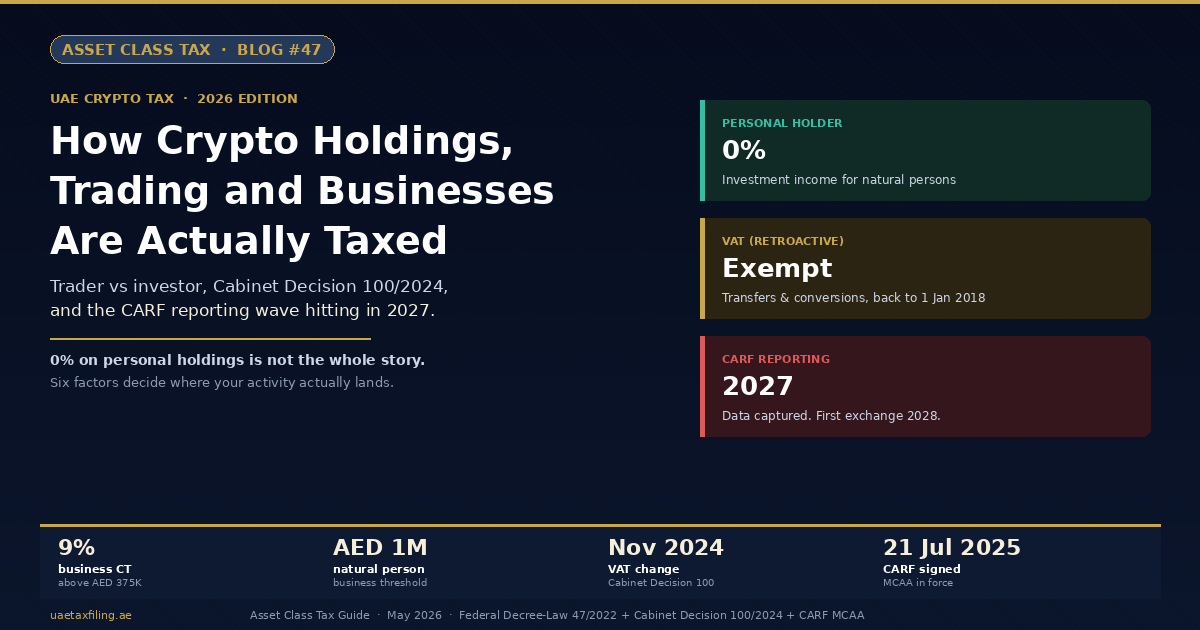
His story is the most common we see in 2026. The headline that the UAE imposes 0% personal income tax on crypto is correct, but it has been doing a lot of marketing work for a regulatory environment that has, in the last 18 months, become considerably more complex. Cabinet Decision No. 100 of 2024 amended the VAT Executive Regulations to make crypto transfers and conversions exempt from VAT, retroactively to 1 January 2018. The Federal Tax Authority confirmed the retroactive position in VATP040. Cabinet Decision No. 100 of 2024 also separately addressed cross-border crypto VAT mechanics. Ministerial Decision No. 336 of 2025 formally designated the Virtual Assets Regulatory Authority (VARA) as a competent authority for UAE corporate tax purposes in February 2026. The Dubai Financial Services Authority changed its crypto token regime on 12 January 2026. The UAE signed the CARF MCAA on 21 July 2025 with implementation in 2027 and first international exchanges in 2028.
This guide cuts through the marketing and gives crypto holders, traders, miners, and businesses the practitioner-grade answer they need. Where exactly the 0% sits and what kicks it into 9% corporate tax. The six-factor trader-versus-investor test that decides which side of the line you sit on. The exact VAT mechanics under the new Article 42 of the Executive Regulations. How mining, staking, NFTs, and token-denominated compensation are treated. What the CARF 2027 timeline means for your audit trail today. And the historic VAT exposure that the retroactive exemption may have created for businesses that charged VAT on crypto activity between 2018 and 2024. We cross-link our existing guides on free zone qualifying 0% rate, VAT registration, voluntary disclosure to the FTA, and every UAE tax change in 2026 for the surrounding mechanics this article relies on.
"Most crypto holders in the UAE assume zero tax means zero documentation. The 0% headline is real for genuine personal investment, but the CARF reporting starting in 2027 means every UAE-licensed exchange is going to report your trades to the FTA, and the FTA will then share that data with the jurisdiction you used to be tax-resident in. The clean-up window is now, not when the first reporting cycle lands."
Jazim, CEO, UAE Tax Filing LLC
The personal vs business split that decides 0% vs 9%
Crypto tax in the UAE for natural persons works on a single question: is the activity a Business Activity? If yes, corporate tax can apply. If no, it falls outside the CT regime entirely, the holder pays 0% personal tax (because there is no UAE personal income tax), and capital gains are likewise untaxed at the individual level. The question is binary in theory and fuzzy in application. Article 11(6) of Federal Decree-Law No. 47 of 2022 makes natural persons taxable on business income only above AED 1 million in turnover in a Gregorian calendar year. Below the threshold, no registration is required and no CT is due. Above the threshold, the natural person registers as a Taxable Person under Cabinet Decision No. 49 of 2023, pays 0% on the first AED 375,000 of taxable income, and 9% above.
But the threshold only matters if the activity is a business in the first place. Ministerial Decision No. 49 of 2023 on the Specification of the Categories of Businesses or Business Activities Conducted by a Resident or Non-Resident Natural Person specifically carves out wage income, real estate investment income (without licence), and personal investment income from the definition of Business or Business Activity. Personal investment income is defined as investment activity that is not conducted through a licence and is not a commercial business. The trick is that nobody, including the FTA, has defined the line between personal investment trading and commercial trading with a single bright-line test. So we work from factors.
The six-factor trader vs investor test (the framework no one publishes)
Across jurisdictions where similar rules exist (the UK, Australia, Canada, Germany), the courts and tax authorities have built up a body of case law that turns on factors rather than thresholds. The FTA has not yet published equivalent guidance on crypto specifically, but our experience in early audits suggests the FTA reaches for the same factors that other authorities use. We use six in our defence files. If three or more of these factors lean to commercial activity, treat the activity as a Business Activity, register if turnover exceeds AED 1 million, and pay 9% on profits above AED 375,000.
Factor 1. Frequency and volume
How many trades per month? What is the total turnover? A holder who buys Bitcoin twice a year and sells once is clearly investing. A holder who executes 12-15 trades a day across three exchanges is plainly trading. The middle ground (one to two trades a month, varied positions, moderate turnover) is investment territory. AED 4 million in annual crypto turnover would be high for an investor, normal for a trader. AED 200,000 in annual turnover is investor territory regardless of how many transactions.
Factor 2. Holding period
Average days held. Holding periods of less than 30 days suggest trading intent. Holding periods of more than 12 months suggest investment intent. Mixed patterns require a weighted average. The FTA has not specified a threshold, but the OECD's CARF rules and the Foreign Earned Income Exclusion guidance in adjacent jurisdictions use roughly the same heuristic.
Factor 3. Capital source
Own funds, or leveraged or borrowed? A holder using their own savings to take long-term positions looks like an investor. A trader using margin, futures, perpetuals, or borrowed capital looks like a commercial trader because the activity is intentionally engineered for short-term return. Use of derivatives is the single strongest signal of trading intent. Yield farming on borrowed capital is similarly difficult to defend as personal investment.
Factor 4. Use of professional infrastructure
Dedicated trading software, multiple exchange API connections, bots, algorithmic strategies, OTC desk access, dedicated trading screens or terminals, paid market data subscriptions. None of these are conclusive on their own. The aggregate use of professional infrastructure that goes beyond what a passive holder would set up signals commercial intent. The presence of a single hardware wallet does not. The presence of three exchange API keys plus a TradingView Pro subscription plus a bot running on a VPS does.
Factor 5. Commercial intent indicators
Public marketing of trading services, soliciting clients, fee structures, business name use, any social media presence as a trader, signal services, paid copy-trading. Any of these alone is enough to tip activity into Business Activity. A holder running a Telegram group selling "alpha" cannot reasonably claim the underlying trading is personal investment.
Factor 6. Accounting and operational treatment
How the holder treats the activity themselves. Separate bookkeeping. Dedicated bank accounts. Audit trail. Business plan. Treatment of crypto profits as business income on their existing tax filings in their previous jurisdiction. If the holder runs the activity like a business, defends it as a business, accounts for it as a business, and then claims it is personal investment to the FTA, the position is weak.
How we use the framework in defence files:Each factor is scored on a 1 to 5 scale. 1 = clearly investment, 5 = clearly commercial. Sum the six scores. 6-15 (investment): no CT registration, 0% applies on the full holding. 16-23 (mixed): document the position carefully, monitor turnover, consider voluntary CT registration to avoid future challenge. 24-30 (commercial): treat as Business Activity, register if turnover crosses AED 1 million, file CT returns, pay 9% on profits above AED 375,000.Tariq the software developer scored 26: 4 trades a day (5), average hold 7 days (5), own funds but margin used (3), three exchange APIs and a bot (5), no public marketing (2), separate bank accounts and bookkeeping (5). Above the AED 1 million turnover threshold. Should have been registered for CT from 2024. The unwind in 2026 involved voluntary disclosure under Article 10 of the Tax Procedures Law plus retrospective CT registration.
The VAT story: Cabinet Decision 100 of 2024 and the retroactive exemption
Until late 2024, VAT treatment of crypto in the UAE was unclear. The FTA had not specified whether a crypto-for-crypto trade was a barter transaction subject to VAT on both legs, whether fiat-to-crypto conversion was a financial service, or whether crypto held as inventory by a business attracted VAT on sale. Cabinet Decision No. 100 of 2024, issued 6 September 2024 and effective 15 November 2024, settled the position by amending Article 42(2) of the VAT Executive Regulations to add three new categories of financial service: (k) the transfer of ownership of Virtual Assets, including virtual currencies; (l) the conversion of Virtual Assets; and (m) keeping and managing Virtual Assets and enabling control thereof.
The first two categories (k and l) are exempt from VAT retroactively to 1 January 2018. The Federal Tax Authority confirmed the retroactive position in Public Clarification VATP040, noting that any historic VAT charged on crypto transfers and conversions is now recoverable through the voluntary disclosure mechanism. The third category (m), custody and management of crypto, is exempt only from 15 November 2024 forward. Critically, where the custody or management service is provided for an explicit fee, commission, discount, rebate, or similar consideration, the exemption may not apply and the standard 5% VAT rate may attach to the fee component.
The historic VAT exposure problem. Many UAE crypto businesses (exchanges, brokers, OTC desks) charged VAT on crypto-related services between 2018 and 2024 because the law was unclear. After Cabinet Decision 100 of 2024 and VATP040 confirmed retroactive exemption, those businesses are sitting on incorrect historic VAT positions in either direction. They may have over-charged customers VAT on exempt supplies (creating refund obligations or output tax to be reversed) or under-recovered input tax on the basis that the underlying supply was exempt (when the conversion services were actually within scope). Both positions need to be unwound through voluntary disclosure. The five-year recovery window under the new credit-expiration rule, set out in our VAT credit expiration guide, makes this urgent for any business with historic crypto activity.
For a personal holder making personal trades, the VAT side is almost always irrelevant. Personal investment activity does not attract VAT because there is no taxable supply being made by the individual. The issue is for businesses that touch crypto in their commercial operations. A consultancy receiving crypto as a fee payment is making a supply of consultancy services (5% VAT applies to the consultancy fee, expressed in AED equivalent), not a supply of crypto. A crypto exchange operating in the UAE is supplying financial services that are now exempt under Article 42(2)(k) and (l), but its commission income on those services and its custody fees may still be partly within scope under (m). The detail is in our VAT registration guide, which covers when a crypto-touching business needs to register.
Sitting on a historic VAT-on-crypto position you need to unwind?We unwind incorrect historic VAT positions on crypto transfers, conversions, and custody fees through voluntary disclosure to the FTA. The retroactive exemption back to 1 January 2018 means most positions can be corrected, but the five-year recovery window is closing. WhatsApp UAE Tax Filing on +971 58 562 2437.
Corporate tax for crypto businesses: exchanges, brokers, OTC desks, miners
Once an entity holds itself out as a crypto business, the CT rules apply in the same way they apply to any other business. The 9% rate above AED 375,000. Audited financial statements if revenue exceeds AED 50 million (or under Ministerial Decision 84 of 2025, AED 50 million in any preceding tax period). Transfer pricing under Article 34 on related-party transactions. Tax group eligibility under Article 40 with 95% common ownership. What changes is the substance test if the business is in a free zone, and the regulatory layer that sits on top of the tax position.
The regulatory map
There are four crypto regulators in the UAE in 2026, and their licensing decisions affect tax classifications. The Virtual Assets Regulatory Authority (VARA) regulates virtual asset activities in Dubai outside the DIFC under Dubai Law No. 4 of 2022. Ministerial Decision No. 336 of 2025, announced in February 2026, formally designated VARA as a competent authority for UAE corporate tax purposes, recognising its regulatory role alongside the CMA, CBUAE, DFSA, and FSRA within the federal framework. The Financial Services Regulatory Authority (FSRA) in ADGM regulates virtual asset activities in Abu Dhabi. The Dubai Financial Services Authority (DFSA) regulates virtual asset activities in the DIFC, with a token suitability regime that changed on 12 January 2026 to move responsibility from a published list of Recognised Crypto Tokens to firm-level due diligence. The Capital Markets Authority (CMA, federal) regulates broader securities activity that may extend to certain token offerings.
Free zone qualifying income for crypto businesses
A crypto business in a UAE free zone can qualify for the 0% CT rate on qualifying income, provided it meets the five QFZP conditions under Article 18 of the CT Law: adequate substance, qualifying income, no election to be taxed at 9%, audited financial statements, and transfer pricing compliance. The catch for crypto businesses is in the qualifying income test. Under Cabinet Decision No. 55 of 2023 and Ministerial Decision No. 139 of 2023, transactions with natural persons are an Excluded Activity. A retail crypto exchange serving individual customers from a free zone is largely generating Excluded Activity revenue, which counts against the de minimis threshold (the lower of 5% of total revenue or AED 5 million). Cross the threshold and the QFZP status is lost for the current year and the next four tax years. We cover the full mechanic in our free zone vs mainland article and the free zone 0% qualification guide. The practical result is that most retail-facing crypto businesses are taxed at 9% on most of their revenue, with potentially favourable treatment only on B2B and institutional flows that meet the qualifying activity definitions.
Mining
Commercial crypto mining is unambiguously a business activity. The fair market value of mining rewards on the date they are received is included in business revenue at the AED equivalent. The cost basis of the mined coins is that same AED value, so any subsequent appreciation or depreciation on sale produces a separate trading gain or loss. Hardware depreciation is deductible under IAS 16 (typically 3 to 5 year useful life for ASIC miners). Electricity costs are deductible. The 9% rate applies on profits above AED 375,000. Mining for an individual on a hobby scale (a single rig in a home office, modest hash rate, no commercial intent) is closer to investment activity, but the moment it becomes operationally serious (warehouse space, dedicated supply, scale), it crosses into Business Activity.
Staking, yield, and DeFi
Passive staking rewards on a holder's own coins through a non-custodial wallet or through an exchange's standard staking product are treated as investment yield. For a natural person below the AED 1 million turnover threshold, no CT applies. For a business, staking yield is recognised as ordinary income at the AED fair value on the date the reward becomes available. Active validator operation (running infrastructure, providing services to delegators) is closer to commercial activity. DeFi yield farming, liquidity provision, and impermanent loss are complex. The FTA has not published specific guidance, so practitioners default to recognising rewards at fair value as received and adjusting cost basis on subsequent dispositions, with impermanent loss recognised on actual realisation rather than on a mark-to-market basis.
NFTs, token compensation, and the edge cases that catch businesses out
NFTs
Non-fungible tokens fall within the definition of Virtual Assets under Article 1 of the amended VAT Executive Regulations as digital representations of value that can be traded or transferred digitally. The VAT exemption under Article 42(2)(k) and (l) therefore extends to NFT transfers and conversions. For corporate tax, an NFT creator selling their own work is in Business Activity if the activity is commercial in nature (regular sales, marketing, fee structures) and within the carve-out for personal investment if it is genuinely one-off creative output. An NFT marketplace operator is plainly running a business, subject to 9% above AED 375,000. NFT trading by a natural person is analysed under the same six-factor framework as fungible crypto trading.
Crypto received as payment for services
A consultancy that accepts ETH for a consultancy fee has not made a crypto supply. It has made a consultancy supply, and the consideration happens to be in ETH. The AED equivalent of the ETH on the date of receipt is the revenue figure. VAT at 5% applies to that AED equivalent if the consultancy is VAT-registered. Subsequent appreciation or depreciation of the ETH between receipt and disposal is a separate trading gain or loss, taxable under CT for businesses, not taxable for natural persons within the personal investment carve-out. Many crypto-receiving businesses get this wrong by ignoring the receipt-date fair value and only recording revenue when the ETH is converted to AED, which understates revenue if ETH appreciates between receipt and conversion.
Token-denominated employment compensation
An employee in a UAE crypto firm receiving part of their compensation in the firm's native token, or in BTC, ETH, or other crypto, is receiving employment income. Employment income is not taxable to the employee in the UAE (no personal income tax). But for the employer, the AED fair value of the token compensation on the vesting or grant date is deductible as employment cost under the same IFRS 2 share-based payment mechanics that apply to RSU compensation in conventional firms. The Connected Persons rules under Article 36 and the related-party compensation tests apply if the recipient is a shareholder. This is the same trap that catches UAE professional services firms paying owner-shareholders without proper salary structuring, which we cover in our UAE corporate tax for consultancies, law firms and agencies guide.
Airdrops, forks, and free tokens
An airdrop received by a natural person on personal holdings has no immediate CT consequence (no Business Activity, no taxable event). The cost basis of the airdropped token is zero, so the entire AED value on disposal is the gain (untaxed for personal investors, taxed at 9% above AED 375,000 for businesses). For a business receiving airdrops (which happens to crypto firms and to businesses that hold large positions in protocols), the AED fair value on the date the airdrop becomes available is ordinary income recognised in the books, taxable at 9% above AED 375,000. Hard forks follow the same logic: the new token is recognised at fair value on date of receipt for businesses, ignored for natural persons within the investment carve-out.
CARF: the reporting framework that changes everything from 2027
On 21 July 2025, the UAE Ministry of Finance signed the Multilateral Competent Authority Agreement (MCAA) for the OECD's Crypto-Asset Reporting Framework (CARF), committing the UAE to commence automatic exchanges of information under CARF by 2028 in respect of calendar year 2027 transactions. Blockworks confirmed the implementation timeline shortly after. The UAE is in the 2028-exchange group alongside Hong Kong, Singapore, the Bahamas, the US, Türkiye, and a handful of other major financial centres, behind a 2027-exchange group that includes most of the EU, the UK, Switzerland, the Cayman Islands, and other CARF early adopters.
What CARF does: Reporting Crypto-Asset Service Providers (RCASPs), which is the OECD's name for entities such as exchanges, brokers, custodians, wallet providers, and certain payment processors that handle crypto transactions on behalf of users, must collect tax residency self-certifications from their users, identify transactions in Relevant Crypto-Assets (a defined term that excludes central bank digital currencies and certain specified electronic money products), and report those transactions to the local tax authority of the RCASP. The local tax authority then exchanges that data automatically with the tax authorities of the user's home jurisdiction. OECD guidance confirms that domestic legislative frameworks should be in effect from the start of 2027 in the UAE, with reporting on 2027 calendar year transactions and first international exchanges in 2028.
What CARF reporting will include:User identity: name, date of birth, address, tax identification number, and (for entities) controlling person details.Tax residence: every jurisdiction in which the user is or has been tax-resident during the reporting period.Transaction data: each Exchange Transaction (crypto-to-fiat, fiat-to-crypto, crypto-to-crypto), each Reportable Retail Payment Transaction above USD 50,000, and aggregate transfer data including whether the destination is a self-hosted wallet or an external account.Year-end balances: holdings as at the end of the reporting period.The reporting volume and granularity goes meaningfully beyond what CRS captures for traditional financial accounts.
What this means in practice for a UAE crypto holder: from 1 January 2027, every UAE-licensed exchange you use will be collecting your tax residency information, your transaction history, and your year-end balances. The FTA will receive that data domestically. Where your tax residency self-certification names a foreign jurisdiction, the FTA will then exchange that data with the foreign tax authority automatically in 2028, covering 2027 transactions. Where your tax residency self-certification names only the UAE, the FTA holds the data domestically but can still use it in audits, voluntary disclosure assessments, and cross-border information exchange requests under the existing 137-DTA treaty network and the Multilateral Convention on Mutual Administrative Assistance in Tax Matters.
Two windows close in 2027. First, the documentation window. Any position you take in 2026 (claim personal investor status, claim free zone qualifying income, claim historic VAT exemption under Cabinet Decision 100 of 2024) needs to be documented with a defence file before CARF data starts flowing. The FTA will be cross-referencing CARF data with CT filings and VAT positions from 2027 forward. Second, the home-jurisdiction window. If you broke tax residency in a higher-tax jurisdiction before moving to the UAE, the CARF data flow gives that jurisdiction a basis to look back at the year you left. Anyone with an unclean break needs to address it on the home-jurisdiction side in 2026, not 2027.
The worked example: a UAE crypto trader at AED 6.8 million turnover
We modelled Tariq's actual position. UAE-resident on a free zone software consultancy licence since 2023. Calendar year 2025: AED 6,800,000 in crypto turnover across three exchanges, AED 740,000 in net trading profit, AED 320,000 in software consultancy revenue (his original business). Three scenarios on the unwind.
Scenario A: claim personal investor status, file nothing
Position: argue that all crypto activity is personal investment under the Ministerial Decision 49 of 2023 carve-out, no Business Activity, no CT registration needed. The six-factor test scored 26 out of 30 (commercial). Defending personal investor at audit would require ignoring four of the six factors. Risk: 9% CT on AED 365,000 of taxable trading profit (AED 740K trading + AED 320K consultancy = AED 1.06M, less AED 375K threshold = AED 685K, at 9% = AED 61,650 CT). Plus AED 10,000 late registration penalty under Cabinet Decision 75 of 2023. Plus AED 1,000 per month late filing penalty up to AED 10,000. Plus 14% per annum late payment penalty on the CT due (under the new 2026 regime). Total exposure if challenged: roughly AED 90,000 plus interest. Probability of FTA challenge once CARF data flows in 2028: very high.
Scenario B: voluntary disclosure for 2024 and 2025, retrospective CT registration, going forward as Business Activity
Position: file voluntary disclosure under Article 10 of the Tax Procedures Law for 2024 and 2025. Pay CT on the combined trading and consultancy profits. Pay voluntary disclosure penalty at 1% per month on the tax shortfall under the post-April 2026 regime, which is meaningfully lower than the 5% to 40% legacy regime. Register retrospectively. Going forward, file CT annually, treat trading as Business Activity, claim deductible costs (exchange fees, software subscriptions, allocated office space, network costs). The voluntary disclosure penalty on roughly AED 122,000 of historic CT (covering both 2024 and 2025) comes to AED 14,640 plus the underlying CT. Total: roughly AED 136,640. Cleaner audit position. CARF data flow in 2027/2028 finds a registered, compliant taxpayer.
Scenario C: restructure into an LLC, treat trading as the business, claim QFZP where applicable
Position: incorporate a UAE LLC for the crypto trading business. Capitalise with trading capital. Continue software consultancy as a separate licence. The LLC is a juridical person paying CT at 9% above AED 375,000 on its own taxable profit. Tariq draws a market-rate salary as managing director (deductible against LLC CT under Article 28 and the related-party benchmarking rules). Free zone qualifying income is unavailable because retail crypto trading is not a Qualifying Activity. Net result: similar to Scenario B on the going-forward tax, plus AED 12,000 to AED 25,000 in setup and annual licensing costs for the LLC, but a clean Business Activity structure with deductible operating costs and a clearer audit narrative. Where the trading volume justifies the structure, this is usually the right answer above AED 5 million in annual turnover. The LLC vs sole-trader decision is documented in our UAE corporate tax for consultancies guide, which applies equally to crypto businesses.
Decision matrix for UAE crypto holders in 2026:Under AED 1M annual turnover and six-factor score 6 to 15: personal investor, no registration needed.Under AED 1M turnover but six-factor score 16 to 23: document carefully, monitor, retain defence file.Above AED 1M turnover or six-factor score 24+: Business Activity, register, file CT, pay 9% above AED 375K.Above AED 5M annual turnover: consider LLC structure for cleaner audit position and deductible operating costs.Above AED 50M revenue (the 2025 audited-statements threshold): mandatory audited financials, transfer pricing documentation, tax group consideration.
Need to classify your UAE crypto activity correctly before CARF reporting begins?We run the six-factor trader vs investor analysis, prepare defence files for the position you want to take, file voluntary disclosure where retrospective correction is needed, and structure the going-forward entity. Most cases resolve in 4 to 8 weeks. WhatsApp UAE Tax Filing on +971 58 562 2437.
Six mistakes that turn a clean position into an audit problem
Mistake 1. Assuming 0% means no documentation
The single most common mistake. UAE-resident crypto holders assume that because they owe no personal tax, they have no record-keeping or reporting obligation. Once CARF reporting begins in 2027, every UAE-licensed exchange will hold complete transaction records and will report them to the FTA automatically. The audit trail exists whether the holder builds one or not. The defence is documentation: a contemporaneous record of position-taking (personal investor vs trader), the six-factor analysis at year-end, and any voluntary disclosures filed. Without this, the holder is defending a 2024 or 2025 position from memory in a 2028 audit.
Mistake 2. Crossing the AED 1 million natural-person threshold without registering
Once a natural person's crypto trading turnover crosses AED 1 million in a Gregorian calendar year, CT registration becomes mandatory if the activity is a Business Activity. The registration deadline is the end of the next calendar year. Late registration triggers AED 10,000 in penalties plus AED 1,000 per month late filing penalty up to the AED 10,000 cap per regime. The full schedule of CT penalties and the math that makes early correction cheaper is in our CT penalties 2026 guide.
Mistake 3. Not unwinding historic VAT positions on crypto activity 2018 to 2024
Businesses that charged VAT on crypto-related services between 1 January 2018 and 14 November 2024 are now sitting on positions that should be exempt under Cabinet Decision 100 of 2024 with retroactive effect. The unwind requires voluntary disclosure for each affected period, refund mechanics to the customer where the VAT was passed on, and adjustment of input tax recovery on related expenses. The five-year recovery window starts running from the relevant tax period end, meaning the earliest affected periods (2018 to 2020) are now at the edge of the recovery window. Our voluntary disclosure guide covers the mechanics.
Mistake 4. Treating staking and yield income as untaxed inside a business
A natural person below the AED 1 million turnover threshold pays no CT on personal staking yield because the activity is personal investment. A business holding crypto on its balance sheet (whether a crypto firm or a non-crypto firm with treasury crypto exposure) recognises staking yield as ordinary income at fair value on the date received. Treating it as untaxed because crypto is generally 0% on personal holdings is wrong in the business context and will be flagged on audit once CARF data flow allows the FTA to reconcile reported balances against staking provider data.
Mistake 5. Free zone crypto businesses claiming QFZP on retail revenue
Retail crypto exchanges operating from a UAE free zone routinely claim QFZP status and apply 0% to their full revenue. The Excluded Activity rule under Ministerial Decision 139 of 2023 means transactions with natural persons are non-qualifying, and most retail exchange revenue is from natural persons. A single year breach of the de minimis threshold loses QFZP status for the current year and the next four tax periods. We have seen exchanges lose AED 690,000 a year in additional CT for five years because a single year's classification was wrong. The fix is structural: separate the B2B flows from the B2C flows into different entities, or accept 9% on the retail business and use the qualifying treatment only for genuinely qualifying activities.
Mistake 6. Self-certifying UAE tax residency without meeting the test
From 2027, RCASPs will collect tax residency self-certifications from every user. Self-certifying UAE-only tax residency requires actually meeting the UAE tax residency test under Cabinet Decision No. 85 of 2022 and Ministerial Decision No. 27 of 2023 (the 183-day rule, the 90-day-plus-ties rule, or the Centre of Vital Interests test). A holder who claims UAE-only residency on a CARF form but is actually still tax-resident in a previous jurisdiction is exposing themselves to a misrepresentation finding. Our UAE Tax Residency Certificate guide covers the actual residency tests and the documentation needed to defend a UAE-only position.
Frequently asked questions
Do UAE residents pay tax on personal crypto holdings?
No, provided the activity is genuinely personal investment and not a Business Activity. Personal investment income is carved out of the Corporate Tax regime by Ministerial Decision 49 of 2023. The UAE has no personal income tax. Personal crypto holdings, trading, and staking by a natural person who is not running a business are taxed at 0%. The question is whether the activity is personal investment or Business Activity, which is decided by frequency, volume, holding period, capital source, professional infrastructure, commercial intent, and accounting treatment.
When does crypto trading become a Business Activity under UAE law?
There is no single bright-line test. The Federal Tax Authority has not published specific guidance on crypto trading classification, so practitioners use a six-factor framework: frequency and volume of trading, average holding period, capital source (own funds vs leveraged), use of professional infrastructure, commercial intent indicators, and accounting and operational treatment. Three or more factors leaning to commercial activity typically means the activity should be treated as a Business Activity for CT purposes. Above AED 1 million in turnover in a Gregorian calendar year, registration becomes mandatory if the activity is a business.
Is VAT charged on crypto transfers and conversions in the UAE?
No. Cabinet Decision No. 100 of 2024 amended Article 42 of the VAT Executive Regulations to make the transfer of virtual asset ownership and the conversion of virtual assets VAT-exempt, retroactively to 1 January 2018. The Federal Tax Authority confirmed the retroactive position in Public Clarification VATP040. Custody and management of virtual assets are exempt from 15 November 2024 forward, though custody fees charged as explicit consideration may still attract 5% VAT in some cases.
How does the UAE corporate tax apply to crypto businesses?
Crypto businesses (exchanges, brokers, OTC desks, mining operations, custodians, marketplaces) are subject to the standard 9% CT rate above AED 375,000 of taxable income. Free zone qualifying income at 0% is available in principle, but most retail-facing crypto activity is an Excluded Activity (transactions with natural persons), which limits QFZP eligibility. Audited financial statements are mandatory above AED 50 million in revenue, transfer pricing applies to related-party flows, and the tax group election is available for groups with 95% common ownership.
What is CARF and when does it affect UAE crypto holders?
The Crypto-Asset Reporting Framework (CARF) is the OECD's global standard for automatic exchange of crypto-asset transaction information between tax authorities. The UAE signed the Multilateral Competent Authority Agreement for CARF on 21 July 2025, committing to commence automatic exchanges in 2028 covering 2027 calendar year transactions. From 1 January 2027, every UAE-licensed Reporting Crypto-Asset Service Provider (exchanges, brokers, custodians, wallet providers) will collect tax residency self-certifications and transaction data on every user, report that data to the FTA, and the FTA will exchange it internationally in 2028.
Is mining crypto in the UAE taxable?
Commercial mining is a Business Activity. Mining rewards are recognised as ordinary income at the AED fair value on the date received. The 9% CT rate applies above AED 375,000 of taxable income. Hardware depreciation under IAS 16 (typically 3 to 5 year useful life for ASIC miners), electricity, network, and operational costs are deductible. Hobby-scale mining by an individual that does not meet the Business Activity threshold falls into the personal investment carve-out and is untaxed.
How are NFTs taxed in the UAE?
NFTs fall within the definition of Virtual Assets under the amended VAT Executive Regulations, so NFT transfers and conversions are VAT-exempt under Article 42(2)(k) and (l). For corporate tax, an NFT creator running a commercial creative practice is in Business Activity (9% above AED 375,000). An NFT marketplace operator is plainly a business. NFT trading by a natural person is analysed under the same six-factor framework as fungible crypto trading: occasional NFT purchases as collectibles are personal investment, regular trading and minting is Business Activity.
What happens if I receive crypto as payment for services in the UAE?
The crypto consideration is treated as the AED equivalent value on the date received. For a UAE business, this AED value is revenue for CT purposes, subject to 5% VAT if the underlying service is taxable. Subsequent appreciation or depreciation of the received crypto between receipt and disposal is a separate trading gain or loss, taxable for businesses at 9% above AED 375,000 and untaxed for natural persons within the personal investment carve-out. The cost basis of the received crypto is the AED fair value on receipt date.
Will the FTA see my crypto trades on foreign exchanges?
From 2027 onwards, in most cases yes. The UAE has signed the CARF MCAA, which establishes automatic exchange relationships with other jurisdictions that have signed the same MCAA. Where you trade on a foreign exchange in a CARF-signatory jurisdiction (the EU, UK, Switzerland, the Cayman Islands, Singapore, Hong Kong, the US under its parallel framework, and most major financial centres), the foreign exchange will collect your UAE tax residency self-certification, report your transactions to its local authority, and that authority will exchange the data with the FTA. The reverse also applies for UAE-licensed exchanges reporting on foreign-resident users.
Do I need to register a UAE crypto business with VARA or just with the FTA?
Both. VARA (in Dubai outside DIFC), FSRA (in ADGM), DFSA (in DIFC), or the CMA (federally for certain securities-like activities) regulates the operational and licensing side of any crypto business. The FTA handles the tax side: CT registration, VAT registration where applicable, and from 2027, CARF reporting compliance. Ministerial Decision No. 336 of 2025 designated VARA as a competent authority for UAE corporate tax purposes, which formalises the regulatory-tax interface but does not change the dual-registration requirement.
The 2026 cleanup window before CARF arrives
The UAE's crypto tax position in 2026 is more favourable than almost any other major financial centre, but it is no longer the documentation-free zero-tax environment it was perceived to be three years ago. Personal investment is genuinely 0%. Business Activity at 9% above AED 375,000. VAT on transfers and conversions is exempt back to 2018. Mining, staking yield, NFTs, and token compensation all have clear treatment now. The trader-versus-investor line is fuzzy but defensible if you document the position using the six-factor framework before CARF data starts flowing. The historic VAT exposure on crypto positions between 2018 and 2024 is fixable through voluntary disclosure if started before the five-year recovery window closes on each period.
What changes everything is CARF. From 1 January 2027, every UAE-licensed exchange is collecting full transaction data and tax residency self-certifications. The FTA receives it domestically. In 2028, the first international exchanges begin. Holders, traders, and businesses that have not classified their activity correctly, registered where required, and built a contemporaneous defence file have until the end of 2026 to do so cleanly. After that, the audit trail exists, and any inconsistency between the CARF data and the CT or VAT filings is visible to the FTA on a structured, ongoing basis.
If you hold, trade, mine, or run a business that touches crypto in the UAE, the time to get the position right is 2026. The mechanics are not complicated. The six-factor analysis takes a half-day. The voluntary disclosure, if one is needed, takes two to four weeks. The going-forward registration and entity structure is a four-to-eight-week project. For the technical detail on adjacent mechanics, see our guides on VAT registration, UAE corporate tax deadlines 2026, what you can deduct (and what gets you audited), FTA audits in 2026, IFRS for corporate tax, withholding tax on cross-border payments, and year-end tax planning. For the wider 2026 regulatory picture, see every UAE tax change coming in 2026. Service-specific work is available through our corporate tax services, VAT services, and accounting services pages.
Get your UAE crypto tax position right before CARF reporting begins.We classify the activity (personal investor vs Business Activity), file voluntary disclosure where retrospective correction is needed, register the entity, structure the going-forward operation, and prepare the CARF self-certification documentation. Most cases close inside 8 weeks. WhatsApp UAE Tax Filing on +971 58 562 2437.