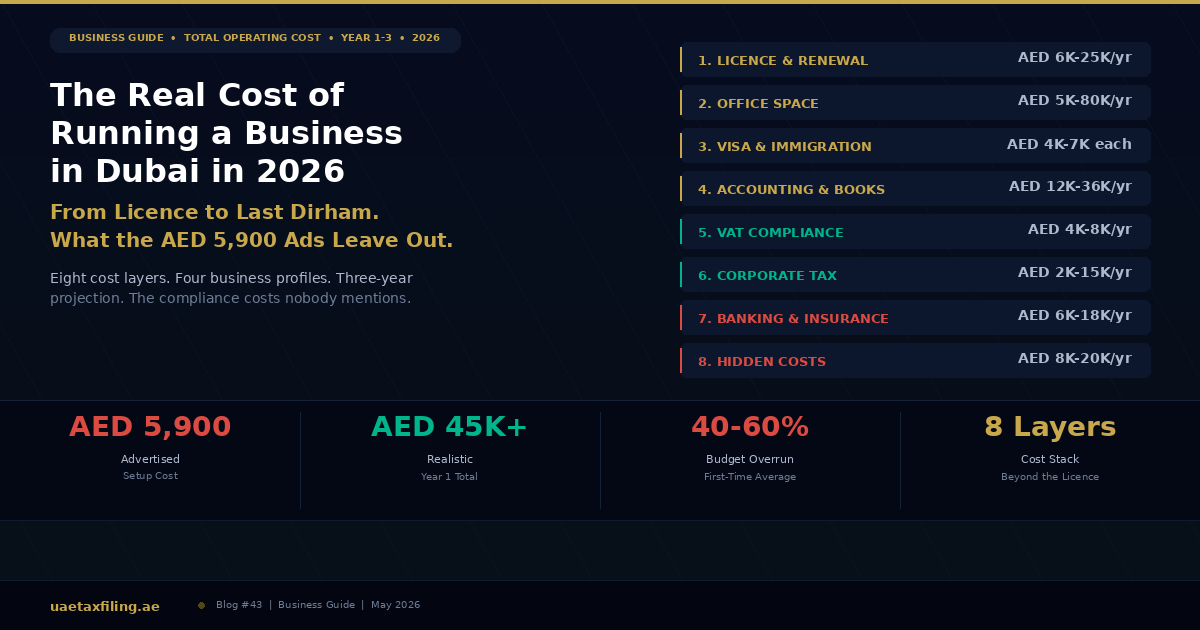
You have seen the ads. 'Start your Dubai business from AED 5,900.' It is on Instagram. It is on Google. It is on the billboard you pass on Sheikh Zayed Road every morning. And it is technically true in the same way that a flight is AED 199: the base fare exists, but by the time you add the bags, the seat, the meals, the insurance, and the airport transfer, the number on your credit card statement is five times the headline.
The AED 5,900 is real. It buys you a freelancer permit in a budget free zone. No visa. No office. No bank account. No accounting. No VAT registration. No corporate tax registration. No health insurance. No Emirates ID. It buys a piece of paper that says you have a licence. It does not buy you a functioning business. As Audit Firms Dubai's cost analysis documented, the realistic first-year budget, including all the items that the headline figure excludes, is AED 30,000 to AED 120,000 depending on structure and location. Budget overruns of 40-60% are the average for first-time entrepreneurs who planned around the headline number.
This article is not about setup. Every company formation firm publishes setup costs. This article is about what it costs to run a business in Dubai, month after month, year after year, across all eight cost layers that determine whether your business survives or runs out of cash. Setup is Day 1. Running is the other 364 days. And the running costs are where most businesses get blindsided, because nobody tells you about them until the invoices arrive.
"Every week, a new client walks in holding a free zone licence they got for AED 12,000. They think they are done. Then I explain that they need CT registration, VAT registration once they cross AED 375,000, quarterly VAT returns, annual CT filing, monthly bookkeeping, health insurance for every visa holder, and a bank account that actually works. The licence was 15% of their first-year cost. The other 85% is what nobody told them about."
Jazim, CEO, UAE Tax Filing LLC
The Eight Cost Layers Nobody Shows You in One Place
Every competitor article covers layers one through three (licence, office, visa) because those are the services they sell. Layers four through eight (accounting, VAT, corporate tax, banking, hidden costs) are where the money quietly disappears, and those are the layers that determine whether your Year 1 cash flow projection is realistic or fictional.
Layer 1: Trade Licence and Annual Renewal
Free zone: AED 5,900 to AED 25,000 per year. The range depends on the free zone authority, the business activity, and the package tier. IFZA and Meydan offer entry-level permits from AED 5,900. DMCC starts around AED 9,000 for registration plus AED 20,000+ for a standard licence. JAFZA and DAFZA fall in the AED 15,000 to AED 25,000 range for trading licences. As DBS's 2026 cost guide confirmed, the minimum realistic free zone cost including licence and basic administration is AED 12,000 to AED 15,000 for a single-person operation.
Mainland: AED 10,000 to AED 25,000 per year. Issued by the Department of Economic Development. Professional licences are cheaper (AED 10,000 to AED 15,000). Commercial and trading licences are more expensive (AED 15,000 to AED 25,000). Industrial licences are the highest. The mainland licence must be renewed annually, and the renewal fee is typically equal to or slightly less than the initial fee. As Daftime's guide confirmed, failure to renew on time results in penalties and potential licence suspension.
The annual renewal is not optional. Your licence expires every year. If you do not renew, your visas become invalid, your bank account gets frozen, and your business is operating illegally. The renewal cost is a permanent annual expense for as long as the business exists. It is not a one-time setup cost.
Layer 2: Office Space
Flexi-desk (free zone): AED 3,000 to AED 15,000 per year. A registered address with minimal physical space. You get a business address for correspondence, limited meeting room access (usually 2 to 4 hours per month), and mail handling. You do not get a private office, a dedicated desk, or significant visa allocation. Most flexi-desks allow 1 to 3 visas. Suitable for solo operators who work from home or client sites.
Serviced office: AED 25,000 to AED 80,000 per year. A furnished, ready-to-use private office with reception, internet, and higher visa allocation. The cost depends on location (DIFC and Downtown are premium, KIZAD and Ajman are budget), size (one-person pod vs four-person office), and the free zone or building. Serviced offices are the sweet spot for businesses with 2 to 5 staff who need client-facing space.
Traditional lease (mainland): AED 30,000 to AED 200,000+ per year. Shell-and-core or fitted offices leased directly from landlords. Mainland businesses require an Ejari-registered tenancy contract. The lease cost depends entirely on the location and size. A 200-square-foot office in Business Bay costs AED 30,000 to AED 50,000. The same size in DIFC costs AED 80,000 to AED 150,000. Visa allocation on the mainland is based on office size: one visa per 80 square feet.
Layer 3: Visa and Immigration
Investor/partner visa: AED 4,000 to AED 7,000 per person. Covers the visa application, medical screening, Emirates ID, and stamping. Each visa holder also requires mandatory health insurance (AED 2,000 to AED 8,000 per year depending on the plan and the emirate). A single investor visa with health insurance costs approximately AED 6,000 to AED 15,000 in Year 1.
Employee visas: AED 3,500 to AED 6,000 per person. Same components as investor visas but often processed in batches. Each employee adds visa cost plus health insurance plus the salary itself. Five employees at AED 5,000 per visa plus AED 3,000 per health insurance = AED 40,000 in visa and insurance costs before anyone starts working.
Renewal every 2 to 3 years. Visas are not permanent. They renew every 2 years (employment and investor visas) or every 5 to 10 years (Golden Visa). Each renewal carries a cost similar to the initial application. Budget for visa renewals as a recurring expense, not a one-time cost.
Licence, office, and visa are the visible costs that every setup firm covers. Layers 4 through 8 are the compliance and operational costs that most new businesses do not budget for. Our accounting team helps new businesses build realistic Year 1 budgets that include every layer. Message us on WhatsApp.
Layer 4: Accounting and Bookkeeping
Monthly bookkeeping: AED 1,000 to AED 3,000 per month (AED 12,000 to AED 36,000 per year). Every business needs someone recording transactions, reconciling bank statements, maintaining the chart of accounts, and producing monthly financial reports. You can do this yourself using accounting software (AED 1,300 to AED 7,200 per year for the software subscription), but most business owners lack the time or the IFRS knowledge to do it accurately. As Meydan's operating cost guide confirmed, most founders spend around AED 1,000 to AED 1,500 per month on bookkeeping. Our outsourced accounting guide covers the full range of what monthly bookkeeping should include.
IFRS financial statements: AED 3,000 to AED 15,000 per year. The CT return requires IFRS-compliant financial statements. For mainland businesses below AED 50 million revenue, these do not need to be audited. For QFZPs, they must be audited every year regardless of revenue. The audit alone costs AED 15,000 to AED 40,000 for free zone companies. This is the cost that catches every small free zone business off guard. As our free zone vs mainland comparison showed, the mandatory audit can exceed the CT saving for businesses with profit below AED 540,000.
Layer 5: VAT Compliance
When it kicks in: VAT registration is mandatory when taxable supplies exceed AED 375,000 over the previous 12 months. Voluntary registration is available at AED 187,500. Our VAT registration guide covers the thresholds and the step-by-step EmaraTax process. Many businesses cross the threshold within 6 to 12 months of launching.
Ongoing cost: AED 4,000 to AED 8,000 per year. Four quarterly VAT returns at AED 1,000 to AED 2,000 per return if outsourced to an accountant. The returns report output VAT (collected from customers) and input VAT (paid on business expenses). Missing a filing deadline triggers an AED 1,000 penalty for the first offense and AED 2,000 for each repeat within 24 months. For e-commerce sellers with marketplace reconciliation complexity, the quarterly cost can be higher.
Layer 6: Corporate Tax
Registration: mandatory for all juridical persons regardless of revenue. Our CT registration guide covers the process. Late registration costs AED 10,000 per entity. This penalty catches thousands of businesses that did not know CT registration was separate from VAT registration and separate from the trade licence.
Annual CT return filing: AED 2,000 to AED 15,000 depending on complexity. Every registered entity must file an annual CT return on EmaraTax, even if the CT payable is zero. For startups with revenue under AED 3 million, Small Business Relief can reduce the CT liability to AED 0, but the filing obligation remains. Late filing carries AED 500 for the first offense and AED 1,000 for each subsequent period, plus 14% annual interest on any unpaid tax. Our penalties guide covers every scenario. Our how to choose a tax firm guide helps you find an advisor who does not skip the critical steps.
The actual CT cost for most SMEs: 0% to 4% of revenue. Our real cost of CT article showed that the effective tax rate for most small businesses is far lower than the 9% headline. A business with AED 1 million in revenue and AED 600,000 in profit pays AED 20,250 in CT ((AED 600K minus AED 375K) x 9%). That is 2% of revenue. Add the filing cost (AED 3,000 to AED 5,000), and the total CT compliance cost is AED 23,250 to AED 25,250 per year. Not nothing, but not the catastrophe that the '9% tax' headlines suggest.
Layer 7: Banking and Insurance
Corporate bank account: AED 0 to AED 5,000 setup, plus AED 1,000 to AED 6,000 per year in fees. Opening a UAE corporate bank account is not guaranteed. Banks reject applications based on business activity, expected turnover, country of origin, and documentation quality. The process takes 2 to 8 weeks. Some banks require minimum balances (AED 25,000 to AED 100,000 for business accounts). Monthly maintenance fees range from AED 50 to AED 500. As SwiftHub's cost breakdown documented, bank account opening assistance from a consultant costs AED 2,000 to AED 5,000 because the process is opaque and rejection rates are high for certain nationalities and business types.
Health insurance: AED 2,000 to AED 8,000 per person per year. Mandatory for every visa holder in Dubai and Abu Dhabi. The cost depends on the plan (basic DHA-compliant plans start around AED 2,000; comprehensive plans with dental and vision reach AED 8,000+). A business with 5 employees spends AED 10,000 to AED 40,000 per year on health insurance alone. This is a legal requirement, not an optional benefit.
Layer 8: The Hidden Costs Nobody Mentions
PRO services: AED 3,000 to AED 8,000 per year. A Public Relations Officer handles government paperwork: visa processing, licence renewals, document attestation, labour card processing, and Ejari registration. Most small businesses outsource this to a PRO service company rather than hiring a full-time PRO. The cost depends on the number of transactions processed per year.
Document attestation and translation: AED 500 to AED 3,000 per occurrence. Official documents (MOA, contracts, powers of attorney) often require Arabic translation and notarization. Each attestation costs AED 150 to AED 500. Legal translations cost AED 100 to AED 200 per page. A business with international contracts may spend AED 2,000 to AED 3,000 per year on translation and attestation.
E-channel deposits and government fees: AED 2,000 to AED 5,000. Some free zones and mainland authorities require refundable e-channel deposits for immigration processing. These range from AED 3,000 to AED 5,000 per visa. The deposit is refundable when the visa is cancelled, but it ties up cash during the visa's lifetime.
WPS compliance: AED 100 to AED 500 per employee per year. The Wage Protection System requires all employee salaries to be paid through approved banking channels. The bank charges a WPS processing fee per salary transfer. Five employees at AED 100 per month adds AED 6,000 per year in banking fees that most businesses do not budget for.
We handle layers 4, 5, and 6 (accounting, VAT, and CT) as integrated services. One engagement covers monthly bookkeeping, quarterly VAT returns, annual CT filing, and all FTA compliance. The cost is predictable and included in one fixed monthly fee. Talk to us on WhatsApp.
Four Business Profiles: What It Actually Costs in Year 1
The total cost depends on the business. Here are four profiles with Year 1 costs built from the eight layers above.
Profile 1: Solo freelancer (free zone, no employees)
Licence (IFZA/Meydan): AED 12,000. Flexi-desk: AED 5,000. One investor visa + health insurance: AED 8,000. Accounting software: AED 1,500. CT registration + nil return filing: AED 2,500. PRO services: AED 3,000. Bank account setup: AED 2,000. Year 1 total: AED 34,000. The AED 5,900 ad covered AED 5,900 of this. The other AED 28,100 was not mentioned.
Profile 2: Service SME with 5 staff (mainland)
Licence (DED professional): AED 12,000. Serviced office: AED 40,000. 5 visas + health insurance: AED 40,000. Monthly bookkeeping: AED 18,000. VAT registration + 4 quarterly returns: AED 6,000. CT return filing: AED 5,000. CT payable (AED 2M revenue, AED 500K profit): AED 11,250. PRO services: AED 6,000. Banking fees: AED 4,000. Year 1 total: AED 142,250.
Profile 3: Trading company with warehouse (JAFZA)
JAFZA licence: AED 22,000. Warehouse + office: AED 80,000. 8 visas + health insurance: AED 64,000. Monthly bookkeeping: AED 30,000. VAT returns (quarterly): AED 8,000. QFZP audit: AED 25,000. CT return filing: AED 8,000. CT payable (QFZP, 0% on qualifying income): AED 0. PRO services: AED 8,000. Banking + insurance + misc: AED 15,000. Year 1 total: AED 260,000. The 0% CT rate saves significant tax but the audit and compliance costs are substantial.
Profile 4: Tech startup with 3 founders (free zone, pre-revenue)
Licence (DMCC/IFZA): AED 15,000. Serviced office: AED 25,000. 3 investor visas + health insurance: AED 24,000. Accounting software + basic bookkeeping: AED 8,000. CT registration + nil return: AED 2,500. Bank account setup: AED 3,000. PRO + attestation: AED 5,000. Year 1 total: AED 82,500. No revenue means no VAT obligation and no CT payable, but the operating costs still run. A pre-revenue startup needs 18 to 24 months of operating capital. At AED 82,500 per year, that is AED 125,000 to AED 165,000 before the business earns its first dirham. Our startup CT guide covers the specific tax considerations for newly incorporated entities.
What Changes in Year 2 and Year 3
Year 2 costs are typically 80-90% of Year 1. The licence renewal is similar to the initial fee. Visa costs drop (no new applications unless hiring). Office costs stay the same or increase with rent escalation (5-10% per year in active Dubai market). Accounting and tax compliance costs remain constant. The one-time setup items (bank account opening, initial PRO processing, e-channel deposits) do not repeat.
Year 3 is where compliance costs increase. If your revenue has grown, your VAT return complexity increases (more transactions, more input VAT claims, higher audit risk). If you crossed AED 375,000 in taxable supplies during Year 2, you are now VAT-registered and paying quarterly filing costs. If your revenue exceeded AED 3 million, SBR is no longer available (it also expires for all businesses after December 2026 tax periods). Your CT liability is now calculated at the full 9% rate on profits above AED 375,000. The jump from AED 0 CT (SBR) to full CT can be AED 20,000 to AED 200,000+ depending on profitability. Plan for it from Day 1.
For the solo freelancer earning AED 500,000 by Year 3: Year 1 cost was AED 34,000 with no tax. Year 3 cost is approximately AED 42,000 (licence renewal AED 12,000, office AED 5,000, visa renewal AED 4,000, bookkeeping AED 12,000, VAT filing AED 6,000, CT filing + tax AED 3,000). The business is spending AED 42,000 per year on compliance and infrastructure to earn AED 500,000. That is 8.4% of revenue on overhead before rent, equipment, and personal expenses. This is the number that matters for cash flow planning.
The AED 5,900 Lie: What the Ads Do Not Tell You
The ads are not lying. They are omitting. A free zone freelancer permit does start at AED 5,900. But that AED 5,900 buys a licence without a visa, without office access, without a bank account, and without any of the compliance infrastructure that makes the licence usable. It is a document in a drawer. As SwiftHub's analysis confirmed, the most common budgeting error among first-time entrepreneurs is underestimating additional charges beyond the headline licence fee.
The minimum realistic Year 1 cost for a solo operator who actually wants to trade, invoice clients, receive payments, and comply with UAE law is AED 25,000 to AED 45,000. For a business with employees, the minimum is AED 80,000 to AED 150,000. For a trading company with inventory and warehouse requirements, the minimum is AED 150,000 to AED 300,000+. These are not luxury figures. These are the costs of being legal, compliant, and operational.
The budget rule: Take the setup firm's quoted figure. Multiply by 2.5 to 3.5. That is your realistic Year 1 total including all eight cost layers. If you cannot afford 3x the quoted setup cost in available capital, you are under-funded. Under-funded businesses run out of cash in Month 6, not because the business failed but because the operational costs exceeded the budget. As Audit Firms Dubai's guide documented, budget overruns of 40-60% are the average. Plan for them.
How to Reduce Costs Without Cutting Compliance
Choose the right jurisdiction from Day 1. Our free zone vs mainland comparison showed that the wrong structure costs more in compliance than the tax it saves. A mainland business under AED 3 million revenue with SBR pays AED 0 CT and has no mandatory audit. The same business in a free zone pays AED 0 CT but spends AED 15,000+ on the mandatory audit. Choose the structure that matches your actual business, not the one with the best headline rate.
Bundle your compliance services. Hiring one firm for bookkeeping, VAT, and CT is cheaper than hiring three separate firms. A bundled compliance engagement typically costs AED 2,000 to AED 4,000 per month and covers everything from Layer 4 through Layer 6. Separate firms charge AED 1,500+ per month for bookkeeping, AED 1,500 per quarter for VAT, and AED 5,000+ for CT filing, totaling more than the bundled rate with coordination overhead on top.
Start with a flexi-desk, not a serviced office. If your business does not require client-facing space and you only need 1 to 2 visas, a flexi-desk saves AED 20,000 to AED 60,000 per year compared to a serviced office. Upgrade when revenue justifies it, not before.
Use accounting software from Day 1. Zoho Books, QuickBooks, or Xero cost AED 1,300 to AED 7,200 per year and eliminate manual bookkeeping errors that cost more to fix later. Proper software from the start means your VAT returns and CT return are prepared from clean data, not reconstructed from bank statements at filing time.
Frequently Asked Questions
How much does it really cost to start a business in Dubai?
The realistic first-year total is AED 25,000 to AED 45,000 for a solo freelancer, AED 80,000 to AED 150,000 for a service SME with 5 staff, and AED 150,000 to AED 300,000+ for a trading company. The AED 5,900 headline covers only the base licence fee.
What are the ongoing annual costs after Year 1?
Year 2 costs are typically 80-90% of Year 1, dropping one-time setup fees but maintaining licence renewal, office rent, visa renewals, accounting, VAT, and CT compliance as recurring expenses.
Is corporate tax included in the setup cost?
No. Corporate tax registration is a separate obligation with a separate AED 10,000 penalty for late registration. CT return filing costs AED 2,000 to AED 15,000 per year depending on complexity, and the CT liability itself depends on your profit.
Do I need an accountant from Day 1?
You need accounting software from Day 1 and a professional accountant by the time you file your first VAT or CT return. Most businesses benefit from monthly bookkeeping starting in Month 1 to avoid reconstructing records later.
Is health insurance mandatory?
Yes. Health insurance is legally required for every visa holder in Dubai and Abu Dhabi. Costs range from AED 2,000 to AED 8,000 per person per year.
What is the cheapest way to set up a legal business in Dubai?
A free zone freelancer permit with a flexi-desk and one visa. Realistic Year 1 cost: AED 25,000 to AED 35,000 including all eight cost layers. Below AED 25,000, you are likely missing a compliance requirement.
How much should I budget for VAT and CT compliance?
AED 6,000 to AED 14,000 per year for a small business: four quarterly VAT returns plus one annual CT return. This assumes outsourced preparation. DIY filing using accounting software reduces this but increases error risk.
What hidden costs catch new businesses the most?
PRO services (AED 3,000 to AED 8,000 per year), bank account opening difficulty and fees (AED 2,000 to AED 5,000), health insurance (AED 2,000+ per visa holder), and the mandatory QFZP audit for free zone companies (AED 15,000 to AED 40,000).
Should I choose a free zone or mainland to save money?
It depends on your revenue, client base, and profit level. Below AED 540,000 in profit with UAE clients, the mainland is cheaper. Above that with international clients, a free zone can save significant CT. Our free zone vs mainland guide covers the full comparison.
How much cash should I have before starting?
At minimum, 18 to 24 months of operating capital. Multiply your estimated Year 1 cost by 1.5 to 2.0 to account for the revenue ramp-up period. Most businesses operate at a loss in Year 1 and break even in Year 2.
The Licence Is 15%. The Other 85% Is the Business.
The trade licence is the most visible cost and the smallest cost. It gets you a legal entity. It does not get you a bank account, a visa, an office, bookkeeping, VAT compliance, corporate tax registration, health insurance, or any of the operational infrastructure that turns a piece of paper into a functioning business.
Budget for all eight layers. Build a Year 1 projection with real AED numbers for your specific business profile. Add 20% contingency. Multiply the setup firm's quote by 3 to get a realistic total. Secure 18 to 24 months of operating capital before you launch. And plan for the compliance costs from Day 1, not from the day the FTA sends you a penalty notice for late registration.
Dubai is one of the best cities in the world to build a business. The 0% personal income tax, the 9% corporate tax with a AED 375,000 zero-rate band, the 140+ treaty network, the strategic time zone, the world-class infrastructure, and the access to capital and talent are all real advantages. But they are advantages for businesses that budget correctly and comply from the start. They are not advantages for businesses that run out of cash in Month 6 because they planned around a AED 5,900 Instagram ad.
We help new businesses in Dubai get the compliance layers right from Day 1. Accounting, VAT, and corporate tax as one integrated service with predictable monthly pricing. No surprises. No penalties. No AED 10,000 late registration bill eight months after incorporation. Start on WhatsApp.