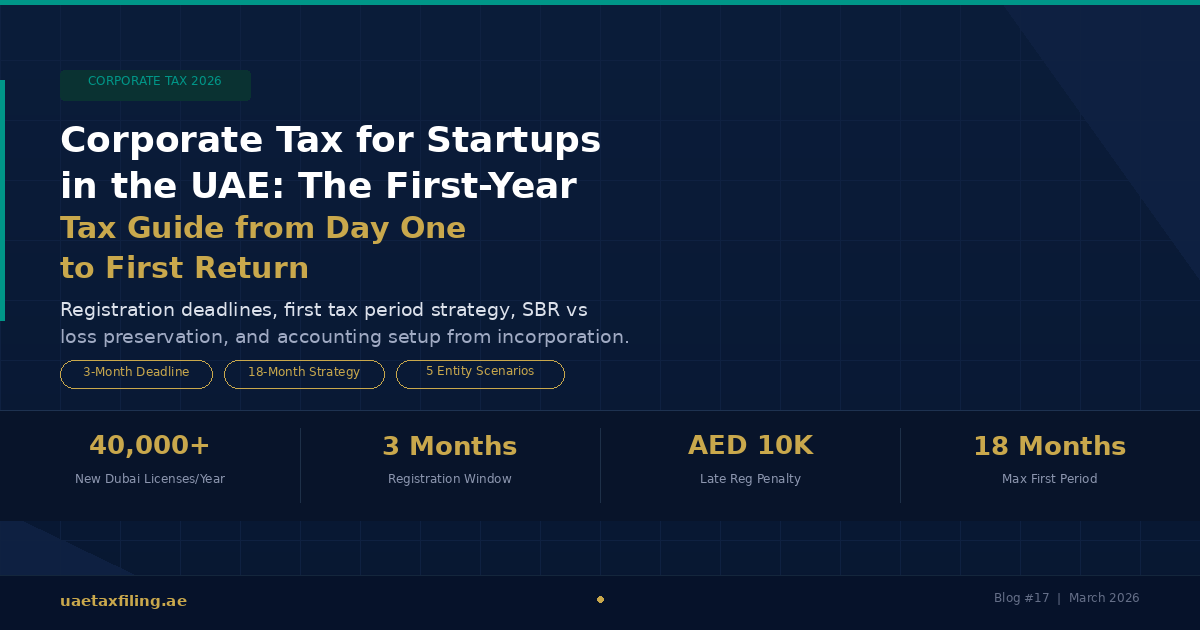
Dubai issued over 40,000 new business licenses in 2024 alone. Abu Dhabi, Sharjah, and the other emirates added tens of thousands more. Every single one of those new businesses is subject to UAE corporate tax from the date of incorporation. Not from the date they start generating revenue. Not from the date they become profitable. From day one.
The FTA issued Decision No. 3 of 2024 establishing that any company incorporated on or after March 1, 2024 must submit a corporate tax registration application within three months of incorporation. Miss that window and you owe an AED 10,000 penalty before you have even made your first sale. As KPMG confirmed, the deadline applies to the submission of the application, not the receipt of the TRN, so the clock starts ticking from the date on your trade license.
But registration is just the first step. The decisions you make in your first year, which financial year-end to choose, whether to extend your first tax period, whether to elect Small Business Relief or preserve your startup losses, whether to register for VAT voluntarily, and which accounting standard to adopt, determine your tax position for years to come. Some of these decisions are irrevocable. Get them wrong in year one and you pay for the mistake every year after.
This guide walks through the complete first-year tax roadmap for new UAE businesses in 2026. Registration timing and the 3-month window. First tax period selection (the 18-month strategy that buys you time). The SBR vs loss preservation decision that trips up most startups. Pre-trading expense treatment. VAT registration strategy. Accounting setup from day one. And five entity-type scenarios covering the most common startup structures. If you have already read our general CT filing guide and our deductions guide, this article applies those frameworks specifically to the startup context.
Registration: The 3-Month Window and the AED 10,000 Penalty
Under FTA Decision No. 3 of 2024, the registration deadline depends on your entity type and when you were incorporated:
Entity Type | Registration Deadline | Key Date Reference
UAE juridical person (LLC, FZE, FZCO) incorporated on or after March 1, 2024 | Within 3 months of incorporation | Date on trade license
Natural person (freelancer, sole proprietor) with turnover > AED 1M | By March 31 of the following year | Calendar year turnover threshold
Non-resident with UAE permanent establishment | Within 9 months of PE creation (pre-March 2024) or 6 months (post-March 2024) | Date of establishing PE
Non-resident with UAE nexus (e.g., real estate income) | Within 3 months of financial year-end | Financial year
The AED 10,000 penalty and the 7-month waiver: If you miss the registration deadline, the FTA imposes an administrative penalty of AED 10,000 under Cabinet Decision No. 10 of 2024. However, there is a temporary waiver: if you file your first corporate tax return (or annual declaration) within 7 months of the end of your first tax period, the penalty is automatically credited back to your EmaraTax account. This does not mean registration is optional. It means the FTA gives you a grace mechanism if you catch up quickly. But relying on this waiver is risky because you cannot file a CT return without a TRN, and obtaining the TRN takes up to 20 business days after application.
Practical advice: Register within the first month of incorporation. Do not wait until month three. The EmaraTax portal requires your trade license to be uploaded and accepted before you can submit the registration application. If there is any issue with your license (wrong activity codes, missing pages, resolution quality), you lose time on resubmission. Give yourself a buffer. The penalties for late registration are avoidable but only if you act early.
Choosing Your First Tax Period: The 18-Month Strategy
Your first tax period starts on the date of incorporation and ends on the financial year-end date you select. The CT Law allows your first tax period to be between 6 and 18 months. This is one of the most important strategic decisions a new business makes, because it determines when your first CT return is due.
Let us compare two scenarios for a company incorporated on July 1, 2025:
| Option A: Dec 31 Year-End | Option B: Jun 30 Year-End
First tax period | Jul 1 to Dec 31, 2025 (6 months) | Jul 1, 2025 to Jun 30, 2026 (12 months)
First CT return due | September 30, 2026 | March 31, 2027
Time from incorporation to first filing | 15 months | 21 months
Extra time gained | Baseline | +6 months
By choosing a June 30 year-end instead of December 31, this startup gains 6 additional months before its first CT return is due. That is 6 more months to generate revenue, close accounts, engage an accountant, and prepare a compliant return. As TaxReady documented in their deadline guide, the first tax period can extend up to 18 months, meaning a company incorporated on January 1, 2025 could choose a June 30, 2026 year-end, creating an 18-month first period with the return not due until March 31, 2027.
When to choose a shorter first period: If your startup was loss-making in its initial months and you want to crystallize those losses into a formal tax loss that can be carried forward, a shorter first period gets those losses recognized sooner. Tax losses carry forward indefinitely (subject to the 75% offset cap and 50% ownership continuity rule). A longer period delays loss recognition but may also mean the losses are offset against later-period profits within the same return.
When to choose a longer first period: If you are not yet profitable and want to delay the compliance burden while you focus on building the business. A longer first period means one return covers more activity, reducing the number of filings and accounting cycles in your early years.
The SBR vs Loss Preservation Decision: The Biggest Trap for Startups
If your startup's revenue is below AED 3 million in a tax period, you may be eligible for Small Business Relief. SBR treats your taxable income as zero, which means you pay zero corporate tax for that period. This sounds like the obvious choice for a new business. It is not.
The trap: SBR treats your taxable income as zero. If your startup had AED 200,000 in expenses and AED 50,000 in revenue, your accounting loss is AED 150,000. Without SBR, that AED 150,000 becomes a tax loss you can carry forward to offset future profits. With SBR, your taxable income is treated as zero, and there is no loss. The AED 150,000 in startup losses is destroyed. Permanently.
For a startup that expects to become profitable within 2 to 3 years, those accumulated losses have real value. Consider this example:
Year | Revenue | Expenses | Profit/Loss | Decision
Year 1 | AED 400K | AED 600K | (AED 200K) loss | SBR or No SBR?
Year 2 | AED 1.5M | AED 1.2M | AED 300K profit | Below AED 375K: no CT either way
Year 3 | AED 3.5M | AED 2.5M | AED 1M profit | CT due: losses matter here
If SBR elected in Year 1: Year 1 loss of AED 200,000 is destroyed. Year 3 taxable income = AED 1,000,000. CT = 9% of (AED 1,000,000 minus AED 375,000) = AED 56,250.
If SBR not elected in Year 1: Year 1 loss of AED 200,000 carries forward. Year 3 taxable income after loss offset = AED 1,000,000 minus AED 150,000 (75% cap of the AED 200,000 loss) = AED 850,000. CT = 9% of (AED 850,000 minus AED 375,000) = AED 42,750. Saving: AED 13,500. The remaining AED 50,000 in unused losses carries forward to Year 4.
The rule of thumb: If your startup is loss-making and you expect to become profitable above AED 375,000 within the next few years, do not elect SBR. Preserve the losses. If your startup is marginally profitable (below AED 375,000) and you genuinely do not expect to exceed AED 3 million in revenue before SBR expires at the end of 2026, SBR may be appropriate because you owe zero CT anyway (profits below AED 375,000 are taxed at 0%). But even then, preserving losses costs you nothing and protects against unexpected growth.
Not sure whether to elect SBR or preserve your startup losses? Our corporate tax team models both scenarios with your actual numbers before you file. Message us on WhatsApp.
Pre-Trading Expenses: Deductible from When?
Most startups incur significant expenses before generating any revenue: trade license fees, office setup, legal costs, consultant fees, marketing, equipment purchases, and employee salaries during the pre-launch phase. The question is whether these pre-trading expenses are deductible for corporate tax purposes.
The UAE Corporate Tax Law does not contain a specific provision excluding pre-trading expenses. Under IFRS accounting, expenses are recognized when incurred, regardless of whether revenue has started. As long as the expenses meet the general deductibility criteria under Article 28 of the CT Law (incurred wholly and exclusively for business purposes, not capital in nature unless depreciable, and not specifically excluded), they are deductible expenses.
Practical treatment: Pre-trading expenses incurred within your first tax period are included in your first CT return. If your first tax period runs from July 1, 2025 to June 30, 2026, all business expenses from July 1, 2025 onward (including pre-revenue expenses) are part of that return. If the pre-trading expenses create a tax loss, that loss carries forward to future periods (unless you elect SBR, which destroys it).
Capital vs revenue expenses: Trade license fees, rent deposits, and office fit-out costs may be capital expenditure that must be depreciated over their useful life rather than deducted in full in Year 1. Equipment, furniture, and IT infrastructure are typically capitalized and depreciated. Legal and consulting fees for business setup are generally deductible as revenue expenses. The distinction matters because capital expenditure reduces your taxable income gradually through depreciation, while revenue expenditure reduces it fully in the year incurred.
VAT Registration Strategy for Startups
Corporate tax and VAT are separate obligations with separate registrations. But the timing of your VAT registration affects your CT position because the VAT you pay on startup costs is only recoverable if you are VAT-registered.
Mandatory registration: Once your taxable supplies exceed AED 375,000 in the past 12 months or are expected to exceed AED 375,000 in the next 30 days. Most active startups reach this threshold within their first year.
Voluntary registration: If your taxable supplies exceed AED 187,500 (or expenses exceed AED 187,500), you can register voluntarily. For startups with significant pre-revenue spending (office lease, equipment, inventory), voluntary registration allows you to recover the 5% input VAT on those purchases from day one.
The math: A startup that spends AED 500,000 on setup costs before generating revenue pays AED 25,000 in VAT on those purchases. If the startup is not VAT-registered, that AED 25,000 is a sunk cost. If the startup registers voluntarily, it recovers the AED 25,000 as input VAT credit. That is AED 25,000 back into the business. The only cost is the compliance burden of filing quarterly VAT returns from day one.
CT interaction: If you are VAT-registered, the VAT you charge customers (output VAT) and the VAT you recover on purchases (input VAT) are excluded from your revenue and expenses for CT purposes. Your CT calculation uses VAT-exclusive figures. If you are not VAT-registered, the irrecoverable VAT on your purchases becomes part of your expense base, which is deductible for CT purposes. Either way, the VAT treatment flows through to your CT return, so your accounting system must handle both correctly from the start.
Accounting Setup from Day One
The single most expensive mistake startups make is not setting up proper accounting from incorporation. They run the business for 12 to 18 months using bank statements and Excel spreadsheets, then try to reconstruct IFRS-compliant financial statements when the CT return is due. That reconstruction costs 3 to 5 times more than setting up properly from the start, and the results are usually less accurate.
Here is what your accounting system needs from day one:
Choose the right accounting standard. If your revenue will be under AED 3 million, you can use cash basis accounting. If under AED 50 million, use IFRS for SMEs. Above AED 50 million, full IFRS. Our IFRS guide covers the three tiers in detail. Most startups fall into the cash basis or IFRS for SMEs tier. Start with IFRS for SMEs even if you qualify for cash basis, because you will likely outgrow AED 3 million and the transition from cash to accrual is disruptive.
Set up a chart of accounts aligned with the CT return. The EmaraTax CT return requires specific line items: revenue, cost of goods sold, gross profit, operating expenses by category, depreciation, finance costs, other income, and net profit. Your chart of accounts should map directly to these categories so the CT return can be populated directly from your financial statements without manual reclassification.
Track deductible vs non-deductible expenses separately. The CT Law identifies specific non-deductible expenses (government fines, 50% of entertainment, donations to non-qualifying entities, personal expenses). Your accounting system should tag these expenses so the CT adjustment is automatic, not a manual review at year-end.
Maintain records from day one. The CT Law requires businesses to retain accounting records for 7 years. VAT records must be kept for 5 years (15 years for real estate). Start your record-keeping from the date of incorporation, not from the date you think compliance starts mattering. The FTA can audit any period within the statute of limitations, and your ability to defend your position depends entirely on the records you kept.
Software recommendation: Zoho Books, QuickBooks Online, or Xero are the most common cloud accounting platforms for UAE startups. All three handle multi-currency, VAT (5%), and produce reports aligned with IFRS. Set up bank feeds from day one so every transaction is captured automatically.
Five Startup Scenarios: From Mainland LLC to Freelancer
Scenario 1: Dubai Mainland LLC (Services Company)
Setup: Two partners incorporate a consulting LLC in Dubai on April 1, 2025. They choose December 31 as their year-end. Revenue in first 9 months: AED 800,000. Expenses: AED 650,000. Each partner draws AED 25,000/month salary.
Tax position: First tax period: April 1 to December 31, 2025 (9 months). CT return due: September 30, 2026. Taxable income before adjustments: AED 150,000. Partner salaries are connected person transactions (must be at market value per transfer pricing rules). If AED 25,000/month is within market range, fully deductible. Profit of AED 150,000 is below AED 375,000 threshold: CT payable = AED 0. But the return must still be filed. SBR is irrelevant here because CT is already zero.
Scenario 2: DMCC Free Zone Company (Trading)
Setup: Sole owner incorporates a DMCC trading company in January 2025. Revenue Year 1: AED 2 million (mostly exports + sales to other free zone entities). AED 300,000 from mainland UAE customers.
Tax position: The company wants QFZP status for the 0% rate. De minimis test: non-qualifying income (AED 300,000 mainland sales) is 15% of total revenue. This exceeds the 5% or AED 5 million de minimis threshold. The company fails the QFZP test and all income is taxed at 9%. Taxable income: AED 2M minus expenses. The owner must understand this before structuring the business, not after the first return is due. If mainland sales will consistently exceed 5% of revenue, a separate mainland entity for those customers may be the better structure.
Scenario 3: Freelancer (Natural Person)
Setup: A marketing consultant operates under a freelance permit. Total 2025 turnover: AED 1.3 million. No employees, works from home.
Tax position: Turnover exceeds AED 1 million, so CT registration was required by March 31, 2026. First tax period for natural persons is the calendar year (January to December). Filing deadline: September 30, 2026 for the 2025 period. The consultant can deduct allowable business expenses: home office (proportional), internet, equipment, software, professional development, travel. Our freelancer guide covers the deduction checklist in detail. Revenue under AED 3 million: SBR is available but the loss preservation analysis applies.
Scenario 4: E-Commerce Startup (Amazon FBA)
Setup: An entrepreneur launches an Amazon FBA business from a mainland LLC in March 2025. First-year revenue: AED 1.8 million. Amazon commission and fulfillment fees: AED 450,000. Inventory purchases: AED 900,000.
Tax position: CT registration required within 3 months of incorporation. VAT registration mandatory once revenue exceeds AED 375,000 (likely by month 4-5). The key issue: Amazon fees are invoiced through non-UAE entities, triggering reverse charge VAT on every commission and fulfillment charge. Revenue must be recorded gross (AED 1.8M), not net of Amazon deductions. Our e-commerce tax guide covers the three marketplace models and the gross vs net recording error in detail. For CT: profit = AED 1.8M minus AED 450K fees minus AED 900K inventory minus other expenses. If profit exceeds AED 375,000, CT at 9% applies on the excess.
Scenario 5: Branch of Foreign Company
Setup: A UK company opens a branch office in Dubai in June 2025. The branch earns AED 5 million in service revenue from UAE clients.
Tax position: The branch is a permanent establishment (PE) of a non-resident person. CT registration required within 6 months of PE establishment. Only UAE-sourced income is taxable (AED 5 million). Head office expenses allocated to the branch must be at arm's length (transfer pricing rules apply). The UK company may be able to credit UAE CT against UK corporation tax under the UK-UAE double tax agreement. As Chambers & Partners noted, the participation exemption and foreign PE exemption provide relief for structured cross-border arrangements.
The First-Year Tax Checklist
Month 1 (Incorporation): Register for corporate tax on EmaraTax (do not wait until month 3). Choose your financial year-end strategically (consider the 18-month first period option). Set up cloud accounting software with the correct chart of accounts. Start recording every transaction from day one.
Month 1-2: Decide on VAT: mandatory if you expect AED 375,000+ in taxable supplies within 12 months, voluntary if above AED 187,500. Register on EmaraTax if applicable. Ensure your invoicing system charges and displays VAT correctly.
Month 3-6: File first VAT return if registered (due 28 days after quarter-end). Begin tracking deductible vs non-deductible expenses. If you have related party transactions (owner salary, intercompany charges), document the arm's length basis.
Month 6-9: Mid-year review: is revenue approaching AED 3 million (SBR threshold)? Is the business profitable or loss-making? Model the SBR vs loss preservation decision with actual numbers. Review whether your accounting standard is still appropriate for your revenue level.
Month 9-12 (pre-year-end): Finalize year-end adjustments. Close the books. Prepare financial statements under the correct IFRS standard. Calculate taxable income with all six adjustment categories. Review deductions for completeness. If applicable, prepare transfer pricing documentation.
Month 12-18 (post-year-end): File your corporate tax return on EmaraTax within 9 months of year-end. Pay any CT due by the same deadline. The FTA has urged businesses to file well before the deadline because last-minute bank transfers may not process in time, resulting in late payment penalties even if the return is submitted on time.
Frequently Asked Questions
When must a new UAE company register for corporate tax?
Within 3 months of incorporation (date on your trade license) for companies incorporated on or after March 1, 2024. The AED 10,000 late registration penalty applies, with a 7-month waiver if the first CT return is filed within 7 months of the first tax period end.
Can I choose my financial year-end?
Yes. You can choose any year-end date. Your first tax period can be between 6 and 18 months. Choosing strategically can delay your first CT return by up to 6 months compared to a standard calendar year-end.
Should my startup elect Small Business Relief?
Only if you are marginally profitable (below AED 375,000) and do not need to preserve losses. If your startup is loss-making, do not elect SBR because it destroys your tax losses permanently. Those losses have real value when you become profitable.
Are pre-trading expenses deductible?
Yes, if incurred wholly and exclusively for business purposes. Capital expenses (office fit-out, equipment) are capitalized and depreciated. Revenue expenses (legal fees, consulting, marketing) are deductible in the period incurred.
Should my startup register for VAT voluntarily?
If you have significant pre-revenue expenses (AED 187,500+), voluntary registration recovers the 5% input VAT on those costs. The trade-off is quarterly filing compliance from day one.
Which accounting standard should my startup use?
Cash basis if revenue under AED 3 million (by election). IFRS for SMEs if under AED 50 million. We recommend starting with IFRS for SMEs even if you qualify for cash basis, because the transition when you outgrow AED 3 million is disruptive.
Do free zone startups get 0% corporate tax automatically?
No. Free zone entities must qualify as a QFZP by meeting substance requirements, qualifying activity tests, and the de minimis rule for non-qualifying income. Failing any condition means 9% tax on all income, potentially for 5 years.
What happens if I do not file my first CT return?
Late filing penalty: AED 500 per month for the first 12 months, then AED 1,000 per month from month 13 onward. Late payment: 14% per annum non-compounding, calculated monthly. Both penalties apply simultaneously and accumulate rapidly.
Do I need an audited financial statement for my first CT return?
Audited financials are mandatory for businesses with revenue above AED 50 million and for all QFZPs. For other startups, an audit is not legally required for CT purposes but is strongly recommended for audit readiness and financial credibility.
Can I carry forward losses from my first year indefinitely?
Yes. Tax losses carry forward indefinitely with no expiry, subject to two conditions: you can only offset up to 75% of taxable income in any given year, and you must maintain at least 50% ownership continuity (or demonstrate the business continues in a substantially similar manner after an ownership change).
Your First Year Sets the Foundation
Every established business in the UAE was once a startup making these same decisions. The ones that got it right started with proper accounting from day one, registered on time, chose their first tax period strategically, preserved their startup losses instead of electing SBR reflexively, and built their records as if an FTA auditor would review them tomorrow.
The ones that got it wrong are the businesses now paying 3 to 5 times the normal accounting fees to reconstruct 18 months of financial records from bank statements, discovering that their SBR election destroyed AED 500,000 in usable losses, and finding out that their free zone entity does not qualify for the 0% rate because they never set up the transfer pricing documentation that QFZP status requires.
You are reading this guide at the right time. The 2026 tax changes have tightened every part of the compliance framework. The FTA is enforcing registration deadlines, cross-referencing VAT and CT data, and auditing at record levels. But the rules are clear, the deadlines are known, and the decisions you make now determine whether compliance is a routine cost of doing business or an expensive problem you solve under pressure.
Launching a new business in the UAE? Our corporate tax team handles CT registration, first-year accounting setup, SBR analysis, and first CT return filing. Our accounting services set up IFRS-compliant bookkeeping from day one so your records are always CT-ready. And our VAT team handles registration and quarterly filing from your first return. Get started on WhatsApp.