In March 2026, a Stockholm-based founder named Erik Lundqvist sat across from us with a printout of three cost spreadsheets. He had spent eleven weeks researching where to base the holding company for his B2B SaaS business. His revenue had just crossed $1.2 million. His investor wanted Singapore. His co-founder wanted London. He himself was leaning Dubai because of the tax. The three spreadsheets disagreed by more than $180,000 a year on the same business profile, and every spreadsheet had been written by someone selling a service in that exact city.
His question was not new. It is the same question we hear every week from founders running consulting firms, agencies, e-commerce brands, fintechs, and IP-heavy ventures: where should the company actually be based? What this article does that the typical setup-firm comparison does not is take all eight cost layers seriously, work through a real revenue profile in all three jurisdictions, and tell you where each city honestly wins. Not the version where Dubai always wins because the article is published in Dubai. The version where the answer depends on what your business actually does.
Why most Dubai vs Singapore vs London comparisons get the wrong answer
The standard format goes like this. A table with three columns. Corporate tax rate at the top. Personal tax rate next. Some bullet points about lifestyle. A conclusion that recommends whichever city the publisher operates from. By construction, the comparison reduces an eight-dimensional decision to a one-dimensional headline.
The headline number is misleading in all three directions. Singapore advertises 17% but a qualifying startup in its first three years pays an effective rate closer to 6%. The UK advertises 25% but a small company under £50,000 of profit pays 19% and the marginal band creates a 26.5% effective rate that surprises founders who land in the middle. The UAE advertises 9% but free zone qualifying income remains at 0%, and the Small Business Relief regime that some businesses still rely on operates under a different revenue test than most founders realise. Three rates published as three numbers. Each one is correct only with caveats that the comparison tables omit.
The deeper problem is that corporate tax rarely turns out to be the largest line item on the comparison. For a five-person service company doing under $1.5 million in revenue, the corporate tax bill in any of the three cities is rarely the differentiator. Office rent, payroll-side taxes, social-security contributions, banking access, and visa-related costs change the rankings completely. We have seen the same business profile come out cheapest in Dubai by 18% and cheapest in London by 9% in two separate analyses, both correct, depending on which cost layers were included. That is the gap this article is built to close.
The eight cost layers that actually decide the answer
We built this analysis around the same eight-layer framework documented in our flagship piece on the real cost of running a business in Dubai. The layers apply to every jurisdiction. Costs differ. The structure does not.
- Layer 1 - Setup and licensing. Government fees, agent fees, name reservation, identity verification, registered address.
- Layer 2 - Office and physical presence. Flexi-desk, serviced office, traditional lease, plus service charges and local property taxes where they apply.
- Layer 3 - Visa and work authorisation. Founder visa, employee visas, dependants, health surcharges, sponsor licence costs, ongoing renewals.
- Layer 4 - Corporate income tax. Headline rate, exemptions, reliefs, and what your effective rate actually works out to at your profit level.
- Layer 5 - Consumption tax. VAT, GST, registration thresholds, filing frequency, and the cash-flow drag of input recovery.
- Layer 6 - Payroll and social charges. Employer-side contributions, pension obligations, gratuity provisions, and the difference between hiring locals and hiring foreigners.
- Layer 7 - Compliance and accounting. Bookkeeping, audit thresholds, statutory filings, transfer pricing documentation where applicable.
- Layer 8 - Banking, treasury, and the hidden costs. Account opening friction, FX spreads, payment-processing fees, professional indemnity, and the time-value of compliance overhead.
Run any business through these eight layers in all three cities and the answer stops looking obvious. Run it through just layer 4 and the answer always favours Dubai. The first version is the version that holds up to a CFO review. The second is the version that gets you sold a free zone licence.
Dubai in 2026: lowest tax exposure, highest banking friction
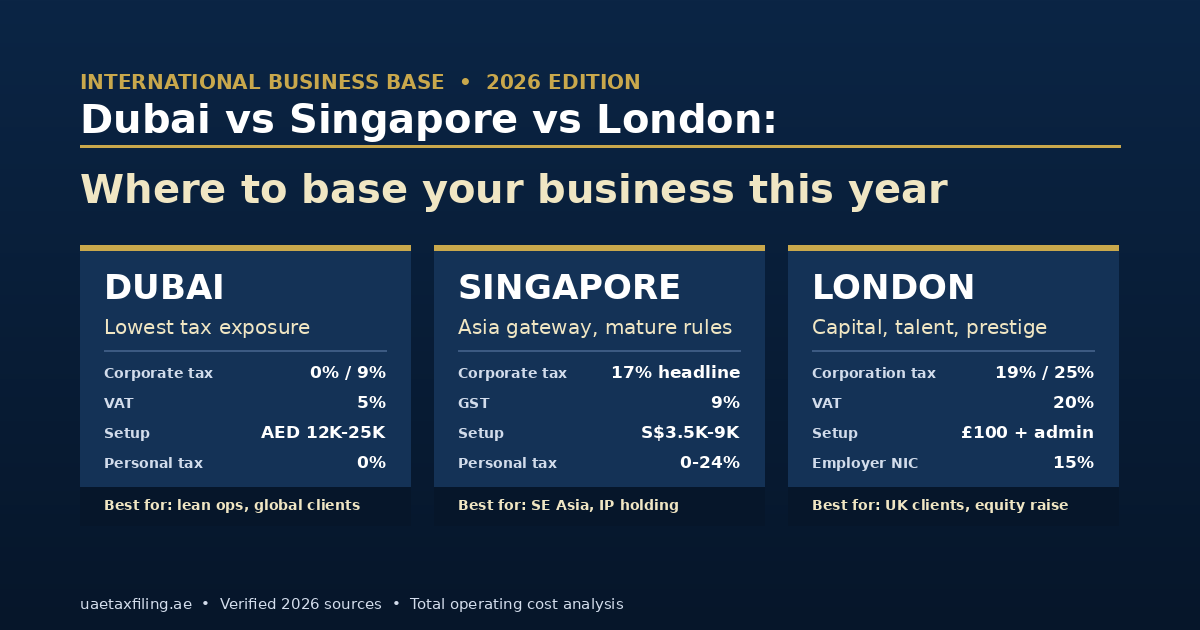
The UAE remains the lowest-tax jurisdiction of the three on every metric that matters at the company level. Headline corporate tax is 9% above AED 375,000, with 0% below. Free zone qualifying income remains at 0% under the QFZP regime. There is no personal income tax. There is no capital gains tax. There is no payroll tax of any kind on the employer side, beyond a 12.5% to 20% gratuity provision that accrues only on termination.
Setup ranges from AED 12,000 to AED 25,000 in a free zone for a single-shareholder operation, and AED 15,000 to AED 30,000 on the mainland for a service licence. A serviced office for a five-person team in Business Bay or DMCC sits at AED 60,000 to AED 90,000 a year. Five visas including health insurance run AED 35,000 to AED 50,000 in year one, with renewals every two years at similar levels. Accounting and VAT compliance for a five-person service company comes in at AED 24,000 to AED 36,000 a year if outsourced.
Where Dubai wins decisively is the tax stack. A free zone company with qualifying income pays zero corporate tax. A mainland company with profits between AED 375,000 and roughly AED 4.16 million pays 9% on the slice above the de minimis. There is no employer national insurance, no payroll tax, no social security contribution for non-Emirati staff. The 5% VAT applies above an AED 375,000 turnover threshold, which captures most operating businesses but at a rate that is the lowest of the three. The complete tax mechanics, including which entities qualify for free zone treatment, are covered in our free zone corporate tax 0% qualification guide and our deeper free zone vs mainland decision framework. A side-by-side of what corporate tax actually costs at different revenue levels lives in our real corporate tax cost analysis for UAE businesses. Filing deadlines and registration mechanics live in our UAE corporate tax registration walkthrough and the 2026 deadlines guide.
Where Dubai loses is bank account opening and the Small Business Relief misunderstanding. UAE banks have tightened onboarding for non-resident shareholders since 2024, and account opening that was once a four-week process now routinely takes ten to fourteen weeks for foreign founders without UAE residency. The Small Business Relief, which exempts companies with revenue under AED 3 million from corporate tax until end of 2026, is widely misread. The threshold is revenue, not profit, and crossing it once disqualifies the company from the relief in subsequent years. We unpack the trap in detail in our AED 3 million decision article. Founders also overlook withholding tax exposure on outbound payments to high-tax jurisdictions, which is covered in our withholding tax and treaty guide.
Building a Year 1 budget for a UAE entity? Start with our breakdown of the full eight-layer running cost of a Dubai business in 2026.
Singapore in 2026: the most engineered tax system on the list
Singapore is the jurisdiction founders consistently underestimate on cost and overestimate on simplicity. The headline is a flat 17% corporate tax, lower than the UK and higher than the UAE. The reality, for any company in its first three Years of Assessment, is meaningfully lower. The Start-Up Tax Exemption (SUTE) exempts 75% of the first S$100,000 of chargeable income and 50% of the next S$100,000, which works out to a maximum exemption of S$125,000 a year. After three years the company moves to the Partial Tax Exemption (PTE), which exempts S$102,500 a year in perpetuity. On top of that, Budget 2026 added a 40% Corporate Income Tax Rebate capped at S$30,000 per company for the YA 2026, and a S$1,500 cash grant for active companies that employed at least one local employee in 2025. The mechanics are documented at the Inland Revenue Authority of Singapore source page (iras.gov.sg corporate tax).
Setup with the Accounting and Corporate Regulatory Authority (ACRA) costs S$315 in government fees: S$15 for name application and S$300 for company registration (ACRA fees). Foreign founders cannot use Singpass, so a Registered Filing Agent is required, and most agent packages run S$1,500 to S$3,200 for incorporation. The hidden mandatory cost for foreign founders is the local resident director requirement: at least one director must be a Singaporean citizen, permanent resident, or Employment Pass holder. If your founding team has none of those, a nominee director service costs S$2,000 to S$5,000 a year. Annual ACRA filing is S$60. A company secretary is mandatory within six months and runs S$300 to S$900 a year. A registered local address is mandatory and adds S$300 to S$600 a year.
The Employment Pass (EP) is where the real cost lives. Effective from 1 January 2025 and continuing through 2026, the minimum qualifying salary is S$5,600 a month for most sectors and S$6,200 a month for financial services, rising to S$6,000 and S$6,600 respectively from 1 January 2027 (Ministry of Manpower, mom.gov.sg eligibility). A new applicant must also pass the COMPASS framework with at least 40 points across salary, qualifications, diversity, and the employer's local hiring record. Application and issuance fees total S$330 per pass. Practically, this means a foreign founder cannot pay themselves below S$67,200 a year on an EP, and that salary attracts personal income tax at progressive rates that top out at 24% on income above S$1 million.
GST in Singapore is 9%, raised from 8% on 1 January 2024 and unchanged for 2026. The registration threshold is S$1 million in taxable turnover over a 12-month period. Below that, registration is voluntary and worth doing only if your input tax recovery exceeds the compliance cost. Audit is required unless the company qualifies as a small company by meeting two of three tests: revenue at or below S$10 million, assets at or below S$10 million, employees 50 or fewer. A typical owner-managed services company with under S$5 million revenue and a handful of staff is audit-exempt, which saves S$2,000 to S$8,000 a year.
Office space in Singapore's Central Business District is the second largest line item after payroll. Grade A rents in Q1 2026 averaged S$12.04 per square foot per month according to JLL Singapore data, with Grade AAA buildings reaching S$13.28. A 600 square foot Grade B office in the city fringe at S$8 per square foot translates to S$57,600 a year in base rent before service charges. A serviced office for five desks in Tanjong Pagar or Robinson Road sits at S$5,000 to S$12,000 per month depending on submarket and amenity level.
Where Singapore wins is regulatory credibility, treaty network, and Asia access. Where it loses is the layered cost stack: nominee directors, mandatory secretaries, EP salary floors, and CBD rents that compound to a meaningful annual figure even before tax.
London in 2026: highest tax, highest payroll cost, highest prestige
The UK runs the most complicated of the three corporate tax regimes. The small profits rate is 19% on profits up to £50,000. The main rate is 25% on profits at or above £250,000. Profits between the two thresholds attract marginal relief calculated at 3/200, which produces an effective marginal rate of 26.5% on every additional pound earned in that band. A company at £180,000 in profit pays roughly £43,950 in corporation tax, an effective rate near 24.4%. Both thresholds are divided across associated companies and pro-rated for short accounting periods. The full mechanics are documented at GOV.UK Corporation Tax.
Setup is genuinely cheap. From 1 February 2026, Companies House charges £100 for a digital incorporation, up from £50, and the annual confirmation statement filing rose to £50 from £34 (Companies House fees). A registered office address through a service provider runs £39 to £150 a year. An accountant for a small limited company runs £840 to £1,800 a year. There is no nominee director requirement, no mandatory company secretary for private companies, and no resident director condition. A non-resident can incorporate, own 100% of the shares, and act as the sole director without ever setting foot in the UK.
Where London becomes expensive is everywhere except the company formation form. Employer National Insurance Contributions rose to 15% from 6 April 2025, with the secondary threshold cut to £5,000 a year, where it has been frozen until 2030 to 2031. The Employment Allowance offsets up to £10,500 of annual employer NIC liability, but only one allowance applies per business, regardless of headcount. For a company employing four staff at £40,000 each, the employer NIC bill before allowance is around £21,000, dropping to £10,500 after the allowance. That alone is more than the entire UAE corporate tax liability for the same business in most profit ranges.
Visa costs are the second hidden tier. To sponsor a foreign worker on the Skilled Worker route, the employer must hold a sponsor licence, which costs £574 for a small or charitable sponsor and £1,579 for a medium or large sponsor as of January 2026. Each Certificate of Sponsorship is £525. The Immigration Skills Charge is £480 a year for small sponsors, £1,320 a year for large sponsors. The visa application fee, payable by the worker, rose to £819 for a 3-year out-of-country application from 8 April 2026, and the Immigration Health Surcharge is £1,035 a year for adults. A small employer sponsoring one foreign founder for a 3-year visa is looking at roughly £2,539 in employer-side fees alone, before legal costs that typically add £2,000 to £5,000.
VAT is 20%, the highest of the three. The registration threshold is £90,000 in 12-month rolling turnover, the highest in absolute terms but the lowest as a percentage of typical revenue. Most operating service companies hit the threshold in their first or second year. Filing is quarterly under Making Tax Digital for VAT, which has been mandatory for all VAT-registered businesses since April 2022.
Office costs in central London are extreme. West End prime rents reached £182.50 per square foot a year in early 2026 according to Oktra and Cushman & Wakefield data, with Mayfair and St James's seeing transactions at £200 to £240 per square foot. The City Core averaged £100 per square foot. Shoreditch and East London ran £45 to £70. Service charges add £8 to £18 per square foot, and business rates add another 40% to 50% of the base rent. A 600 square foot office in the City Core comes in at roughly £85,000 a year all-in. The same footprint in Shoreditch costs £45,000 to £55,000. A 5-desk serviced office in the City runs £750 to £1,300 per desk per month, or £45,000 to £78,000 a year for the whole team.
Where London wins is access. To clients in the UK and EU. To equity capital. To English-speaking talent at depth. To a legal system that international counterparties recognise without negotiation. Where it loses is the cumulative cost of every line item except the formation fee itself.
The worked example: a five-person service company in 2026
We modelled the same business profile in all three cities. A B2B service company. Five people on the team: one founder and four employees. Annual revenue of AED 3,000,000 in Dubai, S$1,100,000 in Singapore, and £600,000 in London. Net profit margin of 30%, giving AED 900,000, S$330,000, and £180,000 of pre-tax profit. Service revenue is mostly export billed to clients outside the home jurisdiction. Office is serviced for five desks. Founder takes minimum permitted salary in each jurisdiction. The numbers below are full-year recurring costs in year one, excluding one-off setup fees, in each local currency, sourced from the working assumptions in the city sections above.
Cost layer
Dubai (AED)
Singapore (SGD)
London (GBP)Setup year 1 | 20,000 | 5,000 | 150
Office (5 desks, serviced) | 75,000 | 60,000 | 55,000
Founder visa + 4 staff visas | 45,000 | 330 | 2,539
Annual compliance + accounting | 30,000 | 5,500 | 2,100
Corporate tax on AED 900K / SGD 330K / GBP 180K profit | 47,250 | 20,910 | 43,950
Employer payroll-side taxes (4 staff) | 0 | 0 (foreign EP) or 40,800 (CPF) | 10,500 (after allowance)
Total non-payroll annual cost | 217,250 | 91,740 | 114,239
Reading the same numbers as prose, because the table compresses what actually matters: the year-one setup cost in Dubai is roughly AED 20,000 once licence, agent, and bank account opening assistance are included; in Singapore it is around S$5,000 with agent fees factored in; in London the Companies House fee is £100 with about £150 in registered address and identity verification on top. Office rent for a serviced five-desk office is AED 75,000 in a mid-tier free zone or Business Bay address, S$60,000 in a Tanjong Pagar managed office, and roughly £55,000 for a five-desk serviced setup in the City fringe. Founder and staff visa costs are highest in Dubai (AED 45,000 for five visas with health insurance), modest in Singapore (S$330 for one EP if the four employees are local), and London (£2,539 for one Skilled Worker sponsorship with the small-sponsor ISC for three years, assuming the four staff are UK residents).
Annual compliance and accounting come in at AED 30,000 for a five-person UAE entity with VAT, S$5,500 in Singapore (audit-exempt, basic accounting), and around £2,100 in London. Corporate tax on the profit profile is AED 47,250 at 9% above the AED 375,000 de minimis (mainland), S$20,910 in Singapore after SUTE and the YA 2026 CIT Rebate, and £43,950 in London after marginal relief. Employer payroll-side taxes are zero in Dubai for non-Emirati staff, zero in Singapore for foreign Employment Pass holders but S$40,800 a year in CPF if all four staff are local hires, and £10,500 in London after the Employment Allowance offset. The total non-payroll annual operating cost works out to AED 217,250 in Dubai, S$91,740 in Singapore, and £114,239 in London.
Converted at indicative early-2026 mid-market rates of AED 3.67 to USD 1, S$1.35 to USD 1, and £0.78 to USD 1, those totals translate to roughly $59,200 in Dubai, $67,950 in Singapore, and $146,460 in London. Singapore narrowly wins on totals if all four employees are foreign EP holders. London becomes 2.5 times more expensive than the other two if the founder needs to sponsor visas and the team is UK-based. Dubai wins decisively when the founder needs personal income tax minimisation on top, since AED 0 of personal income tax versus a top rate of 24% in Singapore and 45% in the UK changes the founder's net take-home by tens of thousands of dollars at modest income levels.
These numbers are sensitive to four variables. Office choice is the largest. A flexi-desk in Dubai brings non-payroll cost below AED 100,000 a year. A 1,000 square foot Mayfair office in London pushes non-payroll cost above £200,000. Staff nationality changes Singapore's totals by S$40,000 in either direction. Free Zone qualifying income status changes Dubai's CT to zero. Profit level shifts the UK from 19% to 25% to 26.5% effective. Anyone running this analysis without explicitly modelling those four levers is comparing rounded headlines, not real businesses.
If your numbers don't match the worked example, ask us to model your specific case against the full eight-layer Dubai cost framework.
Where each city actually wins, profile by profile
Dubai wins for
Globally distributed service companies billing clients outside the GCC, where the 0% qualifying free zone treatment applies and personal income tax of 0% boosts founder take-home meaningfully. Lean operations with under twenty staff and limited UK or EU client exposure. Trading and re-export businesses that benefit from the UAE's network of DTAAs and the absence of withholding tax on most outbound flows. Founders prioritising near-term cash retention over long-term capital raise positioning. The three to five year holding company that wants to compound profits before a deferred personal tax event in another jurisdiction.
Dubai loses if: your business needs UK or EU regulatory licences, your investor base wants a Singapore or Cayman holding structure, your team needs deep access to UK or European talent pools, or your model depends on serving institutional clients who require an established home-jurisdiction presence for procurement reasons. The trap to avoid is taking the 0% headline, building a substance-light entity, and discovering at audit that the entity does not qualify for QFZP treatment. The qualification rules are technical, and we walk through them in the free zone 0% qualification guide.
Singapore wins for
Companies operating across Southeast Asia, where Singapore's network of double tax treaties, the AANZFTA framework, and bilateral investment treaties simplify cross-border structures meaningfully. IP-heavy ventures, where Singapore's IP Box equivalent (the Innovation and Capability Voucher schemes plus the new AI deduction announced in Budget 2026) and the IRAS section 13 exemptions on certain foreign-sourced income are genuinely useful. Fintech and payments businesses that need MAS regulatory standing for institutional partnerships. Companies that anticipate raising Series A or later from Asia-focused VCs, where a Singapore Pte Ltd is the default expected structure. Holding companies for regional subsidiaries, where Singapore's territorial tax basis makes it efficient.
Singapore loses if: you cannot fund the EP salary floor from day one, your team is fully remote with no local director, your business model is light on Asian customer revenue, or your founder is a single person who would otherwise have no need for the nominee director infrastructure. The S$5,600 monthly EP minimum forces a baseline founder salary that the UAE simply does not require. For pre-revenue or very lean operations, Singapore can become the most expensive of the three cities once nominee director and EP salary are factored in.
London wins for
B2B service companies with predominantly UK or EU clients, where being domiciled in the same jurisdiction as the buyer simplifies VAT, contracts, and procurement. Equity-stage companies planning to raise from London, US East Coast, or European venture capital, where the UK Ltd structure is the path of least resistance for diligence. Talent-heavy businesses, particularly in deep tech, fintech, life sciences, and creative industries, where the depth and quality of the available workforce justifies the higher fully-loaded cost per hire. Companies with strong intellectual property where the UK's R&D tax relief and patent box can return real cash. Founders who want optionality on personal residence under the new four-year FIG regime that replaced non-dom status from April 2025.
London loses if: your revenue is under £500,000, you have no UK clients, and you do not need UK talent. At that scale, the headline 25% main rate plus 26.5% marginal effective plus 15% employer NIC plus 20% VAT plus £55,000 of office and visa costs adds up to a tax stack that simply does not work for an early-stage offshore-revenue business. London's strengths kick in at scale and at the specific business profiles where the qualitative advantages compound. Below that, the cost is real and the offsetting benefits are theoretical.
How to actually pick: a four-question framework
Ignore the comparison table for a moment. Run your business through these four questions in order. The answer that emerges is more reliable than any cost spreadsheet.
- 1. Where are your clients? If 60%+ of revenue comes from a single region, base in that region. UK and EU clients want UK invoicing in the same currency. US-only clients are jurisdiction-agnostic and Dubai becomes default. Asian clients value Singapore presence.
- 2. Where is your capital coming from? Investor location often dictates entity location. London-based VCs want UK Ltd or US Delaware. Singapore-based funds want Pte Ltd or Cayman. Dubai-based PE is comfortable with UAE entities and free-zone structures.
- 3. What is your founder personal tax goal? 0% personal income tax in the UAE. 0% to 24% progressive in Singapore. 20% to 45% in the UK plus dividend tax. The differential at $200,000 of personal income alone exceeds $40,000 a year between the UAE and the UK. Compounded over five years, the personal tax delta often outweighs the corporate tax delta entirely.
- 4. What is your revenue trajectory? A pre-$500K revenue business should not be in London. A $500K to $5M business has a real choice between Dubai and Singapore. Above $5M, the choice depends on operating geography rather than tax. Get the question right at the relevant scale, not at theoretical scale.
Most founders skip these and start with the corporate tax rate. That is the wrong order. The corporate tax rate matters less than where your clients are, where your capital is, what you take home personally, and where your business is heading. The rate is the last filter, not the first.
The honest conclusion
There is no city that wins universally. Dubai is the cheapest stack for a globally distributed service company with no UK or EU client dependence, especially when personal tax is included. Singapore is the cleanest fit for IP-heavy or Asia-facing businesses with the cash flow to fund nominee director and EP costs from day one. London is the highest-cost option in absolute terms but the only credible base for a venture-backed business with predominantly UK or EU clients and a path to a Series A from London-based capital.
Erik, the Stockholm founder we opened with, ended up choosing Dubai for the operating company and London for a UK subsidiary that holds his EU client contracts. The combined structure costs more than either alone, but it solved the tax problem in Dubai and the procurement problem in London. That kind of dual-base structure is increasingly common at the $1M to $5M revenue range, and the right answer is usually not one of the three cities, but two of them, structured deliberately.
The numbers and rules in this article reflect 2026 positions as published by the FTA, IRAS, MOM, ACRA, and HMRC. Tax law in all three jurisdictions changes on a rolling basis. Singapore typically updates rules at Budget in February. The UAE published its e-invoicing schedule and corporate tax updates through Cabinet Decisions in 2025 and early 2026. The UK runs a Finance Act cycle each November. Anyone making a base-jurisdiction decision should pressure-test this analysis against the rules in force at the time of incorporation, ideally with a registered tax adviser in each jurisdiction. We've covered the rolling UAE side of that in our every UAE tax change coming in 2026 guide.
Planning a UAE entity as part of a multi-jurisdiction structure? Read our guide on year-end tax planning for UAE businesses.
Frequently asked questions
Is Dubai always cheaper than Singapore and London on corporate tax?
On the headline rate, yes. The UAE's 9% rate above AED 375,000 (and 0% below, plus 0% qualifying free zone income) is lower than Singapore's 17% and the UK's 19% to 25%. On effective rate at small profit levels, Singapore's SUTE in years one to three brings it close to Dubai's 9%, and small UK companies pay 19%. The headline ranking holds at large profit levels. The effective ranking depends on your profit band and exemption eligibility.
Which city has the cheapest setup cost in 2026?
London on government fee alone, at £100 for digital incorporation. Dubai on bundled all-in cost for a foreign founder, at AED 12,000 to AED 25,000 including agent, registered address, and visa. Singapore is the most expensive for foreign founders due to the mandatory nominee director (S$2,000 to S$5,000 a year) on top of agent fees.
Do I need a local director in any of the three cities?
Singapore yes, UK no, UAE conditional. Singapore requires at least one resident director (citizen, permanent resident, or EP holder). The UK has no local director requirement; a non-resident can be the sole director and shareholder. The UAE requires no local director on free zone or mainland LLC structures (since the 100% foreign ownership reform of June 2021), though a local service agent may still be needed for some mainland activities.
Which city has the lowest personal income tax for the founder?
The UAE at 0%. Singapore is progressive from 0% to 24% with the top rate kicking in at S$1 million of taxable income. The UK is 20% to 45% plus dividend tax for additional-rate taxpayers. Across a five-year holding period, the personal tax delta between the UAE and the UK alone often exceeds $200,000 for a founder taking $250,000 a year.
Can I run a UK Ltd or Singapore Pte Ltd from Dubai?
Yes, both jurisdictions allow non-resident directors, but tax residency follows central management and control. If the board meetings happen in Dubai and key decisions are made there, the company risks being treated as UAE tax-resident regardless of where it is incorporated. The UAE Tax Residency Certificate guide on our blog covers the substance test in detail. Get advice before assuming you can incorporate in one place and operate from another.
How does Singapore's Start-Up Tax Exemption (SUTE) work in practice?
For the first three Years of Assessment, qualifying companies pay 0% on the first 75% of S$100,000 of chargeable income (so S$75,000 is exempt) and 0% on the first 50% of the next S$100,000 (so S$50,000 is exempt). Maximum exemption is S$125,000 per year. After year three, the company moves to PTE with an annual exemption of S$102,500. Property and investment-holding companies are excluded.
How much does it cost to sponsor a foreign worker in London versus Dubai?
Dubai: AED 5,000 to AED 7,000 per visa plus AED 2,000 to AED 8,000 health insurance, totalling roughly AED 8,000 to AED 13,000 per worker every two to three years. London: £574 sponsor licence (one-off, small sponsor) plus £525 Certificate of Sponsorship plus £480 to £1,320 a year Immigration Skills Charge, plus the worker's own £819 visa fee and £1,035 a year IHS. London's three-year sponsorship of one foreign worker by a small employer is roughly £2,539 in employer-side cost plus £3,924 in worker-side cost.
What is the VAT or GST registration threshold in each city?
Dubai: AED 375,000 in 12-month taxable turnover, with 5% VAT. Singapore: S$1,000,000 in 12-month taxable turnover, with 9% GST. London: £90,000 in 12-month rolling turnover, with 20% VAT. The UK's threshold is the lowest in absolute terms; the UAE has the lowest rate.
Where is the easiest place to open a business bank account in 2026?
London by far. Most UK challenger banks open business accounts in 24 to 72 hours for a UK Ltd with a UK director. Singapore is moderate; banks like DBS and OCBC accept fully remote applications for Pte Ltd companies but require detailed KYC. Dubai has tightened materially since 2024; account opening for foreign founders without UAE residency now routinely takes 10 to 14 weeks, and several major banks have raised minimum balance requirements to AED 500,000 or more.
What about a multi-jurisdiction structure: Dubai operating company plus UK or Singapore subsidiary?
Common at the $1M to $5M revenue range. The typical structure is a Dubai parent for the global tax-efficient stack, with a UK Ltd or Singapore Pte Ltd subsidiary that holds the regional client contracts and locally compliant invoicing. Done properly, this captures the tax benefit of the UAE while solving the procurement and credibility problem in the client jurisdiction. Done badly, it creates transfer-pricing risk in both jurisdictions.
About this analysis
This article was prepared by the editorial team at UAE Tax Filing LLC, an FTA-registered professional tax and accounting firm based at Sofitel Downtown, Dubai. We work with founders, SMEs, and multi-jurisdiction holding structures across the UAE, with frequent client-side exposure to Singapore and UK structures. The numbers in this article are sourced from the Federal Tax Authority (UAE), the Inland Revenue Authority of Singapore (IRAS), the Accounting and Corporate Regulatory Authority (ACRA), the Ministry of Manpower (MOM), Companies House (UK), HMRC, JLL, Cushman & Wakefield, and Oktra, all referenced inline. All figures are valid as of May 2026 and may change with fiscal updates in any of the three jurisdictions.
If you are weighing a UAE entity as part of a multi-base structure, our team can model the full eight-layer cost in your specific business profile. Contact us at uaetaxfiling@gmail.com or visit uaetaxfiling.ae to book a consultation. For deeper reads on any of the topics raised here, see our guides on transfer pricing in the UAE, outsourced accounting costs in Dubai, IFRS financial statements for UAE corporate tax, VAT registration in the UAE, the UAE Tax Residency Certificate, corporate tax for startups, the UAE R&D tax credit, and how to choose a corporate tax firm in Dubai.