There are hundreds of firms in Dubai offering corporate tax services. Some of them are excellent. Some of them are dangerous. The problem is that from the outside, they look identical. Both have professional websites. Both claim FTA expertise. Both promise compliance. The difference only becomes visible when the FTA sends you an audit notice and you discover that the firm you hired filed your return using your VAT records instead of IFRS financials, missed a transfer pricing disclosure on a related party transaction, or deducted expenses that are explicitly non-deductible under the CT law.
By then, the penalties are yours. Not the firm's. The FTA holds the taxpayer responsible for the accuracy of the return, regardless of who prepared it. A bad advisor's mistake becomes your AED 10,000 penalty, your 14% annual interest on underpaid tax, your post-audit assessment. As Excellent Accountants' guide documented, choosing the right tax consultant is not just about saving time. It protects your business from penalties, audit risks, and costly mistakes.
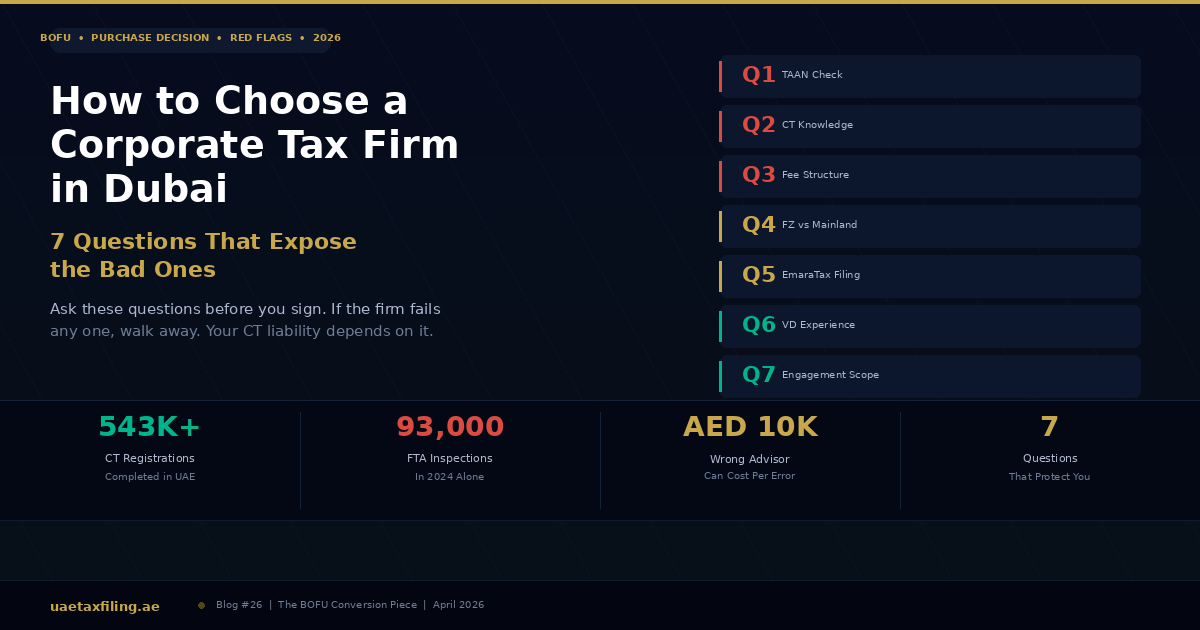
This article is not a 'Top 10 Best Tax Firms in Dubai' listicle. Those articles are ads. This article gives you seven specific questions to ask any firm before you sign an engagement letter. Each question is designed to reveal a specific weakness. If the firm cannot answer any one of them satisfactorily, that tells you something important about whether they can protect your business.
"A good tax firm costs money. A bad tax firm costs more. The difference between the two is not visible on their website or their LinkedIn page. It is only visible in the questions you ask before you hire them, and in the quality of the return they file after you do."
Jazim, CEO, UAE Tax Filing LLC
Question 1: "What Is Your Tax Agent Registration Number?"
This is the first question because it is the most disqualifying. In the UAE, only FTA-registered tax agents are legally authorized to represent your business before the Federal Tax Authority. This includes filing CT returns on your behalf, responding to FTA queries, handling audit correspondence, filing voluntary disclosures, and submitting reconsideration requests. An unregistered consultant can prepare your return, but they cannot submit it, defend it, or represent you if the FTA challenges it.
The FTA maintains a public registry of registered tax agents on its website. Every registered agent has a Tax Agent Registration Number (TAAN). Ask for it. Then verify it on the FTA portal. As Znzir's guide noted, hiring an uncertified consultant leaves your business without a legal representative in high-stakes situations. You should always ask for the TAAN and verify it directly.
A firm that cannot provide a TAAN is not a tax agent. They may be an accounting firm, a bookkeeping service, or a general consultancy that offers tax as a side service. There is nothing wrong with hiring them for bookkeeping. But if they are filing your CT return, they are operating outside the scope that the FTA recognizes, and you have no legal recourse through the FTA if they make errors.
Red flag: The firm hesitates, gives you a VAT registration number instead of a TAAN, or says 'we work through a registered agent.' If they work through someone else's TAAN, ask who that agent is and whether you will have direct access to them during an audit. If the answer is no, your relationship with the person who is legally responsible for your filing is indirect at best.
Question 2: "Walk Me Through the Difference Between Accounting Profit and Taxable Income"
This question tests whether the firm understands the core mechanism of UAE corporate tax. The CT return does not start from revenue. It starts from accounting net profit per your IFRS financial statements and then applies a series of adjustments to arrive at taxable income. These adjustments include adding back non-deductible expenses (fines, penalties, entertainment above 50%, personal expenses), removing exempt income (qualifying dividends, certain capital gains), adjusting for timing differences (provisions, unrealized gains under the realisation basis), and applying the AED 375,000 zero-rate band.
A firm that understands this will walk you through it clearly. They will mention specific adjustments by name. They will reference the IFRS-to-taxable-income reconciliation that forms the backbone of every CT return. They will explain that accounting profit and taxable income are almost never the same number.
A firm that does not understand this will give you a vague answer about '9% on profits.' That answer tells you they are preparing your return by taking your accounting profit and multiplying it by 9%, which skips every adjustment and produces an incorrect taxable income. Our 9 mistakes article covers this as Mistake 8: the most common calculation error in UAE CT returns.
Red flag: The firm cannot name at least three specific adjustments between accounting profit and taxable income. If they say 'we just apply 9% to your profit,' they do not understand the CT law well enough to file your return correctly.
Question 3: "What Is Your Fee Structure, and What Exactly Is Included?"
Pricing transparency is a direct indicator of operational maturity. A reputable firm will provide a clear engagement letter with a defined scope of work, a list of deliverables, a fee amount or fee range, and a timeline. As EAS MEA's advisor selection guide recommended, transparency in pricing is vital. Avoid advisors with vague 'success-based' fees or hidden charges for every email or phone call.
The UAE tax advisory market has three common fee models. Fixed annual retainers (AED 5,000 to AED 50,000+ depending on complexity, covering CT registration, return preparation, and filing) are the most transparent. Per-filing fees (a flat rate for each CT return filed) work for simple structures. Hourly billing (AED 300 to AED 1,500+ per hour) works for advisory but is unpredictable for compliance work. As Fastlane's guide documented, some firms now offer CT filing from as low as AED 199 for simple structures, while complex group filings can cost AED 30,000 to AED 50,000.
The question is not just 'how much' but 'what is included.' A CT filing engagement should include, at minimum: review or preparation of IFRS financial statements, the IFRS-to-taxable-income reconciliation with all adjustments documented, preparation of the 8-schedule EmaraTax return, transfer pricing disclosure if applicable, submission to the FTA, and post-filing review of the FTA's assessment. If any of these are excluded, you are paying for an incomplete service. Our outsourced accounting guide covers the full spectrum of what CT compliance should include.
Red flag: 'Success-based' fees where the firm charges a percentage of 'tax savings.' This model incentivizes the firm to deduct everything aggressively, including non-deductible expenses, to show you a lower tax bill. The FTA catches these deductions during audits, and the penalties land on you, not on the firm that advised the deduction. Also watch for firms that quote a low base fee but charge separately for 'consultations,' 'emails,' or 'FTA correspondence.' Those add-ons can triple the effective cost.
Our engagement letters include a defined scope, fixed pricing, and a complete list of deliverables before you sign anything. We do not charge for emails, WhatsApp messages, or phone calls during an engagement. See what is included in your free consultation.
Question 4: "How Would You Advise Me on Free Zone vs Mainland Structuring?"
This question tests strategic depth. A compliance-only firm can file your return. A strategic advisor can tell you whether your business structure is costing you money. The free zone vs mainland comparison is the most consequential structuring decision in UAE corporate tax, and the answer is not always what business owners expect.
The right answer involves the AED 540,000 crossover point: below this profit level, paying 9% on the mainland is cheaper than maintaining the 0% free zone rate after mandatory audit costs (AED 15,000 to AED 40,000), QFZP monitoring, substance documentation, and the five-year disqualification risk premium. A firm that understands this will ask about your profit level, your client geography (qualifying vs non-qualifying income), and your compliance cost tolerance before recommending a structure.
A firm that says 'free zone is always better because 0% is less than 9%' does not understand the total compliance cost and will give you structuring advice that costs you money. A firm that says 'it depends on your specific numbers' and asks to see your financials before advising is the one that will get the answer right. Our QFZP guide covers the qualification conditions, and our SBR analysis covers the mainland alternative that free zone companies cannot access.
Red flag: The firm recommends a structure without asking about your revenue, profit, client geography, or current compliance costs. Structure advice given without seeing your numbers is guesswork, and guesswork on a decision that affects your CT liability for years is unacceptable.
Question 5: "Can You Name the 8 Schedules in the EmaraTax CT Return?"
This question separates firms that actually file CT returns from firms that talk about filing CT returns. The UAE corporate tax return on EmaraTax has 8 schedules. Our complete EmaraTax walkthrough covers each one in detail. A firm that files returns regularly can name them without looking them up: the business details schedule, the revenue schedule, the expense schedule, the adjustments schedule (where the IFRS-to-taxable-income reconciliation lives), the elections schedule (SBR, realisation basis, and other elections), the related party and transfer pricing disclosure schedule, the loss utilization schedule, and the tax calculation and payment schedule.
Why does this matter? Because a firm that cannot name the schedules has either never filed a CT return or has filed so few that the process is not familiar. Corporate tax filing is not theoretical knowledge. It is operational competence. The firm needs to know which schedule captures which data, how the schedules interact (the adjustments schedule feeds into the tax calculation schedule, the elections schedule determines whether SBR or the realisation basis applies), and what happens when a schedule is filled incorrectly (the FTA rejects the return or, worse, accepts it with errors that trigger a later audit).
Red flag: The firm cannot name the schedules, gives you a generic answer like 'we handle all the filing,' or confuses the CT return schedules with the VAT return boxes. VAT and CT are different systems with different filing mechanisms. A firm that conflates them will produce the kind of cross-system errors that our 9 mistakes article covers in detail.
Question 6: "Have You Ever Filed a Voluntary Disclosure, and What Triggered It?"
This question tests real-world crisis experience. Voluntary disclosures are filed when a business discovers an error in a previously submitted return. The error could be an incorrect deduction, a missing revenue item, an undisclosed related party transaction, or a VAT-CT mismatch. Under the April 14, 2026 penalty regime, VDs filed before an FTA audit notice carry a reduced penalty of 1% per month of the tax difference. VDs filed after an audit notice jump to 15% fixed plus 1% per month.
A firm that has filed voluntary disclosures understands what goes wrong in practice, not just in theory. They have seen the errors that the FTA catches, they know the VD process on EmaraTax, and they know how to calculate the penalty exposure before filing. They can also tell you when a VD is necessary and when it is not (not every minor rounding difference requires a formal disclosure).
A firm that has never filed a VD has either never discovered an error in a client's return (unlikely if they have been filing returns for more than one cycle) or has never advised a client to self-correct (concerning, because the penalty math overwhelmingly favors early self-correction). Either way, they lack experience in the situation you will most need them: when something has already gone wrong.
Red flag: The firm says 'we have never needed to file a VD because our returns are always correct.' No firm with a meaningful client base has a 100% error-free record across all clients and all tax periods. The honest answer is: 'Yes, we have filed VDs for clients. Here is what typically triggers them and how we handled it.' That answer demonstrates experience, not perfection.
We have filed voluntary disclosures for clients across VAT and CT. We know the penalty math, the EmaraTax process, and the documentation the FTA expects. If your current firm has never handled a VD, that gap in their experience becomes your risk. Talk to us on WhatsApp.
Question 7: "Can You Show Me a Sample Engagement Letter?"
The engagement letter is the contract between you and the tax firm. It defines the scope of work, the deliverables, the timeline, the fee, the responsibilities of each party, and the terms of termination. A professional firm will have a standardized engagement letter that they customize for each client. It will clearly state what is included in the fee and, critically, what is not included (advisory work beyond the scope, additional entity filings, audit representation, and similar add-ons that may be priced separately).
The engagement letter should specify: the tax periods covered (e.g., January 1 to December 31, 2025), the services included (CT return preparation, IFRS review, TP disclosure, EmaraTax filing, post-filing assessment review), the deadline the firm commits to (September 30 for calendar-year entities, with internal milestones), the documents you must provide and by when, the fee amount and payment terms, and a clause specifying who bears the cost of penalties resulting from the firm's errors.
That last clause is the most important and the most commonly missing. If the firm makes an error that results in an FTA penalty, who pays? Some firms include an indemnity clause. Others disclaim all liability. You need to know which one you are signing before you sign it.
Red flag: The firm does not use engagement letters, or the letter is a one-paragraph email that says 'we will handle your CT for AED X.' No scope definition, no deliverables list, no deadline commitment, no liability terms. This is not an engagement. It is a handshake. And handshakes do not protect you when the FTA sends an assessment notice.
Beyond the Questions: Three Signals That Matter More Than Answers
Signal 1: Do they ask you questions before quoting a price? A firm that quotes a fee without understanding your business structure, the number of entities, your revenue scale, your related party transactions, and your QFZP status is guessing. The right firm asks questions first, reviews your financials, and then quotes based on actual complexity. If you receive a price quote in the first phone call before any documents are shared, the price is either too low (and will increase once they see the real work) or too high (and padded to cover unknowns they did not bother to investigate). As EAS MEA's guide emphasized, a true tax advisor first understands your business before proposing solutions.
Signal 2: Do they have content that demonstrates expertise? Published thought leadership, guides, and technical articles are difficult to fake. A firm that publishes detailed, accurate content about UAE CT law (not generic marketing pages with 'contact us for more') has demonstrated expertise publicly. You can fact-check their published content against what you know. If their published guidance contradicts the FTA's public clarifications or contains outdated information (such as old penalty figures that were updated by Cabinet Decision 129), that tells you something about their currency and attention to detail.
Signal 3: How do they communicate? Tax compliance is time-sensitive. The September 30 deadline does not wait for a firm that takes three days to respond to an email. Ask how they communicate (WhatsApp, email, portal), what their response time commitment is, and whether you will have a dedicated contact or be passed to a different person each time. Our own model is WhatsApp-first because that is how UAE businesses actually communicate: fast, informal, and documented. A firm that insists on formal email chains for every question may be professional, but they may also be slow when you need them most.
What Good Firms Do That Bad Firms Skip
Good firms reconcile your VAT revenue against your CT revenue before filing and document every variance. Bad firms file the CT return without checking whether the numbers match the VAT returns, creating the mismatch that triggers automated FTA audits.
Good firms model the SBR decision for you, showing the AED cost of electing vs not electing, including the loss carry-forward trade-off. Bad firms tick the SBR box without telling you that the election destroys your losses.
Good firms prepare a transfer pricing disclosure for every related party transaction and advise you when a management fee, an intercompany loan, or a shared cost allocation needs arm's length documentation. Bad firms skip the disclosure because they either do not know it is required or do not want to do the extra work.
Good firms flag the wire transfer timing trap on September 30 and advise you to pay by September 28. Bad firms submit your return on September 30 and leave the payment timing to you, without mentioning that a Wednesday afternoon wire settles on Thursday.
Good firms explain which expenses are deductible and which are not) before you incur them. Bad firms let you deduct everything, file the return, and leave you exposed when the FTA disallows the deductions during an audit.
The difference is not visible in a sales meeting. It is visible in the quality of the return, the accuracy of the filing, and the silence from the FTA after submission. The businesses that hear nothing from the FTA are the ones whose firms got it right.
The AED Cost of the Wrong Advisor: Three Real Scenarios
Scenario 1: The missed SBR election. A startup with AED 2 million revenue and AED 400,000 profit hires a general accountant who files the CT return without electing SBR. The company pays AED 2,250 in CT ((AED 400K minus AED 375K) x 9%). With SBR, the CT would have been AED 0. The accountant charged AED 3,000 for the filing. The total cost of the wrong advisor: AED 5,250 versus AED 3,000 for a firm that would have elected SBR. Difference: AED 2,250 thrown away because a box was not ticked.
Scenario 2: The undisclosed related party transaction. A family business with two companies charges AED 500,000 in management fees between them. The tax firm files the CT return without a transfer pricing disclosure on Schedule 5. The FTA audits the return (management fees between related entities are a known audit trigger), adjusts the transfer price, assesses additional CT of AED 30,000, applies late payment interest at 14% p.a. for 12 months (AED 4,200), and adds the post-audit penalty (15% of AED 30,000 = AED 4,500 plus 1% per month). Total exposure: approximately AED 42,000. The tax firm charged AED 5,000 for the original filing. The TP disclosure that was skipped would have added AED 2,000 to the engagement. Cost of the wrong advisor: AED 42,000 versus AED 7,000.
Scenario 3: The non-deductible expense trap. A trading company deducts AED 300,000 in entertainment expenses at 100% instead of the 50% cap. The firm that prepared the return did not know about the cap. The FTA disallows AED 150,000, assesses additional CT of AED 13,500, applies interest and penalties totaling approximately AED 5,000. Total cost: AED 18,500. The correct deduction (50%) would have cost AED 0 in penalties. The firm charged AED 4,000 for the filing. Cost of the wrong advisor: AED 22,500 versus AED 4,000.
Pattern: In every scenario, the cost of the wrong advisor exceeds the cost of the right advisor by 3x to 6x. The cheapest filing fee is not the cheapest total cost. The total cost includes the filing fee plus every penalty, interest charge, and audit assessment that results from errors the firm made or failed to prevent.
Ask us the seven questions. We will answer every one. Our TAAN is verifiable on the FTA portal. Our engagement letters define scope, deliverables, timeline, and liability. Our pricing is fixed, published, and includes everything listed above. Start the conversation on WhatsApp.
Frequently Asked Questions
Do I need a tax firm, or can my accountant file my CT return?
Your accountant can prepare the financial statements, but the CT return requires tax-specific adjustments that go beyond standard accounting. If your accountant is also a registered tax agent with IFRS-to-taxable-income reconciliation experience, they can handle both. If they are not, you need a dedicated tax firm for the CT filing.
How much should corporate tax filing cost in Dubai?
Simple single-entity filings range from AED 2,000 to AED 10,000. Multi-entity group filings with TP documentation range from AED 15,000 to AED 50,000+. Any quote below AED 2,000 likely excludes critical steps like the IFRS reconciliation or TP disclosure.
What is the difference between a tax agent and a tax consultant?
A tax agent is FTA-registered and legally authorized to represent you before the FTA. A tax consultant provides advisory services but may not have the legal authority to file returns or correspond with the FTA on your behalf. Verify the TAAN.
Can I verify a firm's Tax Agent Registration Number?
Yes. The FTA publishes a registry of registered tax agents on its website. Ask the firm for their TAAN and check it against the FTA's public list.
What should an engagement letter include?
Tax periods covered, services included, deliverables, deadline commitments, documents you must provide, fee amount and payment terms, and a liability clause specifying who bears the cost of penalties resulting from the firm's errors.
Should I choose a Big Four firm or a smaller specialist?
Big Four firms (EY, Deloitte, PwC, KPMG) are excellent for large multinationals with complex cross-border structures. For UAE SMEs, a smaller specialist firm with deep local FTA experience often delivers faster service, more direct partner access, and lower fees.
How do I know if my current firm is doing a good job?
Ask them the 7 questions in this article. Review whether your CT return includes a documented IFRS-to-taxable-income reconciliation. Check whether your related party transactions are disclosed on Schedule 5. If any of these are missing, your return may contain errors that have not been caught yet.
What is the biggest mistake businesses make when choosing a tax firm?
Choosing on price alone. The cheapest filing fee often excludes critical steps (TP disclosure, IFRS reconciliation, post-filing review) that prevent penalties. The total cost of a cheap filing plus the penalties it causes is always higher than the cost of a proper filing.
Can I switch tax firms mid-year?
Yes. There is no lock-in with the FTA. You can authorize a new tax agent on EmaraTax at any time. The new firm will need access to your prior returns and financial records to ensure continuity.
What questions should I ask about audit support?
Ask whether audit representation is included in the engagement or priced separately. Ask how many FTA audits the firm has handled. Ask what their response time commitment is if you receive an audit notice. An audit notice typically gives you 5 to 10 business days to respond.
The Seven Questions. One Conversation. Your Decision.
The right tax firm is not the one with the best website, the longest client list, or the lowest price. It is the one that can answer these seven questions without hesitation. It is the one that asks you questions before quoting a price. It is the one whose engagement letter defines exactly what you are paying for and who is responsible when something goes wrong.
The wrong tax firm is the one that cannot provide a TAAN, quotes you a price in the first phone call, charges success fees, confuses VAT with CT, has never filed a voluntary disclosure, and sends you a one-paragraph email instead of an engagement letter. That firm will cost you more in penalties than any proper firm would ever charge in fees.
Ask the questions. Listen to the answers. Then decide.