Before June 2023, thousands of UAE businesses operated with a part-time bookkeeper, a spreadsheet, and a yearly visit from an auditor. That was enough. VAT returns needed filing quarterly, but the accounting behind them was manageable. Financial statements were a formality for license renewal, not a legal foundation for tax calculations.
Corporate tax changed that equation permanently. Your CT return starts with the accounting net profit from your financial statements. If those statements are not prepared under the correct IFRS standard, or if the six adjustments from accounting profit to taxable income are calculated incorrectly, every number on your return is wrong. The FTA requires 7 years of record retention, cross-references your VAT filings against your CT revenue, and conducts 93,000+ inspections per year. The era of casual bookkeeping is over.
For most small and medium businesses in Dubai, hiring a full-time accountant to handle all of this is either too expensive or too risky (a single employee creates a single point of failure). The practical answer is outsourcing. But the outsourced accounting market in Dubai ranges from AED 499 per month to AED 15,000 per month, and the difference between those tiers is not just price. It is the difference between a bookkeeper who records transactions and a firm that delivers CT-ready financial statements.
This guide is the buyer's manual. Real AED costs for in-house vs outsourced accounting, from actual Dubai market data. What each service tier includes and does not include. The five questions to ask before signing an engagement. The red flags that your current bookkeeper is not CT-ready. And the specific requirements that corporate tax, VAT, and transfer pricing create for your accounting function. If you run a business in Dubai and you need to decide how to handle your accounting in 2026, this is the piece that gives you the numbers to make that decision.
The Real Cost: In-House Accountant vs Outsourced Firm
The most common reason businesses outsource accounting is cost. But the cost comparison is not as simple as salary vs retainer. A full-time in-house accountant carries costs that most business owners underestimate, while outsourced firms include services that most business owners do not realize they are getting. Here is the complete picture, using 2026 Dubai market data from Indeed, MenaJobs, and SSCOGlobal.
Cost Component | In-House (Monthly AED) | Outsourced (Monthly AED)
Base salary / retainer | 8,000 - 15,000 | 1,500 - 5,000
Visa + Emirates ID processing | 500 - 800 | 0 (not applicable)
Medical insurance (mandatory) | 400 - 1,200 | 0
Annual leave + end-of-service gratuity | 800 - 1,500 (amortized monthly) | 0
Office space + workstation + IT | 1,000 - 2,500 | 0
Accounting software license | 200 - 800 | Usually included
Training + CPD on CT/VAT updates | 200 - 500 | Included (firm responsibility)
Sick leave / absence cover | No backup (single point of failure) | Team coverage built in
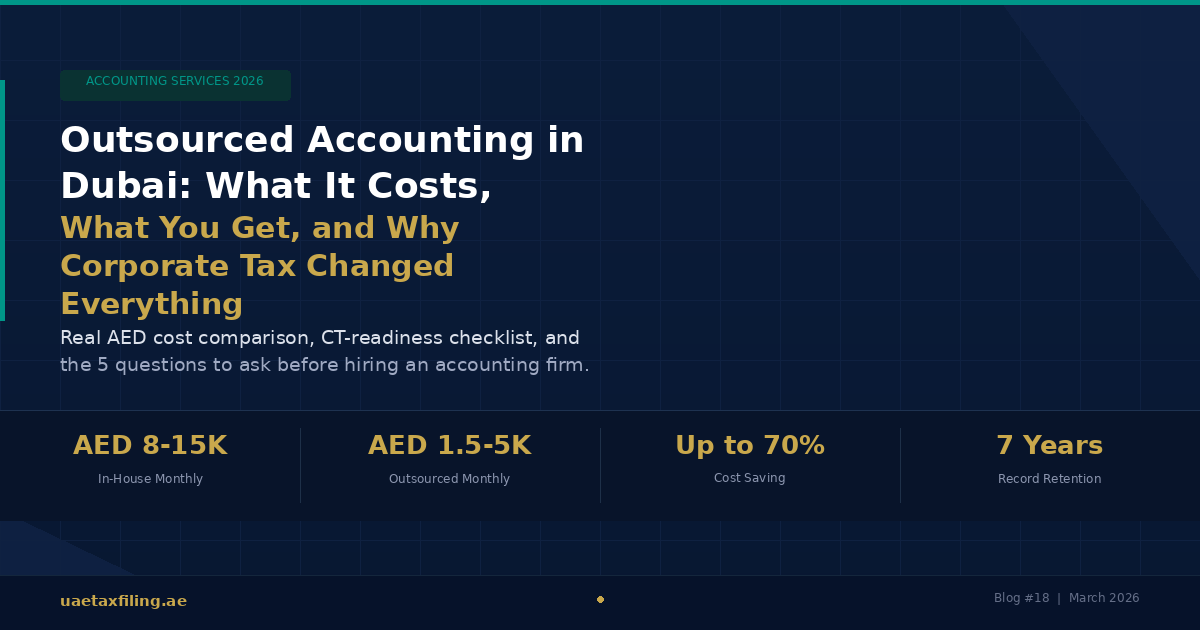
Total monthly cost | AED 11,100 - 22,300 | AED 1,500 - 5,000
Annual cost | AED 133,200 - 267,600 | AED 18,000 - 60,000
The annual saving ranges from AED 73,200 to AED 209,600 depending on the seniority of the in-house hire and the scope of the outsourced engagement. As Fastlane's 2026 pricing analysis confirmed, even their entry-level AED 499/month package includes CT and VAT filing, which would otherwise require specialized knowledge that a junior bookkeeper at AED 5,000 to AED 8,000 per month does not possess.
The hidden cost of in-house: A single employee handling your entire accounting function creates a dependency risk. When that person is on leave, sick, or resigns, your accounting stops. In a CT environment where quarterly VAT returns have rigid deadlines (28 days after quarter-end) and the annual CT return has a single non-extendable deadline, a gap in your accounting function is not just inconvenient. It is a penalty risk.
What an Outsourced Accounting Engagement Actually Includes
Not all outsourced accounting is the same. The market in Dubai has three tiers, and understanding what each tier includes (and excludes) is essential for choosing the right fit.
Tier 1: Basic Bookkeeping (AED 1,000 - 3,000/month)
Includes: Monthly transaction recording in your accounting software, bank reconciliation, accounts payable and receivable tracking, basic trial balance.
Does NOT include: Financial statement preparation (P&L, balance sheet, cash flow), VAT return filing, corporate tax calculation, IFRS adjustments, audit support. You still need someone else to handle tax compliance.
Best for: Very small businesses with simple transactions that have a separate tax advisor handling CT and VAT.
Tier 2: Full Accounting + VAT (AED 3,000 - 5,000/month)
Includes: Everything in Tier 1, plus monthly P&L and balance sheet preparation, quarterly VAT return filing, expense categorization aligned with CT deduction rules, year-end financial statements under IFRS for SMEs.
Does NOT include: Corporate tax return preparation and filing, transfer pricing documentation, audit support, payroll processing. CT filing is typically a separate annual engagement.
Best for: SMEs with AED 1 million to AED 10 million in annual revenue that need ongoing compliance but file their CT return separately or through a tax advisor.
Tier 3: Full Accounting + VAT + CT (AED 5,000 - 15,000/month)
Includes: Everything in Tier 2, plus annual corporate tax return preparation and filing on EmaraTax, the six IFRS-to-taxable-income adjustments, SBR eligibility analysis, deduction optimization, transfer pricing disclosure support (if applicable), audit-ready documentation, and year-round tax advisory.
Best for: Businesses with AED 3 million+ revenue, multi-entity structures, or free zone entities needing QFZP compliance. This tier replaces both the bookkeeper and the tax advisor under a single engagement.
As Capstone's pricing analysis noted, the cost of outsourced accounting scales with transaction volume, not with fixed overhead. A business processing 50 transactions per month pays less than one processing 500, which makes outsourcing inherently more efficient than a salaried employee whose cost is fixed regardless of workload.
Need a quote for your specific situation? Our accounting team provides all three tiers, from basic bookkeeping to full CT-ready accounting with annual filing. Message us on WhatsApp for a no-obligation scope and price within 24 hours.
What Corporate Tax Changed About Accounting Requirements
Before corporate tax, UAE accounting served three purposes: management reporting, VAT compliance, and license renewal audits. Corporate tax added six requirements that most pre-2023 accounting practices were not designed to handle:
1. IFRS-compliant financial statements. The FTA only accepts IFRS or IFRS for SMEs as the basis for CT calculation. Cash-basis accounting is allowed only for businesses under AED 3 million revenue. If your bookkeeper has been maintaining records in a format that does not produce IFRS-compliant P&L, balance sheet, and cash flow statements, your CT return has no valid starting point.
2. Non-deductible expense tagging. The CT Law identifies specific expenses that cannot be deducted: government fines, 50% of entertainment costs, donations to non-qualifying entities, personal expenses, and connected person payments above market value. Your accounting system must tag these as they are recorded, not reconstruct the categorization at year-end.
3. Revenue reconciliation with VAT. Your annual CT revenue must reconcile with the total of your four quarterly VAT return taxable supply figures. If they do not match, the FTA sees a discrepancy. This means your accounting system must track both VAT and CT implications of every transaction simultaneously.
4. Transfer pricing documentation. If you pay yourself as the owner, charge management fees between related entities, or provide interest-free loans, these are connected person or related party transactions. Your accounting must record them at market value and maintain documentation supporting the arm's length pricing.
5. Loss tracking and carry-forward. Tax losses carry forward indefinitely but can only offset 75% of future taxable income. Your accounting system must maintain a running loss balance across tax periods, track the SBR election impact (SBR destroys losses), and flag the 50% ownership continuity requirement.
6. Seven-year record retention. The CT Law requires financial records to be retained for 7 years from the end of the relevant tax period. VAT records must be kept for 5 years (15 years for real estate). Your accounting firm must maintain organized, retrievable records that can be produced within 30 days of an FTA request.
These six requirements are why the cost of outsourced accounting has increased since 2023. A firm charging AED 1,500 per month for basic bookkeeping may not be handling any of these. A firm charging AED 4,000 per month for full CT-ready accounting is covering all six. The difference in price reflects the difference in what happens when the FTA sends a request.
Five Questions to Ask Before Hiring an Accounting Firm
1. Are you registered with the FTA as a tax agent?
An FTA-registered tax agent has passed the FTA's certification requirements and is authorized to represent businesses before the FTA. Not all accounting firms are tax agents. A firm that handles your bookkeeping but is not a registered tax agent cannot file your CT return on your behalf. You would need a separate tax agent for filing, which means two firms handling your financial data, increasing both cost and coordination risk. The ideal arrangement is a single firm that is both your accountant and your registered tax agent.
2. Which accounting standard do you prepare financial statements under?
The only acceptable answer is IFRS or IFRS for SMEs. If the firm says 'we use [software name] standard format' or 'we follow UAE accounting standards,' that is not a standard the FTA recognizes. The FTA's Accounting Standards Guide (CTGACS1) is explicit: IFRS or IFRS for SMEs only. If your financial statements are not prepared under one of these, your CT return starts from the wrong base.
3. Do you handle the CT adjustments, or just the bookkeeping?
Bookkeeping produces accounting profit. Corporate tax requires six categories of adjustments to get from accounting profit to taxable income: non-deductible expense add-backs, exempt income removal, unrealised gain/loss elections, transfer pricing adjustments, loss relief calculations, and other elections. If the firm only does bookkeeping, you still need a tax professional to calculate taxable income. Ask specifically: 'Do you calculate my taxable income and prepare my CT return, or do I need a separate firm for that?'
4. What software do you use, and do I get real-time access?
Cloud-based accounting software (Zoho Books, QuickBooks Online, Xero) gives you real-time visibility into your financial data. You should be able to log in at any time and see your current P&L, balance sheet, and outstanding receivables/payables. If the firm uses desktop software and sends you PDF reports monthly, you have no real-time visibility and your data is trapped in their office. Ask for cloud access with read-only permissions at minimum.
5. What is your turnaround time for VAT returns and annual financial statements?
VAT returns are due 28 days after quarter-end. If your accounting firm takes 20 days to close monthly books, you have 8 days of buffer for the quarterly return. Financial statements for CT purposes should be ready within 3 to 4 months of year-end to give your tax advisor (or the same firm) enough time to calculate taxable income and file the return well before the 9-month deadline. Ask for specific SLAs: 'How many business days after month-end do you deliver the monthly close?'
Red Flags That Your Current Bookkeeper Is Not CT-Ready
They use cash basis accounting when your revenue exceeds AED 3 million. Cash basis is only allowed for businesses under AED 3 million revenue. Above that, you must use accrual basis under IFRS. If your bookkeeper records income when cash is received and expenses when cash is paid, regardless of your revenue level, your financial statements are non-compliant.
There is no chart of accounts aligned with the CT return. The EmaraTax CT return requires specific line items: revenue by type, cost of goods sold, gross profit, operating expenses by category, depreciation, finance costs, and other income. If your chart of accounts does not map to these categories, every CT filing requires manual reclassification, which is slow, expensive, and error-prone.
They do not separate deductible from non-deductible expenses. If government fines, entertainment costs, and owner personal expenses are all recorded in the same general expense account, the year-end CT adjustment requires line-by-line review of every transaction. A CT-ready accounting system tags non-deductible items as they are recorded.
Your VAT return revenue does not match your annual accounts. This is the most common audit trigger. If the sum of your four quarterly VAT returns shows AED 2.4 million in taxable supplies but your annual financial statements show AED 2.1 million in revenue, the FTA will ask why. The difference might be explainable (timing, accruals), but if your bookkeeper cannot explain it with documentation, it becomes a problem.
They have never heard of the realisation basis election. If your business holds investment property, financial instruments, or any assets measured at fair value under IFRS, the realisation basis election on your first CT return determines whether unrealised gains are taxable. This is an irrevocable election. If your bookkeeper does not know what it is, they are not equipped to support your CT filing. Our IFRS guide covers this election in detail.
They provide annual statements only, not monthly. Monthly financial reporting is not just good practice in the CT era. It is essential for tracking your tax position throughout the year, identifying potential SBR eligibility issues before year-end, and ensuring your books are always audit-ready. Annual-only reporting means you discover problems 12 months too late.
Accounting Software for UAE Businesses: The 2026 Comparison
Feature | Zoho Books | QuickBooks Online | Xero | Tally Prime
UAE VAT support | Yes (native) | Yes (native) | Yes (native) | Yes (add-on)
Multi-currency | Yes | Yes | Yes | Yes
Cloud-based | Yes | Yes | Yes | Hybrid (cloud optional)
IFRS reports | Yes | Yes | Yes | Limited
Bank feed integration | Yes (UAE banks) | Yes (UAE banks) | Limited (some UAE banks) | No
CT adjustment tracking | Manual (journal entries) | Manual (journal entries) | Manual (journal entries) | Manual
Starting price (AED/mo) | ~AED 55 | ~AED 110 | ~AED 95 | ~AED 75 (annual license)
Best for | SMEs, startups, service companies | Established SMEs, retail, multi-entity | Professional services, agencies | Trading companies, legacy users
None of these platforms calculate corporate tax adjustments automatically. The CT adjustment layer (adding back non-deductible expenses, removing exempt income, applying the realisation basis) is a manual process performed by the accountant on top of the software output. The software produces the accounting profit; the accountant converts it to taxable income. This is why an accounting firm that understands both the software and the CT rules delivers better results than a bookkeeper who only knows the software.
Industry-Specific Accounting Needs
Not every business needs the same accounting approach. The scope and complexity vary significantly by industry, and the firm you choose should understand your sector's specific requirements.
E-commerce (Amazon, Noon, Shopify): The accounting is inherently more complex than a standard services company. Revenue must be recorded gross (total customer payment), not net (what the platform deposits in your bank). Platform fees, fulfillment charges, and advertising costs are separate expense line items, each potentially triggering reverse charge VAT if invoiced by a non-UAE entity. Inventory accounting under IFRS requires cost-of-goods-sold calculations, provision for slow-moving stock, and potentially IFRS 15 revenue recognition for bundled offers. The margin between getting this right and getting it wrong is the difference between an accurate CT return and a major audit trigger.
Construction and contracting: Long-term contracts require percentage-of-completion revenue recognition under IFRS 15. Progress billing creates timing differences between recognized revenue and invoiced amounts that must be reconciled for both VAT and CT. Retention amounts, subcontractor payments, and project-specific cost tracking add layers of complexity that basic bookkeeping cannot handle. Construction companies also face specific deduction rules around asset depreciation, site costs, and contract penalties.
Professional services (consultants, agencies, legal, IT): Revenue recognition is tied to service delivery milestones, not invoicing dates. Retainer arrangements, time-based billing, and project-based fees each have different IFRS treatments. The key accounting challenge is matching expenses to the periods in which the related revenue is recognized, particularly for multi-month engagements that span across VAT quarters and CT periods.
Trading and import/export: Multi-currency transactions, customs duty treatment, and inventory valuation methods (FIFO, weighted average) are central accounting decisions. Import VAT at customs must be reconciled with input VAT recovery on the quarterly return. Transfer pricing is common in trading structures where goods move between related entities in different jurisdictions or between free zone and mainland entities.
Hospitality and F&B: High-volume daily transactions, tip handling, municipal fees, tourism dirham charges, and food cost accounting create a volume-heavy accounting environment. VAT treatment varies by supply type (dine-in vs takeaway vs delivery), and most hospitality businesses operate on thin margins where accurate expense tracking directly impacts the taxable income calculation.
When evaluating an outsourced firm, ask whether they have clients in your industry. A firm that understands construction percentage-of-completion accounting will deliver better results for a contractor than a generalist who handles it for the first time. Industry experience reduces the learning curve, catches sector-specific errors, and ensures your financial statements reflect how your business actually operates.
When to Switch: Five Signals It Is Time to Outsource
1. You missed or almost missed a filing deadline. If your Q2 VAT return was filed on day 27 of the 28-day window because the books were not closed in time, or if your CT return preparation started in the same month it was due, your current arrangement is not sustainable. The penalties for late filing and late payment are cumulative and expensive. One near-miss is a warning. Two is a pattern.
2. Your in-house accountant resigned. This is the most common trigger for outsourcing. A departing accountant takes institutional knowledge with them. If their replacement needs 2 to 3 months to get up to speed, you have 2 to 3 months of incomplete or delayed accounting during a period when VAT returns are still due every quarter.
3. Your business crossed AED 3 million in revenue. Below this threshold, cash basis accounting was sufficient and SBR eliminated the CT liability. Above it, you need accrual-basis IFRS, a proper taxable income calculation, and potentially more sophisticated deduction tracking. The complexity jump requires a corresponding upgrade in your accounting function.
4. The FTA sent an audit notification. An FTA audit demands organized, retrievable records produced within 30 days. If your current accounting cannot produce a clean trial balance, reconciled bank statements, and supporting documentation for every material transaction within that window, you need professional help immediately.
5. You are spending your own time on accounting. If the business owner is doing the bookkeeping, reviewing the VAT return, or reconciling bank statements personally, the cost is not the AED 3,000 monthly retainer you are saving. It is the revenue you are not generating by spending 20+ hours per month on accounting instead of on your business. At any reasonable hourly rate, the opportunity cost of owner-managed accounting exceeds the cost of outsourcing within the first month.
The best time to switch is before you need to urgently. Transitioning mid-crisis (missed deadline, audit notification, departing staff) costs more and produces worse results than a planned handover with proper onboarding. If you recognize any of these five signals, the conversation should start now, not when the next filing deadline is 48 hours away.
Frequently Asked Questions
How much does outsourced accounting cost in Dubai?
Basic bookkeeping: AED 1,000 to 3,000 per month. Full accounting with VAT: AED 3,000 to 5,000. Full accounting with VAT and CT: AED 5,000 to 15,000. These ranges reflect 2026 Dubai market rates based on business size and transaction volume.
Is outsourced accounting cheaper than hiring in-house?
Yes. The total cost of an in-house accountant (salary, visa, insurance, benefits, office space, software, training) ranges from AED 11,100 to AED 22,300 per month. Outsourced firms provide comparable or better coverage for AED 1,500 to AED 5,000 per month, saving AED 73,200 to AED 209,600 annually.
Can an outsourced firm file my CT return?
Only if the firm includes an FTA-registered tax agent. Basic bookkeeping firms cannot file CT returns on your behalf. Ask specifically whether the firm can file on EmaraTax using their tax agent credentials.
Which accounting standard must my books follow?
IFRS (full) or IFRS for SMEs. Cash basis is allowed only for businesses under AED 3 million revenue. No other standards are accepted by the FTA for corporate tax purposes.
What records must I keep and for how long?
Financial records: 7 years from the end of the tax period. VAT records: 5 years (15 years for real estate). Records must be retrievable within 30 days of an FTA request.
Should I use the same firm for accounting and tax?
Ideally yes. When one firm handles both, the financial statements flow directly into the CT calculation without data transfer, reclassification, or reconciliation between two providers. It reduces cost, errors, and coordination overhead.
How do I switch from my current bookkeeper to an outsourced firm?
The new firm performs a takeover: reviews your existing records, migrates data to their software (or continues on yours), verifies opening balances, and reconciles all accounts as of the handover date. This typically takes 2 to 4 weeks depending on the state of your current records.
Will an outsourced firm handle my FTA audit?
Tier 3 firms (full accounting + CT) typically include audit support. They prepare the documentation package, respond to FTA queries, and represent your business throughout the audit process. Tier 1 and Tier 2 firms may not include this.
What if my current records are a mess?
Most outsourced firms offer a one-time cleanup or reconstruction service. This involves reviewing bank statements, invoices, and receipts to reconstruct accurate records for the periods that need correction. Expect to pay AED 5,000 to AED 20,000 for a reconstruction depending on the volume and complexity.
Does my e-commerce business need different accounting?
Yes. E-commerce businesses have specific requirements: recording gross revenue (not net settlement from platforms), applying reverse charge VAT on marketplace fees, and reconciling platform settlement reports with bank deposits. Our e-commerce tax guide covers these requirements in detail.
Your Accounting Is Your Tax Return
The phrase is worth repeating because it captures the fundamental shift that corporate tax created. Before 2023, accounting was a back-office function that most business owners thought about once a quarter (VAT) or once a year (audit). In 2026, accounting is the foundation of your entire tax position. The six adjustments from accounting profit to taxable income cannot be calculated without accurate, IFRS-compliant financial statements. The CT return cannot be filed without those adjustments. And the FTA cannot be satisfied during an audit without the records that support them.
The businesses that pay the least in penalties, experience the smoothest audits, and make the most informed financial decisions are the ones whose accounting function, whether in-house or outsourced, operates as a continuous process rather than a year-end scramble. Monthly closes, quarterly VAT filings, mid-year CT projections, and year-end statements should all flow from the same data, maintained by the same team, under the same standards.
If you are evaluating whether to outsource, start with the five questions. If your current provider cannot answer all five confidently, that is your answer.
Our accounting services cover all three tiers: monthly bookkeeping, full IFRS financial statement preparation, quarterly VAT return filing, and annual corporate tax calculation and filing. One firm, one team, one set of records. Message us on WhatsApp for a scope and quote within 24 hours.