You have discovered an error in a filed tax return. Maybe your VAT return overstated input tax by AED 30,000. Maybe your first corporate tax return excluded a related party transaction that should have appeared on the transfer pricing disclosure. Maybe your accountant misclassified entertainment expenses as fully deductible when the law caps them at 50%. The error exists, it is sitting in an FTA system, and you need to know what to do next.
The answer is a voluntary disclosure. A voluntary disclosure is a formal correction of a previously filed tax return, submitted through EmaraTax before the FTA discovers the error through its own review or audit. The math is unambiguous: correcting an error yourself costs a fraction of what it costs when the FTA finds it. As Alvarez & Marsal documented, on AED 100,000 of unpaid corporate tax discovered 6 months after the original due date, the voluntary disclosure penalty under the new regime is AED 6,000. If the same error is discovered during an FTA audit, the penalty jumps to AED 15,000 plus the monthly charge, a 150% increase in the starting penalty alone.
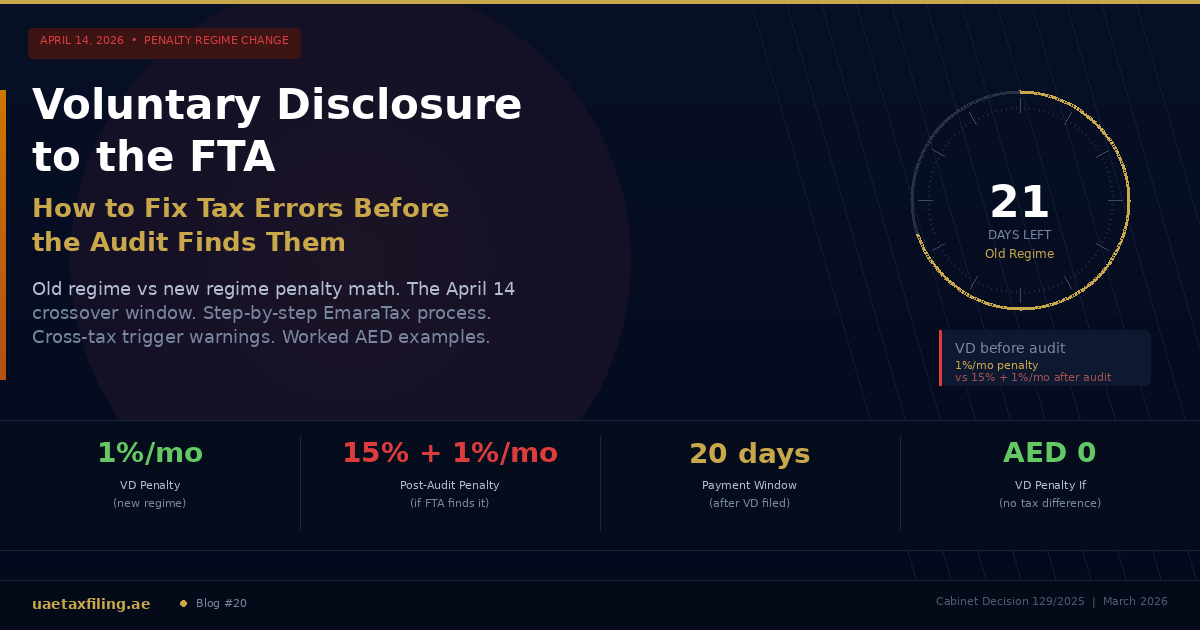
This guide is also time-sensitive. On April 14, 2026, the entire penalty framework for voluntary disclosures changes under Cabinet Decision 129 of 2025. The old stepped-band system (5% to 40% of the tax difference) is replaced by a flat 1% per month model. Our comprehensive 2026 tax changes overview covers the full scope of what shifts on that date, and our VAT penalty guide explains the VAT-side implications in detail. Our CT penalties guide covers the corporate tax penalty cascade. For some errors, disclosing before April 14 is cheaper. For others, waiting until the new regime is cheaper. The crossover analysis in this article is published nowhere else.
"Every tax return has a shelf life. The longer an error sits unfixed, the more expensive it becomes. The FTA rewards businesses that find their own mistakes. That reward disappears the moment an audit notification lands in your EmaraTax inbox."
Jazim, CEO, UAE Tax Filing LLC
When Voluntary Disclosure Is Required
Under Article 7 of the Tax Procedures Law, a voluntary disclosure is mandatory when a taxable person discovers that a previously filed return, or a refund application, contains an error that results in a tax difference. 'Tax difference' means the gap between the tax that was declared and the tax that should have been declared. If you understated your output VAT by AED 5,000 in a quarterly return, the tax difference is AED 5,000. If you claimed AED 20,000 in corporate tax deductions that were not deductible, the tax difference is 9% of AED 20,000 = AED 1,800.
VD is required when: The error changes the amount of tax due. This includes understated output VAT, overstated input VAT, understated CT income, overstated CT deductions, incorrect SBR election that reduced your taxable income to zero when it should not have, missed reverse charge entries, and any error in a VAT refund claim that increased the refund amount.
VD is not required when: The error does not change the tax due. Correcting a typo in your business name, fixing a TRN reference, or updating your address in EmaraTax does not trigger a VD requirement. As MS-CA noted, the updated practice under the new regime allows minor errors that do not affect the tax amount to be corrected through amended returns without triggering the formal VD process or its associated penalties.
The 20-business-day rule: Once you discover an error, you must file the VD within 20 business days. The FTA does not specify how you 'discover' the error, but the clock starts the moment you know (or should have known) that the return was incorrect. If your accountant tells you on March 15 that the Q3 2025 VAT return had an input tax overclaim, the 20-business-day window closes around April 14 (depending on public holidays). This deadline is separate from the payment deadline. Filing the VD and paying the resulting tax difference are two distinct obligations with potentially different timelines.
Discovered an error in your VAT or corporate tax return? Our tax team reviews the error, calculates the exact tax difference, prepares the VD on EmaraTax, and files it within the 20-business-day window. Message us on WhatsApp now.
The April 14 Crossover: Old Regime vs New Regime Penalty Math
This is the analysis no competitor has published. Cabinet Decision 129 of 2025, effective April 14, 2026, replaces the old VD penalty structure with a fundamentally different model. Understanding both is critical for any business disclosing errors in the next 21 days.
The Old Regime (Before April 14, 2026)
Under Cabinet Decision 49 of 2021, VD penalties were calculated as a percentage of the tax difference, based on how long after the original filing the VD was submitted:
VD Filed Within | Penalty (% of Tax Difference) | On AED 50,000 Tax Difference
Before original due date | 0% | AED 0
Within 1 year of due date | 5% | AED 2,500
1 to 2 years after due date | 10% | AED 5,000
2 to 3 years after due date | 20% | AED 10,000
3 to 4 years after due date | 30% | AED 15,000
More than 4 years after due date | 40% | AED 20,000
The old regime rewarded early disclosure heavily: if you caught and corrected an error before the return's original due date, the penalty was zero. Within the first year, just 5%. But the bands escalated steeply. A four-year-old error cost 40% of the tax difference, regardless of the size.
The New Regime (From April 14, 2026)
Under Cabinet Decision 129 of 2025, the stepped bands are replaced with a time-based monthly model:
Scenario | Penalty
VD filed, error does not change tax due | Penalty may be waived entirely
VD filed before FTA audit notification | 1% per month of tax difference (from original due date to VD date)
VD filed after FTA audit notification | 15% fixed + 1% per month (to VD date)
Error discovered by FTA during audit (no VD filed) | 15% fixed + 1% per month (to assessment date)
The new model is linear: every month of delay adds exactly 1% of the tax difference. There are no stepped jumps, no cliff edges. But there is also no zero-penalty window for corrections made before the original due date. As GFLO Consultancy explained, the penalty may be waived if the correction does not change the tax amount due, but any error that increases the tax liability triggers the 1% monthly charge from the original due date forward.
Worked Examples: Which Regime Is Cheaper for Your Error?
This is where the practical decision gets made. The answer depends on two variables: how old the error is and how large the tax difference is. The percentage-per-month under the new regime means the crossover point is around 5 months: errors younger than 5 months are cheaper to disclose under the old regime (5% flat vs 1% x months), while errors older than 10 months begin to favor the new regime.
Scenario 1: AED 10,000 tax difference, error is 4 months old
| Old Regime (before Apr 14) | New Regime (after Apr 14)
Penalty calculation | 5% of AED 10,000 | 1% x 4 months x AED 10,000
Penalty amount | AED 500 | AED 400
Cheaper regime? |
| New regime saves AED 100
Scenario 2: AED 50,000 tax difference, error is 8 months old
| Old Regime (before Apr 14) | New Regime (after Apr 14)
Penalty calculation | 5% of AED 50,000 | 1% x 8 months x AED 50,000
Penalty amount | AED 2,500 | AED 4,000
Cheaper regime? | Old regime saves AED 1,500 |
Scenario 3: AED 200,000 tax difference, error is 18 months old
| Old Regime (before Apr 14) | New Regime (after Apr 14)
Penalty calculation | 10% of AED 200,000 | 1% x 18 months x AED 200,000
Penalty amount | AED 20,000 | AED 36,000
Cheaper regime? | Old regime saves AED 16,000 |
Scenario 4: AED 200,000 tax difference, error is 36 months old
| Old Regime (before Apr 14) | New Regime (after Apr 14)
Penalty calculation | 20% of AED 200,000 | 1% x 36 months x AED 200,000
Penalty amount | AED 40,000 | AED 72,000
Cheaper regime? | Old regime saves AED 32,000 |
The pattern: For errors within the first year (the 5% band), the old and new regimes cross over at 5 months. Below 5 months, the new regime is marginally cheaper. Above 5 months, the old regime is cheaper. For errors older than 1 year, the old regime is almost always cheaper because the 10% and 20% bands are capped, while the new regime's 1% per month keeps accumulating without limit.
The tactical conclusion: If you have a known error that is more than 5 months old and the tax difference is material, there is a financial incentive to disclose before April 14, 2026, under the old regime. Once April 14 passes, the 1% per month charge continues to grow, and there is no cap. However, this decision must be weighed against the transitional provisions: the FTA has not published explicit guidance on how errors straddling the April 14 date will be calculated. Professional advice is not optional here.
Have a known error that needs disclosure? The regime choice matters. Our corporate tax team and VAT advisory team calculate the penalty under both regimes and file under whichever is cheaper for your situation. WhatsApp us now before April 14.
Voluntary Disclosure vs Audit Discovery: The Cost Comparison
The penalty gap between self-correction and FTA discovery is the entire reason voluntary disclosure exists. The FTA designed the system to reward proactive compliance. As Alvarez & Marsal's analysis showed, the FTA's 2024 Annual Report revealed 93,000 inspection visits in that year alone, a 135% increase from the previous year. The FTA is not waiting for errors to surface. It is actively looking.
AED 50,000 Tax Difference | VD Before Audit (new regime) | VD After Audit Notice | FTA Assessment (no VD)
6 months after due date | AED 3,000 (1% x 6) | AED 10,500 (15% + 1% x 6) | AED 10,500+
12 months after due date | AED 6,000 (1% x 12) | AED 13,500 (15% + 1% x 12) | AED 13,500+
24 months after due date | AED 12,000 (1% x 24) | AED 19,500 (15% + 1% x 24) | AED 19,500+
At every time point, the VD penalty is lower than the audit-discovery penalty. At 6 months, the difference is AED 7,500 (71% cheaper). At 12 months, AED 7,500 (56% cheaper). At 24 months, AED 7,500 (38% cheaper). The 15% fixed penalty that applies after an audit notification is the price of inaction. It is a permanent surcharge that cannot be negotiated, waived, or appealed.
There is an additional cost that does not appear in penalty tables: the audit process itself. An FTA audit is not a single interaction. It involves formal notifications, document requests, information exchange over business days, potential site visits, and a period of uncertainty during which the FTA may examine not just the specific error but the entire return. The operational disruption, professional fees for audit support, and management time consumed by an audit far exceed the penalty difference alone.
How to File a Voluntary Disclosure on EmaraTax: Step by Step
The VD process is entirely digital. There is no paper form, no in-person submission, and no appointment required. The process differs slightly between VAT and CT disclosures, but the core workflow is the same.
Step 1: Log in to EmaraTax. Access your business account at eservices.tax.gov.ae. Go to the tax type (VAT or Corporate Tax) for which the error occurred.
Step 2: Identify the return period. Select the specific tax period that contains the error. For VAT, this is the quarter (e.g., Q3 2025). For CT, this is the tax year (e.g., January to December 2024). You cannot file a VD for a return that has not yet been filed, and you cannot file a VD for a period where no return is due.
Step 3: Initiate the voluntary disclosure. Click 'Voluntary Disclosure' for the selected period. EmaraTax will open a form that mirrors the original return. You must enter the corrected figures in the same fields where the original error appeared. Do not leave the remaining fields blank; they must reflect the same values as the original return.
Step 4: Declare the reason for the correction. EmaraTax requires a written explanation of the error. Be specific: 'Input VAT on invoice #1234 from Supplier X was claimed at AED 15,000 but the correct amount was AED 10,000 due to a currency conversion error' is appropriate. 'Error in VAT' is not. The FTA reviews these explanations. Vague descriptions may prompt follow-up inquiries.
Step 5: Submit the VD. Review the corrected figures, confirm the tax difference, and submit. EmaraTax calculates the VD penalty automatically based on the applicable regime (old or new, depending on whether the VD is filed before or after April 14, 2026).
Step 6: Pay the tax difference and penalty. The tax difference and the VD penalty appear as separate liabilities in your EmaraTax account. Payment is due within 20 business days of the VD submission date. This is a separate deadline from the original return's payment deadline. Late payment on the VD itself triggers the standard 14% per annum interest charge on the unpaid amount.
Keep all supporting documentation: the original return (download a copy from EmaraTax before filing the VD), the corrected figures with workings, the invoices or records that justify the correction, and the VD confirmation from EmaraTax. The FTA requires record retention for 7 years for corporate tax and 5 years for VAT (15 years for real estate). If you use outsourced accounting, confirm that your firm has copies of all corrected workings and can produce them on request.
The Cross-Tax Trigger: How a VAT Disclosure Can Open a CT Review
This risk is discussed by zero competitors and understood by very few businesses. The FTA operates a unified taxpayer profile. Your VAT filings, CT filings, and disclosure history are all visible in a single system. When you file a voluntary disclosure for one tax, the FTA can see the correction and cross-reference it against the other tax.
Consider this scenario: a business files a VAT VD correcting AED 100,000 in previously overstated input VAT. The correction means the business paid AED 5,000 more in VAT than originally declared. The FTA's automated system flags this: if input VAT was overstated, were the corresponding expenses also overstated on the CT return? If the business claimed those same expenses as deductible costs for CT purposes, the CT return may also be incorrect. The FTA does not need to open a formal audit to review this; the VD itself provides the data point that triggers the cross-reference.
The practical implication: before filing a VD for either tax, review the impact on the other tax. If the error affects both VAT and CT, file both disclosures simultaneously. Filing a VAT VD today and hoping the CT implications go unnoticed is not a strategy. The FTA's cross-referencing capability, documented in their 2024 Annual Report showing 93,000 inspections, runs systematically, not manually.
For e-commerce sellers this risk is particularly acute. Marketplace fees from Amazon and Noon carry reverse charge VAT obligations that are also CT-deductible expenses. An error in the reverse charge entry on the VAT return almost certainly means an error on the CT return as well. For freelancers who import services from overseas, the same dynamic applies: a missed reverse charge on the VAT side means a missed expense or a missing entry on the CT side.
The Seven Most Common Errors That Require Voluntary Disclosure
1. Input VAT overclaim on non-deductible expenses. Claiming input VAT on expenses that are blocked: entertainment for non-employees, personal expenses of shareholders, or expenses related to exempt supplies. This is the most common VAT error. The FTA checks this against your expense categories.
2. Missed reverse charge on imported services. Foreign service providers (advertising agencies, SaaS providers, consultants) do not charge UAE VAT. The buyer must self-account through the reverse charge mechanism. Missing the output VAT entry understates your VAT liability. Missing the corresponding input VAT entry means you also miss a legitimate recovery.
3. Incorrect SBR election. Filing a CT return with Small Business Relief elected when revenue exceeded AED 3 million, or electing SBR without understanding that it permanently destroys loss carry-forward capacity. If the election was incorrect, the return must be corrected through VD. New businesses are particularly exposed to this error because SBR appears attractive in the first year without considering multi-year tax planning.
4. Related party transactions not disclosed. Failing to disclose transactions with related parties or connected persons above the threshold (AED 40 million aggregate related party, AED 500,000 connected person). The disclosure is mandatory; omission is an error on the return itself.
5. Revenue timing mismatch between VAT and CT. Recording revenue for VAT in one quarter but for CT in a different period. As we discussed in the IFRS guide, revenue recognition under accounting standards and VAT tax point rules can differ. The error is not the timing difference itself; it is failing to reconcile and document the difference.
6. Incorrect QFZP income classification. A free zone entity claiming 0% CT on income that does not qualify as qualifying income (e.g., mainland-source services that exceed the de minimis threshold). This error risks not just the VD penalty but the five-year disqualification from QFZP status.
7. Overclaimed VAT on credits that have expired. Claiming input VAT on credits older than 5 years (from January 1, 2026) or from the transitional window (pre-2021 credits expiring December 31, 2026). If the credit has expired, the claim is invalid and must be reversed through VD.
What Happens After You File a Voluntary Disclosure
Filing the VD is not the end of the process. Four things happen next.
The FTA reviews the disclosure. The FTA may accept the VD as filed, or it may request additional information. There is no guaranteed acceptance period. If the FTA considers the VD incomplete or if the correction appears to require further examination, it can open a tax audit within the scope of the disclosed period. Filing a VD does not immunize you from audit; it demonstrates compliance intent, which the FTA considers during enforcement decisions.
The penalty is calculated. EmaraTax computes the VD penalty and adds it to your tax liability. Under the new regime, this is 1% per month of the tax difference, counted from the original due date of the return to the date the VD is submitted. The penalty appears as a separate line item in your EmaraTax account.
The 20-business-day payment clock starts. You have 20 business days from the date the VD is filed to pay both the tax difference and the VD penalty. If you do not pay within this window, the 14% per annum late payment interest begins accruing on the unpaid amounts. This is separate from the VD penalty itself; it is additional interest on top of it.
Your compliance history is updated. The FTA maintains a compliance score for each taxpayer. A VD is recorded as proactive compliance. An audit finding is recorded as non-compliance. While the FTA has not published the exact scoring methodology, the practical effect is observable: businesses with clean compliance histories experience fewer and less intensive audit interactions.
The partner agency we match you with handles the entire VD process: error identification, tax difference calculation, penalty regime analysis, EmaraTax filing, and post-VD follow-up. It files both VAT disclosures and CT disclosures from a single set of reconciled records, eliminating cross-tax trigger risk. Start on WhatsApp.
Frequently Asked Questions
What is a voluntary disclosure to the FTA?
A voluntary disclosure is a formal correction of a previously filed tax return submitted through EmaraTax. It is required when you discover an error that changes the amount of tax due.
What is the penalty for a voluntary disclosure in the UAE?
From April 14, 2026: 1% per month of the tax difference, calculated from the original due date to the VD filing date. Before April 14: a stepped percentage ranging from 0% (if corrected before due date) to 40% (errors older than 4 years).
Is there a penalty if the error does not change the tax amount?
Under the new regime, the penalty may be waived entirely if the correction does not affect the amount of tax due. Minor administrative errors can often be corrected through amended returns without triggering the VD process.
How long do I have to file a voluntary disclosure?
20 business days from the date you discover (or should have discovered) the error.
What happens if I file a VD after receiving an FTA audit notification?
The penalty increases to 15% fixed plus 1% per month. This is significantly more expensive than disclosing before audit notification. Always disclose before an audit if possible.
Can a VAT voluntary disclosure trigger a corporate tax review?
Yes. The FTA operates a unified taxpayer profile. Corrections to VAT returns can be cross-referenced against CT filings. If the same error affects both taxes, file both disclosures simultaneously.
How do I pay the tax difference after filing a VD?
The tax difference and VD penalty appear as liabilities in EmaraTax. Payment is due within 20 business days. Late payment triggers 14% per annum interest, calculated monthly.
Should I disclose before or after April 14, 2026?
It depends on the error's age and size. For errors more than 5 months old, the old regime (before April 14) is typically cheaper. For errors less than 5 months old, the new regime may be marginally cheaper. Consult a tax professional to calculate both scenarios.
What if the FTA rejects my voluntary disclosure?
The FTA may request additional information or documentation rather than outright rejection. If the FTA considers the disclosure incomplete, it may open a review. Filing a comprehensive, well-documented VD reduces this risk.
What records should I keep after filing a VD?
The original return, corrected figures with workings, supporting invoices and records, VD confirmation from EmaraTax, and proof of payment. Retain for 7 years (CT) or 5 years (VAT, 15 years for real estate).
Every Error Has a Cost. Disclosure Controls That Cost.
Tax errors are not moral failures. They are arithmetic and classification problems in a tax regime that is three years old, changing rapidly, and layered across VAT, CT, and excise simultaneously. Errors happen to well-run businesses with competent accountants. The difference between a manageable cost and a damaging penalty is the speed and completeness with which you correct them.
The FTA designed the voluntary disclosure system to make self-correction the rational choice. At every time point, the VD penalty is lower than the audit penalty. At every error size, proactive disclosure costs less than reactive discovery. The only way to lose this advantage is to wait.
April 14, 2026 is not just a penalty regime change. It is a prompt. If you have known errors in VAT or CT returns, the old regime's stepped bands are available for 21 more days. After that, the 1% per month clock runs from the original due date with no cap and no discount for early correction. The window is closing. Use it.