A UAE technology company spends AED 3 million per year on software development: engineers building new AI algorithms, data scientists testing machine learning models, and product teams iterating on experimental features that may or may not work. Until March 2026, those costs were fully deductible as business expenses under the standard CT deduction rules, reducing the taxable income by AED 3 million. The tax saving: AED 270,000 (9% of AED 3M). That was the entire benefit.
From tax periods starting January 1, 2026, the same company can claim an R&D tax credit of up to AED 1.25 million on that AED 3 million in qualifying expenditure. The deduction still applies (the AED 3M is still a deductible expense). The credit is applied on top: it directly reduces the CT liability, dirham for dirham, after the taxable income calculation. The company deducts the AED 3M from revenue, calculates its CT, and then reduces that CT by up to AED 1.25M. The effective tax cost of the R&D drops dramatically.
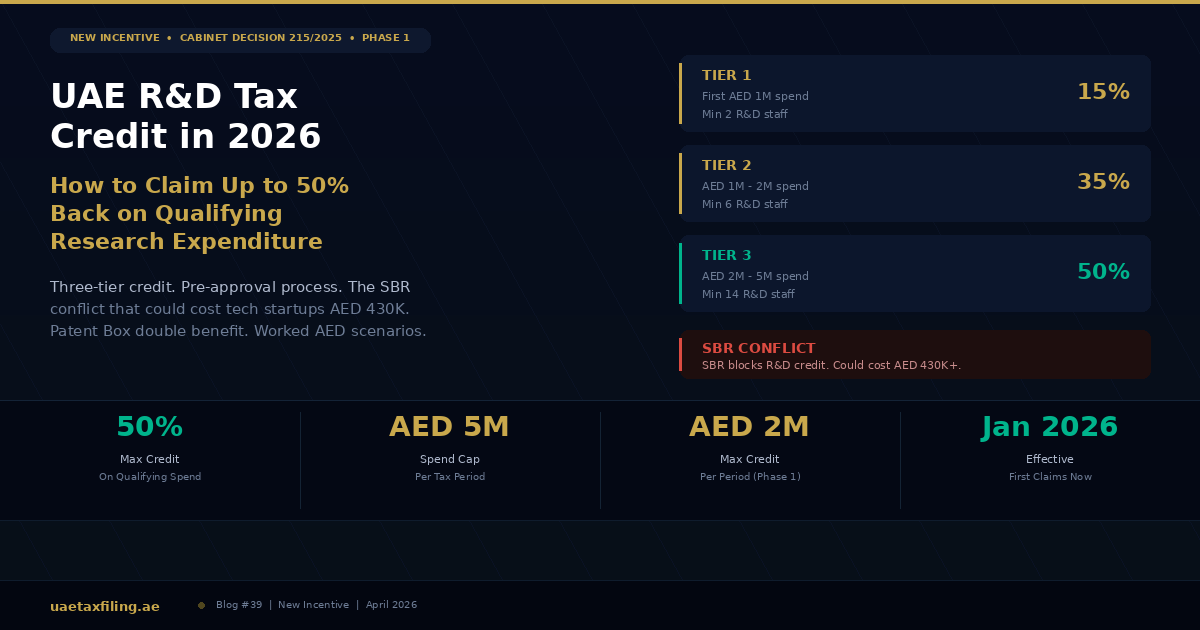
Cabinet Decision No. 215 of 2025 and Ministerial Decision No. 24 of 2026 established the framework. As PwC's detailed analysis documents, this is Phase 1 of the UAE's R&D incentive program, with the Ministry of Finance signaling potential enhancements (including refundable credits) in future phases. The credit is non-refundable in Phase 1, meaning it offsets CT liability but does not generate a cash payment if the credit exceeds the tax owed. It is capped at AED 2 million per tax period. And it requires mandatory pre-approval from the Emirates Research and Development Council before any claim is made.
This article breaks down the three-tier credit structure, the five qualifying criteria every R&D activity must meet, the expenditure categories that qualify (and those that do not), the pre-approval process, the SBR conflict that could cost R&D-active startups hundreds of thousands of dirhams, and the Patent Box double benefit that makes the UAE one of the most innovation-friendly tax environments in the world.
"This is the first time the UAE has offered a tax incentive that rewards spending rather than just low rates. Every other advantage in the UAE tax system is structural: low rates, zero-rate bands, free zone exemptions. The R&D credit is different. It says: spend money on innovation in the UAE, and we will give part of it back. For tech companies, biotech firms, and manufacturing R&D teams, this changes the financial calculus of where to locate their development operations."
Jazim, CEO, UAE Tax Filing LLC
The Three-Tier Credit Structure: 15%, 35%, and 50%
The R&D tax credit is not a flat rate. It operates on a progressive tiered system where the credit percentage increases with both the amount of qualifying expenditure and the number of R&D staff employed. As Deloitte's comprehensive analysis documents, the tiers are designed to reward businesses that make larger R&D commitments and create more R&D jobs in the UAE.
Tier 1: 15% credit on the first AED 1 million of qualifying R&D expenditure. Requires a minimum average of 2 R&D personnel during the tax period. Maximum credit from this tier: AED 150,000. This is the entry-level tier designed for small R&D teams and early-stage research projects.
Tier 2: 35% credit on qualifying R&D expenditure between AED 1 million and AED 2 million. Requires a minimum average of 6 R&D personnel. Maximum credit from this tier: AED 350,000 (35% of AED 1M incremental spend). Combined with Tier 1: up to AED 500,000.
Tier 3: 50% credit on qualifying R&D expenditure between AED 2 million and AED 5 million. Requires a minimum average of 14 R&D personnel. Maximum credit from this tier: AED 1,500,000 (50% of AED 3M incremental spend). Combined with Tiers 1 and 2: up to AED 2,000,000.
The tiers are cumulative: a business spending AED 4 million with 14+ R&D staff claims 15% on the first AED 1M (AED 150K) plus 35% on the next AED 1M (AED 350K) plus 50% on the next AED 2M (AED 1M) = AED 1,500,000 total credit. The overall cap per tax period is AED 2 million, which is reached at AED 5 million in qualifying expenditure with 14+ staff.
Staff counts matter. The staffing thresholds are minimum averages across the tax period, not headcounts at a single point. A company with 10 R&D engineers in January and 18 in December averages 14, which qualifies for Tier 3. A company with 14 staff for six months and 4 staff for six months averages 9, which qualifies for Tier 2 but not Tier 3. As JAXA's analysis documented, the staff must be directly involved in qualifying R&D activities, not general administrative or commercial staff allocated to an R&D project label.
What Counts as Qualifying R&D: The Five Frascati Criteria
Not every development activity qualifies. Ministerial Decision 24/2026 requires that qualifying R&D activities meet all five criteria from the OECD Frascati Manual, the internationally recognized framework for defining and measuring R&D. Every activity must be:
1. Novel. The work must aim to produce new findings, knowledge, or results that did not previously exist. Applying existing knowledge to a known problem with a known solution is not novel. Building a mobile app using standard frameworks and established design patterns is not R&D. Building a new machine learning algorithm that processes data in a way no existing algorithm can is novel.
2. Creative. The work must involve original concepts, hypotheses, or approaches. Routine engineering, standard quality testing, and incremental product updates do not satisfy the creativity requirement. The work must involve genuine intellectual contribution beyond applying established methods.
3. Uncertain. The outcome of the work, or the means of achieving it, must not be known in advance. If you know the answer before you start, it is not R&D. The uncertainty can be about the technical feasibility (will this approach work?), the optimal method (which of several experimental approaches will produce the best result?), or the timeline (how long will development take given the unknowns?). Routine software development where the outcome is predictable does not qualify.
4. Systematic. The work must follow a structured plan with a defined budget. Ad hoc experimentation without a project plan, budget allocation, and documented methodology does not qualify. The Emirates R&D Council will evaluate whether the project was conducted with proper planning and resource allocation.
5. Transferable or reproducible. The results must be capable of being applied or replicated in other contexts. Proprietary trade secrets that cannot be documented or transferred do not satisfy this criterion. The knowledge generated must be codifiable: documented in reports, patents, publications, or technical specifications that others could use or build upon.
Excluded activities: Social sciences, humanities, and the arts are explicitly excluded. Market research, consumer testing, routine quality control, aesthetic design work, business process optimization, and legal or financial analysis are not qualifying R&D. As Chambers & Partners' UAE guide confirms, routine software updates or aesthetic design changes do not qualify, but the development of new AI algorithms, advanced manufacturing processes, or sustainable energy solutions are positioned for claims.
Which Expenditures Qualify (and Which Do Not)
Staff costs (with 30% uplift). Salaries, benefits, and social contributions for employees directly involved in qualifying R&D activities. The legislation provides a 30% uplift on staff costs to account for associated overheads (office space, utilities, IT infrastructure) without requiring the business to separately calculate and allocate those overheads. If a developer earns AED 300,000 per year and spends 100% of their time on qualifying R&D, the qualifying expenditure is AED 390,000 (AED 300K plus 30% uplift). If they spend 60% of their time on R&D and 40% on commercial work, the qualifying expenditure is AED 234,000 (60% of AED 390K).
Consumables and materials. Lab supplies, prototypes, test components, and materials directly consumed during R&D activities. This does not include general office supplies or materials used for commercial production.
Subcontracting to UAE-based entities. Payments to UAE-based third-party research institutions, universities, or specialist contractors for contracted R&D services. The subcontractor must be UAE-based. Payments to foreign research institutions do not qualify. This is a deliberate policy choice: the incentive rewards R&D activity conducted within the UAE.
Capitalized costs of internally generated intangibles. If R&D expenditure is capitalized as an intangible asset under IFRS (for example, development costs meeting the capitalization criteria under IAS 38), the capitalized amount qualifies for the credit. This is important: the credit is available whether the R&D costs are expensed or capitalized, ensuring that the accounting treatment does not determine the tax benefit.
What does NOT qualify. Expenditure funded by a government grant (you cannot claim both a grant and a credit on the same costs). Expenditure that is not deductible for CT purposes (non-deductible expenses cannot generate R&D credits). Expenditure on routine activities (quality control, maintenance, standard testing). Expenditure on activities outside the UAE (the R&D must be conducted in the UAE). And critically: the minimum qualifying R&D expenditure per project is AED 500,000 (excluding the 30% staff uplift). Projects with total R&D spend below AED 500,000 are not eligible.
Identifying which of your activities and expenditures qualify requires specialist review against the Frascati criteria. Our corporate tax team assesses your R&D portfolio, maps qualifying expenditure to the tiered credit structure, and prepares the pre-approval application to the Emirates R&D Council. Message us on WhatsApp.
The Pre-Approval Process: You Must Apply Before You Claim
The R&D credit cannot be claimed retroactively on your CT return without prior authorization. Each qualifying R&D project must be pre-approved by the Emirates Research and Development Council (the 'Council') before the credit can be included on the tax return. As PwC's analysis emphasizes, the mandatory pre-approval is where many businesses will succeed or fail in their R&D credit claims.
The application process. Submit an application to the Council in the prescribed form describing: the R&D project objectives, the technical uncertainties being addressed, the planned methodology, the expected timeline, the projected expenditure by category, the number of R&D personnel involved, and how the project meets each of the five Frascati criteria. The Council evaluates whether the project qualifies and issues approval or rejection.
Timing. The application should be submitted before or during the tax period in which the R&D expenditure is incurred. Applying after the tax period has ended and the CT return is being prepared creates timing risk. If the Council has not issued approval by the time the CT return is due, the credit cannot be claimed on that return. Start the application process early, ideally at the beginning of the tax period when the R&D project begins. For tax periods starting January 1, 2026 (the first eligible period), applications should be submitted as soon as possible.
Project-level approval. Approval is granted per project, not per entity. A company with three R&D projects must submit three separate applications. Each project is evaluated independently against the qualifying criteria. Approval for one project does not extend to others.
Documentation requirements. The Council expects detailed project documentation: technical specifications, research plans, budget allocations, staff assignments with time-tracking records, progress reports, and results documentation. As JAXA's guide advises, businesses should establish dedicated R&D documentation practices from the start of the project, not at the end when filing the credit claim. Seven years of record retention is required for R&D credit documentation, compared to the standard five years for general CT records.
The SBR Conflict: The AED 430,000 Mistake R&D Startups Are About to Make
This is the most important section of this article for any tech startup or innovation-driven SME with revenue under AED 3 million.
Under Small Business Relief, businesses with revenue under AED 3 million can elect SBR and pay zero CT. Our SBR guide covers the mechanics. But the R&D credit legislation explicitly excludes businesses that elect SBR from claiming the R&D credit. You cannot have both. SBR or R&D credit. Not both.
The math of the mistake. A SaaS startup with AED 2.5 million in revenue and AED 1.5 million in qualifying R&D expenditure (8 R&D engineers). If it elects SBR: CT = AED 0. R&D credit = AED 0 (SBR excludes it). If it does NOT elect SBR: revenue AED 2.5M, expenses AED 2.1M (including the AED 1.5M R&D), taxable income AED 400,000, less AED 375K band = AED 25,000 at 9% = AED 2,250 CT. R&D credit: 15% on first AED 1M (AED 150K) + 35% on AED 0.5M (AED 175K) = AED 325,000 credit. But the credit is non-refundable, so it can only offset CT up to the amount owed. CT liability: AED 2,250. Credit used: AED 2,250. Remaining credit: AED 322,750 (cannot be refunded in Phase 1, but can be transferred to a group entity).
At first glance, SBR saves AED 2,250 and the R&D credit also saves AED 2,250. Identical outcome. But the picture changes in two ways.
First: group transfer. If the startup is part of a group with a profitable parent (at least 75% common ownership), the unused AED 322,750 can be transferred to the parent to offset its CT liability. The parent saves up to AED 322,750 in CT. SBR destroys this opportunity. Our tax group formation guide and loss carry-forward article cover the group transfer mechanics.
Second: future profitability. SBR expires after December 2026 for tax periods ending on or before December 31, 2026. From 2027, the startup pays CT at the standard rate. If the R&D credit documentation and pre-approval were established now (while revenue is low), the credit applies to future tax periods when CT liability is higher. But in Phase 1, the credit cannot be carried forward (unused credit in the entity that generated it is lost). This changes if Phase 2 introduces refundable credits or carry-forward provisions.
The decision framework. For R&D-active businesses under AED 3M revenue with no group entities: SBR and R&D credit produce similar CT results (both near zero). SBR is simpler. Choose SBR. For R&D-active businesses under AED 3M revenue with a profitable group parent: do NOT elect SBR. Generate the R&D credit and transfer the unused portion to the parent. The group saves hundreds of thousands. For R&D-active businesses above AED 3M revenue: SBR is not available. The R&D credit is the primary tool for reducing CT below the standard rate.
Worked Scenario: AED 3 Million in R&D Expenditure, 15 Engineers
A biotech company operating from Dubai Science Park. Revenue: AED 8 million. Total expenses: AED 6.5 million, of which AED 3 million is qualifying R&D expenditure (15 R&D scientists and engineers, consumables, UAE-based lab subcontracting). Pre-approval obtained from the Emirates R&D Council for two qualifying projects.
Step 1: Calculate CT before credit
Revenue: AED 8,000,000. Total expenses: AED 6,500,000. Net profit: AED 1,500,000. Less AED 375,000 band: AED 1,125,000 taxable at 9%. CT before credit: AED 101,250.
Step 2: Calculate R&D credit
Qualifying R&D expenditure: AED 3,000,000. R&D staff: 15 (meets all tier thresholds). Tier 1: 15% x AED 1,000,000 = AED 150,000. Tier 2: 35% x AED 1,000,000 = AED 350,000. Tier 3: 50% x AED 1,000,000 = AED 500,000. Total credit: AED 1,000,000.
Step 3: Apply credit against CT
CT before credit: AED 101,250. R&D credit available: AED 1,000,000. Credit applied: AED 101,250 (limited to CT liability because the credit is non-refundable). CT after credit: AED 0. Unused credit: AED 898,750. Effective tax rate: 0% of revenue (before R&D credit: 1.3%).
The AED 898,750 in unused credit can be transferred to a group entity with at least 75% common ownership in the same tax period. If the parent company has AED 898,750 or more in CT liability, the transfer saves the group that amount. If there is no qualifying group entity, the unused credit is lost in Phase 1 (no carry-forward, no refund). This is why Phase 2 (expected to introduce refundable credits) matters: it would turn that AED 898,750 into cash.
Our real cost of CT article showed that most UAE businesses pay an effective rate of 0% to 4% of revenue. With the R&D credit, innovation-intensive businesses can push the effective rate to 0% even at revenue levels well above the AED 3 million SBR threshold.
The R&D credit calculation requires precise expenditure categorization, staff time tracking, and project-level documentation. Our accounting team sets up dedicated R&D cost centers in your accounting software), maintains the documentation trail, and coordinates the pre-approval application. Talk to us on WhatsApp.
The Patent Box Double Benefit: R&D Credit Plus 0% on IP Income
The UAE's tax framework creates a powerful combination for innovation-driven businesses. As Pro Partner Group's analysis observed, the R&D credit complements the existing Patent Box regime, where qualifying intellectual property income benefits from a 0% CT rate under the QFZP framework.
The double benefit works like this. First, spend AED 3 million on qualifying R&D in the UAE. Claim up to AED 1 million in R&D tax credit (reducing your CT liability). Second, the R&D produces a patent, copyrighted software, or other qualifying IP. Licence that IP to international clients. The licensing income is qualifying intellectual property income for QFZP purposes and is taxed at 0%. The result: the UAE subsidized 15-50% of the development cost through the R&D credit, and then taxed the resulting income at 0%.
For a technology company that develops software in a UAE free zone and licences it globally, the total tax cost of the innovation lifecycle approaches zero: the development is partially refunded through the R&D credit, and the commercial exploitation is tax-free under QFZP. This combination positions the UAE competitively against established innovation hubs. As Chambers & Partners documented, qualifying IP income from patents and copyrighted software can benefit from a 0% CT rate if the IP is developed or managed in the UAE, effectively creating a Patent Box regime. Note that trademarks are excluded from qualifying IP income.
The substance requirement. The Patent Box benefit requires that the core income-generating activities (CIGAs) related to the IP are conducted in the UAE. For IP developed through R&D, this means the R&D activity itself provides the substance documentation. The R&D credit pre-approval, the staff time records, the project documentation, and the Council's approval all serve as evidence that the IP was developed in the UAE with genuine substance. The R&D credit documentation doubles as QFZP substance evidence. Our free zone vs mainland comparison covers the broader QFZP substance requirements.
Transferring Unused Credits to Group Entities
Unused R&D credits can be transferred within a qualifying group. As Deloitte's analysis confirms, the transfer is subject to specific conditions.
75% common ownership. One entity must hold at least 75% direct or indirect ownership in the other, or a third entity must hold 75% in both. The ownership must be maintained throughout the relevant tax period.
Same tax period. The transfer must occur within the same tax period. Credits cannot be carried forward in the transferring entity and then transferred in a later period. The transfer is a current-period event only.
Transferee uses credit after its own. The receiving entity must first apply its own available R&D credits (if any) before using transferred credits. The transferred credit is capped at the transferee's remaining CT liability after its own credits are applied.
No carry-forward by transferee. Transferred credits that exceed the transferee's CT liability are lost. They cannot be carried forward or re-transferred. This means the transfer must be sized carefully: over-transferring wastes credits, just as over-transferring group losses wastes losses.
Six Mistakes Businesses Will Make With the R&D Credit
1. Electing SBR while conducting qualifying R&D. SBR excludes the R&D credit. For businesses with group entities, this can cost hundreds of thousands in transferable credits. Model both scenarios before electing SBR.
2. Not obtaining pre-approval before filing the CT return. The credit requires project-level pre-approval from the Emirates R&D Council. Filing a CT return with an R&D credit but no pre-approval will result in the credit being disallowed and possible penalties for incorrect filing. Apply early.
3. Claiming credit on routine development activities. Standard software updates, UI redesigns, quality testing, and process improvements do not meet the Frascati criteria. Only activities with genuine technical uncertainty, novelty, and creative problem-solving qualify. Mislabeling routine work as R&D is a compliance risk.
4. Failing to maintain time-tracking records for R&D staff. The staffing thresholds (2, 6, 14) are based on average R&D personnel. Staff who split time between R&D and commercial work must have documented time allocation. Without time records, the staffing threshold cannot be proven, and the tier qualification collapses to a lower level or zero.
5. Including foreign subcontractor costs. Only payments to UAE-based R&D subcontractors qualify. Outsourcing development to a team in India, Pakistan, or Eastern Europe produces non-qualifying expenditure. The R&D must be conducted in the UAE.
6. Ignoring the AED 500,000 minimum project threshold. R&D projects with total qualifying expenditure below AED 500,000 (excluding the 30% staff uplift) are not eligible. Small experimental projects must be combined into larger qualifying projects or they will not meet the threshold.
How the R&D Credit Fits Into Your Year-End Tax Planning
The R&D credit adds a new element to the year-end planning process. Before the September 30 CT filing deadline, R&D-active businesses must: confirm that pre-approval has been obtained from the Emirates R&D Council for each qualifying project, finalize R&D expenditure categorization in the accounting system (separate cost centers for R&D staff, consumables, subcontracting), verify average R&D staff counts across the tax period (determines which tier applies), calculate the credit across all three tiers, determine whether unused credit will be transferred to a group entity (and coordinate with the transferee's CT return preparation), and ensure the CT return correctly reports the credit amount with supporting documentation.
For the first eligible period (tax periods starting January 1, 2026), the CT return filing deadline is September 30, 2027. Businesses should begin the pre-approval process and documentation setup immediately to ensure a clean first claim. Our startup CT guide covers the broader first-return considerations for newly established businesses, and the 2026 tax changes guide places the R&D credit in the context of the full regulatory shift happening this year.
Frequently Asked Questions
What is the maximum R&D tax credit available?
AED 2 million per tax period, achieved at AED 5 million in qualifying expenditure with a minimum of 14 R&D staff (50% rate at the highest tier).
Is the R&D credit refundable?
Not in Phase 1. The credit offsets CT liability but does not generate a cash refund if it exceeds the tax owed. The Ministry of Finance has indicated that Phase 2 may include refundable credits.
Can free zone companies claim the R&D credit?
Free zone entities subject to the 9% CT rate (on non-qualifying income) can claim the credit against that CT liability. Entities benefiting from the 0% QFZP rate on qualifying income cannot claim the credit against income that is already tax-free, but may claim it against their non-qualifying income CT or Top-up Tax.
Can I claim the credit if I elected Small Business Relief?
No. Businesses that elect SBR are explicitly excluded from claiming the R&D credit. If your qualifying R&D expenditure exceeds AED 500,000, evaluate whether the R&D credit provides more value than SBR before making the election.
What are the Frascati Manual criteria?
Five criteria that every qualifying R&D activity must meet: novel (new findings), creative (original concepts), uncertain (outcome not known in advance), systematic (planned and budgeted), and transferable or reproducible (results can be applied elsewhere).
Do I need pre-approval from the Emirates R&D Council?
Yes. Mandatory. Each qualifying R&D project must be pre-approved before the credit can be claimed on the CT return. Apply early in the tax period, not at filing time.
Can unused credits be carried forward to the next year?
No, not in Phase 1. Unused credits in the entity that generated them are lost at the end of the tax period. They can be transferred to a group entity (75% common ownership, same period) but cannot carry forward.
What is the minimum project expenditure threshold?
AED 500,000 per qualifying R&D project, excluding the 30% staff cost uplift. Projects below this threshold are not eligible.
Does the credit apply to R&D outsourced abroad?
No. Only R&D activities conducted in the UAE and payments to UAE-based subcontractors qualify. Foreign outsourcing costs are excluded.
How does the R&D credit interact with the Patent Box?
They complement each other. The R&D credit subsidizes the development cost (up to 50% back). The Patent Box (0% QFZP rate on qualifying IP income) exempts the commercial income from the resulting IP. Together, they can reduce the total tax cost of the innovation lifecycle to near zero.
The UAE Is Paying You to Innovate. Document Everything.
The R&D tax credit is the first expenditure-based incentive in the UAE's tax system. Every other tax advantage is structural: low rates, exemptions, thresholds. The R&D credit is different. It rewards spending. It says: hire engineers in the UAE, build products in the UAE, conduct research in the UAE, and the government will return up to half of that investment through your CT return.
Phase 1 is non-refundable and capped at AED 2 million. Those limitations will likely expand in Phase 2. But the documentation, pre-approval, and cost-tracking requirements apply now. Businesses that build the infrastructure today (dedicated R&D cost centers, time-tracking systems, Council pre-approvals, Frascati-aligned project documentation) will be positioned to claim the maximum benefit when the program expands.
Start the pre-approval process now. Set up the cost centers now. Track the time now. The credit applies from January 1, 2026. Every qualifying dirham you have already spent this year is eligible. The only question is whether you documented it well enough to prove it.
R&D credit claims require specialist tax planning, Council pre-approval coordination, expenditure categorization, and CT return integration. We match you with an FTA-registered partner agency that handles the full process from initial eligibility assessment to credit calculation and filing. Start on WhatsApp.