The headline is simple: 9% corporate tax on profits above AED 375,000. Every news article about the UAE's tax system leads with that number. Every LinkedIn post about 'the end of the tax-free era' anchors on it. Every WhatsApp forward from a worried business owner circles back to it. Nine percent.
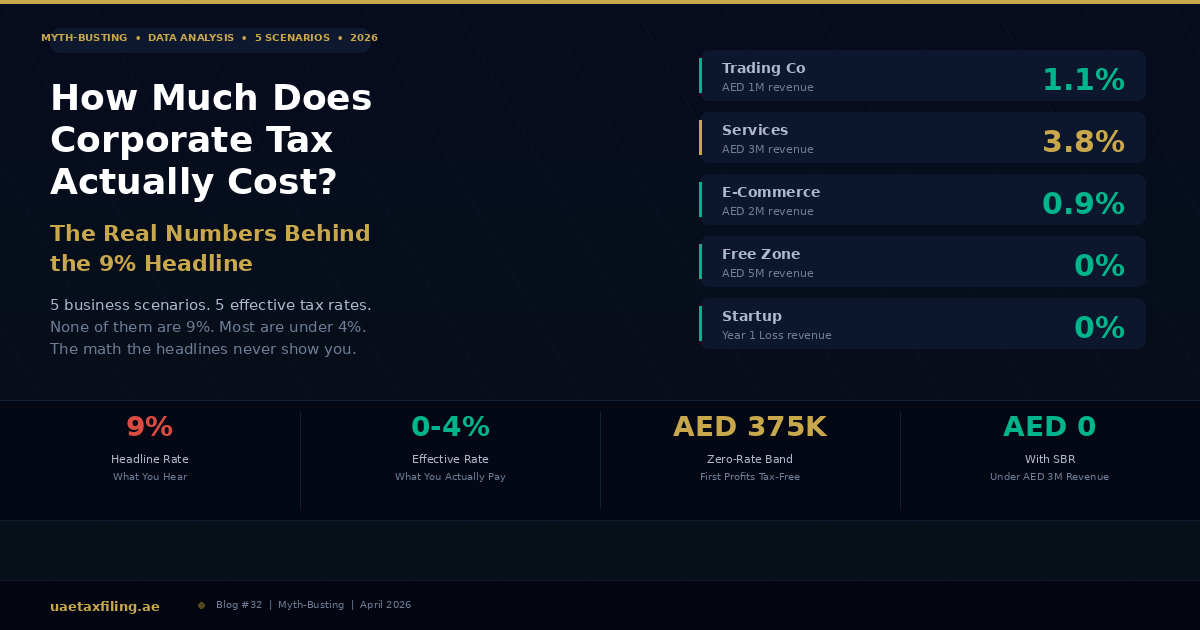
The headline is also misleading. Not wrong. Misleading. Because 9% is the statutory rate applied to taxable income, not to revenue. The distance between those two numbers is where the real story lives. Our 2026 tax changes guide covers every regulatory shift this year, but the question this article answers is more fundamental: how much does corporate tax actually cost in AED, for real businesses, with real numbers? A trading company with AED 1 million in revenue does not pay AED 90,000 in corporate tax. It pays approximately AED 11,250. A service business at AED 3 million pays approximately AED 56,250, not AED 270,000. An e-commerce seller at AED 2 million pays approximately AED 17,986. A free zone QFZP with qualifying income pays AED 0. A startup that made a loss in its first year pays AED 0.
The effective tax rate for most UAE SMEs is between 0% and 4% of gross revenue. That is one of the lowest effective rates in the world. As PwC's UAE tax summary confirms, the standard CT rate is 9% on taxable income exceeding AED 375,000, with 0% on the first AED 375,000. But taxable income is not revenue. It is revenue minus cost of goods sold, minus operating expenses, minus every deduction the CT law allows, minus the AED 375,000 zero-rate band. By the time all of those reductions are applied, the base on which 9% is calculated is a fraction of the original revenue figure.
This article runs the actual math for five different UAE businesses. Each scenario uses realistic numbers: real expense ratios, real margin structures, and the real CT calculation that produces the real AED amount you actually owe. The gap between the headline and the reality is significant. Here it is, with numbers.
"Every new client we onboard asks the same question: how much is this going to cost me? They expect to hear 9% of their revenue. When we show them the actual calculation, the number is usually between 0% and 4% of revenue. The relief on their face is visible. The UAE has corporate tax now. The UAE is still one of the most tax-efficient places in the world to run a business. Both things are true at the same time."
Jazim, CEO, UAE Tax Filing LLC
Why 9% Is Not 9%: The Three Reductions Most People Miss
Reduction 1: Expenses. Corporate tax is not charged on revenue. It is charged on profit. Revenue minus cost of goods sold minus operating expenses equals net profit. A business with AED 1 million in revenue and AED 700,000 in total expenses (COGS, rent, salaries, marketing, utilities, professional fees) has a net profit of AED 300,000. The 9% applies to the AED 300,000, not the AED 1 million. Our deductions guide covers every expense category and whether it is deductible, partially deductible, or non-deductible.
Reduction 2: The AED 375,000 zero-rate band. The first AED 375,000 of taxable income is taxed at 0%. Not 9%. Zero. This band applies to every taxable person, regardless of size. A business with AED 500,000 in taxable income pays 9% only on the amount above AED 375,000, which is AED 125,000. The CT is AED 11,250, not AED 45,000. As ClearTax's UAE CT overview documents, this dual-tier system is designed specifically to support small and medium-sized businesses.
Reduction 3: Small Business Relief. For businesses with revenue under AED 3 million, Small Business Relief treats taxable income as zero. No CT payable. Period. This relief is available until tax periods ending December 31, 2026. The majority of UAE SMEs qualify. SBR alone brings the effective rate for most qualifying businesses to 0%.
The formula: Revenue minus expenses = net profit. Net profit minus AED 375,000 band = taxable amount. Taxable amount x 9% = CT payable. CT payable divided by revenue = effective rate. That effective rate is the number that actually matters. It is never 9% of revenue. It is always lower.
Scenario 1: A Trading Company With AED 1 Million Revenue
A general trading company in Dubai imports and sells consumer products. Revenue of AED 1 million. Cost of goods sold (product cost plus import duties plus freight) at 55% of revenue: AED 550,000. Operating expenses (rent AED 60,000, two staff AED 180,000, utilities and insurance AED 24,000, marketing AED 20,000, accounting fees AED 12,000, other AED 29,000): AED 325,000.
Revenue: AED 1,000,000. Less COGS: AED 550,000. Gross profit: AED 450,000. Less operating expenses: AED 325,000. Net profit: AED 125,000. Less AED 375,000 band: AED 0 taxable (net profit is below the band). CT payable: AED 0. Effective rate: 0% of revenue.
This is not a special case. A trading company with a 12.5% net margin and AED 1 million in revenue owes zero corporate tax because the net profit falls below the AED 375,000 band. No SBR election needed. No free zone QFZP required. The standard mainland CT calculation produces AED 0.
Scenario 2: A Professional Services Firm With AED 3 Million Revenue
A consulting firm in Dubai with a team of 12 people. Revenue of AED 3 million from client projects. No cost of goods sold (service business). Operating expenses: staff salaries and benefits AED 1,500,000, office rent AED 240,000, professional indemnity insurance AED 35,000, software and tools AED 48,000, travel AED 60,000, client entertainment AED 80,000 (50% deductible = AED 40,000 deducted, AED 40,000 added back), marketing AED 45,000, accounting and tax advisory AED 24,000, other overheads AED 48,000. Total deductible operating expenses: AED 2,040,000.
Revenue: AED 3,000,000. Less operating expenses: AED 2,040,000. Add back non-deductible entertainment: AED 40,000. Net taxable income: AED 1,000,000. Less AED 375,000 band: AED 625,000 taxable at 9%. CT payable: AED 56,250. Effective rate: 1.9% of revenue.
A professional services firm with AED 3 million in revenue and a 33% net margin (high for the sector) pays AED 56,250 in CT. That is 1.9% of revenue. Not 9%. Not even close. The AED 375,000 band and the high operating expense base (salaries dominate in professional services) compress the effective rate dramatically. This firm is above the SBR threshold (AED 3M), so relief is not available. But the effective rate is still under 2%. For comparison, the same firm operating in the UK at the same profit level would pay approximately 25% CT on the same income.
Scenario 3: An E-Commerce Seller With AED 2 Million on Amazon.ae
An Amazon.ae seller with AED 2 million in gross customer orders. COGS (product cost, import duties, freight): AED 860,000. Marketplace fees (referral, FBA, storage, closing): AED 406,000. Other operating expenses (PPC advertising, rent, accounting, software, packaging): AED 159,160. This is the same worked example from our e-commerce CT guide.
Gross revenue: AED 2,000,000. Less COGS: AED 860,000. Less marketplace fees: AED 406,000. Less operating expenses: AED 159,160. Net profit: AED 574,840. Less AED 375,000 band: AED 199,840 taxable at 9%. CT payable: AED 17,986. Effective rate: 0.9% of revenue.
Under 1% of gross revenue. The marketplace fee structure (25-35% of the selling price going to Amazon) compresses the net margin to the point where the AED 375,000 band absorbs most of the remaining profit. This seller could alternatively elect SBR (revenue is under AED 3M) and pay AED 0. The SBR election eliminates the AED 17,986 entirely but destroys loss carry-forward if the next year is unprofitable. For a consistently profitable seller, SBR is the obvious choice until it expires in December 2026.
Want to know your actual effective rate? Our corporate tax team calculates it from your real numbers, not from headlines. The answer is almost always lower than you expect. Message us on WhatsApp.
Scenario 4: A Free Zone QFZP With AED 5 Million Revenue
A technology company operating from Dubai Internet City with AED 5 million in revenue from clients outside the UAE (qualifying income under the QFZP rules). Staff costs AED 2.5 million, office AED 350,000, other operating expenses AED 650,000. Net profit: AED 1.5 million.
Revenue: AED 5,000,000 (100% qualifying income). Net profit: AED 1,500,000. QFZP rate on qualifying income: 0%. CT payable: AED 0. Effective rate: 0% of revenue.
Zero CT on AED 1.5 million in profit. This is the most tax-efficient structure available in the UAE, and it is completely legal. The QFZP framework allows free zone entities with 100% qualifying income (from clients outside the UAE or from other free zone entities) to pay 0% CT. The cost is compliance: mandatory audited financial statements (AED 15,000 to AED 40,000/year), substance documentation, and the five-year disqualification risk if the income classification fails. Our free zone vs mainland analysis covers the AED 540,000 profit crossover point where the compliance cost of maintaining QFZP status exceeds the tax saving.
For comparison: this same business would pay approximately AED 101,250 in CT if it were on the mainland (9% on AED 1.5M minus AED 375K = AED 1,125,000 x 9%). The free zone saving is AED 101,250 per year, minus the audit cost of AED 15,000 to AED 40,000. Net annual saving: AED 61,250 to AED 86,250. As Chambers & Partners' UAE guide notes, no specific rules prevent individuals from incorporating to benefit from potential tax efficiencies. The QFZP framework is one of those efficiencies.
Scenario 5: A Startup in Its First Year With a Loss
A tech startup incorporated in January 2025. Revenue of AED 400,000 in its first year from early clients. Expenses: three founders drawing salaries of AED 480,000 total, office AED 60,000, software development costs AED 120,000, marketing AED 80,000, legal and licensing AED 35,000, other AED 25,000. Total expenses: AED 800,000. Our startup CT guide covers the registration timeline and first-return considerations for newly incorporated entities.
Revenue: AED 400,000. Less expenses: AED 800,000. Net loss: AED (400,000). CT payable: AED 0. Effective rate: 0% of revenue. Loss carry-forward: AED 400,000 available to offset future profits (up to 75% of taxable income in each future period, carried forward indefinitely as long as 50% ownership continuity is maintained).
No CT on a loss year. The loss is an asset: it can be carried forward to reduce CT in future profitable years. If this startup earns AED 800,000 in taxable income next year, it can offset AED 400,000 of the loss (capped at 75% of the AED 800,000 = AED 600,000, so the full AED 400,000 is used). Taxable income drops to AED 400,000, minus the AED 375,000 band, leaving only AED 25,000 taxable at 9% = AED 2,250 in CT. As PwC's guide confirms, the UAE allows tax losses to be carried forward indefinitely with the ownership continuity condition. This is more generous than many developed jurisdictions.
The startup should NOT elect SBR in its loss year. SBR treats taxable income as zero, which means the loss is not recognized and cannot be carried forward. Electing SBR on a loss year destroys AED 36,000 in future CT savings (AED 400,000 x 9%). The SBR decision must be made with future profitability in mind.
The Pattern: What Drives the Gap Between 9% and the Real Rate
Across all five scenarios, the effective rate ranges from 0% to 1.9% of revenue. None of them approach 9%. The reasons are structural, not accidental.
Expenses reduce the taxable base. The UAE CT law taxes profit, not revenue. Every dirham spent on legitimate business expenses (salaries, rent, COGS, marketing, professional fees, travel, software) reduces the base on which 9% is applied. Businesses with high expense ratios (trading companies with 55-65% COGS, service firms with 50-70% staff costs, e-commerce sellers with 20-35% marketplace fees) have naturally compressed effective rates. Our influencer CT guide showed an effective rate of 5.2% on AED 1.8 million in income, and our e-commerce guide showed 0.9% on AED 2 million. The only businesses that approach a 9% effective rate on revenue are those with near-zero expenses and near-100% profit margins, which effectively do not exist in practice. Businesses with related party transactions can further optimize through proper transfer pricing, though the transactions must be at arm's length to be deductible.
The AED 375,000 band absorbs the first layer. For every business, the first AED 375,000 of taxable income is tax-free. For businesses with AED 500,000 in taxable income, the band eliminates 75% of the tax base. For businesses with AED 1 million in taxable income, the band eliminates 37.5%. For businesses with AED 5 million, the band eliminates 7.5%. The band's impact diminishes as profit grows, but for the vast majority of UAE SMEs (where net profits are between AED 200,000 and AED 1.5 million), the band is the single largest reducer of effective rate.
SBR eliminates CT entirely for businesses under AED 3M. Until December 2026, businesses with revenue below AED 3 million can elect SBR and pay AED 0 in CT regardless of profit. As The National reported, the UAE's 2026 tax changes continue to support small businesses through this and other relief mechanisms. After 2026, SBR expires and the standard calculation applies, but the AED 375,000 band remains permanent.
QFZP eliminates CT for qualifying free zone income. The 0% rate on qualifying income is not a loophole. It is a policy instrument designed to maintain the UAE's competitiveness as a regional headquarters location. Companies that meet the QFZP conditions (adequate substance, qualifying income only, audited financials) pay no CT on revenue from international clients. This is the structural advantage that keeps multinationals headquartered in Dubai.
How the UAE Compares Globally: 9% in Context
The UAE's 9% headline rate is the lowest statutory corporate tax rate of any major economy. As the OECD's international taxation framework documents, the global minimum tax under Pillar Two is set at 15% for large multinationals with consolidated revenue above EUR 750 million. For everyone else, the UAE's 9% stands alone.
For context, the corporate tax rates in major competing business hubs are: Singapore at 17%, Hong Kong at 16.5%, Ireland at 15% (increased from 12.5% under Pillar Two), the UK at 25%, Germany at approximately 30% (including solidarity surcharge and trade tax), the US at 21% federal (plus state taxes), and Saudi Arabia at 20%. The UAE's 9% is not only lower than all of these, it is applied after a AED 375,000 zero-rate band that most jurisdictions do not offer. The effective comparison is even more favorable than the headline comparison.
For SMEs specifically, the effective rate comparison is dramatic. A UAE business with AED 3 million in revenue and AED 1 million in profit pays approximately AED 56,250 in CT (1.9% of revenue). The same business in the UK would pay approximately GBP 56,250 (25% of GBP 225,000 profit, roughly equivalent). In Singapore, approximately SGD 68,000 (17% after partial exemptions). In the US, approximately $47,250 in federal CT alone (21% of profit minus the qualified business income deduction). The UAE's effective rate is consistently the lowest among comparable jurisdictions, even after corporate tax was introduced.
Understanding your effective rate is the first step. Reducing it through proper structuring, deduction optimization, and SBR planning is the next. Our corporate tax team models your specific numbers and identifies every legal reduction available to your business. Talk to us on WhatsApp.
What Pushes the Effective Rate Higher (and How to Avoid It)
High profit margins without corresponding expenses. A real estate holding company that earns AED 2 million in rental income with only AED 200,000 in expenses has a net profit of AED 1.8 million. CT: AED 128,250 (9% of AED 1,425,000). Effective rate: 6.4% of revenue. This is the highest effective rate in any realistic UAE scenario, and it still does not reach 9%. Businesses with structurally high margins (investment income, property rental, licensing fees) have less expense compression and therefore higher effective rates. Our real estate CT guide covers the specific considerations for property businesses, including the realisation basis election that can defer CT on unrealized gains.
Non-deductible expenses inflating the taxable base. If a business spends AED 100,000 on fines, penalties, personal expenses run through the company, and entertainment above the 50% cap, those amounts are added back to taxable income. They increase the effective rate without reducing actual expenses. The solution is simple: stop running non-deductible expenses through the business. Our 9 mistakes article covers the most common non-deductible items that businesses accidentally claim.
Missing the SBR election. A business under AED 3 million that does not elect SBR pays CT unnecessarily. For the trading company in Scenario 1, the CT is already AED 0 (profit below the band), so SBR is irrelevant. But for a business with AED 2.5 million revenue and AED 600,000 profit, failing to elect SBR means paying AED 20,250 in CT that could have been AED 0. The election is a checkbox on the CT return. One checkbox worth AED 20,250.
Wrong structure for the business model. A business earning 100% international income on the mainland pays 9% CT on income above AED 375,000. The same business in a free zone with QFZP status pays 0%. The structuring decision, covered in our free zone vs mainland analysis, can be the difference between a 3% effective rate and a 0% effective rate. But the decision must be made before the tax period starts. Restructuring mid-year creates complications and transition costs that may exceed the saving.
The Real Cost Beyond the Tax: Compliance Expenses
The CT payable is only part of the total cost. The compliance cost (accounting, tax advisory, filing, record-keeping) adds to the annual burden. For most UAE SMEs, the compliance cost is between AED 5,000 and AED 25,000 per year depending on complexity. For QFZPs requiring mandatory audit, add AED 15,000 to AED 40,000. Our outsourced accounting guide covers the full cost spectrum, and our guide to choosing a tax firm helps you evaluate what that fee should include.
For the trading company in Scenario 1 (CT = AED 0), the total cost of corporate tax is the compliance cost alone: approximately AED 5,000 to AED 10,000 for basic accounting and filing. For the consulting firm in Scenario 2 (CT = AED 56,250), the total cost is AED 56,250 plus approximately AED 15,000 in compliance = AED 71,250, which is 2.4% of revenue. For the QFZP in Scenario 4 (CT = AED 0), the total cost is AED 0 in CT plus AED 25,000 to AED 40,000 in audit and compliance = AED 25,000 to AED 40,000, which is 0.5% to 0.8% of revenue.
Total cost = CT payable + compliance cost. For most UAE SMEs, total cost is between 0.5% and 3% of revenue. For businesses qualifying for SBR, total cost is compliance only (0.2% to 0.5% of revenue). Even including compliance, the UAE's total tax cost is dramatically lower than any competing jurisdiction.
Frequently Asked Questions
Is corporate tax 9% of my revenue?
No. It is 9% of your taxable income above AED 375,000. Taxable income is revenue minus all deductible expenses and adjustments. The effective rate on revenue is typically between 0% and 4% for most UAE SMEs.
What is the effective corporate tax rate for a typical UAE business?
Between 0% and 4% of gross revenue, depending on profit margins, expense structure, and whether SBR or QFZP applies. The five scenarios in this article range from 0% to 1.9%.
Do I owe CT if my profit is below AED 375,000?
No. The first AED 375,000 of taxable income is taxed at 0%. If your net profit is below this threshold, your CT is AED 0. You must still file a return by the filing deadline (September 30 for calendar-year entities) to avoid the AED 500 late filing penalty.
How does UAE CT compare to other countries?
The UAE's 9% is the lowest statutory rate among major economies. Singapore is 17%, Hong Kong 16.5%, UK 25%, US 21% federal, Germany approximately 30%. The effective rate is even more favorable due to the AED 375,000 band.
Can I reduce my effective rate further?
Yes. Through proper expense categorization, SBR election (if eligible), QFZP structuring (if applicable), and ensuring all deductible expenses are claimed. A professional tax review typically identifies AED 5,000 to AED 50,000 in missed deductions.
Is SBR available forever?
No. SBR is available for tax periods ending on or before December 31, 2026. From 2027, businesses under AED 3M will pay CT at the standard rate (9% on income above AED 375,000).
What about VAT? Is 5% VAT on top of 9% CT?
VAT and CT are separate taxes. VAT (5%) is charged to customers and remitted to the FTA. CT (9%) is paid from your net profit. They are not added together. Total tax cost includes both, but VAT is a pass-through collected from customers, not a cost to the business (assuming proper input credit recovery).
Do freelancers pay corporate tax?
Natural persons (freelancers, sole proprietors) pay CT only if their business turnover exceeds AED 1 million. Below that threshold, no CT obligation. Our freelancer guide covers the details.
What is the cost of compliance on top of the tax?
AED 5,000 to AED 25,000 per year for accounting and filing. Add AED 15,000 to AED 40,000 for mandatory audit if you are a QFZP. Total cost including compliance is typically 0.5% to 3% of revenue.
Is the UAE still tax-free?
There is no personal income tax on salaries. Corporate tax at 9% applies to business profits above AED 375,000. The effective rate for most SMEs is 0% to 4% of revenue. The UAE remains one of the lowest-tax jurisdictions in the world.
9% Is the Rate. 0% to 4% Is the Reality.
The five scenarios in this article produce effective rates of 0%, 0%, 0.9%, 1.9%, and 0%. None of them reach 9%. None of them approach the 15% to 30% rates that businesses in Europe, the US, or Asia pay. The UAE introduced corporate tax in 2023. The UAE remains, by a wide margin, one of the most tax-efficient environments in the world for businesses of every size.
The fear is understandable. For three decades, the UAE had no corporate tax at all. Any number above zero feels like a loss. But the math tells a different story. A trading company at AED 1 million pays AED 0. A consulting firm at AED 3 million pays AED 56,250. An e-commerce seller at AED 2 million pays AED 17,986. A startup with a loss pays AED 0 and carries the loss forward. A QFZP pays AED 0.
The 9% headline is real. The 0% to 4% effective rate is also real. The second number is the one that actually hits your bank account. Know your number.
We calculate your specific effective rate from your actual financials, identify every deduction and relief you qualify for, and file the CT return at the lowest legally correct amount. The first conversation is free. Start on WhatsApp.