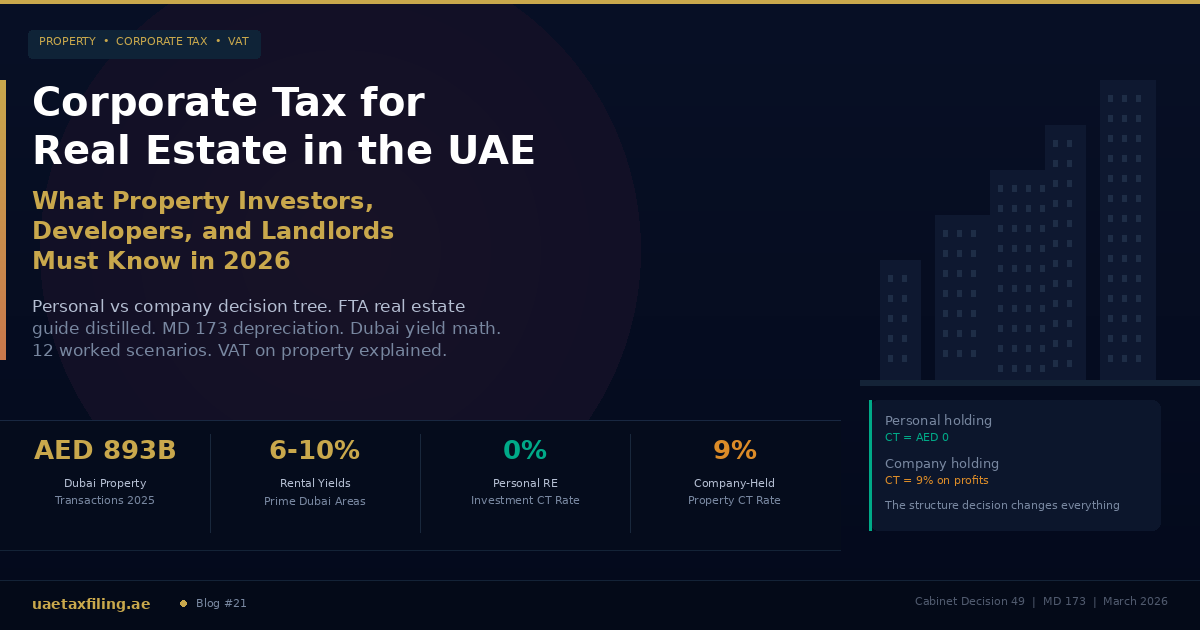
Dubai recorded AED 893 billion in property transactions in 2025 according to the Dubai Land Department, a record that reinforced the UAE's position as one of the world's most active real estate markets. Residential rental yields in prime areas run between 6% and 8%. In emerging neighborhoods, they reach 8% to 10%. Thousands of investors, both UAE residents and non-residents, hold properties personally, through LLCs, through free zone companies, or through a mix of all three.
The question every one of them asks is the same: do I owe corporate tax on my property income? The answer depends entirely on how you hold the property, whether you hold a licence, and whether your activity qualifies as 'investment' or 'business' under Cabinet Decision 49 of 2023. Get the structure right, and your rental income is completely exempt from corporate tax. Get it wrong, and you owe 9% on every dirham of profit above AED 375,000, plus potential transfer pricing complications if you use a related company to manage your properties.
This guide is the definitive reference for property investors, landlords, developers, and real estate managers. It distills the FTA's official Real Estate Investment Guide (CTGREI1), published October 2024, into plain language with worked AED examples. It covers the personal vs company decision, the 4% notional depreciation under Ministerial Decision 173 of 2025, the VAT treatment across residential, commercial, and mixed-use properties, and every scenario from passive long-term leasing to licensed holiday home operations.
"Property is the UAE's biggest asset class. It is also the area where the most expensive tax mistakes happen, because investors assume the old zero-tax reality still applies to every structure. It does not. The corporate tax exemption for individuals is real, but it has boundaries. Cross those boundaries, and the 9% rate applies to everything."
Jazim, CEO, UAE Tax Filing LLC
The Fundamental Rule: Personal Investment Is Exempt, Business Activity Is Taxable
Article 2(2)(c) of Cabinet Decision 49 of 2023 defines 'Real Estate Investment' as any investment activity conducted by a natural person (an individual) related to the sale, leasing, sub-leasing, and renting of land or real estate property in the UAE that is not conducted, or does not require to be conducted, through a licence from a licensing authority. This income is excluded from corporate tax entirely, regardless of the amount.
Read that definition carefully. Three conditions must all be true for the exemption to apply:
1. You are a natural person (individual). Companies, LLCs, FZCOs, and any other juridical person do not qualify. If you hold property through a company, the rental income is business income and is subject to CT at 9% on profits above AED 375,000. There is no exemption for corporate-held real estate.
2. The activity does not require a licence. Long-term residential leasing in most emirates does not require a licence. Registering a tenancy contract through Ejari (Dubai) or Tawtheeq (Abu Dhabi) is an administrative record, not a business licence. But if your activity requires a licence from any licensing authority (such as a holiday home permit from Dubai's Department of Economy and Tourism), your income crosses from 'investment' into 'business.'
3. The activity is not a commercial business. The FTA looks at substance, not labels. An individual who buys, renovates, and sells 15 properties per year is running a property development business, licence or not. Frequent trading, organized marketing, and employee-level operations signal business activity under the Commercial Transactions Law.
As Lexology's analysis noted, the distinction between investment and business is determined by the substance of the activity, not its form. The FTA examines whether the level of organization, frequency, and commercial intent cross the threshold from passive holding to active enterprise.
Exempt vs Taxable: Eight Real Estate Scenarios
The FTA's CTGREI1 guide includes 12 worked examples. Here are the eight scenarios most relevant to UAE property investors, rewritten in plain language with AED context:
Scenario | CT Treatment | Why
Individual owns 3 apartments, rents long-term, no licence | EXEMPT (AED 0 CT) | Personal investment activity. No licence required. Ejari is administrative, not a licence.
Individual sells personal residence at a profit | EXEMPT (AED 0 CT) | Personal residence disposal. Not business activity.
Individual earns variable rent linked to tenant's revenue | EXEMPT (AED 0 CT) | Variable rent does not change the nature. Still investment if no licence.
Individual operates licensed holiday homes (DET permit) | TAXABLE (9% CT) | Holiday home permit = licence. Income becomes business income.
LLC owns commercial building, collects rent | TAXABLE (9% CT) | Company is a juridical person. No exemption exists for corporate-held property.
Individual uses own company as agent to collect rent | EXEMPT for individual | If company acts as agent (not principal), income belongs to individual. Company's agency fee is taxable for the company.
Property developer buys land, builds, and sells units | TAXABLE (9% CT) | Development for sale is commercial activity requiring a licence.
Free zone company owns mainland property, rents it | TAXABLE (9% CT) | Rental income from a non-free-zone tenant is non-qualifying income for QFZP.
The holiday home trap: This is the scenario that catches the most investors. Dubai requires all short-term rental operators (stays under 30 days) to register with the Department of Economy and Tourism and obtain a holiday home permit. That permit is a licence. The moment you obtain it, your rental income from those units shifts from exempt personal investment to taxable business income. If your turnover from licensed holiday home operations exceeds AED 1 million in a calendar year, you must register for corporate tax. As a freelancer or sole proprietor, your CT filing obligations begin from that point.
Not sure whether your property income is exempt or taxable? Our corporate tax team reviews your holding structure, licensing status, and activity profile to determine your exact CT position. Message us on WhatsApp.
Personal vs Company Holding: The Decision That Changes Your Tax Bill
This is the section no competitor publishes with real numbers. The structure decision is the single most important tax variable for UAE property investors. Here is the math, using actual Dubai market conditions.
Scenario: 3 residential apartments in Dubai Marina, purchased for AED 5,000,000 total, generating AED 360,000/year in gross rental income (7.2% yield). Annual expenses: AED 60,000 (service charges, maintenance, Ejari fees, insurance). Net rental income: AED 300,000.
Option 1: Held personally (no licence, long-term leasing)
Line Item | Amount
Gross rental income | AED 360,000
Expenses | AED 60,000
Net income | AED 300,000
Corporate tax | AED 0 (exempt under Cabinet Decision 49)
Net after-tax income | AED 300,000
Option 2: Held through a mainland LLC
Line Item | Amount
Gross rental income | AED 360,000
Expenses (incl. company admin costs) | AED 80,000
MD 173 notional depreciation (4% x AED 5M) | AED 200,000 deduction
Taxable income (AED 360K minus AED 80K minus AED 200K) | AED 80,000
CT: 0% on first AED 375,000 | AED 0 (income below threshold)
Corporate tax | AED 0 (taxable income below AED 375K)
Net after-tax income (before depreciation add-back) | AED 280,000 (AED 360K minus AED 80K expenses)
In this specific scenario, both options result in zero CT because the LLC's taxable income falls below AED 375,000 after the MD 173 depreciation deduction. But the LLC has AED 20,000 more in expenses (company administration, accounting fees, and annual licence renewal). The personal holding produces AED 300,000 in net income. The LLC produces AED 280,000. Personal holding wins by AED 20,000 per year.
When does the LLC become advantageous? At scale. If the same investor holds AED 20,000,000 in property generating AED 1,440,000 in gross rental income (7.2% yield), the math shifts. Personal holding: AED 0 CT but no depreciation deduction and no ability to offset property losses against other business income. LLC holding: AED 800,000 depreciation deduction (4% x AED 20M) reduces taxable income significantly, and any net losses can be carried forward against future profits. For large portfolios where the investor also runs other businesses through the same group, the LLC structure enables loss transfers and group tax planning that are impossible with personal holdings.
As Alvarez & Marsal's analysis emphasized, the choice between individual and corporate ownership depends on the individual facts and circumstances. There is no universal answer. The math changes with portfolio size, property type (residential vs commercial), financing structure, and the investor's broader business activities.
Ministerial Decision 173: The 4% Depreciation Advantage for Company-Held Property
Ministerial Decision 173 of 2025 introduced a specific depreciation adjustment for investment properties held at fair value under IFRS. Under standard IFRS accounting, investment properties measured at fair value are not depreciated. Changes in fair value flow through profit or loss, but there is no annual depreciation charge. This creates a problem for corporate tax: a company holding property at fair value shows the full rental income as taxable profit, with no depreciation to reduce it.
MD 173 solves this by allowing a notional depreciation deduction of 4% per year on the original cost of the property (excluding land, which is not depreciable). This applies only to properties held at fair value in the IFRS financial statements. Properties accounted for under the cost model already have depreciation built into the accounts and do not need this adjustment.
Worked example: A company purchases a commercial property for AED 10,000,000. The building component is estimated at AED 8,000,000 (land: AED 2,000,000). The property is held at fair value under IAS 40. Annual MD 173 deduction: 4% x AED 8,000,000 = AED 320,000. This deduction reduces taxable income by AED 320,000 per year. Over 10 years, the cumulative deduction is AED 3,200,000. However, on sale, any depreciation previously claimed may need to be added back to taxable income. The exit math matters as much as the annual math.
This depreciation advantage only exists for corporate holdings. Individuals holding property personally cannot claim depreciation because their rental income is exempt from CT entirely. This is one reason large-portfolio investors may prefer company structures despite the additional compliance cost.
VAT on Real Estate: What Property Investors Need to Know
VAT on property is a separate tax obligation from corporate tax, but the two interact. Here is how VAT applies across property types:
Property Type | Sale VAT | Lease/Rent VAT | Input VAT Recovery
New residential (first sale) | Zero-rated (0%) | Exempt (0%) | Yes (developer can recover)
Used residential (resale) | Exempt | Exempt (0%) | No
Commercial property | 5% VAT | 5% VAT | Yes
Bare land | Exempt | Exempt | No
Mixed-use (residential + commercial) | Apportioned | Apportioned | Partial (commercial portion only)
Hotel/serviced apartment | 5% VAT | 5% VAT | Yes
The critical distinction: Residential property sales and leases are generally exempt from VAT, which means no VAT is charged to the tenant or buyer. But 'exempt' also means the landlord cannot recover input VAT on expenses related to exempt supplies. This matters for property developers who incur significant input VAT on construction costs. The first sale of a new residential building is zero-rated (not exempt), allowing the developer to recover input VAT while still not charging VAT to the buyer. After the first sale, subsequent resales become exempt, and input VAT recovery stops.
For investors holding commercial properties, the 5% VAT on rent is collected from tenants and remitted to the FTA through quarterly VAT returns. The landlord can recover input VAT on commercial property expenses (maintenance, agency fees, professional services). This VAT obligation applies whether the property is held personally or through a company.
Municipality fees are a separate cost layer. Dubai charges a 5% municipality housing fee on residential rent (paid by the tenant through DEWA). Abu Dhabi charges 3%. Sharjah charges 2%. Commercial properties in Dubai attract a 10% municipality fee. These are not VAT. They are local government fees that reduce the tenant's effective rental yield but do not create a tax obligation for the landlord.
We handle both the VAT and corporate tax obligations for property investors from a single set of reconciled accounting records. No discrepancies. No audit flags. Start on WhatsApp.
Free Zone Companies and Real Estate: The QFZP Qualification Trap
Free zone companies holding UAE real estate face a specific challenge. As Alvarez & Marsal detailed, rental income from a Qualifying Free Zone Person (QFZP) is treated differently depending on the property type and the tenant:
Commercial property rented to a free zone person: Qualifying income. Subject to the 0% CT rate if all other QFZP conditions are met.
Commercial property rented to a mainland (non-free zone) tenant: Non-qualifying income. Subject to the 9% CT rate. If this non-qualifying income exceeds the de minimis threshold (5% of total revenue or AED 5 million, whichever is lower), the entire entity loses QFZP status for five years.
Residential property: Non-qualifying income regardless of who the tenant is. Subject to the 9% CT rate.
This means a DMCC or JAFZA company that derives rental income from mainland commercial tenants or any residential tenants is earning non-qualifying income that threatens its QFZP status. The five-year disqualification period is the same risk that applies to transfer pricing failures. If a free zone company's real estate income breaches the de minimis limit, the 0% rate disappears for the current year and the next four years. On a company with AED 5,000,000 in annual profit, that disqualification costs AED 2,025,000 in additional CT over five years (AED 5M x 9% x 5 years, minus the AED 375K band).
Opening Balance Sheet: How Pre-CT Property Values Are Set
Properties acquired before the first CT period carry their historical cost in the company's books. But for CT purposes, the opening balance sheet can use either historical cost or fair market value as of the first day of the first tax period. This choice is critical because it determines the base value from which depreciation is calculated and from which capital gains are measured on sale.
Consider a company that purchased a commercial property for AED 3,000,000 in 2018. By June 1, 2023 (the start of CT), the property's market value had risen to AED 5,500,000. If the company elects to use fair market value for the opening balance sheet, the property enters the CT regime at AED 5,500,000. Any future sale above AED 5,500,000 generates a taxable capital gain. Any sale below AED 5,500,000 generates a deductible loss. The AED 2,500,000 in pre-CT appreciation is permanently shielded from corporate tax.
This election is available only once, at the start of the first tax period. For most companies, this election has already been made or should have been made in their first CT return. If you hold property through a company and have not addressed your opening balance sheet, this is an error that may require a voluntary disclosure to correct.
Record Retention: The 15-Year Rule for Real Estate
Standard record retention for VAT is 5 years. For corporate tax, it is 7 years. But real estate has a special rule: records related to real estate transactions must be retained for 15 years from the end of the tax period in which the property was disposed of. This applies to purchase contracts, construction invoices, tenancy contracts, renovation costs, valuation reports, and all supporting documentation.
The 15-year window exists because property holding periods are long and the FTA needs the ability to verify opening balance sheet values, depreciation claims, and capital gains calculations years after the original acquisition. If you cannot produce your 2018 purchase contract during a 2030 FTA audit, you lose the ability to substantiate your cost base. The FTA can then assess a higher capital gain and a higher CT liability.
DLD Transfer Fee: Cost, Not Tax, but CT-Deductible
The 4% Dubai Land Department transfer fee (2% Abu Dhabi) is frequently confused with a tax. It is a one-time government fee on property transfers. For CT purposes, the DLD transfer fee paid on acquisition is part of the property's cost base. It increases the cost from which depreciation is calculated and against which capital gains are measured on sale. For a AED 10,000,000 property, the AED 400,000 DLD fee raises the total cost to AED 10,400,000, reducing any future taxable gain by AED 400,000.
For companies, the DLD fee paid on disposal reduces the net proceeds, further reducing any taxable gain. As Global Property Guide confirmed, the UAE does not impose property tax on real estate ownership, but the transaction costs (DLD fee, registration fee, agent commission) are real and must be factored into both the investment return calculation and the CT treatment.
Our team structures property holdings for the lowest legal tax cost. Personal exemption or company filing, we calculate both and recommend the option that saves you the most over the holding period. Talk to us on WhatsApp.
Non-Resident Property Investors: The Same Rules Apply
Non-resident individuals (investors who do not live in the UAE) receive the same treatment as residents when holding property for personal investment. As the Invest in Dubai government portal confirmed, the 9% CT rate applies to all UAE mainland, free zone, and foreign entities managed and controlled from the UAE. But for individuals, the Cabinet Decision 49 exemption applies equally to residents and non-residents, provided the activity does not require a licence and does not constitute a commercial business.
Where non-residents must be careful is structure. A non-resident who establishes a UAE company to hold property creates a permanent establishment (PE) in the UAE. That company is a UAE tax resident and must register for corporate tax, file annual returns, and pay CT on taxable profits. The non-resident individual's personal property income remains exempt, but the company's income does not. This distinction becomes critical when the same non-resident holds some properties personally and others through a UAE LLC. Our 2026 tax changes guide covers how the FTA's expanded audit powers apply to structures that mix personal and corporate holdings, and our CT penalties guide explains the consequences of late registration for companies that should have registered when the CT regime began.
Non-residents earning rental income through a company may also trigger transfer pricing scrutiny if management fees, maintenance charges, or other intercompany payments flow between the UAE company and the non-resident owner. The FTA expects these payments to be at arm's length. A management fee of 20% of rental income charged by a related overseas entity will be examined for commercial justification. If the FTA determines the fee is excessive, the deduction is denied, and the company's taxable income increases.
Frequently Asked Questions
Is rental income taxable in the UAE?
For individuals holding property without a licence: no. Rental income from personal real estate investment is exempt from corporate tax under Cabinet Decision 49 of 2023. For companies: yes. Rental income earned by a company is taxable at 9% on profits above AED 375,000.
Do I need to register for corporate tax if I own property in the UAE?
If you hold property personally and your rental activity does not require a licence, you are not required to register for CT. If you hold property through a company, the company must register for CT regardless of whether it makes a profit.
Is there capital gains tax on property in Dubai?
For individuals selling personal property: no. For companies: capital gains from property sales are included in taxable income and subject to the 9% CT rate on profits above AED 375,000.
Does the 0% free zone rate apply to property income?
Only if the property is commercial and the tenant is a free zone person. Residential property income and income from mainland tenants are non-qualifying and taxable at 9%. Exceeding the de minimis threshold risks 5-year QFZP disqualification.
What is the MD 173 depreciation deduction?
Companies holding investment properties at fair value under IFRS can claim a 4% annual notional depreciation on the building component (excluding land). This reduces taxable income even though no depreciation is recorded in the financial statements.
How long must I keep property records for tax purposes?
15 years from the end of the tax period in which the property was disposed of. This is longer than the standard 5-year VAT or 7-year CT retention periods.
Is VAT charged on residential rent in the UAE?
No. Residential property leases are VAT-exempt. The tenant pays no VAT on rent. However, the landlord cannot recover input VAT on expenses related to exempt residential supplies.
Should I hold my investment property personally or through a company?
For small portfolios (under AED 5M), personal holding is almost always cheaper: zero CT, lower admin costs. For large portfolios, company holding offers depreciation deductions, loss carry-forward, and group planning benefits that can outweigh the 9% CT cost. The answer depends on portfolio size, financing structure, and broader business activities.
What happens if I operate Airbnb/holiday homes in Dubai?
You must register with Dubai's Department of Economy and Tourism and obtain a holiday home permit. This permit is a licence. Your income becomes taxable business income subject to CT if your annual turnover exceeds AED 1 million.
Can I use a company as an agent to collect rent and still be exempt?
Yes, if the company acts as your agent (not the principal). The rental agreements must show you as the property owner and landlord. The company earns an agency fee (taxable for the company), but the rental income itself remains exempt for you as the individual owner.
The Structure Decision Is the Tax Decision
Corporate tax on UAE real estate is not about rates. The rate is known: 0% for personal investment, 9% for company-held property. The entire tax outcome is determined by how you hold the asset, whether you hold a licence, and how your activity is characterized under the FTA's substance-over-form analysis.
For the majority of UAE property investors, those holding a few residential units under long-term leases without a licence, the exemption under Cabinet Decision 49 provides complete protection from corporate tax. The zero-tax reality they have always known continues to apply. But for investors scaling into larger portfolios, operating short-term rentals, holding through companies, or mixing personal and corporate holdings, the rules are precise and the penalties for getting them wrong are permanent.
The September 30, 2026 CT filing deadline applies to every company holding property. If your LLC, FZCO, or mainland company owns real estate and earned rental income in 2025, the CT return is due in six months. The opening balance sheet election, the depreciation method, the transfer pricing treatment of management fees between your personal holdings and your company, the VAT position on commercial vs residential supplies, all of it must be documented, calculated, and filed on time.
The cost of getting the structure right is a few hours of professional analysis. The cost of getting it wrong is years of CT liability that should never have existed.