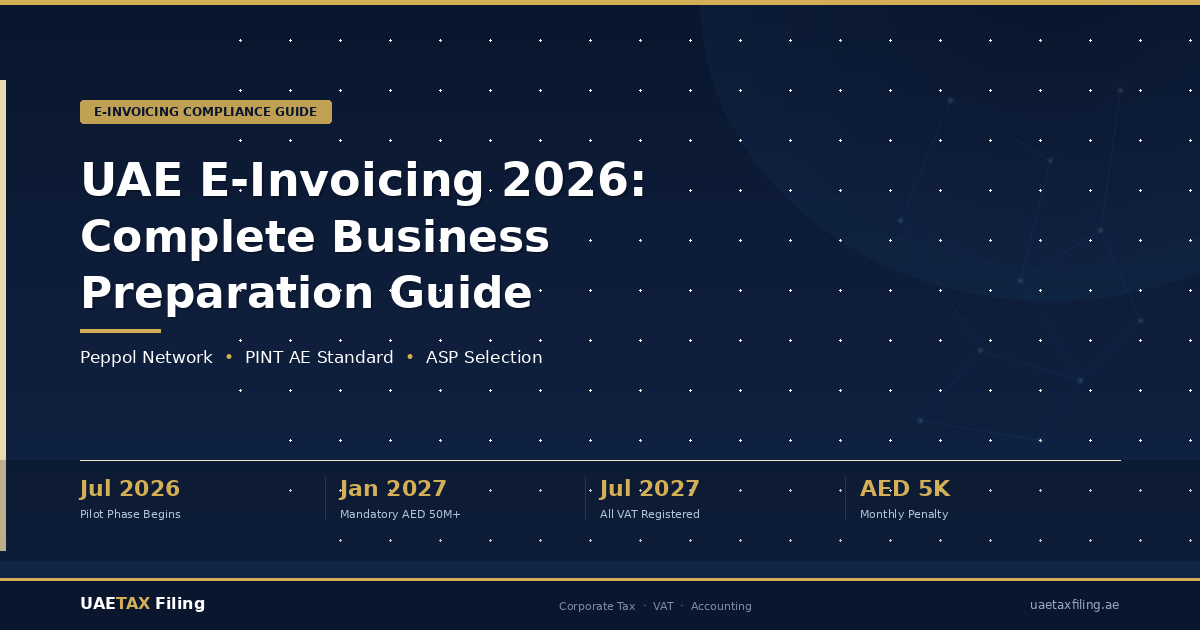
The UAE is introducing a mandatory electronic invoicing system that will fundamentally change how every business in the country issues, exchanges, and reports invoices. This is not a small software update or a minor procedural tweak. It is the largest operational shift in UAE tax compliance since VAT was introduced in 2018, and the Ministry of Finance has just published its official Electronic Invoicing Guidelines (February 2026) to give businesses a comprehensive framework for preparation.
Starting with a pilot programme in July 2026 and mandatory compliance for large businesses from January 2027, the new Electronic Invoicing System (EIS) will replace traditional PDF, paper, and email-based invoicing with structured, machine-readable digital documents exchanged through a secure national network. The FTA will receive transaction data in near real time, giving it unprecedented visibility into business activity across the country.
This guide explains everything your business needs to know: the phased rollout timeline, the technical requirements, how the system works, how to select an Accredited Service Provider, the penalty framework for non-compliance, and a practical step-by-step preparation checklist. Whether you are a large enterprise with complex ERP systems or an SME using basic accounting software, you will find the specific guidance you need to prepare effectively. For an overview of all UAE tax changes happening in 2026, including VAT amendments and penalty reforms, see our comprehensive UAE Tax Changes 2026 guide.
Need help preparing for e-invoicing? Book your free consultation with UAE Tax Filing today.
1. What Is E-Invoicing Under the UAE Framework?
Under the UAE's new Electronic Invoicing System, an e-invoice is a structured, machine-readable tax document that can be processed automatically by the systems of the seller, the buyer, and the Federal Tax Authority. This is a critical distinction. A PDF sent by email, a scanned paper invoice, a Word document, or an image file does not qualify as an e-invoice under the new framework, regardless of how professional or detailed it looks.
Valid e-invoices must be issued in structured digital formats such as XML or JSON, following the UAE's PINT AE (Peppol International UAE) data standard. They must be transmitted through an Accredited Service Provider (ASP) connected to the Peppol network, and the relevant tax data must be reported to the FTA's e-Billing platform. The system covers both tax invoices and credit notes, and it applies to all business-to-business (B2B) and business-to-government (B2G) transactions. Business-to-consumer (B2C) transactions are currently excluded from the mandate, though the Ministry has indicated this may change in a future phase.
The legal foundation for the system is built on three key pieces of legislation: Ministerial Decision No. 243 of 2025, which establishes the Electronic Invoicing System itself; Ministerial Decision No. 244 of 2025, which sets the implementation timelines; and Cabinet Resolution No. 106 of 2025, which defines the penalties for non-compliance.
2. How the UAE E-Invoicing System Works: The 5-Corner Model
The UAE has adopted a Decentralised Continuous Transaction Control and Exchange (DCTCE) model built on the Peppol network. This is often called the "5-corner model" because it involves five parties in every transaction, adding the FTA as a fifth participant alongside the traditional four corners of buyer, seller, and their respective service providers.
Here is how a typical e-invoice transaction flows under the new system:
Step 1: Your business generates an invoice through your ERP, accounting, or billing system. The invoice data includes all mandatory fields defined in the PINT AE Data Dictionary.
Step 2: The data is sent to your Accredited Service Provider (ASP), referred to as Corner 2 in the model. Your ASP validates the invoice against the UAE e-invoicing schema and converts it into the standard PINT AE XML format if it is not already in that form.
Step 3: Your ASP transmits the validated e-invoice to the buyer's ASP (Corner 3) through the Peppol network. Simultaneously, your ASP reports the Tax Data Document (TDD) to the FTA (Corner 5).
Step 4: The buyer's ASP receives and validates the invoice, then delivers it into the buyer's system in the agreed format. The buyer's ASP also reports the corresponding tax data to the FTA, confirming the transaction from the buyer's side.
Step 5: Message-level status (MLS) responses confirm whether the invoice and tax data have been successfully exchanged and reported. Both parties and the FTA have a complete, validated record of the transaction.
This architecture means the FTA receives transaction data in near real time, without waiting for quarterly VAT returns. It dramatically increases the speed and accuracy of compliance monitoring, cross-referencing, and audit targeting. For businesses, it also reduces invoice disputes, accelerates payment cycles, and creates a tamper-proof audit trail for every transaction.
3. E-Invoicing Implementation Timeline: Every Deadline You Need to Know
The UAE is rolling out e-invoicing in carefully structured phases, giving businesses time to prepare based on their size and type. Understanding which phase applies to your business is the first step in your preparation.
July 1, 2026 (Pilot Phase): The pilot programme launches with a selected Taxpayer Working Group testing the system under Ministry and FTA supervision. From this date, any business may voluntarily opt in and begin using the Electronic Invoicing System. Voluntary participants are exempt from penalties during this period.
July 31, 2026: Large businesses with annual revenue of AED 50 million or more must have appointed an Accredited Service Provider by this date. This is a hard deadline, and failure to meet it triggers penalties from the date mandatory compliance begins.
January 1, 2027 (Phase 1 Mandatory): Mandatory e-invoicing begins for all VAT-registered businesses with annual revenue of AED 50 million or more. From this date, all B2B invoices and credit notes must be issued, transmitted, and reported through the Electronic Invoicing System.
March 31, 2027: Businesses with annual revenue below AED 50 million and government entities must have appointed an ASP by this date.
July 1, 2027 (Phase 2 Mandatory): Mandatory e-invoicing extends to all remaining VAT-registered businesses with revenue below AED 50 million. This covers SMEs, startups, freelancers, and most mainland and free zone entities.
October 1, 2027 (Phase 3): Government entities must receive and, where applicable, issue e-invoices via the national system. B2G transactions become fully digital.
Important Note: E-invoicing requirements apply to all businesses operating in the UAE for in-scope transactions, regardless of their VAT registration status. This means even businesses that are not currently VAT-registered may be affected if they engage in B2B or B2G transactions that fall within scope. The Ministry of Finance and FTA may refine dates or thresholds through future announcements, so businesses should monitor official communications continuously.
4. What Changes for Your Business: From PDFs to Structured Data
If your business currently issues invoices using PDF templates, Excel spreadsheets, Word documents, or accounting software that produces printable invoices, the transition to e-invoicing requires significant changes to both your technology and your processes.
The PINT AE Data Standard
Every e-invoice must conform to the PINT AE (Peppol International UAE) data standard, which defines the mandatory, conditional, and optional fields for each invoice type. The Data Dictionary includes over 135 fields across 16 different invoice use cases, including standard tax invoices, reverse charge invoices, free zone supplies, continuous supply invoices, credit notes, and self-billing scenarios.
The mandatory header fields include: invoice number, invoice issue date, invoice type code, currency code, supplier and buyer names, addresses, and Tax Registration Numbers (TRNs), payment terms, and purchase order references. Each line item must include a description of goods or services, quantity, unit price, VAT percentage (0%, 5%, or exempt), tax category code, and the VAT amount for that line. If your accounting currency is not AED, the exchange rate field becomes mandatory.
The standard requires invoices to be generated in XML format based on UBL 2.1, with each element appearing in the correct order as defined in the Data Dictionary. Your ASP may accept other input formats (such as JSON or CSV) from your system, but it must convert them to the official PINT AE XML before transmission and reporting.
Invoice Storage Requirements
E-invoice data must be stored within the UAE, or otherwise in line with the Tax Procedures Law, and made available to the FTA on request. The minimum retention period is five years for VAT purposes and at least seven years where UAE Corporate Tax applies. For capital assets and certain real estate transactions, retention periods may extend to 10 or 15 years. While your ASP may provide built-in archiving services, your business remains legally responsible for ensuring records are maintained correctly and are accessible for audit purposes.
System Failure Reporting
If your e-invoicing system experiences a technical failure, whether on your side or your ASP's side, you must notify the FTA within two business days of the occurrence. Failure to report system malfunctions within this window triggers a penalty of AED 1,000 per day of delay. This requirement applies to both issuers and recipients of e-invoices, so you need clear internal procedures for monitoring, detecting, and reporting system issues promptly.
5. How to Select an Accredited Service Provider (ASP)
Every business subject to the e-invoicing mandate must work through an Accredited Service Provider. The ASP is not optional. It is the mandatory intermediary that validates, transmits, and reports your invoices through the national system. Selecting the right ASP is one of the most important decisions you will make during your e-invoicing preparation.
Who Are the Pre-Approved ASPs?
The Ministry of Finance maintains an official list of pre-approved e-invoicing service providers under Ministerial Decision No. 64 of 2025. As of the latest published list, the following nine providers have received pre-approval:
1. Comarch Middle East FZ LLC (comarch.com)
2. Cygnet Digital IT Solutions LLC (cygnet.one)
3. Defmacro Software DMCC (ClearTax) (cleartax.com/ae)
4. Deloitte & Touche M.E. (deloitte.com)
5. Flick Network LLC (flick.network)
6. Oxinus Holding Limited (oxinus.holdings)
7. Pagero Gulf FZLLC (Thomson Reuters) (pagero.com)
8. Skill Quotient Technologies (skillquotientgroup.com)
9. SunTec (Xelerate) Business Solutions DMCC (suntecgroup.com)
This list is updated periodically as new providers complete the accreditation process. Final accreditation is granted under Article 16 of the Ministerial Decision after providers pass production trail runs and tax data reporting testing. To earn accreditation, each ASP must be an active Peppol-certified service provider, hold ISO 27001 (information security) and ISO 22301 (business continuity) certifications, have at least two years of e-invoicing system experience, and maintain a UAE trade licence.
What to Look For When Choosing Your ASP
ERP Compatibility: Can the ASP integrate with your current accounting or ERP system? Most global ASPs support SAP, Oracle, and Microsoft Dynamics. For SMEs using Zoho, QuickBooks, or Tally, look for ASPs that offer cloud portals, API connectors, or plug-and-play add-ons.
Invoice Volume and Pricing: Many ASPs offer tiered pricing based on invoice volume. Some provide at least 100 free invoices per year for SMEs. Understand the cost structure before committing, including setup fees, monthly subscriptions, and per-invoice charges.
Implementation Support: Does the ASP provide data mapping assistance, testing environments, staff training, and ongoing technical support? For enterprises, the implementation process can take three to six months. For SMEs, a well-supported ASP can have you operational in weeks.
Archiving and Compliance: Does the ASP offer compliant data storage within the UAE? While convenient, remember that your business retains legal responsibility for data retention regardless of what the ASP provides.
Multi-Entity Support: If your business operates multiple entities, branches, or free zone and mainland operations, ensure the ASP can handle complex multi-entity structures with separate TRNs and reporting requirements.
6. Penalty Framework: What Non-Compliance Will Cost You
Cabinet Resolution No. 106 of 2025 establishes the first dedicated penalty framework for e-invoicing non-compliance in the UAE. The penalties are structured to ensure businesses take implementation seriously and maintain ongoing compliance. Critically, voluntary participants are exempt from penalties until their mandatory phase begins.
AED 5,000 per month for failing to implement the Electronic Invoicing System or failing to appoint an ASP within the required timeframe. This penalty accumulates monthly for as long as the business remains non-compliant, meaning a full year of delay costs AED 60,000.
AED 100 per invoice for each electronic invoice not issued or transmitted within the specified timeframe. This penalty is capped at AED 5,000 per month.
AED 100 per credit note for each electronic credit note not issued or transmitted on time, also capped at AED 5,000 per month.
AED 1,000 per day for failing to notify the FTA of any malfunction in the Electronic Invoicing System within the required timeframe (two business days).
AED 1,000 per day for failing to notify your appointed ASP of any modification to the data registered with the Authority within the specified timeframe.
These e-invoicing penalties are separate from and in addition to the standard VAT penalties under the new penalty regime taking effect April 14, 2026. For details on the broader penalty changes, see our guide on the new UAE VAT penalty regime for 2026.
7. E-Invoicing for SMEs vs. Large Enterprises: Different Paths to Compliance
While the technical compliance requirements are identical for all businesses, the complexity and cost of implementation vary significantly based on your business size and existing systems.
For SMEs and Small Businesses
Small and medium enterprises generally rely on SaaS accounting software or basic billing tools. The good news is that e-invoicing does not need to be a complex IT project for SMEs. The focus should be on selecting an ASP that offers a user-friendly cloud portal or a plug-in for your existing accounting software. Many ASPs offer subscription-based pricing with minimal upfront investment, and some provide a baseline of free invoices to support small businesses during the transition.
If you currently use software like Zoho Books, QuickBooks, Tally, or Xero, check with your provider or with the ASPs on the MoF list to confirm whether an integration is available. In many cases, the ASP handles the format conversion, validation, and transmission, meaning your team continues entering invoices in a familiar interface while the ASP handles the technical compliance layer behind the scenes.
For Large Enterprises
For businesses operating complex ERP systems like SAP, Oracle, or Microsoft Dynamics, e-invoicing implementation is a structured IT and finance transformation project that can take three to twelve months to complete. The process involves mapping all invoice data fields to the PINT AE standard, building or configuring API integrations with your chosen ASP, testing end-to-end transaction flows, handling special cases like credit notes, reversals, and self-billing, and training staff across finance, IT, tax, and procurement departments.
Implementation costs for enterprises typically range from AED 575,000 to AED 1.45 million, covering ERP customisation, API integration, testing environments, consulting, and training. However, the return on investment is significant: studies estimate cost reductions of 66% to 80% on invoice processing once the system is fully operational, with payback periods of 12 to 24 months.
8. Transactions Excluded from the E-Invoicing Mandate
Not every transaction falls within the scope of mandatory e-invoicing. The following categories are currently excluded:
• B2C (business-to-consumer) transactions, until a future phase is announced
• Government activities performed in a sovereign capacity (as opposed to commercial capacity)
• Certain financial services transactions that are exempt or zero-rated under the VAT law
• Certain services performed by airlines and international transport providers
• Transactions specifically excluded by the Ministry of Finance through future decisions
Even if your business has some excluded transactions, all B2B and B2G supplies remain within scope. Most businesses will need to implement e-invoicing for the majority of their transactions.
9. Your Step-by-Step E-Invoicing Preparation Checklist
Use this checklist to ensure your business is fully prepared before your applicable compliance deadline:
1. Determine Your Compliance Phase. Check your annual revenue against the AED 50 million threshold to confirm whether you fall into Phase 1 (January 2027) or Phase 2 (July 2027). Mark the corresponding ASP appointment deadline and go-live date in your calendar.
2. Conduct a Gap Analysis. Audit your current invoicing setup. Identify every system that creates invoices today, including ERP, POS, and billing tools. Assess whether your software can generate structured data in the PINT AE format or whether upgrades are needed.
3. Map Your Data Fields. Compare your current invoice data fields against the PINT AE Data Dictionary. Identify missing mandatory fields, particularly TRNs, VAT breakdowns, tax category codes, and line-level details. Ensure your master data (customer names, addresses, TRNs) is accurate and complete.
4. Select and Appoint an ASP. Review the MoF pre-approved list and evaluate ASPs based on ERP compatibility, pricing, implementation support, and archiving capabilities. Sign an agreement and begin the onboarding process well before your ASP appointment deadline.
5. Integrate Your Systems. Work with your ASP to connect your accounting or ERP system to their platform. This may involve API development, middleware configuration, or adopting the ASP's cloud portal. Ensure your system can generate, validate, and transmit invoices through the ASP.
6. Test Thoroughly. Run end-to-end tests during the voluntary phase (July 2026 onward). Generate sample invoices, transmit them through the ASP, and verify that validation, exchange, and FTA reporting all function correctly. Test rejection handling and resubmission workflows.
7. Train Your Team. Provide training for finance, accounting, IT, and procurement staff on the new invoicing workflows, error handling procedures, system failure reporting requirements, and compliance obligations.
8. Establish Internal Procedures. Document your invoice approval workflows, error correction processes, system failure notification procedures (two business day FTA reporting window), and data retention policies. Assign clear ownership for each responsibility.
9. Register on EmaraTax. Ensure your business is registered on the FTA's EmaraTax portal and that your e-invoicing settings, including your selected ASP, are correctly configured.
10. Monitor and Update. Stay informed of MoF and FTA announcements that may refine deadlines, technical specifications, or scope. The e-invoicing framework may evolve as the system matures.
Our VAT compliance services and accounting and bookkeeping support include full e-invoicing readiness assessments, system preparation guidance, and ongoing compliance monitoring.
Frequently Asked Questions About UAE E-Invoicing
What is UAE e-invoicing and when does it become mandatory?
UAE e-invoicing is the mandatory electronic creation, exchange, and reporting of invoices in structured digital formats (XML/JSON) through the FTA's national Electronic Invoicing System. A pilot phase begins July 1, 2026. It becomes mandatory for large businesses (AED 50 million or more in annual revenue) from January 1, 2027, and for all remaining VAT-registered businesses from July 1, 2027.
Can I still send PDF invoices after the mandate begins?
No. Once your mandatory compliance phase begins, PDF, paper, scanned, and emailed invoices will not qualify as valid e-invoices under the UAE framework. All in-scope invoices must be issued in structured machine-readable formats (XML/JSON) and transmitted through an Accredited Service Provider.
Do I need to upgrade my accounting software for e-invoicing?
In most cases, yes. Your system must be able to capture all mandatory PINT AE data fields and either generate compliant XML directly or connect to an ASP that handles the conversion. Many ASPs offer plug-ins or cloud portals that work alongside existing accounting software, minimizing the need for full system replacement.
How much does e-invoicing implementation cost for an SME?
Costs for SMEs are generally modest. Many ASPs offer subscription-based plans, and some provide a baseline of free invoices. The primary costs are ASP subscription fees, any necessary software upgrades, and staff training time. For most small businesses, the total annual cost is significantly less than the potential penalties for non-compliance.
Are free zone companies required to comply with e-invoicing?
Yes. E-invoicing applies to all businesses operating in the UAE, including free zone entities, for in-scope B2B and B2G transactions. Free zone companies are subject to the same deadlines based on their revenue threshold.
What happens if my e-invoicing system goes down?
You must notify the FTA within two business days of any system malfunction. Failure to report within this window incurs a penalty of AED 1,000 per day of delay. Establish clear internal procedures for monitoring and reporting system issues.
How does e-invoicing affect my VAT returns?
E-invoicing creates a direct, real-time data feed to the FTA. Over time, this is expected to simplify VAT return preparation because the FTA will already have your transaction data. However, you remain responsible for filing accurate VAT returns on schedule. The e-invoicing data will be cross-referenced against your returns during audits.
Start Preparing Now: The Window Is Open but Closing Fast
The UAE's e-invoicing mandate is not a distant future concern. The pilot phase is just months away, and businesses with revenue of AED 50 million or more must have their ASP appointed by July 31, 2026. Even SMEs that fall into Phase 2 should begin preparations now, because system assessments, data cleanup, ASP selection, integration, testing, and staff training all take time, and the consequences of last-minute implementation are costly both financially and operationally.
At UAE Tax Filing LLC, we help businesses across Dubai and the UAE navigate complex compliance transitions with confidence. Our VAT services include e-invoicing readiness assessments, gap analysis, ASP coordination, and ongoing compliance support. Combined with our corporate tax services and monthly bookkeeping, we ensure your entire tax compliance framework is connected, consistent, and audit-ready.