UAE e-invoicing is the biggest change to business finance operations since VAT arrived in 2018 — and it is now law, not a proposal. This guide explains exactly what is changing, when it affects your business, how the technology works, what the penalties are, and the concrete steps to be ready. Every date and figure below is drawn from the UAE's published legal instruments, not guesswork.
What this guide covers
- What "e-invoicing" actually means in the UAE
- The legal basis: the decisions that make it mandatory
- The rollout timeline and phases
- Who must comply — and when
- The Peppol 5-corner model, explained simply
- What an ASP is and how to choose one
- The technical building blocks (PINT AE, formats, ERP)
- A practical readiness checklist
- Penalties for non-compliance
- How e-invoicing connects to VAT and Corporate Tax
- Common mistakes to avoid
- Frequently asked questions
What "e-invoicing" actually means in the UAE
An e-invoice is not a PDF emailed to your customer. A PDF is a picture of an invoice that a human has to read and re-type. A true e-invoice is a structured data file — machine-readable fields for the supplier, buyer, line items, tax and totals — that flows directly from your system into your customer's system, and is reported to the Federal Tax Authority (FTA) along the way.
- Paper / PDF invoice: human-readable only; manual entry on the other side.
- Digital invoice: sent electronically but still unstructured (e.g. a scanned image).
- E-invoice (what the mandate requires): structured, validated, exchanged through an accredited network, and reported to the FTA automatically.
Once you understand that an e-invoice is data, not a document, every other requirement in this guide makes sense. For the mechanics of how that data moves, see our explainer on the Peppol 5-corner model.
The legal basis: the decisions that make it mandatory
UAE e-invoicing rests on a clear stack of legislation, so this is not optional guidance:
- Federal Decree-Law No. 16 of 2024 amended the VAT law to formally recognise electronic invoices as valid tax documents (in effect from 1 November 2024).
- Ministerial Decision No. 243 of 2025 established the Electronic Invoicing System, including which transactions are in and out of scope.
- Ministerial Decision No. 244 of 2025 set the implementation timelines and the rules for Accredited Service Providers.
- Cabinet Decision No. 106 of 2025 introduced the penalty framework for non-compliance.
In short: the system is defined, the timeline is set, and the fines are already written into law. The only open question for most businesses is which phase they fall into.
The rollout timeline and phases
Quick answer — when does UAE e-invoicing start? A voluntary pilot opens on 1 July 2026. The first mandatory wave goes live on 1 January 2027 for the largest businesses, with smaller businesses following from 1 July 2027.
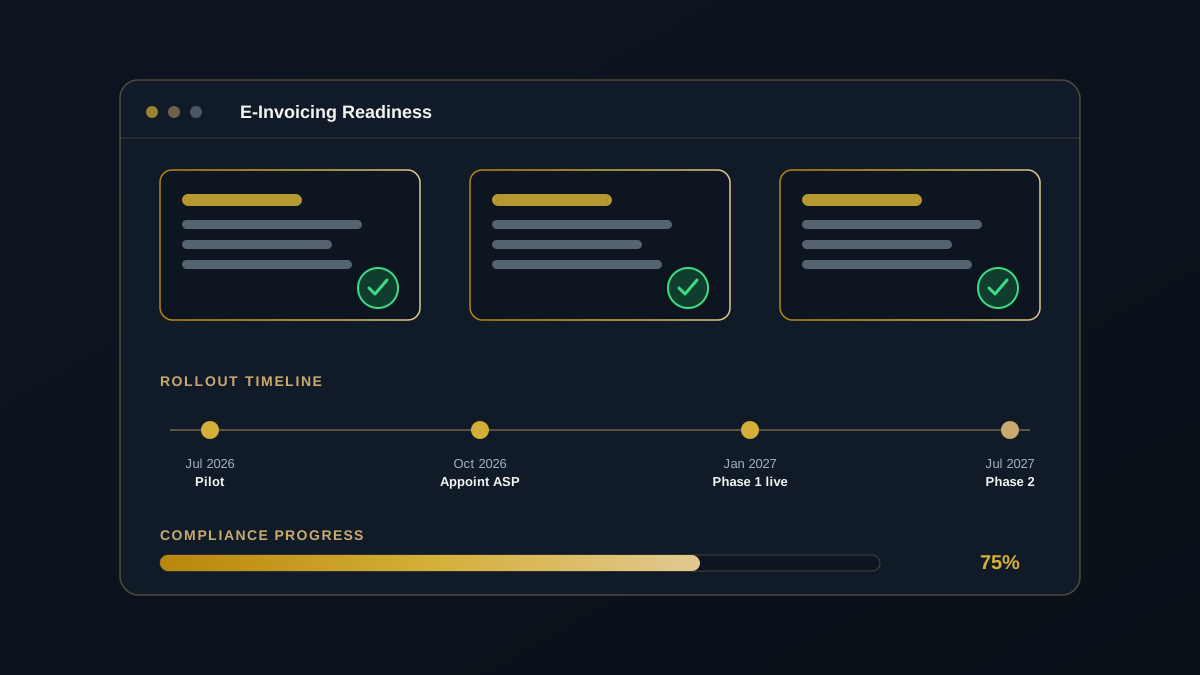
| Stage | Date | Who it affects |
|---|---|---|
| Voluntary pilot opens | 1 July 2026 | Early adopters and the Taxpayer Working Group |
| Appoint an ASP by | 30 October 2026 | Businesses with revenue of AED 50 million or more |
| Phase 1 go-live (mandatory) | 1 January 2027 | Businesses with revenue of AED 50 million or more (B2B and B2G) |
| Appoint an ASP by | 31 March 2027 | Businesses with revenue below AED 50 million |
| Phase 2 go-live (mandatory) | 1 July 2027 | Businesses with revenue below AED 50 million |
| Government entities | 1 October 2027 | UAE government bodies |
Note that the ASP-appointment deadline for large businesses was extended by the Ministry of Finance from 31 July 2026 to 30 October 2026 — but the go-live date stayed at 1 January 2027. The single most important date for many companies is therefore not go-live but the appoint-an-ASP deadline, because onboarding and testing take time. To pin your own dates, use our deadline calculator and set free deadline reminders.
Who must comply — and when
The mandate is sequenced by business size (revenue), largest first. Key points:
- B2B and B2G first. Business-to-business and business-to-government transactions are the priority.
- B2C is excluded from mandatory e-invoicing under Article 4 of Ministerial Decision No. 243 of 2025 — at least for now.
- Free-zone companies are not exempt. Being in a free zone changes your Corporate Tax position (see the Free Zones hub), but it does not remove your e-invoicing obligations.
- Intra-group transactions are expected to be brought in later (around 2029).
Practical rule of thumb: if you are VAT-registered and trade B2B or B2G, assume you will be in scope — the only question is which phase. Not sure your VAT position is correct? Check our VAT registration thresholds and the VAT threshold checker.
The Peppol 5-corner model, explained simply
The UAE has adopted a Peppol-based Decentralised Continuous Transaction Control and Exchange (DCTCE) model — often called the "5-corner" model. Here is the whole thing in one diagram:
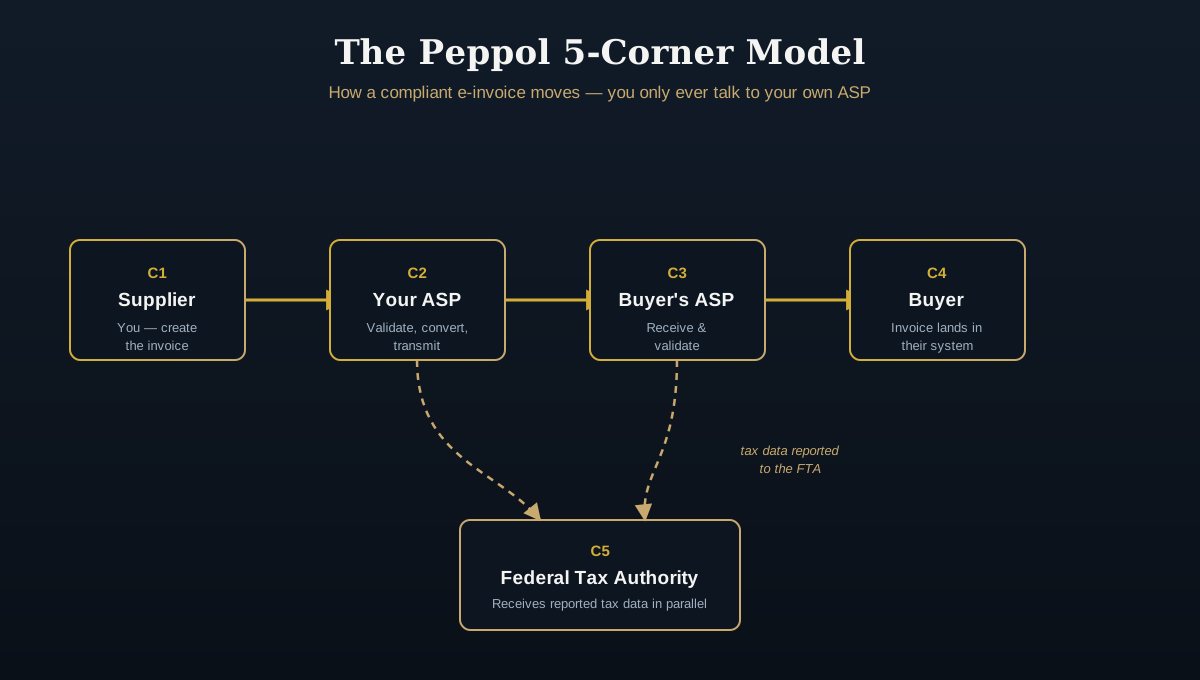
| Corner | Who | Role |
|---|---|---|
| C1 | Supplier (you) | Creates the invoice in your system |
| C2 | Your ASP | Validates, converts to the standard format, transmits |
| C3 | Buyer's ASP | Receives and validates the invoice |
| C4 | Buyer | Receives the structured invoice into their system |
| C5 | FTA platform | Receives the reported tax data in parallel |
The elegance of the model is that you only ever talk to your own ASP. Your ASP handles format conversion, validation, secure transmission to the buyer's ASP, and reporting to the FTA. You do not integrate directly with the government or with each customer. For a deeper walkthrough, read the 5-corner model explained.
What an ASP is and how to choose one
Quick answer — what is an ASP? An Accredited Service Provider is a government-approved company that connects your business to the e-invoicing network: it validates your invoices, converts them to the required format, transmits them, and reports the tax data to the FTA on your behalf. Using an accredited provider is mandatory — you cannot simply email structured files yourself.
When you evaluate ASPs, weigh:
- Accreditation status — confirm the provider is officially accredited (or on the published path to it).
- ERP / accounting integration — does it connect natively to your system (Zoho, Tally, SAP, Oracle, QuickBooks, Microsoft Dynamics)?
- Coverage — can it handle both sending and receiving, B2B and B2G?
- Validation quality — strong pre-submission validation prevents rejected invoices.
- Support and SLAs — local support and uptime guarantees matter when invoicing is real-time.
- Pricing model — per-document, tiered, or flat; understand the total cost at your volume.
We cover the selection criteria in detail in what an ASP is and how to choose one. This is the highest-leverage decision in your whole e-invoicing project.
The technical building blocks
You do not need to become an integration engineer, but you should recognise the moving parts:
- PINT AE — the UAE's national Peppol specification (data dictionary) that defines every mandatory field your invoices must carry.
- Structured format (UBL/XML) — the machine-readable container. Your ASP usually generates this from your data, so you rarely touch raw XML.
- ERP / accounting integration — the connection between your finance system and your ASP. This is where most of the real project work lives.
- Master-data hygiene — correct Tax Registration Numbers (TRNs), legal names, addresses and tax codes for every customer and supplier. Bad master data is the number-one cause of rejected e-invoices.
A practical readiness checklist
Work through these in order — each is a discrete, assignable task:
- Confirm your phase. Estimate your revenue tier and likely go-live date.
- Audit your invoicing today. List every system that issues invoices — you may have more than you think.
- Clean your master data. Verify TRNs, legal names and addresses for all trading partners.
- Map your tax codes. Make sure each product or service is mapped to the correct VAT treatment.
- Choose and onboard an ASP. Start early — onboarding and testing are not instant.
- Integrate and test. Run end-to-end test invoices through the network before go-live.
- Train your team. Both accounts receivable and accounts payable change.
- Lock your deadlines. Use the e-invoicing readiness tool and free reminders so nothing slips.
Our step-by-step SME preparation guide expands each of these into concrete actions for smaller teams.
Penalties for non-compliance
Cabinet Decision No. 106 of 2025 sets out the fines. Once your phase is live, the headline penalties are:
| Violation | Penalty |
|---|---|
| Failure to implement the system or appoint an ASP | AED 5,000 per month |
| Failure to issue / transmit an e-invoice or credit note | AED 100 per invoice (capped at AED 5,000 per month) |
| Failure to notify the FTA of a system malfunction in time | AED 1,000 per day (or part-day) |
Importantly, voluntary early adopters are not penalised during their voluntary period — another reason to start before your phase becomes mandatory. We track the full schedule in e-invoicing penalties, and the wider administrative-penalty landscape in our Deadlines & Penalties hub.
How e-invoicing connects to VAT and Corporate Tax
E-invoicing does not exist in isolation — it is the data layer beneath your other tax obligations:
- VAT: structured invoice data will increasingly reconcile against your VAT returns, meaning fewer errors. See how to file a VAT return.
- Corporate Tax: accurate, timestamped transaction data strengthens the records behind your Corporate Tax position. Unsure of your obligations? Start with do I need to register for Corporate Tax?
- Audit readiness: a complete, structured invoice trail makes any future FTA review dramatically smoother.
Think of e-invoicing as the foundation that makes both VAT and Corporate Tax compliance easier — not a separate burden bolted on top.

Common mistakes to avoid
- Treating it as an IT-only project. Finance, tax and operations all own a piece — IT alone cannot fix master data or tax-code mapping.
- Waiting for the go-live date. The binding constraint is ASP onboarding and testing, which happens months earlier.
- Ignoring inbound invoices. You must receive e-invoices too, not just send them — accounts payable changes as well.
- Dirty master data. Wrong TRNs and mismatched legal names cause rejections on day one.
- Assuming a free-zone exemption. Your free-zone status does not remove the obligation.
How we help
E-invoicing readiness is exactly the kind of structured, deadline-driven project where getting the sequence right saves you money and stress. We help you confirm your phase, clean and map your data, shortlist and onboard an accredited ASP, and run end-to-end testing before your go-live. We are not a tax agent ourselves — where a regulated submission is required, the formal filing is routed through our network of FTA-registered partner Tax Agencies, so it is handled correctly the first time. Start with the free e-invoicing readiness check, set deadline reminders, or explore the full E-Invoicing hub.
Frequently asked questions
Is e-invoicing mandatory in the UAE?
Yes. It is being phased in under Federal Decree-Law No. 16 of 2024 and Ministerial Decisions 243 and 244 of 2025, starting with the largest businesses and expanding to all VAT-registered B2B and B2G businesses.
When does UAE e-invoicing start?
A voluntary pilot opens on 1 July 2026. Mandatory go-live is 1 January 2027 for businesses with revenue of AED 50 million or more, and 1 July 2027 for smaller businesses.
Is a PDF invoice an e-invoice?
No. A PDF is an image of an invoice. A compliant e-invoice is a structured data file exchanged through an accredited provider and reported to the FTA.
Who has to comply first?
Businesses with annual revenue of AED 50 million or more must appoint an ASP by 30 October 2026 and go live on 1 January 2027.
Do free-zone companies have to use e-invoicing?
Yes. Free-zone status affects your Corporate Tax position but does not exempt you from e-invoicing.
Does e-invoicing apply to B2C sales?
No. Business-to-consumer transactions are excluded from mandatory e-invoicing under Article 4 of Ministerial Decision No. 243 of 2025.
What is an ASP and do I need one?
An Accredited Service Provider connects you to the e-invoicing network. Using one is mandatory — you cannot self-transmit invoices.
What is the Peppol 5-corner model?
A network model where you talk only to your ASP, which exchanges invoices with the buyer's ASP and reports tax data to the FTA in parallel.
What is PINT AE?
The UAE's national Peppol specification — the data dictionary defining the mandatory fields every e-invoice must contain.
What are the penalties for non-compliance?
Under Cabinet Decision No. 106 of 2025: AED 5,000 per month for failing to implement the system or appoint an ASP; AED 100 per missing invoice (capped at AED 5,000 per month); and AED 1,000 per day for not reporting a system malfunction in time.
How much does e-invoicing cost?
An ASP fee (per-document or subscription) plus one-off integration and internal data-cleanup time. Small businesses on cloud accounting platforms typically pay a modest monthly fee.
What do I need technically to get ready?
A compatible accounting or ERP system, a connection to an accredited ASP, clean customer and supplier master data, and correctly mapped tax codes.
How is the UAE model different from Saudi Arabia's ZATCA?
Both pursue the same goal, but the UAE uses a Peppol-based decentralised (5-corner) model, with ASPs exchanging invoices and reporting to the FTA. The validation and reporting flows differ in detail.
Will e-invoicing replace VAT returns?
Not immediately. Over time, structured invoice data is expected to streamline and help pre-populate VAT reporting, reducing manual preparation.
What is the single most important deadline?
Usually the appoint-an-ASP date, not go-live, because onboarding and testing take time. Anchor your plan to it and track it with free reminders.