Last updated: 20 August 2026 · Written by the UAE Tax Filing editorial team · Reviewed by Jazim, CEO, UAE Tax Filing LLC (Dubai) · 12 min read
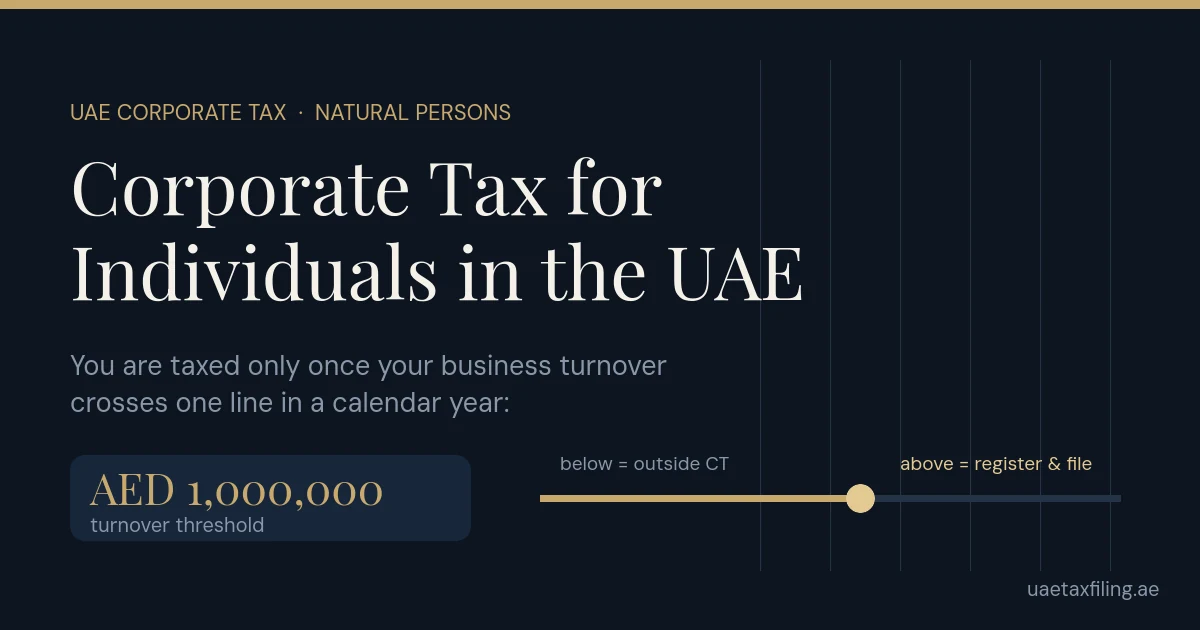
Individuals pay UAE Corporate Tax only on business income, and only once that income passes a line. A natural person is taxed where their total turnover from a business or business activity exceeds AED 1 million in a Gregorian calendar year. Salary, personal investments and rental income never count — so most employees and passive investors owe nothing at all. Payments to directors and officers carry their own limits — see our guide to who counts as a director or officer.
The single most common mistake is adding everything up. Your salary, your rent from a flat, and your personal share trading are carved out by law. Only what you earn from actually running a business counts toward the AED 1 million line.
The short version
- Only business income is taxed. Under Article 11 of Federal Decree-Law No. 47 of 2022, a natural person is a Taxable Person only for a business or business activity they conduct.
- The line is AED 1 million a year. Corporate Tax applies only where business turnover exceeds AED 1,000,000 in a Gregorian calendar year, under Cabinet Decision No. 49 of 2023.
- Three big income types are excluded. Wage, personal investment income and real estate investment income are not business activity — they never count, at any amount.
- Register by 31 March. Cross the AED 1 million line in a year, and you must register by 31 March of the following year.
- Then 0%, then 9%. The first AED 375,000 of taxable income is taxed at 0%; the rest at 9%, with Small Business Relief available up to AED 3 million of revenue.
What this covers
- What a “natural person” means
- Do you owe it? The AED 1 million test
- What counts toward the AED 1 million
- Salary, investments and rent: the three carve-outs
- When to register: the 31 March deadline
- The rate: 0%, 9% and Small Business Relief
- A worked example: mixed income
- Freelancers, influencers and sole establishments
- Frequently asked questions
What a “natural person” means
A natural person is an individual human being — you, personally — as opposed to a juridical person, which is a company or other legal entity. UAE Corporate Tax treats the two differently, and for individuals it reaches only the business they carry on, not their private life.
The law makes an individual a Taxable Person only when they conduct a business or business activity in the UAE. That covers a freelancer invoicing clients, a doctor in private practice, a trader with a sole establishment, or a consultant working under their own name. It does not cover someone simply earning a salary or holding investments. The distinction is the activity, not the person: the same individual can have taxable business income and, alongside it, income that is completely outside the tax.
Compare an employee with a side business. Their monthly salary is outside Corporate Tax no matter how large. The design fees they earn freelancing at the weekend are business income and can be taxed — but only if those fees cross the threshold.
Key takeaway: Corporate Tax follows the business, not the individual. Being a natural person with income does not make you taxable; conducting a business does.
Do you owe it? The AED 1 million test
An individual owes UAE Corporate Tax only if turnover from their business exceeds AED 1 million in a Gregorian calendar year. Below that line there is no registration, no return and no tax for that year.
Turnover here means the gross amount of business income — the total you invoice or take in from the activity, before costs, measured over the January-to-December year. It is a turnover test, not a profit test: the AED 1 million looks at what comes in, while the tax itself, if you cross the line, is charged on profit. Two people with the same AED 900,000 of freelance income are both outside the tax; the moment one reaches AED 1,000,001, they step inside it.

Key takeaway: The AED 1 million test is about business turnover in a calendar year, not your total income and not your profit. Under the line, you are simply out.
What counts toward the AED 1 million
Only turnover from a business or business activity counts toward the AED 1 million line. That is income from actively running something — a trade, a profession, a commercial venture — whether or not it is licensed.
The income that counts is straightforward once you separate “work I do” from “assets I hold.” Fees from freelancing and consulting, sales through a sole establishment, professional practice income, and any commercial or trading activity all count. What does not count is the return on wealth you simply own. The table below draws the line.
| Counts toward the AED 1m | Never counts (at any amount) |
|---|---|
| Freelance and consulting fees | Wage or salary from employment |
| Sole establishment sales and revenue | Personal investment income (own-account shares, crypto) |
| Professional practice income | Real estate investment income (renting out property) |
| Commercial, trading or licensed business activity | Interest and dividends held personally |
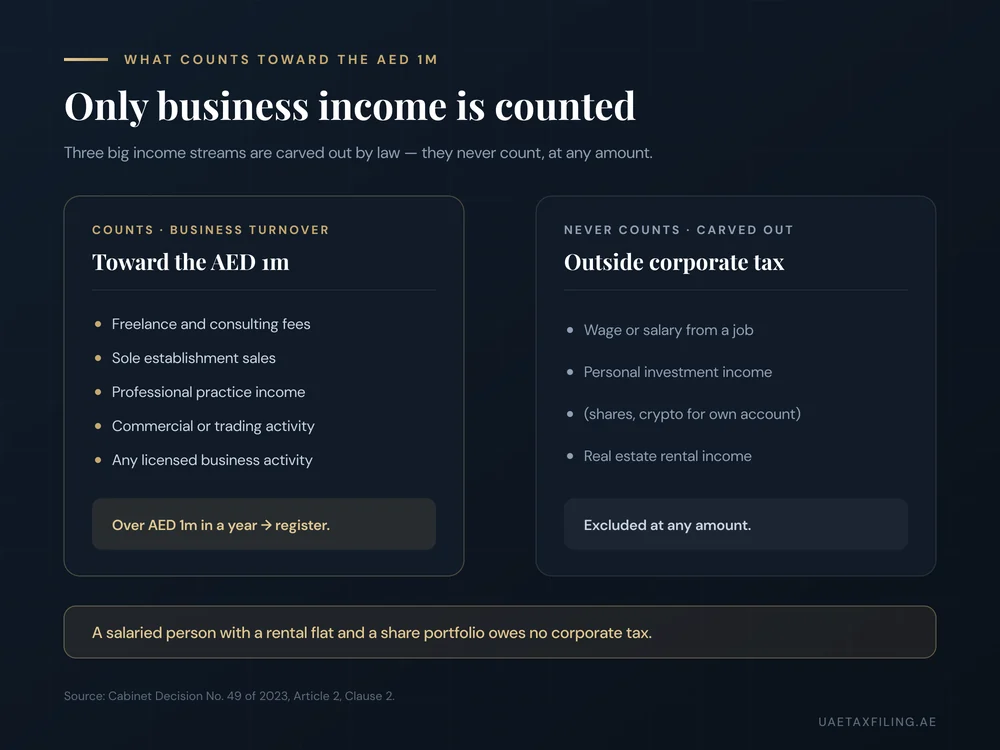
Key takeaway: Count what you earn from working or trading; ignore what you earn from owning. Only the first column moves you toward the AED 1 million line.
Salary, investments and rent: the three carve-outs
Three categories of income are excluded from Corporate Tax for individuals by law, regardless of amount. Under Cabinet Decision No. 49 of 2023, wage, personal investment income and real estate investment income are not treated as business activity at all.
Each has a precise meaning. Wage is the remuneration an employee receives under an employment contract — salary, allowances and bonuses, in cash or in kind. Personal investment is investment activity you conduct for your own account that does not need a licence and is not a commercial business, such as buying shares or crypto personally. Real estate investment is income from the sale, lease, sub-lease or rent of UAE property where no licence is required. A salaried employee with a rented-out apartment and a personal stock portfolio has three income streams and none of them is business income.
The carve-outs are absolute on amount. A landlord earning AED 4 million a year from rent, with no licensed property business, has zero business turnover for this test — and owes no Corporate Tax as an individual. The number that matters is business turnover, and rent is not business turnover.
Property is the one to watch. Passive renting is excluded, but running a licensed real estate business is not — the boundary is whether the activity is, or must be, licensed. We cover that line in detail in our guide to corporate tax and real estate for UAE property investors.
Key takeaway: Salary, personal investing and property rental are outside Corporate Tax for individuals at any size. They are not business activity, so they never push you over the AED 1 million line.
When to register: the 31 March deadline
A natural person who crosses the AED 1 million line must register for Corporate Tax by 31 March of the following year. The deadline comes from Federal Tax Authority Decision No. 3 of 2024 on registration timelines.
The mechanism is a calendar. Your tax period as an individual is the Gregorian year, January to December. If your business turnover exceeds AED 1 million during a year, you have until 31 March of the next year to submit your Tax Registration application, and then until nine months after year-end — 30 September — to file the return and pay. Registering is not the same as being taxed: you register because you crossed the turnover line, then the tax is charged on your profit.
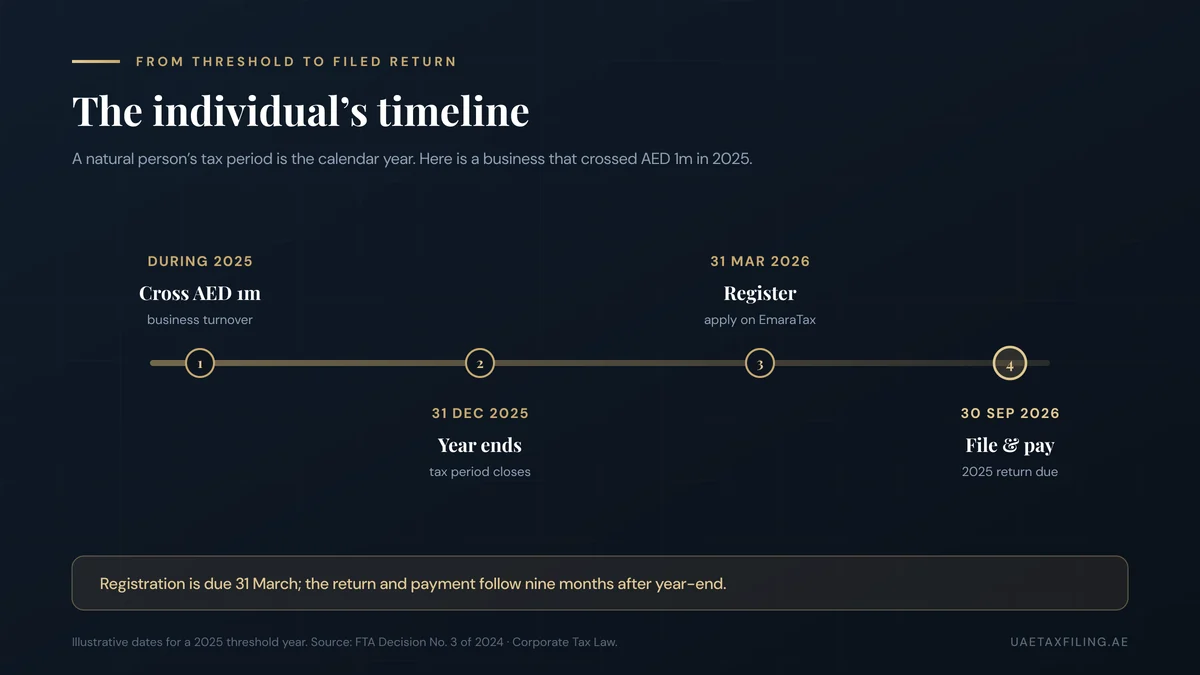
The steps, for an individual who has just crossed the line:
- Confirm the year you crossed AED 1 million. Total your business turnover for each Gregorian year; the first year over the line is your first tax period.
- Register on EmaraTax by 31 March. Apply for a Corporate Tax registration in your own name — see our EmaraTax registration walkthrough.
- Keep business records. Track income and deductible costs for the year, separately from personal finances.
- File and pay by 30 September. Submit the return and settle any tax within nine months of year-end — the wider calendar is in our 2026 Corporate Tax deadlines guide.
Key takeaway: Cross AED 1 million in a year, register by 31 March of the next year, then file and pay by 30 September. Missing the registration date carries its own penalty, separate from any tax.
The rate: 0%, 9% and Small Business Relief
Individuals pay the same Corporate Tax rates as companies: 0% on the first AED 375,000 of taxable income and 9% above it. The rate applies to profit, not to the turnover figure used for the threshold test.
Two reliefs soften the early years. The AED 375,000 zero-rate band means a freelancer with, say, AED 500,000 of taxable profit pays 9% on only AED 125,000 — about AED 11,250. On top of that, Small Business Relief lets a natural person elect to be treated as having no taxable income for a period where their revenue is AED 3 million or below, which removes the tax entirely for eligible small operators while they still file. It is an election, and it suits individuals whose business is real but modest.
The mechanics and the trade-offs of that election are set out in our guide to Small Business Relief and the AED 3 million decision.
Key takeaway: Above the threshold, you pay 0% up to AED 375,000 of profit and 9% beyond. Small Business Relief can take an eligible individual’s tax to zero up to AED 3 million of revenue — but you still register and file.
A worked example: mixed income
The clearest way to see the rules is a person with several income streams. Consider Layla, a Dubai resident with a full-time job, a rented apartment, a personal share portfolio, and a weekend consulting practice.
Her salary is AED 300,000, her flat brings in AED 120,000 of rent, her shares pay AED 40,000 in dividends, and her consulting invoices total AED 1,150,000 for the year. Only the consulting is a business activity. The salary is wage, the rent is real estate investment income, and the dividends are personal investment income — all three are carved out. Her business turnover is AED 1,150,000, which is over the line, so she must register by 31 March of the following year and file for that year. If Layla’s consulting had come in at AED 900,000 instead, she would owe nothing and need not register at all.
Change one number and the outcome flips. It is never the size of someone’s total income that triggers Corporate Tax — it is whether the business slice, on its own, clears AED 1 million.
Key takeaway: Strip out salary, rent and personal investments first. Test only the business turnover that remains against the AED 1 million line.
Freelancers, influencers and sole establishments
Freelancers, content creators and sole establishments are the individuals most often caught by these rules, because their income is business income by nature. Each earns from an activity they conduct, so their fees count toward the AED 1 million from the first dirham.
The threshold is what separates a hobby from a taxable business. A freelancer billing AED 1.2 million is over the line and registers; one billing AED 600,000 is not. A content creator’s brand deals, ad revenue and sponsorships are all business turnover, which adds up faster than people expect. A sole establishment is simply a business owned by one individual, so its revenue is that person’s business turnover. We go deeper on two of these groups in our guides to Corporate Tax for freelancers and Corporate Tax for influencers and content creators.
Key takeaway: If you earn from work you do rather than assets you hold, your income is business turnover. Track it across the year and watch the AED 1 million line.
Tell us your situation — your business turnover for the year, and whether you also have salary, rent or personal investments — and we will tell you whether you cross the AED 1 million line, when you must register, and what you would owe. Where you need to register and file, we match you with an FTA-registered partner agency that handles it. Message the team on WhatsApp using the button below.
Frequently asked questions
Do individuals pay corporate tax in the UAE?
Only on business income. A natural person is subject to UAE Corporate Tax where their turnover from a business or business activity exceeds AED 1 million in a Gregorian calendar year. Individuals with only salary, personal investments or rental income are not taxed and do not register.
What is the AED 1 million threshold?
It is the point at which an individual’s business becomes taxable. Under Cabinet Decision No. 49 of 2023, Corporate Tax applies to a natural person only where their total business turnover exceeds AED 1,000,000 in a Gregorian year. Turnover is gross business income, measured before costs.
Does my salary count toward corporate tax?
No. Wage — salary, allowances and bonuses under an employment contract — is excluded from Corporate Tax for individuals at any amount. It is not a business activity, so it never counts toward the AED 1 million line and is never taxed.
Is rental income subject to corporate tax for individuals?
No, where it is passive. Real estate investment income — renting out UAE property without a licence — is carved out regardless of size. A landlord with no licensed property business owes no Corporate Tax on rent, even on several million dirhams a year.
Do I pay corporate tax on personal share or crypto trading?
Not on personal investing. Investment you conduct for your own account, without a licence and not as a commercial business, is personal investment income and is excluded. If instead you run a licensed trading business, that activity is business turnover and counts.
When must a natural person register for corporate tax?
By 31 March of the year after you cross the line. If your business turnover exceeds AED 1 million during a Gregorian year, Federal Tax Authority Decision No. 3 of 2024 requires you to register by 31 March of the following year, then file and pay within nine months of year-end.
What rate do individuals pay?
The first AED 375,000 of taxable income is taxed at 0%, and the amount above it at 9%. The rate applies to profit, not to the turnover figure used for the threshold. Small Business Relief can reduce the tax to zero for eligible individuals with revenue up to AED 3 million.
I have a job and freelance on the side — do I need to register?
Only if the freelancing alone crosses AED 1 million. Your salary is ignored for this test. If your freelance turnover for the year is over AED 1 million you register and file; if it is below, you do not, however large your salary is.
Do I still register if my business turnover is under AED 1 million?
No. A natural person whose business turnover does not exceed AED 1 million in the year is not conducting a taxable business and is not required to register for Corporate Tax for that year. If your turnover later crosses the line, the registration duty begins then.
How we verified this: the threshold, definitions and exclusions are taken from Cabinet Decision No. 49 of 2023 and Article 11 of Federal Decree-Law No. 47 of 2022; the registration deadline is from Federal Tax Authority Decision No. 3 of 2024. Check current guidance in the FTA legislation library. This article is general information, not tax advice.
Last updated: 20 August 2026 · Reviewed by Jazim, CEO, UAE Tax Filing LLC (Dubai)