A Dubai apartment. Rented to a family on an annual Ejari. AED 180,000 in rental income per year. The owner lives in London, visits twice a year, and has never heard of corporate tax. The question: does he owe CT on that AED 180,000? The answer, according to the FTA's published guidance, is almost always no. But it depends on one specific test, and that test is not the number.
The same owner decides to convert the apartment to a short-term holiday home on Airbnb. Same apartment, same location, but now he applies for a DET holiday home permit and lists the unit at AED 800 per night. Annual gross rental: AED 220,000. The question: does he owe CT on that AED 220,000? The answer, according to the same FTA guidance, is now yes if his total licensed business turnover exceeds AED 1 million in a calendar year, and possibly earlier for VAT purposes. The apartment did not change. The tax treatment did.
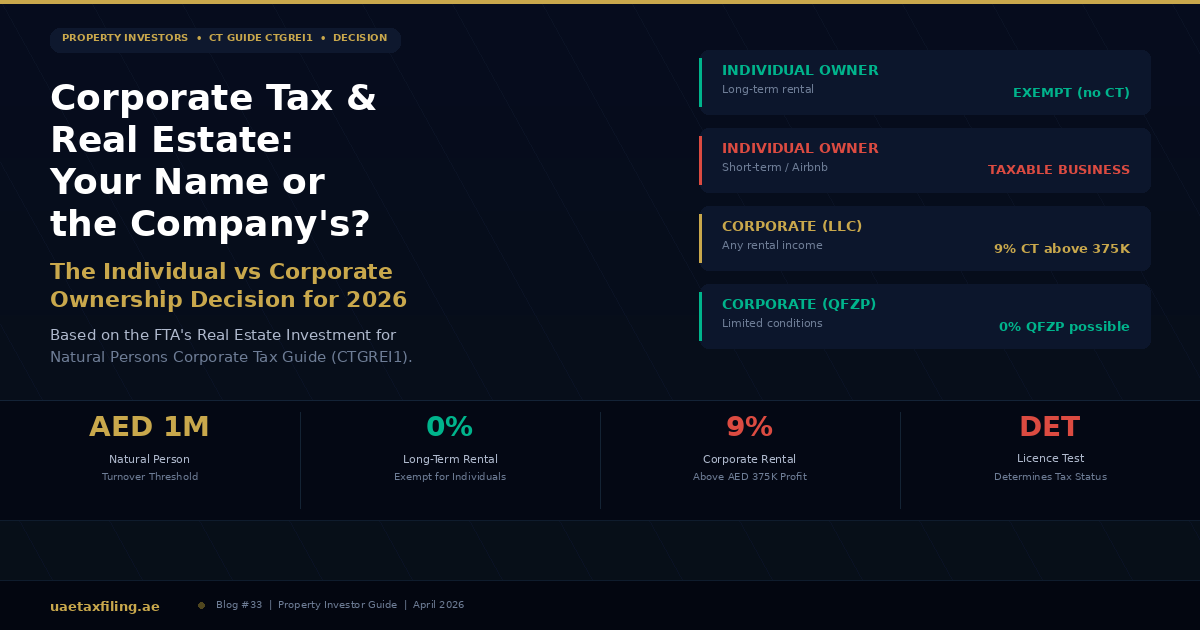
This is the most misunderstood area of UAE corporate tax. The headline version ('no personal income tax in Dubai') is true but incomplete. The detailed version, set out in the FTA's Real Estate Investment for Natural Persons Corporate Tax Guide (CTGREI1) published in October 2024, draws a specific line between investment activity (exempt) and business activity (taxable). The line runs through a single question: does the activity require a licence from a UAE licensing authority? If yes, the income is business income and enters the CT calculation. If no, the income is Real Estate Investment income and is excluded from CT entirely.
This article explains the licence test, walks through the natural person exemption in detail, maps the three scenarios where the exemption breaks (short-term rental, business scale, corporate ownership), runs the AED math for three real investor profiles, and addresses the corporate structuring decision that most portfolio landlords are getting wrong. Our real estate CT guide covers the corporate side of property investment (companies that own and operate real estate as a business); this article covers the individual side (natural persons earning rental income in their own name). If you own UAE property, the first thing you need to know is which side of that line you are on.
"Every property investor asks the same first question: how much tax am I going to pay on my rental income? And the answer is almost always zero. But then they ask the second question: I want to put my apartments on Airbnb to earn more. That is where the conversation changes. The moment you need a DET permit, you have crossed from investment into business. The exemption is gone. People do not realize their structure changed until we explain it to them."
Jazim, CEO, UAE Tax Filing LLC
What the FTA's CTGREI1 Guide Actually Says
The FTA published CTGREI1, the Real Estate Investment for Natural Persons Corporate Tax Guide, on October 24, 2024. It is the authoritative source for individual property investors. The guide is not itself law, but it explains how the FTA applies Cabinet Decision No. 49 of 2023, which defines what counts as Real Estate Investment income (excluded from CT) and what does not.
The core rule. A natural person is subject to CT only if they conduct a business or business activity in the UAE and the turnover from that business exceeds AED 1 million in a Gregorian calendar year. Cabinet Decision No. 49 of 2023 excludes three specific income categories from counting as business activity: wages (salary income), personal investment income (dividends, interest on deposits), and Real Estate Investment income (rental and sale income from property held as an investment).
The Real Estate Investment definition. As Lexology's detailed analysis of the guide documented, Real Estate Investment covers selling, leasing, sub-leasing, or renting land or real estate property in the UAE. Importantly, the FTA treats this list as exhaustive: if the activity is not one of these four, it does not qualify as Real Estate Investment. Rendering services in relation to property (property management for third parties, development, construction, brokerage) is a business activity, not investment.
The decisive test: does the activity require a licence? The FTA's guide is clear on this. Real Estate Investment is activity that is NOT conducted through a licence and does not require a licence from a UAE licensing authority. If the activity requires a licence from the DET, the Dubai Land Department, Abu Dhabi DED, or any similar body, it is a licensed business activity and falls within the scope of CT. If no licence is required or held, the income is Real Estate Investment income and is excluded.
Critical clarification from the guide: The CT Law itself does not create a licensing requirement. Licensing requirements come from separate laws and the relevant licensing authorities (DET in Dubai, DED in Abu Dhabi). What the FTA says is: go check the licensing legislation first. If that legislation requires a licence for your specific activity, CT applies. If it does not, Real Estate Investment exemption applies.
Long-Term Residential Rental: The Clear Exemption
The most common scenario: a natural person owns one or more residential apartments or villas and rents them out on annual contracts to residents. Ejari is registered. Rent is collected monthly or quarterly. The owner may manage the property personally or engage a rental agency to find tenants and collect rent.
Under the CTGREI1 guide, this is Real Estate Investment activity. Leasing residential property to long-term tenants does not require the owner to hold a trade licence. The Fintedu analysis of the guide confirms: a natural person leasing residential property in their own name is not subject to corporate tax, even if a manager or agent is used. The rental income is excluded from CT. Any expenses related to that rental (service charges, maintenance, mortgage interest, property management fees) are also excluded. These amounts do not appear on a CT return because there is no CT return to file for this income.
The rental agent exception. Even if the rental agent that manages the property on behalf of the owner holds a property management licence, this does not disqualify the owner. The FTA's guide is explicit: the rental agent may require a Licence to conduct its Business, but that does not disqualify the natural person owner from qualifying for the Real Estate Investment exclusion, provided the owner himself does not hold a Licence personally. The licence test applies to the owner, not the agent.
Number of properties does not matter. The exemption is not limited by the number of properties owned. A natural person who owns one apartment and a natural person who owns twenty apartments are in the same category, as long as the activity does not require a licence. As the FTA guide example establishes, large residential portfolios held in personal name for long-term rental remain exempt. This is the structural reason why Dubai landlord investors often hold property in personal name rather than through a company: the exemption scales with the portfolio.
The Dubai Municipality 5% housing fee. This is a separate charge, not a CT issue. Tenants pay 5% of annual rental value to Dubai Municipality (collected through DEWA). It is paid by the tenant, not the landlord. Abu Dhabi tenants pay 3%. Sharjah 2%. This is a municipal rental tax, not income tax, and it does not affect the CT analysis. Commercial property rentals have a separate 10% municipal charge.
The Short-Term Rental Trap: Airbnb Breaks the Exemption
The moment a natural person starts short-term or holiday home rental (Airbnb, Booking.com, Vrbo, Dubizzle nightly rentals), the tax treatment changes structurally. Short-term rental in Dubai requires a Holiday Home permit from the Department of Economy and Tourism (DET). Similar licences apply in other emirates. The licence is the trigger. As Lexology's analysis explains, a natural person that rents out a villa on a short term basis might find that he is required to obtain a licence from the DET to carry out the activity; if so, he would not be eligible for the Real Estate Investment income exemption.
What this means in practice. The rental income from short-term rental activity is now business income. It counts toward the AED 1 million CT registration threshold that applies to natural persons. If the total turnover from the licensed business activity (plus any other business activities the natural person conducts) exceeds AED 1 million in a calendar year, the natural person must register for CT, file an annual return, and pay 9% on profits above AED 375,000. Our freelancer CT guide covers the registration process for natural persons; the same rules apply to individuals running short-term rental businesses.
VAT may apply even below the CT threshold. Short-term rental is a standard-rated supply for VAT. If the total taxable supplies exceed the AED 375,000 VAT registration threshold, the individual must register for VAT separately from CT. This can happen before the CT threshold is reached: a natural person earning AED 500,000 from short-term rental must register for VAT but not necessarily for CT (because the CT threshold is AED 1 million).
Mixed portfolios: the apportionment rule. Many landlords own some units on long-term tenancy and others on short-term holiday rental. The FTA guide addresses this. The long-term units remain Real Estate Investment (exempt). The short-term units are licensed business (taxable). The natural person must apportion common expenses between the two categories on a reasonable basis (typically property value or time-usage). As Fintedu's detailed commentary noted, this ensures an accurate reflection of the tax-deductible expenses for business activities, while real estate investment income remains unaffected.
The four-apartment example: Mr. B owns four apartments in Dubai Marina. Two are rented on annual Ejari tenancy contracts to residents (AED 150,000 each per year). Two are operated as holiday homes on Airbnb with DET permits (AED 200,000 each per year). The two long-term units produce AED 300,000 in Real Estate Investment income (exempt). The two short-term units produce AED 400,000 in licensed business turnover. Mr. B's total business turnover is AED 400,000, which is below the AED 1 million CT registration threshold. He does not need to register for CT, but he may need to register for VAT (since AED 400,000 exceeds the AED 375,000 VAT threshold). If he adds two more holiday homes next year and business turnover rises to AED 1.2 million, he must register for CT. The FTA's audit framework increasingly cross-references DET permit data against CT and VAT registrations, so mixed portfolios need clean documentation from the start.
Our corporate tax team reviews your property portfolio against the CTGREI1 framework: which units are exempt, which generate business income, where VAT and CT registration thresholds sit, and what restructuring options make sense for your specific situation. Message us on WhatsApp.
The Business Scale Trap: When Investment Becomes Business
The FTA guide is clear that number of properties alone does not disqualify a natural person from the Real Estate Investment exemption. But certain activities conducted alongside ownership can push the investor over the line into business territory. The transition is not about the number of units; it is about what the owner is doing with them.
Property management services. If the natural person provides property management services to other owners (finding tenants, collecting rent, handling maintenance for properties they do not own), that is a business activity. It requires a Dubai DED or DET licence, and the income from those services is business income subject to CT. Owning and operating your own property remains exempt; managing other people's property is a separate licensed business.
Brokerage or real estate agency. If the individual is introducing buyers to sellers, earning commission on transactions, they are acting as a real estate agent. Real estate brokerage in Dubai requires a RERA licence. This is a business activity. Income is subject to CT if turnover exceeds AED 1 million.
Development or speculative trading. Buying properties with the intent to flip them (short-hold resale for profit, rather than long-term rental) may be treated as a business activity depending on the frequency and pattern. The FTA guide uses the example of a natural person selling their personal residence (one-off sale, not business) versus a pattern of frequent purchases and sales that indicate a trading business. There is no fixed number, but a pattern of multiple transactions per year with short holding periods creates the risk of reclassification.
Operating under a trade licence. If the natural person holds any trade licence for real estate-related activities (including a simple freelance licence to conduct property-related services), that licence brings them within the CT scope for the associated activities. The licence itself is the trigger.
The General Anti-Abuse Rule (GAAR). The FTA has explicit authority under GAAR to recharacterize transactions that abuse the Real Estate Investment exemption. Splitting a portfolio across multiple family members to avoid the AED 1 million threshold, or artificially structuring a business as 'investment,' can trigger GAAR reassessment. As Fintedu's analysis highlighted, GAAR exists specifically to prevent misuse of the exemption.
The Corporate Ownership Path: When an LLC Makes Sense
Some property investors hold real estate through a corporate structure (LLC, offshore company, or free zone entity). The tax analysis is completely different. A juridical person (company) earning rental income is a taxable business, regardless of whether the activity would be exempt if held by a natural person. The Real Estate Investment exemption applies only to natural persons. The moment the property is owned by a company, the income is company income and CT applies.
The 9% calculation for corporate-owned property. A company earning AED 500,000 in rental income pays CT on profits above AED 375,000. If gross rent is AED 500,000 and allowable deductions (service charges, management fees, insurance, maintenance, mortgage interest) are AED 100,000, net profit is AED 400,000. CT is 9% of (AED 400,000 minus AED 375,000) = 9% of AED 25,000 = AED 2,250. Our how much does CT actually cost article includes this as one of the higher-margin scenarios where the effective rate remains low despite limited expense compression.
The free zone trap. A company in a free zone that holds UAE real estate generally does not qualify for the 0% QFZP rate on rental income from that real estate. As Invest in Dubai's taxation analysis explains, rental income from UAE real estate is specifically excluded from the definition of qualifying income for QFZP purposes. A free zone company with UAE rental income pays the standard 9% rate on non-qualifying income, and the mandatory audit cost of QFZP compliance makes this structure typically more expensive than personal ownership for long-term rentals. Our free zone vs mainland comparison covers the structural considerations.
When corporate ownership does make sense. Despite the tax cost, corporate ownership has legitimate uses: (1) liability protection (a company owns the asset; personal liability is limited); (2) succession planning (shares are easier to transfer than property titles in some cases); (3) joint ventures with multiple investors (a company structure is simpler than co-ownership); (4) institutional investors that must hold assets through corporate vehicles for regulatory reasons; (5) hotel apartments or operational property requiring a trade licence anyway. Corporate structures with multiple property-holding entities may also benefit from tax group formation to consolidate returns and offset profits and losses across entities. As VATupdate's analysis of the topic confirmed, the choice between individual and corporate ownership has significant tax implications and should be based on specific circumstances.
The property SPV model. Some sophisticated investors use a Special Purpose Vehicle (SPV) structure, typically through DIFC or ADGM, to hold one or more UAE properties. The SPV is still subject to CT on rental income (no free zone exemption for UAE-source real estate income), but the structure provides liability separation, estate planning efficiency, and a cleaner path for joint ownership or future sale. The annual cost of an SPV (licence, registered office, audit) typically runs AED 30,000 to AED 80,000, so the structure only justifies itself for portfolios generating meaningful income or complex ownership structures.
Three Worked Scenarios: Real AED Math for Real Property Investors
Scenario 1: Mrs. A, single-apartment landlord in JVC
Mrs. A owns one 2-bedroom apartment in Jumeirah Village Circle that she bought in 2019. She rents it on annual Ejari tenancy to a family for AED 95,000 per year. She does not hold any trade licence. She manages the property through Property Finder and does her own small maintenance. Annual costs: service charges AED 8,000, minor maintenance AED 4,000. Net profit after costs: AED 83,000.
Gross rental income: AED 95,000. CT status: Real Estate Investment. CT registration required: No. CT payable: AED 0. VAT status: Residential rental is generally VAT-exempt. No VAT registration required. Total tax cost: AED 0 (plus the 5% Dubai Municipality housing fee paid by the tenant).
Scenario 2: Mr. B, mixed portfolio of long-term and Airbnb
Mr. B owns four apartments in Dubai Marina. Two are rented on annual tenancy (AED 150,000 each = AED 300,000 Real Estate Investment income). Two are operated as holiday homes with DET Holiday Home permits, generating AED 200,000 each in gross bookings (AED 400,000 total licensed business turnover). Holiday home operating costs: AED 180,000 across the two units (cleaning, platform fees, furnishings, utilities). Net profit from holiday homes: AED 220,000.
Long-term rental (Real Estate Investment): AED 300,000 exempt, no CT or VAT obligation. Short-term rental (licensed business): AED 400,000 gross turnover. Below AED 1M CT threshold, so no CT registration. Above AED 375K VAT threshold, so VAT registration required. CT payable: AED 0 (below CT threshold). VAT obligation: 5% on holiday home rentals, quarterly filing. Total tax cost: AED 0 in CT, approximately AED 20,000 in VAT paid by guests (pass-through, not a cost to Mr. B if input VAT is properly recovered).
If Mr. B adds two more holiday home units next year and pushes business turnover above AED 1 million, the CT analysis changes. He must register for CT, file an annual return, and pay 9% on profits above AED 375,000 from the licensed business activity. The long-term rental portion remains exempt. This is the transition point where corporate structuring conversations typically begin.
Scenario 3: Ms. C, commercial property investor through an LLC
Ms. C holds a commercial office floor in Business Bay through a mainland LLC structure. Annual gross rental: AED 850,000. Operating costs (service charges, facility management, insurance, company maintenance): AED 180,000. Net profit: AED 670,000. The LLC has no other activities.
Gross rental income: AED 850,000. Deductible expenses: AED 180,000. Net profit: AED 670,000. Less AED 375,000 zero-rate band: AED 295,000 taxable at 9%. CT payable: AED 26,550. VAT: Commercial rental is subject to 5% VAT = AED 42,500 collected from the tenant and remitted to FTA (pass-through). Effective CT rate on revenue: 3.1%. Filing: Ms. C files the CT return on EmaraTax by the September 30 deadline for her calendar-year LLC.
If Ms. C had held the same property in personal name (natural person, no licence), the rental income would be exempt from CT under Real Estate Investment rules. Her choice to hold through an LLC costs her AED 26,550 per year in CT. In exchange, she gets liability protection and succession clarity. Whether the trade-off makes sense depends on her other assets, her estate planning goals, and whether the LLC has other activities that justify the structure. This is the structuring conversation our corporate tax team has with portfolio investors every week.
Should You Restructure? The Decision Framework
Investors who currently hold property in corporate structures often ask whether they should transfer back to personal ownership to reclaim the exemption. The answer depends on several factors, none of which are purely tax-driven.
Liability considerations. A corporate structure insulates personal assets from claims related to the property (tenant disputes, building damage, third-party liability). For high-value properties or properties with significant tenant-facing risk (hotels, serviced apartments, commercial), the liability protection may justify the tax cost.
Succession and estate planning. UAE law default succession rules may apply differently to property titled in personal name versus company shares. DIFC and ADGM Wills provide specific mechanisms for non-Muslim expat succession; a registered will can direct property held in personal name according to the owner's wishes. Corporate ownership allows share transfer, which can be easier for multi-generational planning in some cases.
Transfer costs. Transferring property from a company to a personal name (or vice versa) triggers the 4% DLD transfer fee on the market value. On a AED 5 million property, that is AED 200,000. Any restructuring must justify this one-time cost against the ongoing annual tax saving. A property generating AED 26,550 per year in CT (Scenario 3) would take 7-8 years to break even on the transfer cost.
Bank and mortgage considerations. Some mortgages are structured specifically to the owner (personal or corporate) and cannot be transferred without refinancing. Refinancing costs and interest rate differences must be factored into any restructuring decision. Corporate structures also carry ongoing accounting and bookkeeping costs that do not apply to personal ownership. Working with the right tax firm to model all of these variables before making the structural decision prevents expensive mistakes.
Property tax structuring is permanent in its consequences. Once you buy in corporate name, transferring out is expensive. Once you buy in personal name, transferring in to a company is expensive. Get the structure right before you buy, not after. Our team runs the analysis for new acquisitions and existing portfolios, identifying the structure that minimizes ongoing cost while meeting liability and succession goals. Talk to us on WhatsApp.
Five Mistakes Property Investors Make
1. Assuming all rental income is exempt. The exemption applies to Real Estate Investment activity, not to all rental income. Short-term rental, serviced apartments, licensed property management, and corporate-owned rentals are all outside the exemption. Check the licence test before assuming exemption.
2. Treating Airbnb income as exempt personal income. Short-term rental in Dubai requires a DET Holiday Home permit. Once the permit is held, the activity is licensed business, not Real Estate Investment. As our 9 mistakes article covers, FTA cross-referencing systems can detect holiday home activity through DET permit data and Airbnb public listings.
3. Holding property through a free zone company to chase the 0% rate. Free zone companies earning UAE-source rental income do not qualify for the QFZP 0% rate on that income. The rental income is non-qualifying and pays 9% on profits above AED 375,000. Our QFZP qualifying rules explain why UAE real estate is specifically excluded.
4. Ignoring VAT on commercial and short-term rentals. Commercial rental is subject to 5% VAT above the AED 375,000 threshold. Short-term residential rental (holiday homes) is also VATable. Residential long-term rental is exempt from VAT. Many individual investors assume all residential rental is VAT-exempt without checking the short-term status. Our VAT return guide covers rental VAT treatment for real estate businesses.
5. Not registering for CT when business turnover crosses AED 1M. A natural person with licensed property activity (holiday homes, brokerage, property management) that exceeds AED 1 million in turnover must register for CT regardless of what the profit is. The AED 10,000 late registration penalty applies per entity. The registration obligation is triggered by turnover, not by profit.
Frequently Asked Questions
Do I pay corporate tax on rental income from my Dubai apartment?
If you are a natural person (individual, not a company), and the apartment is rented on long-term tenancy without a trade licence, no CT applies. The rental income is excluded as Real Estate Investment income under the CTGREI1 guide.
What if I own ten apartments in my personal name?
Still exempt, provided all ten are long-term rentals and you do not hold a trade licence. The number of properties does not matter; the licence test does.
What about Airbnb or holiday home rental?
Short-term rental requires a DET Holiday Home permit in Dubai. Once the permit is held, the activity is licensed business. Income counts toward the AED 1 million CT registration threshold for natural persons, and VAT registration may apply above AED 375,000.
Does it matter if my rental agent has a licence?
No. The licence test applies to the owner, not the agent. If a licensed rental agency manages your property but you do not hold a personal licence, you remain eligible for the Real Estate Investment exemption.
Do I pay CT on profit from selling my property?
Natural person sales of personal real estate held as an investment are excluded from CT as Real Estate Investment income. Sales that form part of a property trading business (frequent buying and selling as a business activity) may be treated as business income subject to CT.
Is rental income from an LLC subject to corporate tax?
Yes. A juridical person (LLC, free zone company, foreign company) earning rental income is a taxable business. CT applies at 9% on profits above AED 375,000.
Can I use a free zone company to avoid CT on rental income?
No. UAE-source rental income is non-qualifying income for QFZP purposes. A free zone company earning rental income pays 9% on profits above AED 375,000 and must also bear mandatory audit costs, making it typically more expensive than personal ownership.
Should I transfer my existing corporate-owned property to personal name?
Possibly, but the 4% DLD transfer fee on market value may outweigh the tax saving. For a AED 5 million property, that is AED 200,000 one-time cost. Calculate the break-even period (transfer fee divided by annual tax saving) before restructuring.
What is the AED 1 million CT threshold for natural persons?
Natural persons must register for CT if their total business or business activity turnover exceeds AED 1 million in a Gregorian calendar year. Wages, personal investment income, and Real Estate Investment income are excluded from this calculation.
Where can I read the official FTA guide?
The Real Estate Investment for Natural Persons Corporate Tax Guide (CTGREI1) is published on the FTA website at tax.gov.ae. It was issued on October 24, 2024, and provides detailed examples of exempt and taxable scenarios.
Your Name or the Company's: Know Before You Buy
The question every UAE property investor should ask before the purchase, not after: what is the end-use? Long-term residential rental in personal name is tax-exempt at every portfolio size. Short-term rental triggers a licence, which triggers CT above AED 1 million turnover. Corporate ownership triggers CT regardless of activity. Commercial rental through a company is taxable. Free zone structures do not help for UAE real estate. The structure decision is permanent in consequence: changing it later costs 4% of market value in DLD transfer fees.
The FTA's CTGREI1 guide gave the market clarity on how natural persons are treated. The rules are favorable. For most individual investors with long-term residential portfolios, the answer on CT is zero. But the boundaries are specific, and the short-term rental market is where most accidental non-compliance happens. If you are buying to rent, rent long-term in personal name and keep the exemption. If you are buying to Airbnb, plan for the licensed business path from day one. If you are buying commercial, the corporate structure is typically unavoidable and the 9% calculation is what it is.
Know which category you are in before you sign the purchase agreement.
The decision between personal and corporate ownership affects your lifetime tax bill on the property. We run the analysis before you buy, not after. Our advisory team reviews your acquisition plans, recommends the optimal structure for your goals, and handles the ongoing compliance if CT applies. Start on WhatsApp.