
Last updated: 6 September 2026 · Written by the UAE Tax Filing editorial team · Reviewed by Jazim, CEO, UAE Tax Filing LLC (Dubai) · 12 min read
For UAE Corporate Tax, a director is someone holding a seat on the board or an equivalent governing body, and an officer is someone with final authority to direct the business or bind it contractually. Both are Connected Persons under Article 36, so payments to them are deductible only up to Market Value — and must be disclosed with the tax return. A job title alone decides nothing.
The Authority made the point twice, in both directions. Someone called “Marketing Director” with no board seat is not a director. Someone with no C-suite title who can actually bind the company is an officer. Substance beats the business card.
The short version
- Director: a natural person holding a position on the board of directors, or an equivalent governing body where there is no board — including board committee members.
- Officer: a natural person with authority to plan, direct and control the business, make final strategic decisions, or approve actions that legally bind it.
- Why it matters: both are Connected Persons, so their pay is deductible only to the extent it matches Market Value and is wholly and exclusively for the business.
- It is also a disclosure item. Payments and benefits to Connected Persons must be reported with the return where they exceed the Authority’s threshold.
- Only natural persons qualify — and where someone is both a Related Party and a Connected Person, they count only as a Related Party.
What this covers
- Why the definition matters
- Who counts as a director
- Who counts as an officer
- The job-title trap, both ways
- The same role, both answers
- Trusts, partnerships and other edge cases
- What to do about it
- Common mistakes
- Frequently asked questions
Why the definition matters
Article 36(2)(b) of the Corporate Tax Law makes a director or officer of a taxable person a Connected Person, and that status carries two consequences. Under Article 36(1), a payment or benefit provided to a Connected Person is deductible only if, and to the extent that, it corresponds with the Market Value of the service or benefit provided, and is incurred wholly and exclusively for the purposes of the business.

The second consequence is disclosure. Under Article 55(1), the Authority can require a taxable person to file information about transactions and arrangements with Connected Persons alongside the tax return, and it currently requires payments or benefits to Connected Persons to be disclosed where they exceed a specified threshold. So misclassifying a senior employee does not just risk a disallowed deduction — it can leave a required disclosure unmade. The disclosure itself sits inside the return, which our EmaraTax return walkthrough steps through.
Key takeaway: Directors and officers are Connected Persons, so their remuneration is capped at Market Value for deduction purposes and is a disclosure item in the return. The classification drives both outcomes.
Who counts as a director
A director is a person who holds a position on the board of directors of the taxable person. The clarification is deliberately broad on type of directorship: a director can be executive, non-executive, temporary, permanent or alternate, and the definition expressly includes any member of a board committee.

Where a taxable person has no board of directors, the term covers a person holding a position on any equivalent governing body, such as a board of trustees or a board of governors, as determined under the law governing the entity’s incorporation or its constitutional documents. Those documents include the memorandum of association, articles of association, a partnership deed or a trust deed. The practical instruction is to read the constitutional documents rather than the org chart.
Key takeaway: If the person occupies a seat on the board or its equivalent under the constitutional documents, they are a director — whatever their executive status, and including committee members.
Who counts as an officer
An officer is a person who holds real authority over the business rather than a particular title. The clarification sets out three alternative tests, and meeting any one of them is enough.
The first is authority and responsibility for planning, directing and controlling the activities of the taxable person, framed by reference to International Accounting Standard 24 on Related Party Disclosures. The second is authority to make final or ultimate strategic decisions in relation to financial, operational or commercial matters. The third is authority to approve actions that legally or contractually bind the taxable person. A person who lacks final or ultimate strategic decision-making or binding authority is not an officer.
The clarification gives an indicative list: Chief Executive Officer, General Manager, Chief Financial Officer, Chief Operating Officer, Chief Commercial Officer, and an authorised representative holding discretionary authority. That list is illustrative, not exhaustive — which is the whole point of the next section.
Key takeaway: An officer is anyone who can plan, direct and control the business, take final strategic decisions, or bind the company. One of the three tests is enough; a C-suite title is not required.
The job-title trap, both ways
A formal appointment or job title is an indicator when assessing officer status, but the Authority is explicit that it should not be relied on as the sole criterion. The trap runs in both directions, and most businesses only guard against one of them.
In one direction: where a person’s job title includes the word “director” but they do not hold a position on the board or an equivalent governing body under the constitutional documents, they are not a director for Article 36(2)(b). A Marketing Director or IT Director with no board seat fails the first test. The enquiry then moves to whether they are an officer, which they may well be.
In the other direction, the clarification is blunt: a person with no formal appointment and no C-suite title who, through their actual conduct, effectively has the authority to plan, direct and control activities, or to take or approve actions that bind the company, is still an officer.
That second limb is the one that catches people. It means the assessment cannot be run off an HR title list. It has to be run off delegations of authority, signing mandates, powers of attorney and how decisions actually get made.
Key takeaway: Titles cut both ways. “Director” in a job title without a board seat does not create a director; no title at all with real binding authority does create an officer.
Unsure which of your senior people are Connected Persons? Send us your org chart, board composition and signing mandates — we will map who falls inside Article 36 and what has to be disclosed, then match you with an FTA-registered partner agency to handle the return. Message the team on WhatsApp below.
The same role, both answers
The clarification resolves the same job in opposite directions depending on authority, and its worked examples are the clearest guide available. The dividing question never changes: can this person make the final call, or do they execute someone else’s?
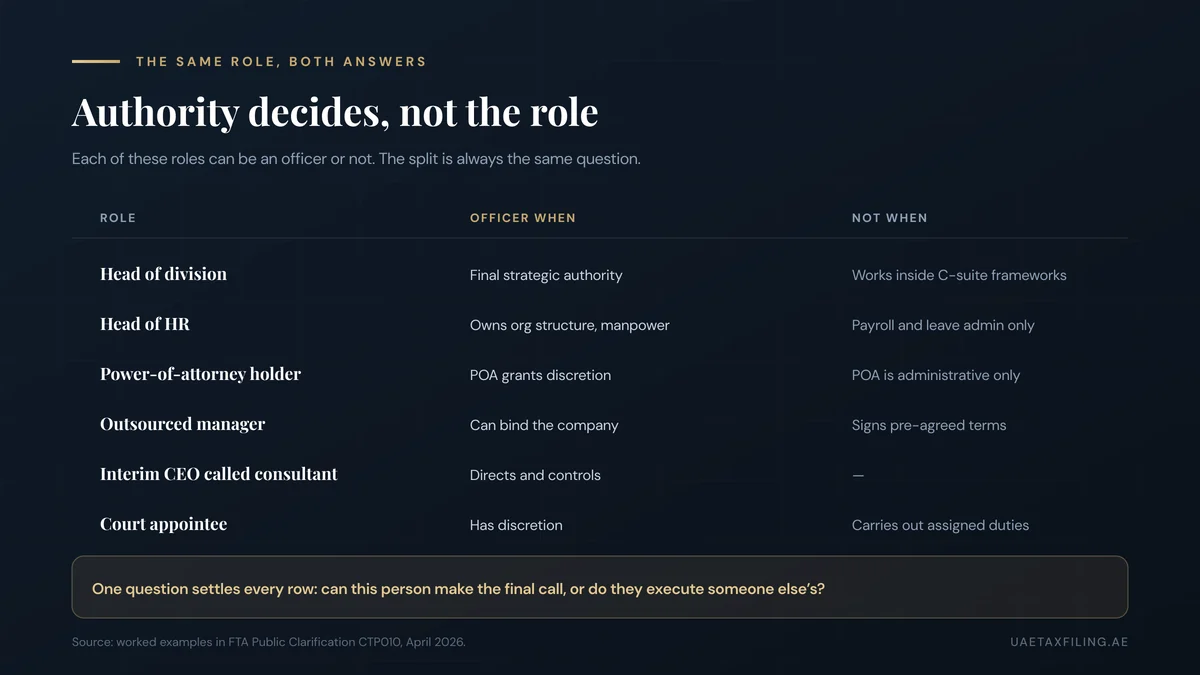
| Role | Officer when | Not an officer when |
|---|---|---|
| Head of division | They hold final strategic authority over financial, operational or commercial matters | They decide only within frameworks set by, and follow instructions of, the C-suite or board |
| Head of HR | They hold final authority over manpower planning, organisation structure or performance management | The role is limited to routine functions such as payroll processing or leave management |
| Power-of-attorney holder | The power of attorney grants discretionary authority to direct activities or take final decisions | The power of attorney is administrative — performing predefined, already-approved tasks |
| Outsourced management | They can make strategic decisions or enter agreements that bind the company | They only conclude negotiations after the material commercial and legal terms are agreed |
| Interim CEO titled “consultant” | They direct and control the activities during the interim period | — |
| Court appointee | They hold discretionary decision-making authority | They only carry out duties assigned by the court |
Two of these deserve emphasis. An employee named in the trade licence or in board resolutions as a key officer is an officer if that naming gives them final authority to approve actions that bind the company — the naming alone is not the test. And an interim CEO carrying the title “consultant” is an officer for that interim period, which is a reminder that temporary arrangements are not outside the rules.
Key takeaway: The same job title lands on either side depending on delegated authority. Assess the mandate, not the role name — and reassess when someone steps into a role temporarily.
Trusts, partnerships and other edge cases
Two structural rules narrow the population, and both are easy to miss. First, only a natural person can be a director or officer of a taxable person for these purposes. A corporate entity appointed to a board does not become a Connected Person under this limb.
Second, where a person is both a Related Party and a Connected Person of a taxable person, they are treated only as a Related Party for Corporate Tax purposes. That matters because the two categories carry different rules, and the transfer pricing framework that governs Related Parties is the more demanding of the two — our guide to transfer pricing in the UAE sets out what that involves.
The definitions also reach beyond companies. They apply to persons including trusts, foundations and unincorporated partnerships treated as fiscally opaque for Corporate Tax purposes. The trustee of a trust that is itself a taxable person is an officer where they hold the authority to direct and control the trust’s activities. Where you are running a foundation structure, that interaction is worth reading alongside our guide to family foundations and Corporate Tax.
Key takeaway: Only natural persons can be directors or officers, and Related Party status overrides Connected Person status where both apply. Trustees of taxable trusts can be officers in their own right.
What to do about it
Turning this into compliance is a mapping exercise against your governance documents, not a policy to write. It is worth doing before the return rather than during it.
- List the board. Pull the actual board composition from the constitutional documents, including alternates and board committee members. Everyone on that list is a director.
- Check for an equivalent body. If there is no board, identify the trustees, governors or equivalent named in the memorandum, articles, partnership deed or trust deed.
- Collect the authority evidence. Signing mandates, delegation-of-authority matrices, powers of attorney, and the names on the trade licence and board resolutions.
- Run the three officer tests against each senior person: planning and controlling, final strategic decisions, authority to bind. One is enough.
- Ignore titles at this stage and revisit them only as supporting evidence, in line with the Authority’s guidance that a title is an indicator rather than a criterion.
- Benchmark the remuneration of everyone on the resulting list against Market Value for the role, since that is the deduction ceiling.
- Feed the list into the disclosure and keep the working papers, which fall under the ordinary record-keeping requirements.
Step three is where the work sits. In practice the delegation-of-authority matrix is the single most useful document, because it states in writing what each role can approve without escalation — which is exactly the question the officer test asks. Companies without one tend to discover the answer only by reconstructing past decisions.
Key takeaway: Start from the constitutional documents and the delegation of authority, not the org chart. Build the Connected Person list first, then benchmark pay against Market Value and disclose.
Common mistakes
The errors are classification errors, and they surface at the point of filing when the disclosure is already due.
Five recur. First, treating job titles as determinative, in either direction. Second, overlooking board committee members, who are expressly included. Third, assuming an outsourced or interim manager is outside scope, when authority rather than employment status decides. Fourth, missing the Related Party override and applying Connected Person rules to someone who should be treated as a Related Party. Fifth, never benchmarking remuneration, which leaves the Market Value cap untested until the FTA tests it — a risk that runs alongside the wider deduction rules in our guide to what you can and cannot claim. Owner-managers should also read this together with Corporate Tax for individuals, since the two interact where you pay yourself.
Key takeaway: Nearly every mistake here is a classification made from an org chart. Build the list from governance documents and delegated authority, and benchmark before you file.
Frequently asked questions
Is someone with “Director” in their job title automatically a director?
No. Where a person’s job title includes the term “director” but they do not hold a position on the board of directors or an equivalent governing body under the constitutional documents, they are not a director for the purposes of Article 36(2)(b). You then need to assess separately whether they are an officer.
Can a company be a director or officer?
No. The clarification states that only a natural person can be a director or officer of a taxable person for these purposes. A corporate entity holding a board seat does not become a Connected Person through this route, though other provisions may still apply to it.
Are non-executive directors included?
Yes. A director can be executive, non-executive, temporary, permanent or alternate, provided they are appointed to the board of directors. The definition also expressly includes any member of a board committee, which is frequently overlooked.
What happens if someone is both a Related Party and a Connected Person?
They are treated only as a Related Party for Corporate Tax purposes. This matters in practice because Related Party transactions fall under the transfer pricing framework, which imposes different documentation and pricing obligations from the Connected Person rules.
Does an outsourced CFO or external manager count?
It depends on their authority, not their employment status. Outsourced management personnel authorised only to conclude negotiations after the material commercial and legal terms are agreed are not officers. Where they can make final strategic decisions or enter binding agreements, they are.
Does holding a power of attorney make someone an officer?
Only if the power of attorney grants discretionary authority for planning, directing and controlling activities, or to make final strategic decisions. A power of attorney that is administrative in nature, allowing predefined and already-approved tasks or following instructions, does not make the holder an officer.
What is the effect on deducting director fees?
Fees paid to a director are deductible only if, and to the extent that, they correspond with the Market Value of the service or benefit provided, and are incurred wholly and exclusively for the purposes of the business. Anything above Market Value is not deductible.
What accounting framework does the officer test refer to?
The authority-and-responsibility limb of the officer test is framed by reference to International Accounting Standard 24 on Related Party Disclosures, which deals with key management personnel. It anchors the test in an established accounting concept rather than leaving it open-ended.
How we verified this: the definitions of “director” and “officer”, the three officer tests, the job-title guidance, the natural-person and Related Party rules and the worked role examples are taken from Federal Tax Authority Corporate Tax Public Clarification CTP010, “Clarification of the terms ‘director’ and ‘officer’ for the purpose of payments to Connected Persons under Article 36 of the Corporate Tax Law”, published April 2026. We extracted the English text directly from the Authority’s bilingual PDF rather than relying on secondary summaries. The underlying provisions are Articles 36(1), 36(2)(b) and 55(1) of Federal Decree-Law No. 47 of 2022. The clarification is available among the FTA’s Corporate Tax guides and references, and the law itself on the FTA legislation page. This article is general information, not tax advice.
Last updated: 6 September 2026 · Reviewed by Jazim, CEO, UAE Tax Filing LLC (Dubai)