Last updated: 31 August 2026 · Written by the UAE Tax Filing editorial team · Reviewed by Jazim, CEO, UAE Tax Filing LLC (Dubai) · 12 min read
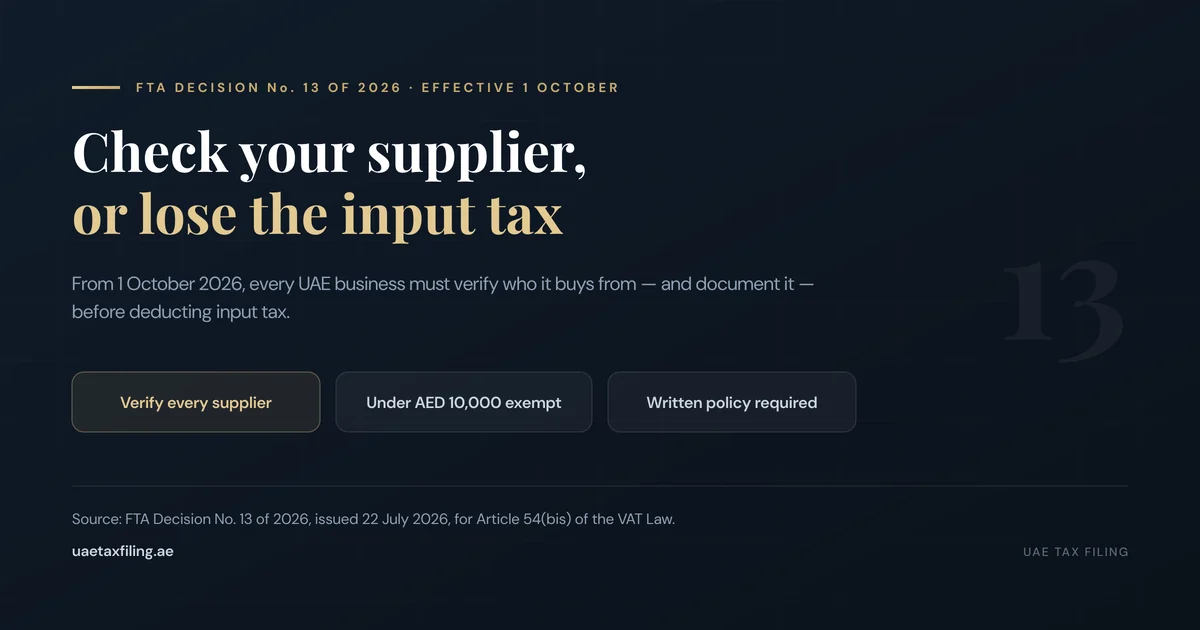
From 1 October 2026, UAE businesses must verify who they buy from before deducting input tax. FTA Decision No. 13 of 2026 sets out mandatory checks on the supplier and on each supply, a written verification policy, and documentation the Authority can demand. Supplies under AED 10,000 are exempt — unless that supplier crosses AED 100,000 over twelve months.
This is the biggest change to UAE input tax recovery since VAT began. It shifts the burden: it is no longer enough to hold a valid tax invoice. You must be able to show you checked who issued it.
The short version
- Effective 1 October 2026. FTA Decision No. 13 of 2026, issued 22 July 2026, implements Article 54(bis) of the VAT Law.
- Verify the supplier and the supply. Identity, place of business and risk indicators for the supplier; commercial logic, payment method and origin of goods for each supply.
- Three thresholds decide your workload. Under AED 10,000 a supply is exempt; AED 100,000 per supplier over 12 months cancels that exemption; AED 375,000 triggers bank-account and reputation checks.
- A written policy is mandatory. Article 5(4) requires a documented policy naming who performs, reviews and supervises verification, and their powers.
- Payment must be electronic. Cash is allowed only with a documented commercial reason, within legislated limits, and must be easily verifiable.
What this covers
- What Decision 13 of 2026 actually requires
- The three thresholds that decide your workload
- Verifying the supplier
- The three risk indicators
- Verifying each supply
- The written policy most firms will miss
- What to do before 1 October
- Common mistakes
- Frequently asked questions
What Decision 13 of 2026 actually requires
FTA Decision No. 13 of 2026 is a set of mandatory measures, procedures and conditions a taxable person must complete to verify the validity and integrity of supplies received before deducting input tax. It was issued on 22 July 2026 and takes effect on 1 October 2026, giving effect to Article 54(bis) of Federal Decree-Law No. 8 of 2017.

The structural change matters more than any single check. Until now, input tax recovery rested on holding a valid tax invoice and using the purchase for taxable supplies. Decision 13 adds a third condition: demonstrable due diligence on the counterparty. A perfect invoice from an unverified supplier no longer secures the deduction. The invoice rules themselves have not changed — our guide to UAE tax invoice requirements still applies in full — but they are now the floor rather than the ceiling.
Key takeaway: From 1 October 2026 input tax recovery requires three things, not two: a valid tax invoice, a taxable use, and documented verification of the supplier and the supply.
The three thresholds that decide your workload
Three figures determine how much verification each purchase needs: AED 10,000, AED 100,000 and AED 375,000. Article 6 allows a taxable person to disregard the measures where the consideration excluding VAT is less than AED 10,000 — but that exemption is withdrawn where total supplies from the same supplier exceed AED 100,000 over the previous twelve months, or are expected to over the next twelve.
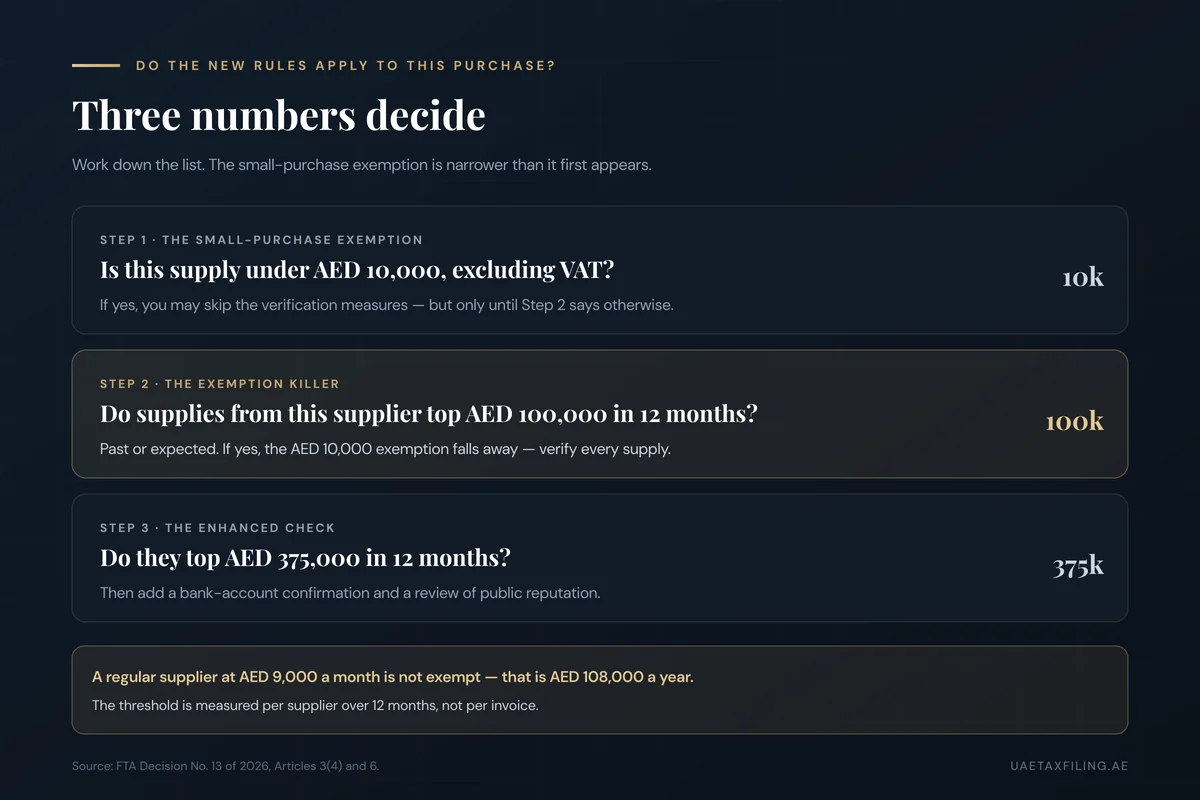
| Threshold | Measured how | Effect |
|---|---|---|
| AED 10,000 | Per supply, excluding VAT | Below it, verification measures may be disregarded |
| AED 100,000 | Per supplier, over 12 months (past or expected) | Cancels the AED 10,000 exemption entirely |
| AED 375,000 | Per supplier, over 12 months (past or expected) | Adds bank-account confirmation and reputation review |
Read the second row carefully, because it is where most businesses will be caught out. The thresholds are measured per supplier across twelve months, not per invoice. A regular vendor billing AED 9,000 a month falls under the AED 10,000 exemption on every single invoice, yet reaches AED 108,000 across the year — so the exemption never applied. The practical test is not “is this invoice small” but “is this supplier small, over a year”.
Key takeaway: Under AED 10,000 per supply is exempt only while that supplier stays under AED 100,000 over twelve months. Recurring small invoices from one vendor are almost always inside the rules.
Verifying the supplier
Supplier verification under Article 3 requires you to establish who the supplier is, that they have a real place of business, and that no risk indicators apply. The requirements split by whether your supplier is an individual or a company.
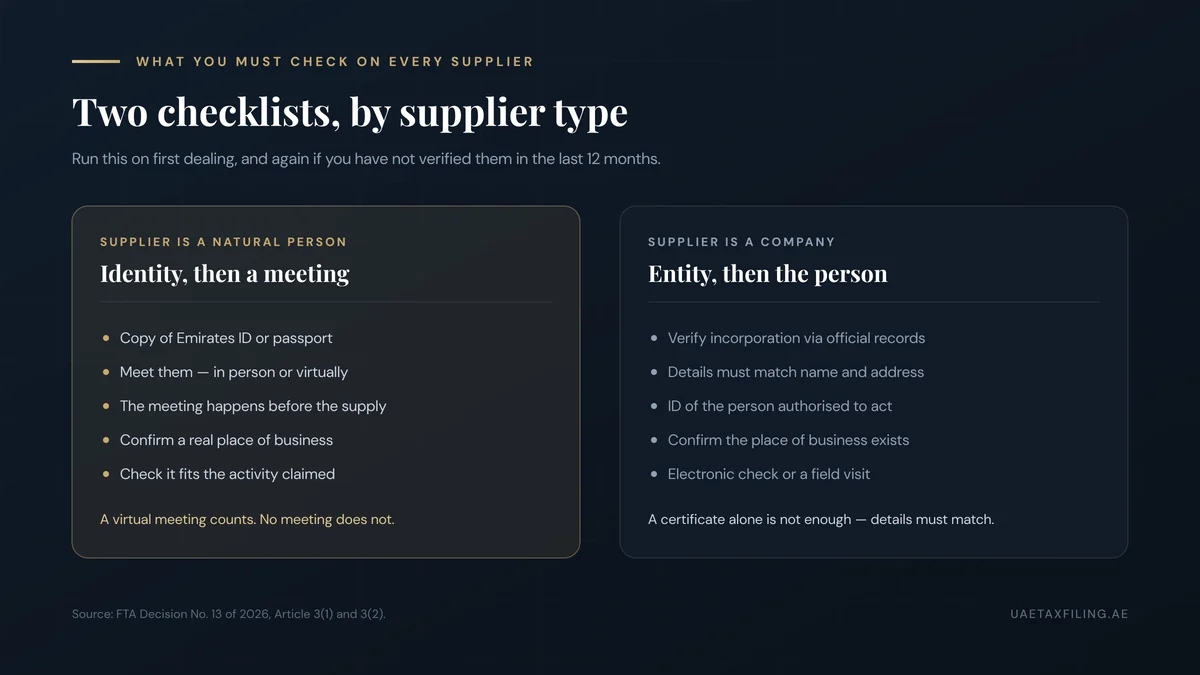
Where the supplier is a natural person, you must obtain a copy of valid proof of identity — an Emirates ID or passport — and meet the supplier, whether in person or virtually, before making the supply. That meeting requirement is easy to overlook and impossible to fix retrospectively. Where the supplier is a legal person, you must verify incorporation through official databases or obtain the certificate of incorporation, with details matching the entity’s name, address and employees, and separately verify the identity of the director, agent or employee authorised to represent it.
Both types then require verification of the place of business: confirm it actually exists using appropriate electronic means or a field visit, and confirm it is compatible with the nature of the activities carried out. A trading company registered to a mailbox is precisely the mismatch this is written to catch.
The meeting requirement for individual suppliers is the sharpest edge in the decision. A virtual call counts. No contact at all does not — and you cannot go back and hold a meeting after the supply.
Key takeaway: Identify the supplier with official documents, confirm a real and appropriate place of business, and for individuals meet them before the supply. Re-verify any supplier you have not checked in the previous twelve months.
The three risk indicators
Article 3(3) names three risk indicators you must screen every supplier against. They are specific and testable rather than open-ended judgement calls.
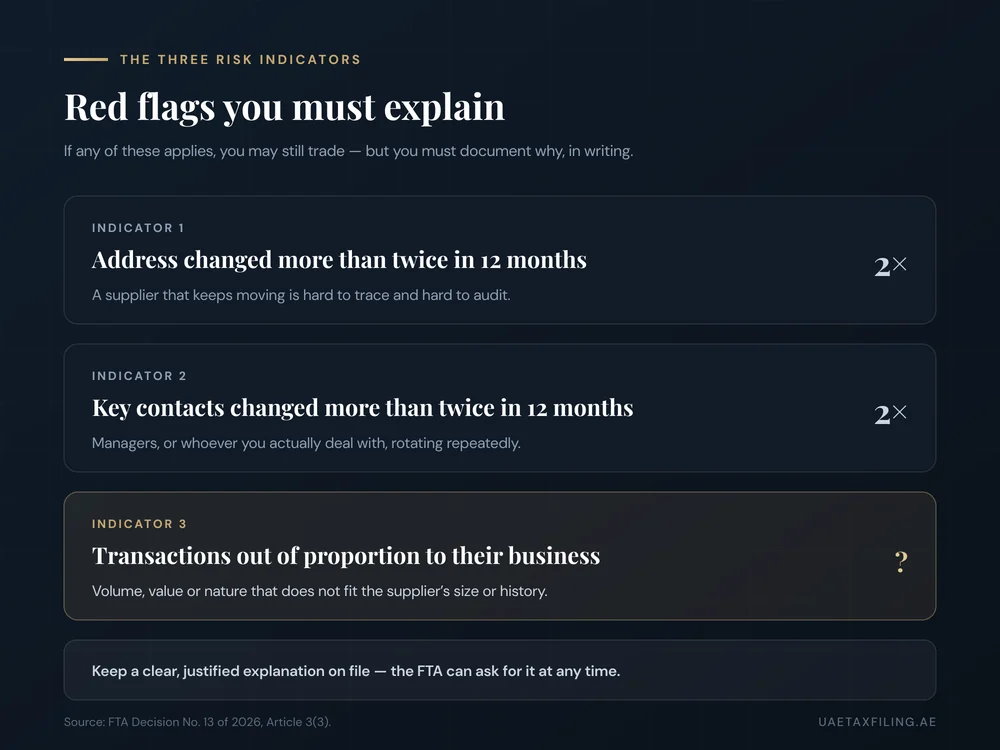
The indicators are: the supplier has changed its address more than twice over the previous twelve months; it has changed its key employees — managers, or those you deal with — more than twice over the previous twelve months; or it has undertaken transactions disproportionate or unexpected in volume, value or nature compared with the size of its business and its trading history.
Crucially, a flag does not bar the transaction. Where an indicator applies, Article 3(3)(b) requires you to retain a clear and justified explanation and submit it to the Authority on request, provided the explanation does not contradict evidence available to you. A supplier that relocated twice while expanding is explainable; the obligation is to write that reasoning down at the time, not to reconstruct it under audit.
Key takeaway: Screen for three specific flags — repeated address changes, repeated personnel changes, and out-of-proportion transactions. If one applies, keep a written, evidence-consistent justification on file.
If you are not sure how many of your suppliers cross AED 100,000 a year, send us your supplier ledger and we will map it against the new thresholds before the deadline — and match you with an FTA-registered partner agency to build the verification file. Message the team on WhatsApp below.
Verifying each supply
Beyond the supplier, Article 4 requires verification of each taxable supply you receive, covering its commercial logic, how it is paid for, and its circumstances. This applies to every supply, not just first dealings.
Three tests run in parallel. General assessment: the supplier’s engagement in the transaction must rest on genuine commercial reasons. Payment conditions: the method must be commercially justifiable, and where a third party is involved in paying or receiving payment, or payment goes to a bank account outside the supplier’s country of incorporation, there must be a reasonable commercial explanation. The decision also states the consideration shall be paid by electronic means; cash requires a documented commercial reason, must sit within the thresholds in the tax legislation, and must be easily verifiable.
Circumstances of the supply is the widest test. You must check that prices or margins are not commercially unjustifiable or significantly out of line with market conditions without clear reason; that the goods or services fall inside the supplier’s ordinary activity and commercial licence; that the goods are authentic, of verifiable origin, and that the supplier owns them or has the right to dispose of them; and where the supplier acts as an intermediary, that its role has a clear commercial explanation. If you already document reverse-charge transactions carefully, our guide to the reverse charge mechanism shows the evidence standard the FTA now expects across the board.
Key takeaway: Every supply must make commercial sense, be paid electronically unless cash is justified and documented, and involve goods the supplier is licensed to sell and entitled to dispose of.
The written policy most firms will miss
Article 5(4) requires every taxable person to maintain a documented policy identifying the persons responsible for implementing, reviewing and supervising verification, stating their powers and responsibilities clearly, and kept where the required documents are held. This is a governance document, not a checklist.
It is the requirement most likely to be overlooked, because it is the only one that cannot be satisfied by doing the work. A business could verify every supplier impeccably and still breach Article 5(4) by never writing down who owns the process. The rest of Article 5 sets the operating rhythm: verify a supplier on first dealing or where they have not been verified in the previous twelve months, verify each taxable supply received, and document the steps taken with supporting records that let the Authority confirm they were carried out.
Those records then fall under the ordinary retention regime, which for Corporate Tax purposes runs seven years — see our guide to record-keeping requirements for how long each category must survive and in what form.
Key takeaway: Write a verification policy naming who runs, reviews and supervises the checks, and store it with your tax records. Performing the checks without documenting ownership of the process is still a breach.
What to do before 1 October
Preparing for Decision 13 is a scoping exercise first and a process build second. The businesses that struggle in October will be those that treat it as a policy to write rather than a supplier base to segment.
- Pull twelve months of supplier spend. Total by supplier, not by invoice. This single report tells you who is in scope.
- Segment against the thresholds. Flag every supplier above AED 100,000 (exemption lost) and above AED 375,000 (bank and reputation checks).
- Verify the top tier first. Work down by value. Your AED 375,000-plus suppliers carry the heaviest requirements and the largest input tax at risk.
- Collect the documents. Identity papers, incorporation evidence, authorised-representative ID, bank confirmations, place-of-business evidence.
- Screen for the three risk indicators and write the justification for any that apply, while the reasoning is fresh.
- Write the Article 5(4) policy naming the responsible people and their powers, and file it with your tax records.
- Fix payment routing. Move remaining cash settlements to electronic payment, or document why cash is commercially necessary.
The scoping step usually surprises people. In supplier ledgers we review, the count of vendors above AED 100,000 a year is consistently far smaller than management expects — often a small minority of names carrying the large majority of spend. That is good news: the workload concentrates, and it can be cleared in weeks rather than months if you start from the value ranking rather than alphabetically.
Key takeaway: Start by totalling twelve months of spend per supplier, then verify downward by value. Scope first, document second — the obligation is heavy only if you treat every vendor as equal.
Common mistakes
The errors that will cost input tax in the first months are misreadings of scope, not failures of effort.
Five stand out. First, treating AED 10,000 as a blanket small-purchase exemption, when Article 6(2) removes it for any supplier above AED 100,000 over twelve months. Second, measuring thresholds per invoice rather than per supplier over a rolling year. Third, skipping the meeting with individual suppliers, which cannot be remedied after the supply. Fourth, doing the checks but writing no policy, breaching Article 5(4) despite good practice. Fifth, assuming a clean invoice is still sufficient — the point of the decision is that it is not. Where deductions are disallowed, the consequences flow through the penalty regime covered in our guide to the 2026 UAE VAT penalty regime, and the evidence you assemble now is exactly what an inspection asks for — see how FTA audits work in practice.
Key takeaway: The costly mistakes are scope errors — misreading the exemption, measuring per invoice, or skipping documentation. Each is avoidable by reading Articles 5 and 6 precisely.
Frequently asked questions
When do the new input tax verification rules start?
1 October 2026. FTA Decision No. 13 of 2026 was issued on 22 July 2026 and Article 7 states it comes into effect as of that date. It applies to verification of supplies received before deducting input tax, so purchases from 1 October onward fall squarely inside it.
Does this apply to every purchase my business makes?
No. Article 6 allows you to disregard the measures where the consideration excluding VAT is less than AED 10,000. But that exemption does not apply where total supplies received from that supplier exceed AED 100,000 over the previous twelve months, or are expected to exceed it over the next twelve.
How are the AED 100,000 and AED 375,000 thresholds measured?
Per supplier, across a twelve-month window, looking both backwards and forwards. The decision refers to supplies received over the previous twelve months or expected over the next twelve. It is not an invoice-by-invoice test, which is why recurring small purchases from one vendor can still be in scope.
What extra checks apply above AED 375,000?
Two. You must obtain written confirmation from an authorised bank in the State that the supplier holds a bank account, without relevant reservations or conditions — and the confirmation need not be addressed to you. You must also review publicly available reviews and media coverage from reliable sources for consistency with the supplier’s business and any signs of suspected tax evasion.
Do I really have to meet suppliers who are individuals?
Yes, where the supplier is a natural person. Article 3(1)(a) requires a copy of valid identity proof and that you meet the supplier, in person or virtually, before making the supply. A video call satisfies it; proceeding with no contact does not, and the requirement cannot be met retrospectively.
Can I still pay suppliers in cash?
Only with justification. The decision states consideration shall be paid by electronic means, and where payment is made in cash it must rest on a documented commercial reason, sit within the thresholds set in the applicable tax legislation, and be easily verifiable. Routine cash settlement without documentation is not compliant.
How often do I need to re-verify an existing supplier?
At least every twelve months. Article 5(1) requires supplier verification when dealing with a supplier for the first time, and on recurrent dealings where the supplier has not been verified over the previous twelve months. Each taxable supply received must be verified under Article 4 regardless.
What happens if a supplier triggers a risk indicator?
You are not barred from trading with them. Article 3(3)(b) requires you to retain a clear and justified explanation for why the indicator applies and to submit it to the Authority on request, provided it does not contradict evidence available to you. The obligation is to document the reasoning, not to walk away.
Is holding a valid tax invoice no longer enough?
Correct. A valid tax invoice remains necessary but is no longer sufficient on its own. Decision 13 of 2026 adds documented verification of the supplier and the supply as a condition to be satisfied before input tax is deducted, which is a change in what you must be able to prove, not just what you must hold.
How we verified this: every requirement, threshold and date above is taken from Federal Tax Authority Decision No. 13 of 2026 (“Measures, Procedures and Conditions required by Taxable Persons for the Verification of the Validity and Integrity of the Supplies before Deduction of Input Tax”), issued 22 July 2026 and effective 1 October 2026, made for the purposes of Article 54(bis) of Federal Decree-Law No. 8 of 2017. We extracted Articles 2 to 7 directly from the Authority’s published PDF rather than relying on secondary summaries; the text is an unofficial translation. Confirm the current position on the FTA legislation page and in the VAT Decree-Law. This article is general information, not tax advice.
Last updated: 31 August 2026 · Reviewed by Jazim, CEO, UAE Tax Filing LLC (Dubai)