Last updated: 20 August 2026 · Written by the UAE Tax Filing editorial team · Reviewed by Jazim, CEO, UAE Tax Filing LLC (Dubai) · 11 min read
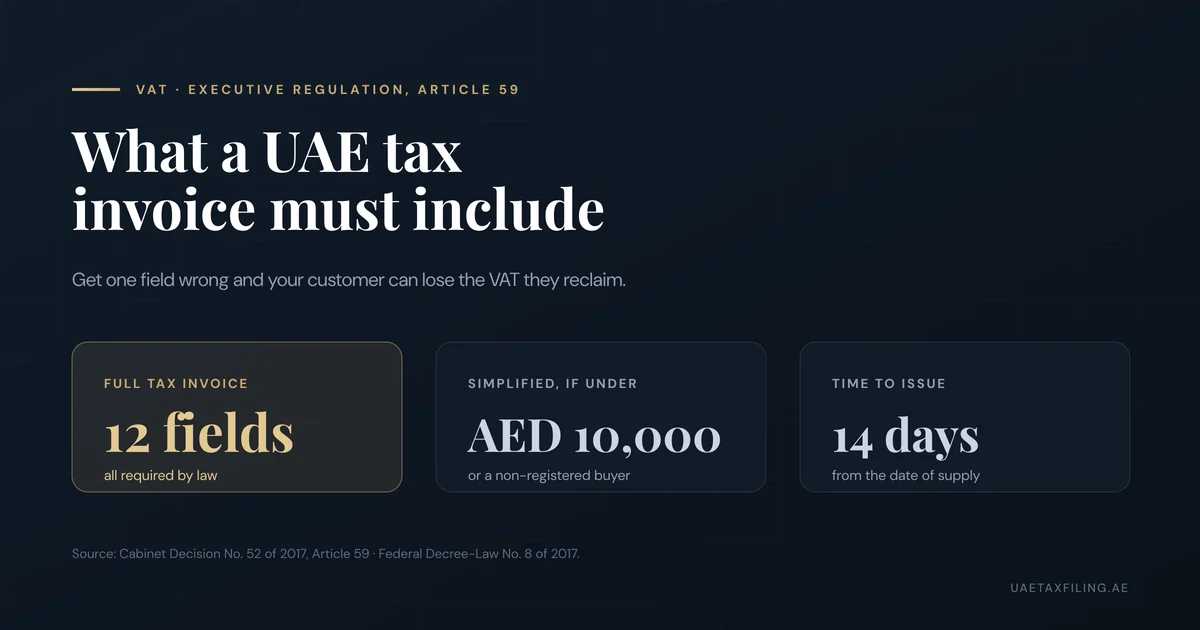
A UAE tax invoice must carry twelve specific particulars to be valid, and the first is the words “Tax Invoice” on the document itself. It has to show your Tax Registration Number, a sequential number, the tax charged in AED, and — for a registered customer — their details too. Get a field wrong and your customer can be denied the VAT they try to reclaim.
A tax invoice is not just a bill. It is the document that lets your customer recover the 5% VAT you charged. When a field is missing, the Federal Tax Authority can refuse that recovery — so a sloppy invoice costs your customer money and costs you the relationship.
The short version
- A full tax invoice needs twelve fields. Under Article 59 of the VAT Executive Regulation, from the words “Tax Invoice” to the tax amount in AED, all are mandatory.
- The TRN is central. Your Tax Registration Number must appear, and so must the customer’s where they are VAT-registered.
- Simplified invoices have five fields. You may issue one where the buyer is not registered, or is registered and the supply is AED 10,000 or less.
- Reverse charge blocks the simplified form. Where the customer accounts for the tax, you must issue a full invoice with the reverse-charge statement.
- You have 14 days. A full tax invoice must be issued within 14 days of the date of supply; a simplified one on the day itself.
What this covers
- What a tax invoice is
- The full tax invoice: the twelve fields
- The simplified tax invoice: five fields
- Which one to issue: the AED 10,000 line
- Reverse charge: when simplified is barred
- When to issue it: the 14-day rule
- Electronic invoices and 2026 e-invoicing
- Common mistakes that cost the VAT
- Frequently asked questions
What a tax invoice is
A tax invoice is the formal document a VAT-registered business must issue for a taxable supply, showing the tax charged. It is the evidence the Federal Tax Authority relies on: the supplier uses it to declare output tax, and the customer uses it to reclaim input tax.
The rules sit in Article 59 of Cabinet Decision No. 52 of 2017, the Executive Regulation of the VAT law, most recently amended by Cabinet Decisions No. 100 of 2024 and No. 100 of 2025. The Regulation sets out two formats — a full tax invoice and a simplified tax invoice — and specifies exactly what each must contain. A document that calls itself an invoice but omits a required particular is not a valid tax invoice, whatever it is headed. UAE nationals building their own home use a separate scheme — see our guide to the new residence VAT refund.
Compare it with an ordinary quote or delivery note, which carry no tax consequences. Only a compliant tax invoice moves VAT: it fixes the amount of output tax the supplier owes and the input tax the customer may recover. That is why the form is prescribed down to the field.
Key takeaway: A tax invoice is the VAT document, not just a bill. Its job is to let the customer reclaim input tax, and that only works if every required field is present.
The full tax invoice: the twelve fields
A full tax invoice must contain twelve particulars, and every one is mandatory under Article 59(1). They run from the heading to the tax figure, and a compliant invoice shows them all.
The list is fixed: the words “Tax Invoice”; your name, address and TRN; the customer’s name, address and TRN where they are registered; a sequential invoice number; the date of issue; the date of supply if different; a description of the goods or services; the unit price, quantity, tax rate and line amount in AED; any discount; the gross amount in AED; the tax amount in AED with the exchange rate if you converted from another currency; and, where the customer accounts for the tax, a reverse-charge statement. Your TRN comes from registration — our VAT registration guide covers how to obtain one.
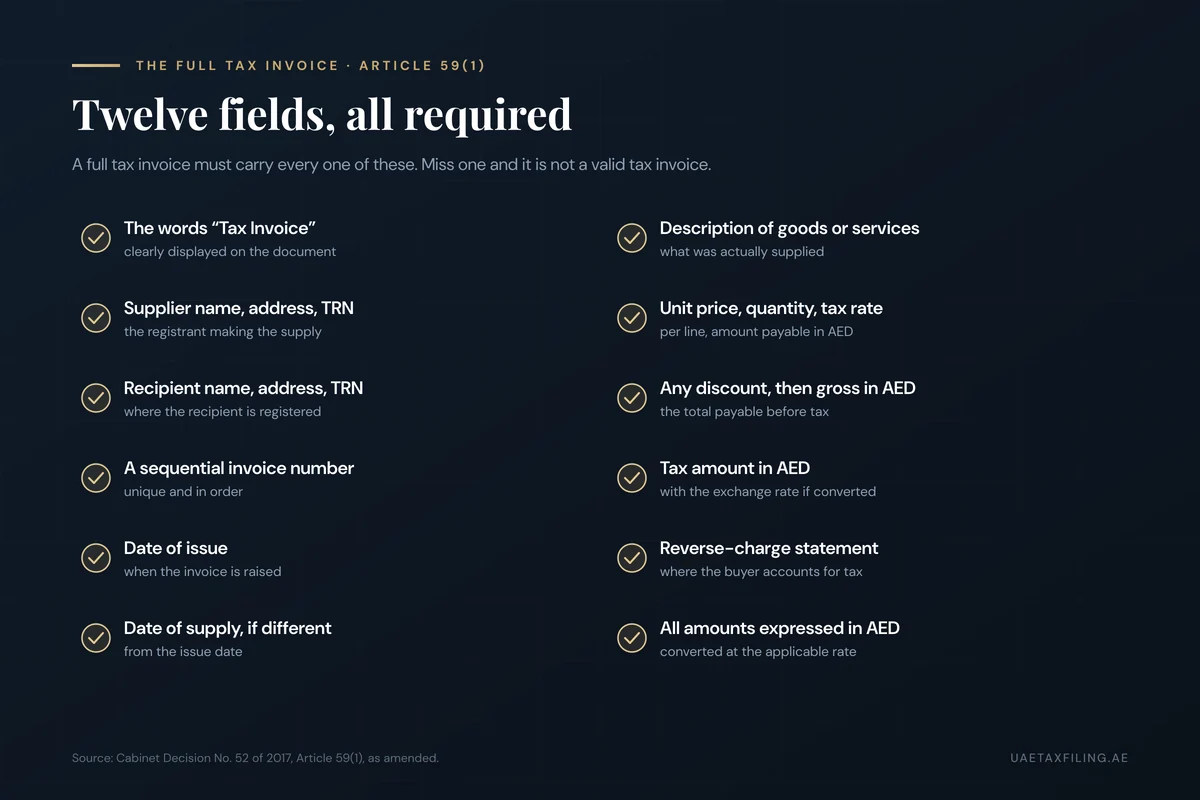
The AED requirement catches exporters and cross-border sellers. Even if you invoice a client in dollars or euros, the tax amount must be shown in dirhams, with the exchange rate applied. The rate to use is the one published by the UAE Central Bank at the date of supply.
Key takeaway: A full tax invoice is a twelve-field document. The headline, both parties’ TRNs, a sequential number and the tax shown in AED are the ones businesses most often get wrong.
The simplified tax invoice: five fields
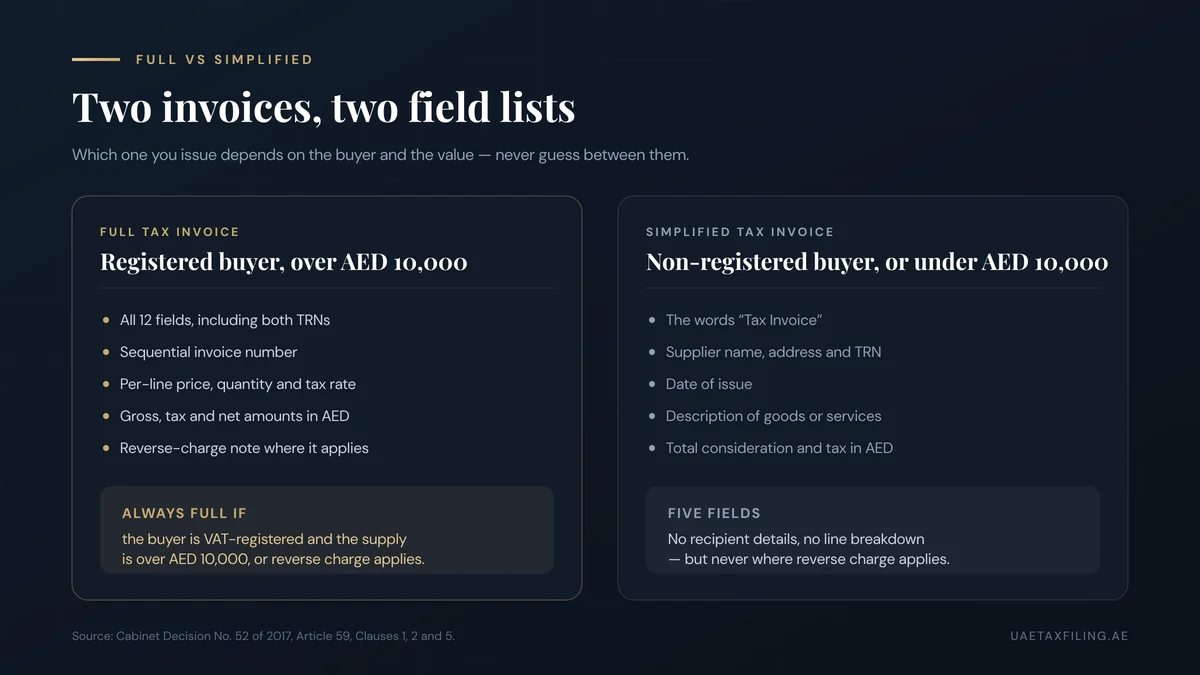
A simplified tax invoice is a shorter form with only five required fields, meant for retail and small-value sales. It drops the customer’s details and the line-by-line breakdown, keeping just the essentials.
Under Article 59(2), a simplified invoice needs the words “Tax Invoice”, your name, address and TRN, the date of issue, a description of the goods or services, and the total consideration and the tax amount, expressed in AED. There is no requirement to show the recipient’s name or TRN, and the tax can be shown as a single figure rather than line by line. A supermarket receipt that carries the store’s TRN and the VAT total is a simplified tax invoice.
The simplified form is a genuine shortcut, but it is not a free pass. It still must say “Tax Invoice”, still must carry your TRN, and still must state the tax. A plain sales receipt with none of those is not a tax invoice, and a registered customer cannot reclaim VAT from it.
Key takeaway: A simplified tax invoice has five fields and no customer details. It suits retail and small sales — but the “Tax Invoice” wording, your TRN and the tax amount are non-negotiable even here.
Which one to issue: the AED 10,000 line
You may issue a simplified tax invoice only in two situations: when the customer is not VAT-registered, or when the customer is registered and the supply is AED 10,000 or less. In every other case, the full invoice is required.
The logic is about who reclaims. A non-registered consumer cannot recover VAT, so the shorter form is fine at any value. A registered business customer can recover VAT, so above AED 10,000 the FTA wants the full record — both TRNs, the sequence, the breakdown. At or below AED 10,000, a registered customer can still be given a simplified invoice. The table shows the split.
| Situation | Invoice to issue |
|---|---|
| Customer not VAT-registered (any value) | Simplified tax invoice |
| Registered customer, supply AED 10,000 or less | Simplified tax invoice |
| Registered customer, supply over AED 10,000 | Full tax invoice |
| Reverse charge applies (any value) | Full tax invoice |
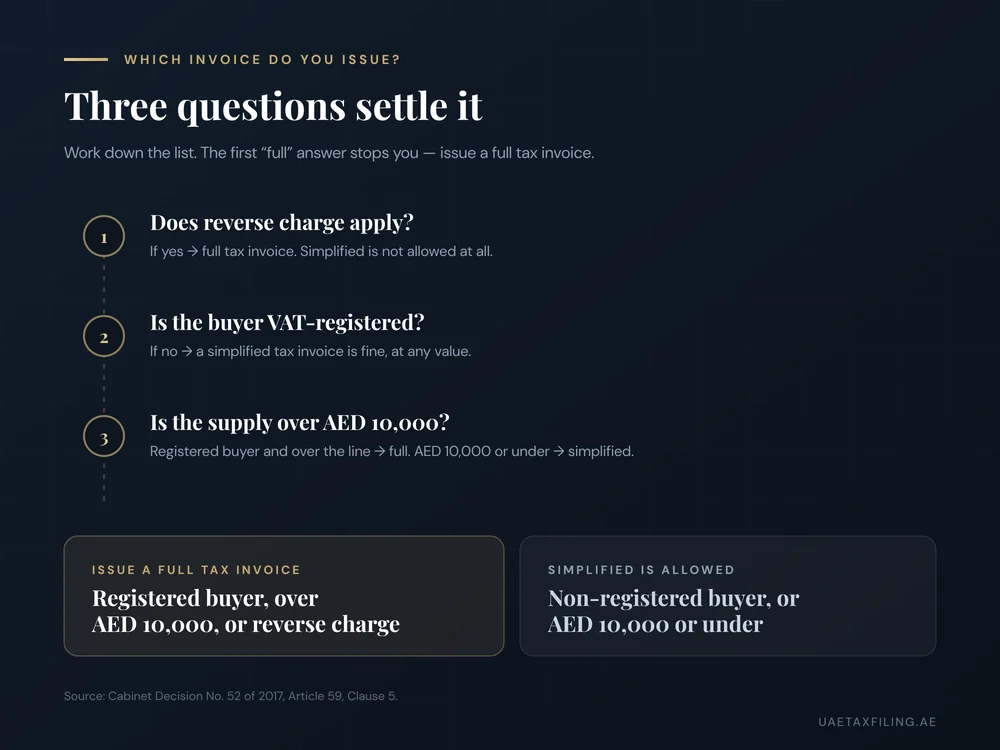
Key takeaway: Simplified is allowed for non-registered buyers, or for registered buyers at AED 10,000 or less. A registered buyer over AED 10,000 always gets a full invoice.
Reverse charge: when simplified is barred
Where the reverse charge mechanism applies, you must issue a full tax invoice — the simplified form is never allowed. The reverse charge shifts responsibility for the VAT from the supplier to the customer, and the invoice has to say so.
This matters most on imports and certain domestic supplies where the buyer self-accounts for the tax. Article 59 requires a statement that the recipient is required to account for the tax, plus a reference to the relevant provision of the law. Because that statement can only sit on a full invoice, the simplified route is closed whenever reverse charge is in play. The mechanics of who accounts for what are set out in our guide to the reverse charge mechanism.
Key takeaway: Reverse charge forces a full invoice with an explicit statement that the customer accounts for the tax. A simplified invoice can never carry a reverse-charge supply.
When to issue it: the 14-day rule
A full tax invoice must be issued within 14 calendar days of the date of supply. A simplified tax invoice, by contrast, must be issued at the time of supply — on the day itself.
The date of supply is the trigger, not the date you get paid. For most sales it is the earlier of delivery, invoicing or payment; for continuous supplies it follows the contract or payment schedule. Once that date is fixed, the 14-day clock starts for a full invoice. Miss it, and you have failed to issue a tax invoice on time — a separate administrative breach that carries its own fine under the 2026 VAT penalty regime, on top of any error in the invoice itself.
Key takeaway: Full invoices have a 14-day window from the date of supply; simplified invoices are issued on the day. Late issuance is its own penalty, distinct from a wrong field.
Electronic invoices and 2026 e-invoicing
Electronic tax invoices are already permitted, provided the invoice is stored securely and its authenticity and integrity are guaranteed. Article 59(8) allows an invoice to be issued by electronic means on those two conditions.
That is separate from the structured e-invoicing mandate the UAE is rolling out from 2026, which moves businesses to a standardised electronic format reported through accredited channels. The Article 59 content rules do not disappear under e-invoicing — the same twelve fields still have to be present; they simply travel in a structured file rather than a PDF. Our e-invoicing preparation guide covers what changes and when.
Key takeaway: You can already invoice electronically if you store it securely and preserve its integrity. The 2026 e-invoicing mandate adds a format and a reporting channel — it does not remove the field requirements.
Common mistakes that cost the VAT
The most expensive invoice errors are the ones that block your customer’s input-tax recovery. They are also the easiest to avoid, because they are almost always a missing field rather than a hard calculation.
Five recur in practice. Run each invoice past them before it goes out:
- No “Tax Invoice” heading. A document headed only “Invoice” fails the very first requirement.
- A missing TRN. Your TRN must appear; the customer’s must appear where they are registered and the supply is over AED 10,000.
- No sequential number. Invoices must run in an identifiable sequence — random or duplicated numbers break the audit trail.
- Tax not shown in AED. Foreign-currency invoices still need the VAT expressed in dirhams, with the exchange rate.
- Issued late. Beyond 14 days from the date of supply for a full invoice.
A missing field does not just risk a penalty for you; it can cost your customer the 5% they expected to reclaim, which is why disputes over defective invoices are common. If VAT compliance is stretching your team, the routine filing that surrounds these invoices — covered in our guide to filing your quarterly VAT return — is exactly the work we can arrange for you.
Key takeaway: Most invoice failures are a missing heading, TRN, sequence or AED figure. A five-point check before sending prevents nearly all of them — and protects your customer’s recovery.
Tell us how you invoice — your software, your customer mix, and whether you sell across borders — and we will tell you whether your tax invoices meet Article 59 and where they are exposed. Where you need registration or ongoing VAT filing, we match you with an FTA-registered partner agency that handles it. Message the team on WhatsApp using the button below.
Frequently asked questions
What must a UAE tax invoice include?
A full tax invoice must contain twelve particulars under Article 59(1): the words “Tax Invoice”, the supplier’s name, address and TRN, the customer’s name, address and TRN where registered, a sequential number, the issue date, the supply date if different, a description, the unit price, quantity, tax rate and amount in AED, any discount, the gross amount, and the tax amount in AED. Where reverse charge applies, it must also state that the customer accounts for the tax.
What is a simplified tax invoice?
A simplified tax invoice is a shorter form with five fields: the words “Tax Invoice”, the supplier’s name, address and TRN, the date of issue, a description, and the total consideration and tax amount in AED. It does not need the customer’s details or a line-by-line breakdown, which makes it suited to retail sales.
When can I issue a simplified tax invoice?
In two cases only: where the customer is not VAT-registered, at any value, or where the customer is registered and the supply is AED 10,000 or less. A registered customer buying more than AED 10,000 must receive a full tax invoice.
Do I need the customer’s TRN on the invoice?
Yes, on a full tax invoice where the customer is VAT-registered. Their name, address and TRN are mandatory on the full form. A simplified invoice does not require the customer’s TRN at all.
How long do I have to issue a tax invoice?
A full tax invoice must be issued within 14 days of the date of supply. A simplified tax invoice must be issued at the time of supply. Issuing late is an administrative breach separate from any content error.
Does a tax invoice have to be in AED?
The tax amount must be shown in AED, even on a foreign-currency invoice. Where you convert from another currency, you must also show the exchange rate applied, using the UAE Central Bank rate at the date of supply.
Is a receipt a valid tax invoice?
Only if it carries the required fields. A retail receipt that displays the words “Tax Invoice”, the seller’s TRN, the date, a description and the tax amount is a valid simplified tax invoice. A plain receipt missing those cannot be used to reclaim VAT.
Can I issue tax invoices electronically?
Yes. Article 59 permits electronic tax invoices provided you can store a copy securely and guarantee the authenticity of origin and integrity of content. The separate 2026 e-invoicing mandate adds a structured format and reporting channel but keeps the same field requirements.
What happens if my tax invoice is missing a field?
It is not a valid tax invoice, which exposes you to a penalty and can block your customer’s input-tax recovery. The FTA can refuse a VAT reclaim supported by a defective invoice, so the practical cost usually lands on the customer and then on the business relationship.
How we verified this: the field lists, the AED 10,000 threshold and the simplified-invoice conditions are taken from Article 59 of Cabinet Decision No. 52 of 2017 (as amended by Cabinet Decisions No. 100 of 2024 and No. 100 of 2025); the issuance timing follows the VAT Decree-Law. Confirm current text in the FTA Executive Regulation. This article is general information, not tax advice.
Last updated: 20 August 2026 · Reviewed by Jazim, CEO, UAE Tax Filing LLC (Dubai)