Last updated: 9 September 2026 · Written by the UAE Tax Filing editorial team · Reviewed by Jazim, CEO, UAE Tax Filing LLC (Dubai) · 13 min read
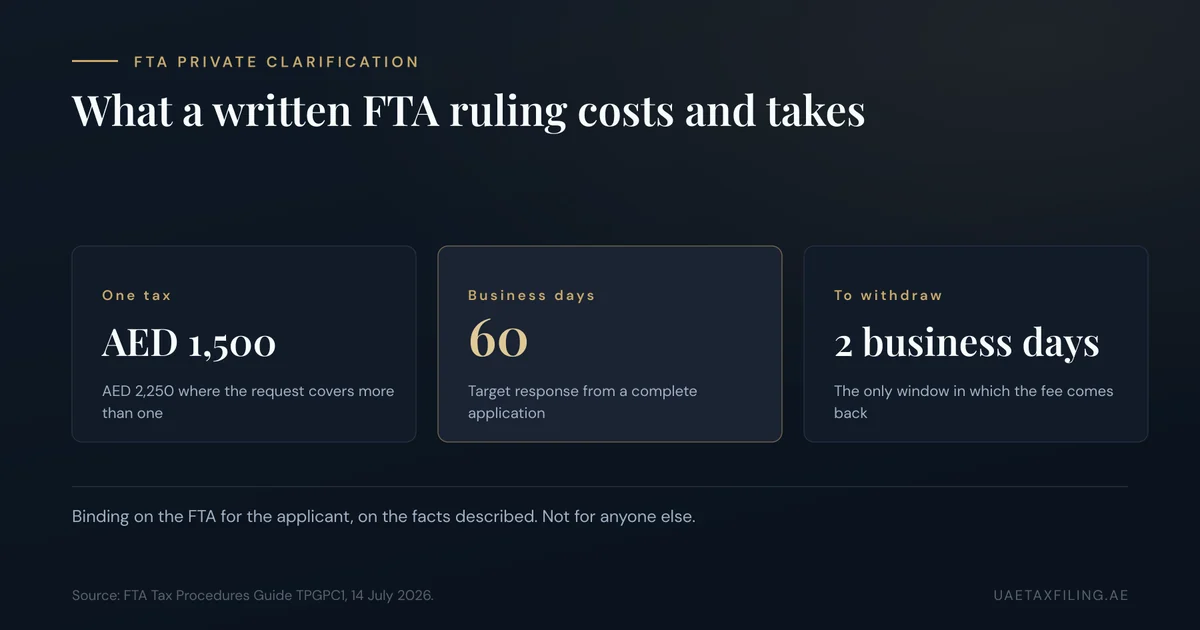
A private clarification is a written ruling from the Federal Tax Authority on how tax law applies to one taxpayer’s specific facts. It costs AED 1,500 for a single tax, AED 2,250 for more than one, and the FTA aims to answer within 60 business days of a complete application. That last number is the one that decides whether a clarification is any use to you at all.
Sixty business days from today is 2 December 2026. If your uncertain position sits in a return due on 30 September, the answer arrives nine weeks after you had to file it.
The short version
- What it is: a binding FTA position on your facts — binding on the Authority, for you, on those facts only.
- What it costs: AED 1,500 for one tax, AED 2,250 for two or more. Non-refundable once two business days have passed.
- How long it takes: the FTA targets 60 business days from a complete application under TPGPC1, published 14 July 2026.
- Check the free route first: on 15 July 2026 the FTA published a consolidated summary of Corporate Tax private clarifications issued up to May 2026. Your question may already be answered at zero cost.
- The most expensive mistake: paying the fee for a question TPGPC1 lists as out of scope. Eleven rejection grounds are published — test against them before you file.
What this covers
- What a private clarification actually is
- What changed on 14 July 2026
- The arithmetic: 60 business days against your deadline
- Check the free route before you pay
- Who may apply, and who may not
- The rejection grounds and the fee you lose
- Public, private, summary: what actually binds
- How to file one, step by step
- When the answer cannot arrive in time
- Frequently asked questions

What a private clarification actually is
A private clarification is a formal written response from the FTA setting out how the tax legislation applies to a specific transaction or arrangement described by the applicant. It is not advice, and it is not a negotiation. You describe facts, you supply your own technical analysis, and the Authority tells you whether it agrees.
The distinction that matters commercially is scope. A private clarification binds the FTA in relation to the applicant and the facts as described. It does not create law, it does not extend to your subsidiary, and it collapses the moment the facts differ from what you wrote. A competitor with an identical structure cannot rely on your clarification, and you cannot rely on theirs.
Compare it to the two things it is often confused with. A public clarification — such as CTP011, issued on 15 July 2026 on transfer pricing downward adjustments — states the Authority’s general interpretation and applies to everyone. A guide explains the mechanics of a regime. Neither responds to your facts. That is the gap the private clarification fills, and the reason it carries a fee.
Key takeaway: you are buying certainty on one position, for one taxpayer, on one set of facts. Priced correctly, that is worth far more than AED 1,500. Priced wrongly — on a question the FTA has already answered publicly — it is AED 1,500 for nothing.
What changed on 14 July 2026
On 14 July 2026 the FTA published an updated Tax Procedures Guide on Private Clarifications, referenced TPGPC1. The guide restates who may apply, which issues qualify, the fee structure, the target turnaround, and — the part practitioners reacted to — an itemised list of grounds on which a request will be rejected.
Two operational points changed the calculus for taxpayers. First, the guide sets the response target at 60 business days from receipt of a complete application. Older FTA material on indirect taxes had circulated a 50-day figure, and both numbers are still repeated across advisory blogs. When you plan around a clarification, plan around 60 business days and treat anything faster as a bonus.
Second, the refund position is narrow and explicit. The fee is refundable only where the request is withdrawn within two business days of submission, or where the FTA declines to issue a clarification because the subject matter is already covered by an ongoing tax audit. Every other rejection — including rejection on scope — leaves the fee with the Authority.
In our filing work the pattern is consistent: the money is rarely lost on a hard technical question. It is lost on a question that was never eligible in the first place.
Key takeaway: TPGPC1 did not make clarifications harder to win. It made the reasons for losing the fee legible in advance, which means there is now no excuse for paying it blind.
The arithmetic: 60 business days against your deadline
Sixty business days is roughly twelve working weeks, and the UAE working week runs Monday to Friday. A complete application submitted on 9 September 2026 therefore has a target response date of 2 December 2026 — before public holidays are taken into account, which push it later, never earlier.
Run that backwards against the Corporate Tax filing deadline, which falls nine months after the financial year end. The result is a hard cut-off date per year end: the last day on which a clarification request could realistically produce an answer before the return is due.
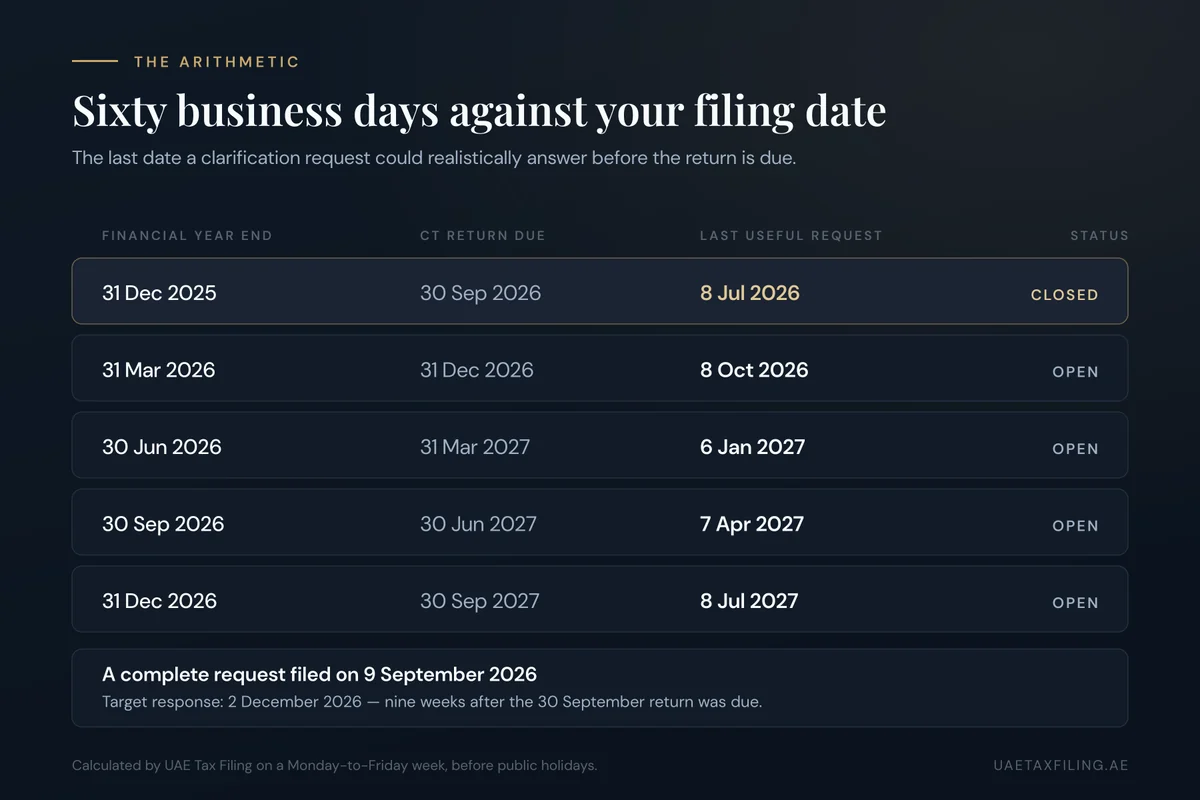
| Financial year end | CT return due | Last useful request date | Status on 9 Sep 2026 |
|---|---|---|---|
| 31 December 2025 | 30 September 2026 | 8 July 2026 | Window closed |
| 31 March 2026 | 31 December 2026 | 8 October 2026 | 29 days left |
| 30 June 2026 | 31 March 2027 | 6 January 2027 | Open |
| 30 September 2026 | 30 June 2027 | 7 April 2027 | Open |
| 31 December 2026 | 30 September 2027 | 8 July 2027 | Open |
Calculated by UAE Tax Filing on a Monday-to-Friday business week, excluding public holidays. Holidays shorten the usable window further, so treat each date as the optimistic end of the range.
The line that matters today is the first one. The FTA confirmed in a statement on 2 September 2026 that taxable persons whose financial year ended on 31 December 2025 must file and pay by 30 September. For those businesses the clarification window shut on 8 July. Anyone still hoping to resolve an uncertain position through a ruling before filing is two months too late, and needs the alternative route set out further down. The full deadline picture sits in our guide to the 2026 Corporate Tax deadlines.
Key takeaway: a clarification is a planning instrument, not a filing-season rescue. Decide whether you need one at least three months before the return is due.
Check the free route before you pay
On 15 July 2026 the FTA published a consolidated summary of the Corporate Tax private clarifications it had issued up to May 2026, arranged as a question-and-answer document. It is the single most useful thing to read before spending AED 1,500, because it shows the positions the Authority has already taken across the areas where taxpayers most often ask.
The summary covers exempt persons, free zone taxation, qualifying activities, substance requirements, taxable income adjustments, the participation exemption, tax groups, loss utilisation, registration requirements, financial statements, tax periods and transitional relief. If your uncertainty sits in one of those areas, there is a real chance the Authority has already addressed a comparable fact pattern.
One caveat, and it is the FTA’s own. The Authority states that clarifications “do not constitute legislation and should not be regarded as generally binding guidance.” The summary tells you how the FTA has read the law before. It does not protect you the way a clarification addressed to you does.
Reading it is still the right first move, for a reason beyond cost. If the summary already answers your question, TPGPC1 lists “concerns existing published guidance” as a rejection ground — so filing anyway is likely to cost you the fee and produce nothing. The free document and the rejection list point in the same direction.
Key takeaway: the consolidated summary is both a free answer and a rejection filter. Read it first in either case. Areas it touches that we cover in depth include the participation exemption, qualifying free zone status and exempt persons.
Who may apply, and who may not
Any natural or juridical person facing genuine uncertainty about their own tax position may apply, and a registered tax agent may apply on a client’s behalf where properly authorised. Group structures are where applications most often fail on eligibility rather than substance.
- VAT group or Corporate Tax group: only the representative member or parent company may submit. A member entity applying in its own name is outside the rules.
- Pillar Two / domestic minimum top-up tax: only the Domestic Designated Filing Entity may submit for the group.
- Tax agent: permitted, but the authorisation must be in place and evidenced at the point of submission.
- Anyone else: an adviser without agent registration, a shareholder, or a related company cannot submit on your behalf.
The practical failure we see is a finance manager submitting from a subsidiary’s EmaraTax profile because that is the login they hold. The question may be perfectly valid. The applicant is not, and the fee goes with it.
Key takeaway: confirm the applicant identity before you draft the question. It is the cheapest check on this list and the one most often skipped.
The rejection grounds and the fee you lose
TPGPC1 sets out the circumstances in which the FTA will reject a request. Treat the list as a pre-submission test: if your request meets any of these descriptions, you are paying AED 1,500 to be told no.
- The applicant is not eligible to submit — wrong entity in a group structure.
- The person submitting lacks authorisation to act for the taxpayer.
- The subject falls outside the scope of a private clarification.
- The request concerns an administrative penalty waiver rather than the application of tax law.
- The request concerns an EmaraTax or IT issue.
- The request concerns a tax assessment already raised.
- The application is incomplete or the facts are insufficiently described.
- The applicant supplied no technical analysis of their own position.
- The matter is already addressed in published FTA guidance.
- The scenario is hypothetical rather than an actual or seriously contemplated transaction.
- The request relates to tax planning, avoidance or evasion.
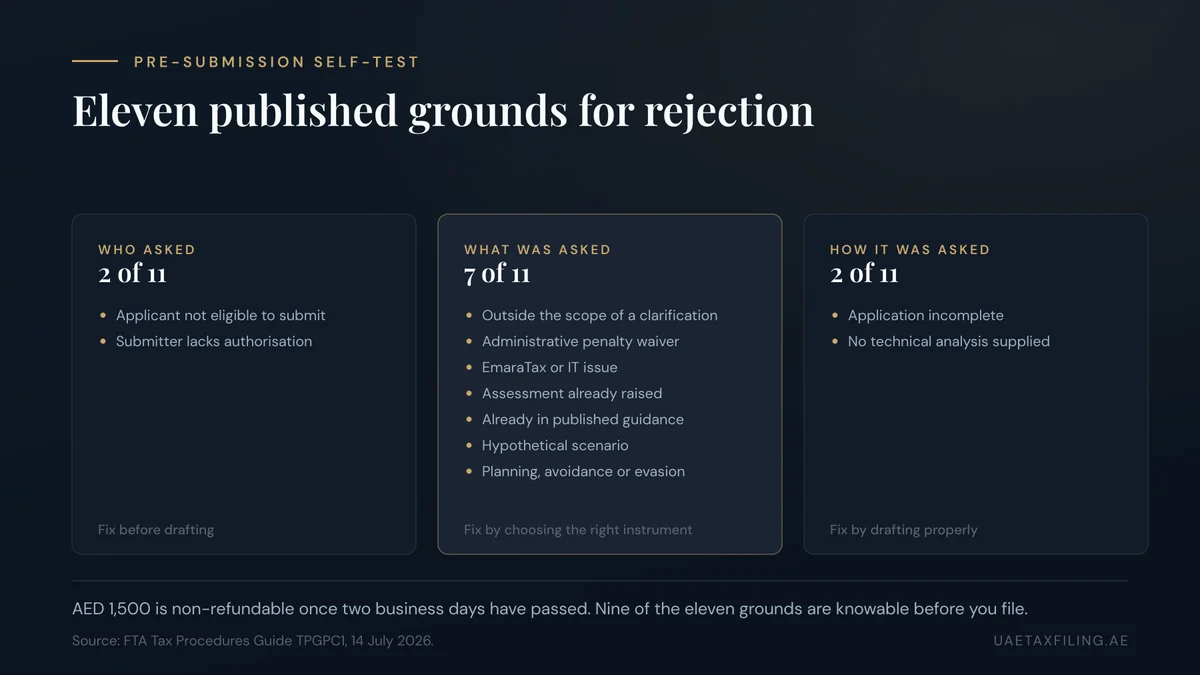
Grounds 7 and 8 deserve separate attention because they are the ones within your control. The FTA expects the applicant to state a position and argue it, citing the relevant articles. A request that describes a transaction and asks “what is the treatment?” is not a clarification request; it is a request for advice, and it reads as incomplete.
Ground 6 is the one that catches businesses under pressure. Once an assessment has been raised, the clarification route is closed and the correct instrument is a reconsideration request. Similarly, if the matter is already inside an open FTA audit, the Authority will decline — and that is one of only two situations in which the fee comes back.
Key takeaway: the fee is not a filing charge, it is a stake. Nine of the eleven grounds are knowable before you submit.
Public, private, summary: what actually binds
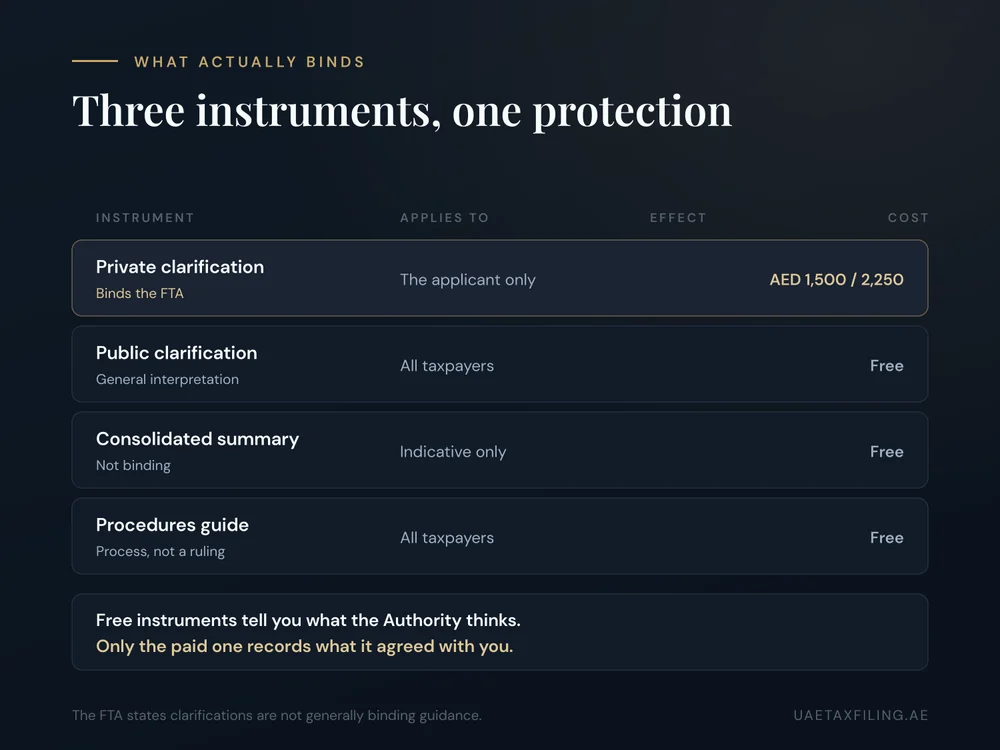
Three FTA instruments are routinely treated as interchangeable and are not. The difference is who is protected, and against what.
| Instrument | Applies to | Binding? | Cost | Use it when |
|---|---|---|---|---|
| Private clarification | The applicant only, on the described facts | Binds the FTA for that taxpayer | AED 1,500 / 2,250 | A material position with no published answer |
| Public clarification (e.g. CTP011) | All taxpayers | States the FTA’s general interpretation | Free | The issue is common and already addressed |
| Consolidated summary (15 Jul 2026) | Indicative, all readers | Explicitly not binding | Free | Testing whether your question is already settled |
| Guide (e.g. TPGPC1) | All taxpayers | Procedural, not a ruling | Free | Understanding process and mechanics |
An example makes the difference concrete. Suppose your question is whether a particular income stream qualifies for the participation exemption. If the consolidated summary describes a comparable holding and the FTA’s position on it, you have a strong indication and no protection. If you obtain a private clarification on your actual shareholding, you have protection — and only for that shareholding, on the facts you described.
Key takeaway: free instruments tell you what the Authority thinks. Only the paid one tells the Authority what it agreed with you.
How to file one, step by step
- Confirm the applicant. Representative member for a tax group, parent for a CT group, Domestic Designated Filing Entity for top-up tax, or an authorised registered tax agent.
- Search the free sources. The consolidated summary of 15 July 2026, the public clarifications, and the relevant FTA guide. If the answer is there, stop.
- Test against the eleven rejection grounds. Particularly scope, assessments, open audits and hypotheticals.
- Write the facts precisely. Dates, amounts, entities, jurisdictions, and the contractual position. The clarification is only as good as the facts it recites.
- State your own technical position. Cite the articles you are relying on and explain your reading. A request without analysis invites rejection on ground 8.
- Submit through EmaraTax with supporting documents and pay AED 1,500, or AED 2,250 where more than one tax is in issue.
- Diarise two business days. That is the only window in which a withdrawal recovers the fee.
- Plan for 60 business days, and decide now what you will file if the answer has not arrived by then.
Step 4 is where most of the value is created or lost. A clarification protects you only to the extent the facts you described match the facts as they were. Vague drafting produces a ruling that does not cover the transaction you actually did, which is worse than no ruling, because it invites reliance you have not earned.
When the answer cannot arrive in time
If your filing date falls inside the 60-business-day window, a clarification cannot help this cycle. Three routes remain, and the choice depends on how material the uncertainty is.
File on your best-supported position and document it. Take the reading you can defend, write a file note recording the analysis, the sources considered and the date of the decision, and keep it with the return working papers. Contemporaneous reasoning is the difference between an error and a defensible position if the Authority later disagrees. The mechanics of the return itself are in our EmaraTax return walkthrough.
File, then correct. Where the position later proves wrong, a voluntary disclosure corrects it on materially better terms than an audit finding. Self-correction is consistently cheaper than discovery.
File now, clarify for next year. If the same position will recur — a recurring related-party charge, a standing free zone activity, a repeated cross-border flow — submit the clarification after filing so the answer governs the next return. This is the highest-value use of the fee and the one most often overlooked, because businesses only think about clarifications when they are already late. Recurring related-party pricing in particular is worth settling in advance; our guide to transfer pricing in the UAE sets out where the exposure concentrates.
The best time to request a clarification is the month after you file, not the month before. You have the facts, you have the position, and you have twelve months of runway.
Key takeaway: a missed window is not a dead end. It is a reason to move the clarification into next year’s planning cycle rather than abandon it.
Frequently asked questions
Is the AED 1,500 refundable if the FTA rejects my request?
Generally no. The fee is refundable only in two situations: you withdraw the request within two business days of submission, or the FTA declines to issue a clarification because the subject matter is covered by an ongoing tax audit. Rejection on scope, eligibility or completeness does not trigger a refund.
Does a private clarification protect me from penalties?
It protects the applicant, on the facts described, for the tax treatment addressed. It does not operate as a general shield, it does not cover a different entity in the same group, and it ceases to apply if the actual facts diverge from those set out in the request.
Can I ask about a transaction I have already completed?
Yes, provided it is an actual transaction and no assessment has been raised and no audit is open on the point. What the FTA will not accept is a hypothetical scenario constructed to test an outcome, which is listed as a rejection ground in TPGPC1.
What is the difference between AED 1,500 and AED 2,250?
AED 1,500 applies where the request concerns a single tax, such as Corporate Tax alone or VAT alone. AED 2,250 applies where the same request covers more than one tax. Splitting one commercial question across two separate single-tax requests costs more than filing it once at the higher fee.
How long does the FTA actually take?
TPGPC1 sets a target of 60 business days from a complete application. Note the word complete: if the Authority comes back for further information, the clock in practice runs from the date that information is supplied, not from your original submission.
Can my accountant submit the request for me?
Only if they are a registered tax agent with authorisation in place for your taxpayer profile. An adviser who is not a registered agent cannot submit on your behalf, and a submission from the wrong party is a published rejection ground.
Is the FTA’s consolidated summary of clarifications binding?
No. The FTA states expressly that clarifications do not constitute legislation and should not be treated as generally binding guidance. The summary shows how the Authority has interpreted the law in comparable cases, which is valuable for planning but is not protection.
Can I request a clarification about an administrative penalty?
No. Penalty waivers sit outside the scope of private clarifications and are handled through the separate waiver and reconsideration channels. A clarification addresses the application of tax law, not the remission of a penalty already imposed.
What happens if my facts change after I receive the clarification?
The clarification applies to the facts as described. Where the arrangement changes in a way that matters to the analysis, the protection falls away for the changed position and a fresh request may be required. Record the facts as at the date of the request so the boundary is clear later.
What to do next
The decision is usually simpler than it looks. If your uncertainty sits in an area the FTA has already addressed publicly, the answer is free and available today. If it is genuinely novel, material and recurring, AED 1,500 buys protection that compounds across every future return. What does not work is discovering the question three weeks before a filing deadline.
If you are holding a position you are not certain about, the useful first step is a second opinion on whether it needs a ruling at all — most do not. Send us the position and the year end, and we will tell you whether the published guidance already covers it, whether a clarification is worth the fee and the wait, and what to file in the meantime.
Sources: FTA Tax Procedures Guide on Private Clarifications (TPGPC1), 14 July 2026; FTA consolidated summary of Corporate Tax private clarifications issued to May 2026, published 15 July 2026; FTA Public Clarification CTP011, 15 July 2026; FTA statement on Corporate Tax return deadlines, 2 September 2026. Legislation and guidance are published on the FTA legislation page and the Corporate Tax guides and references section. Timing calculations are our own, on a Monday-to-Friday business week excluding public holidays.
Last updated: 9 September 2026 · Reviewed by Jazim, CEO, UAE Tax Filing LLC (Dubai)