
Last updated: 20 August 2026 · Written by the UAE Tax Filing editorial team · Reviewed by Jazim, CEO, UAE Tax Filing LLC (Dubai) · 12 min read
An exempt person is a person that sits entirely outside UAE Corporate Tax, and only nine categories qualify under Article 4 — government bodies, natural-resource businesses, qualifying public benefit entities, qualifying investment funds, pension funds and a few related vehicles. Free zone companies, small businesses and relief claimants are not exempt persons. And several of the exempt categories only become exempt after they apply to the Federal Tax Authority.
“Exempt” is the most misused word in UAE tax. A free zone company on 0%, a small business claiming relief, and a shareholder using the participation exemption all still sit inside the tax. An exempt person is different: it is out of the system entirely.
The short version
- Nine categories are exempt. Under Article 4 of Federal Decree-Law No. 47 of 2022, they run from government entities to qualifying investment funds.
- Some are automatic. Government and natural-resource businesses are exempt by status, with no application.
- Others must apply. Qualifying investment funds, pension funds, public benefit entities and their subsidiaries are exempt only after the FTA approves them.
- Exempt is not 0%. A Qualifying Free Zone Person, Small Business Relief and the participation exemption all keep you a taxable person who still files.
- Status can be lost. Break a condition and the exemption ends from the start of that tax period.
What this covers
- What an exempt person is
- The nine categories under Article 4
- Government and natural-resource businesses
- Funds, pensions and charities
- Automatic vs apply-to-the-FTA
- Exempt person vs 0%, relief and participation exemption
- Keeping the exemption
- Do exempt persons still register?
- Frequently asked questions
What an exempt person is
An exempt person is a person on whom UAE Corporate Tax is not imposed at all, as opposed to a taxable person who is inside the tax but may pay 0% or claim reliefs. Being exempt removes the person from the regime; being taxed at 0% keeps you in it.
The distinction runs through the whole law. A taxable person calculates taxable income, applies the rate, and files a return, even if the result is nil. An exempt person is treated as outside that machinery for its exempt activities. Exemption is also narrow and deliberate: the categories are set by Article 4 and cannot be stretched by analogy, which is why most ordinary companies — profitable or not, mainland or free zone — are taxable persons, not exempt persons. The broader map of what changed under the regime is in our guide to every UAE tax change coming in 2026.
Key takeaway: An exempt person is outside Corporate Tax; a taxable person on 0% is inside it. Exemption is a closed list in Article 4, not a status a business can argue its way into.
The nine categories under Article 4
Article 4 lists nine categories of exempt person, and a person must fall squarely within one to be exempt. They are government entities, government-controlled entities, extractive businesses, non-extractive natural resource businesses, qualifying public benefit entities, qualifying investment funds, pension and social security funds, certain wholly-owned subsidiaries of those persons, and any other person the Cabinet later designates.

The list splits into two families. The first four are public-interest or resource activities the federal tax is designed not to reach — government and the oil-and-gas base that is already taxed at Emirate level. The next group covers funds, pensions and charities, which are exempt to avoid taxing pooled savings and public-benefit money. The subsidiary rule then extends exemption to vehicles wholly owned by those persons that only hold assets or perform ancillary functions.
Key takeaway: There are exactly nine exempt-person categories in Article 4. If a person is not clearly within one, it is a taxable person, whatever its size or purpose.
Government and natural-resource businesses
Government entities, government-controlled entities and natural-resource businesses are the categories exempt by their nature, without an application. They cover the state itself and the extractive base already taxed by the Emirates.
There is one important limit on government entities. Under Article 5, a government entity is exempt, but if it conducts a business or business activity under a licence from a licensing authority, that licensed business is taxable and must be accounted for separately. Extractive businesses — oil and gas extraction — are exempt from federal Corporate Tax because they are taxed at Emirate level, while non-extractive natural resource businesses are exempt where they meet the Article 8 conditions, such as earning only from other businesses rather than the end market.
Key takeaway: Government and natural-resource businesses are exempt by category, not by application. But a government entity that runs a licensed commercial business is taxable on that business, kept in separate accounts.
Funds, pensions and charities
Qualifying investment funds, pension and social security funds, and qualifying public benefit entities are the exempt categories aimed at pooled and public-benefit money. Each carries conditions, and each must be recognised by the authorities to be exempt.
A qualifying public benefit entity is a charity or similar organisation listed in a Cabinet Decision, meeting conditions on its purpose and how it uses its income. A qualifying investment fund is a regulated fund that meets Article 10 conditions, typically around regulatory oversight and diversity of ownership, so the exemption reaches genuine collective investment rather than a private holding vehicle. Pension and social security funds — public, or private funds under regulatory oversight — are exempt subject to the conditions the Minister prescribes. A private family holding company that calls itself a “fund” does not qualify simply by the label; it has to meet the actual conditions.
The word on the door does not decide exemption. An investment fund, a pension scheme and a charity are exempt because they meet defined conditions and are approved — not because of what they are called. Miss a condition and the exemption is not available, however worthy the entity.
Key takeaway: Funds, pensions and charities are exempt only if they meet their specific statutory conditions and are recognised. The category label alone is never enough.
Automatic vs apply-to-the-FTA
Some exempt persons are exempt automatically, while others are exempt only after applying to the Federal Tax Authority. Which side you fall on is set by Article 4 itself.
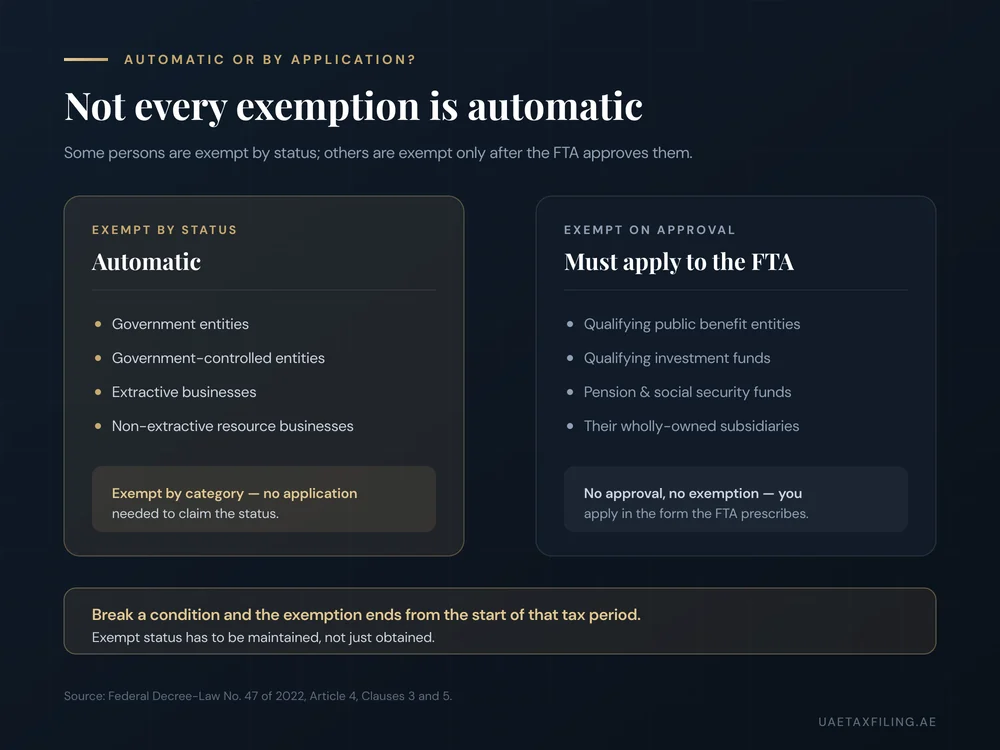
The dividing line is practical. Government, government-controlled and natural-resource businesses are exempt by their category. Qualifying investment funds, pension and social security funds, qualifying public benefit entities and their qualifying subsidiaries are required under Article 4 to apply to the FTA in the form and within the timeline it prescribes, and the exemption takes effect from the tax period stated in the application. In other words, for that second group there is no exemption until the application is made and approved — a fund that assumes it is automatically exempt, and never applies, is not exempt. The application runs through the same EmaraTax system used for ordinary corporate tax registration.
Key takeaway: Government and resource businesses are exempt by status; funds, pensions, charities and their subsidiaries must apply to the FTA and be approved. No application means no exemption for that second group.
Exempt person vs 0%, relief and participation exemption
Being an exempt person is only one of four ways to end up paying no Corporate Tax, and it is the only one that removes you from the tax entirely. The other three keep you a taxable person who still files a return.
The confusion is understandable, because all four can produce a zero bill. But they work at different levels. The table sets them apart.
| Mechanism | What it removes | Still a taxable person? |
|---|---|---|
| Exempt person (Article 4) | The whole person, from the tax | No |
| Qualifying Free Zone Person | The rate on qualifying income (to 0%) | Yes — files a return |
| Small Business Relief | Taxable income (elected to nil) | Yes — still files |
| Participation exemption (Article 23) | Specific income — dividends and gains | Yes — files a return |
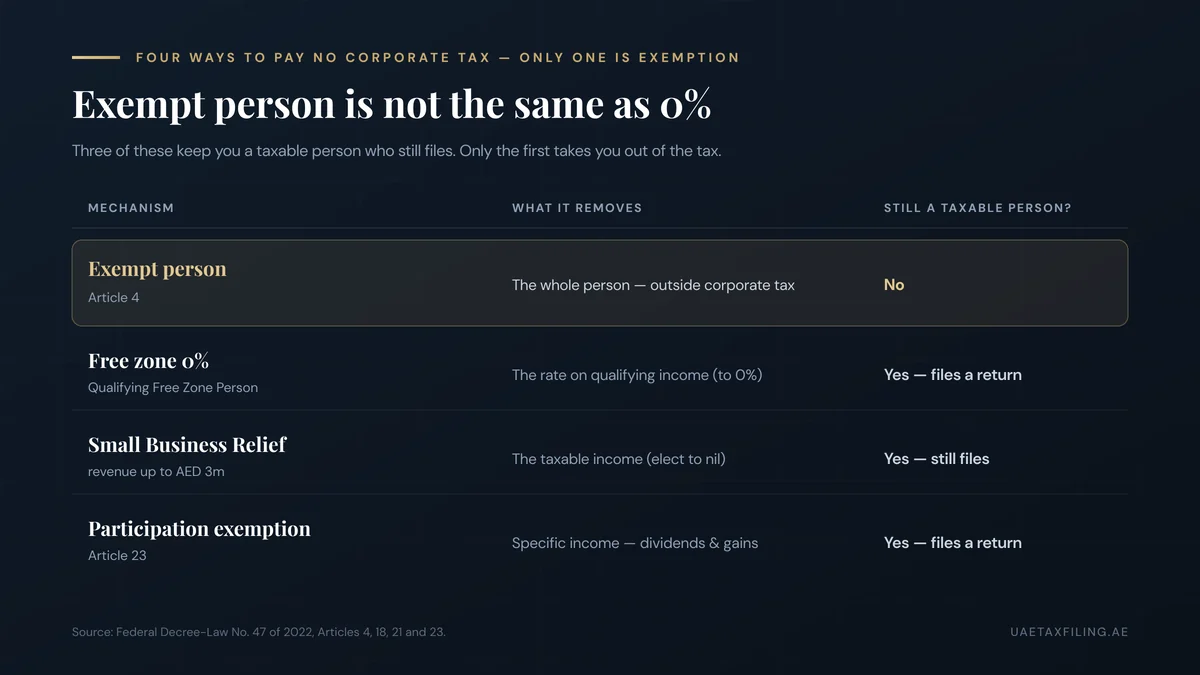
The one that catches people most is the free zone. A Qualifying Free Zone Person pays 0% on qualifying income but is fully within Corporate Tax — it registers, files and can pay 9% on non-qualifying income. Likewise, Small Business Relief and the participation exemption reduce the bill without removing the taxpayer.
Key takeaway: Exempt person, free zone 0%, Small Business Relief and participation exemption are four different things. Only the exempt person is outside the tax; the rest are taxable persons that still file.
Keeping the exemption
Exempt status must be maintained, not just obtained — failing a condition ends the exemption. Article 4 states that if an exempt person stops meeting the relevant conditions at any time in a tax period, it ceases to be exempt from the start of that period.
That backdating is the risk. A qualifying investment fund that breaches an ownership-diversity condition in month ten does not lose exemption from month ten; it loses it for the whole tax period, and becomes taxable on that year’s income. The Minister may allow continuity in limited cases — a temporary, promptly-corrected failure, or a failure caused by liquidation — but the default is strict. Ongoing monitoring of the conditions is therefore part of holding exempt status, not an optional extra.
Key takeaway: Breaking a condition removes exemption from the beginning of that tax period, not the date of the breach. Exempt persons have to monitor their conditions continuously.
Do exempt persons still register?
Exempt status does not automatically mean no dealings with the FTA. The categories that must apply to be exempt necessarily register to make that application, and the FTA can require certain exempt persons to register even where tax is not due.
The practical position varies by category. A government entity carrying on a licensed business registers and files for that business. A qualifying investment fund, pension fund or public benefit entity applies to be recognised as exempt, which is itself a registration step, and may have ongoing information obligations. The safe assumption is that exemption changes what you pay, not whether you engage with the system — so confirming your specific registration and reporting duties is worth doing rather than assuming silence is compliant.
Record-keeping is the duty exempt persons most often overlook. Even where no tax is due, an exempt person generally has to keep records that prove it continues to meet its conditions, because the FTA can ask it to demonstrate its status. A qualifying public benefit entity, for example, needs to show its income is applied to its stated public purpose, and a fund needs to evidence its ownership and regulatory position. Losing those records is how a defensible exemption becomes a disputed one. In practice, an exempt person should keep books to the same standard as a taxable person — the difference is the tax result, not the paperwork behind it, and an audit years later will test exactly that evidence.
Key takeaway: Exemption is not the same as invisibility. Many exempt persons still register, apply or report to the FTA, and a government entity’s licensed business is fully taxable.
Tell us what your entity is — a fund, a foundation, a charity, a government-owned company, or an ordinary business wondering if it qualifies — and we will tell you whether it is an exempt person, whether it must apply, and what it still has to file. Where you need the exemption application or the ongoing filing handled, we match you with an FTA-registered partner agency that does it. Message the team on WhatsApp using the button below.
Frequently asked questions
Who is exempt from UAE corporate tax?
Nine categories of person are exempt under Article 4: government entities, government-controlled entities, extractive businesses, non-extractive natural resource businesses, qualifying public benefit entities, qualifying investment funds, pension and social security funds, certain wholly-owned subsidiaries of those persons, and any other person the Cabinet designates. Everyone else is a taxable person.
Is a free zone company exempt from corporate tax?
No. A Qualifying Free Zone Person pays 0% on its qualifying income but remains a taxable person within Corporate Tax. It must register, file a return, and it can pay 9% on income that is not qualifying income. That is a rate, not an exemption.
Are charities exempt from corporate tax in the UAE?
Only if they are qualifying public benefit entities. A charity must be listed in the relevant Cabinet Decision and meet the conditions on its purpose and use of income, and it must be recognised as exempt. A charity that is not on the list is not automatically exempt.
Do exempt persons have to register or file a return?
It depends on the category. Funds, pensions, public benefit entities and their subsidiaries must apply to the FTA to be exempt, which is a registration step. A government entity that runs a licensed business registers and files for that business. Exemption changes what you pay, not necessarily whether you engage with the FTA.
Is a qualifying investment fund automatically exempt?
No. Under Article 4, a qualifying investment fund must apply to the Federal Tax Authority to be treated as exempt, and the exemption takes effect from the tax period stated in the application. A fund that never applies is not exempt, even if it meets the conditions.
Is a government entity always exempt?
Not entirely. A government entity is exempt, but under Article 5 it is subject to Corporate Tax on any business or business activity it conducts under a licence from a licensing authority. That licensed business is treated separately and taxed like any other business.
What is the difference between an exempt person and small business relief?
An exempt person is outside Corporate Tax altogether. Small Business Relief is claimed by a taxable person with revenue up to AED 3 million, who elects to be treated as having no taxable income but still registers and files. One removes the person; the other reduces a taxpayer’s bill.
Can a business lose its exempt status?
Yes. If an exempt person stops meeting the relevant conditions at any point in a tax period, it ceases to be exempt from the start of that period and becomes taxable on that year’s income. Limited continuity may apply for temporary or liquidation-related failures.
Is a family foundation an exempt person?
Not by default. A family foundation is not one of the Article 4 exempt categories, but it can apply to be treated as a tax-transparent unincorporated partnership, so its income is taxed in the hands of its beneficiaries instead. That is a separate mechanism from exempt-person status.
How we verified this: the categories, the apply-to-the-FTA requirement and the loss-of-status rule are taken from Article 4 (and Article 5) of Federal Decree-Law No. 47 of 2022. Confirm current guidance in the FTA legislation library. This article is general information, not tax advice.
Last updated: 20 August 2026 · Reviewed by Jazim, CEO, UAE Tax Filing LLC (Dubai)