Last updated: 25 August 2026 · Written by the UAE Tax Filing editorial team · Reviewed by Jazim, CEO, UAE Tax Filing LLC (Dubai) · 12 min read
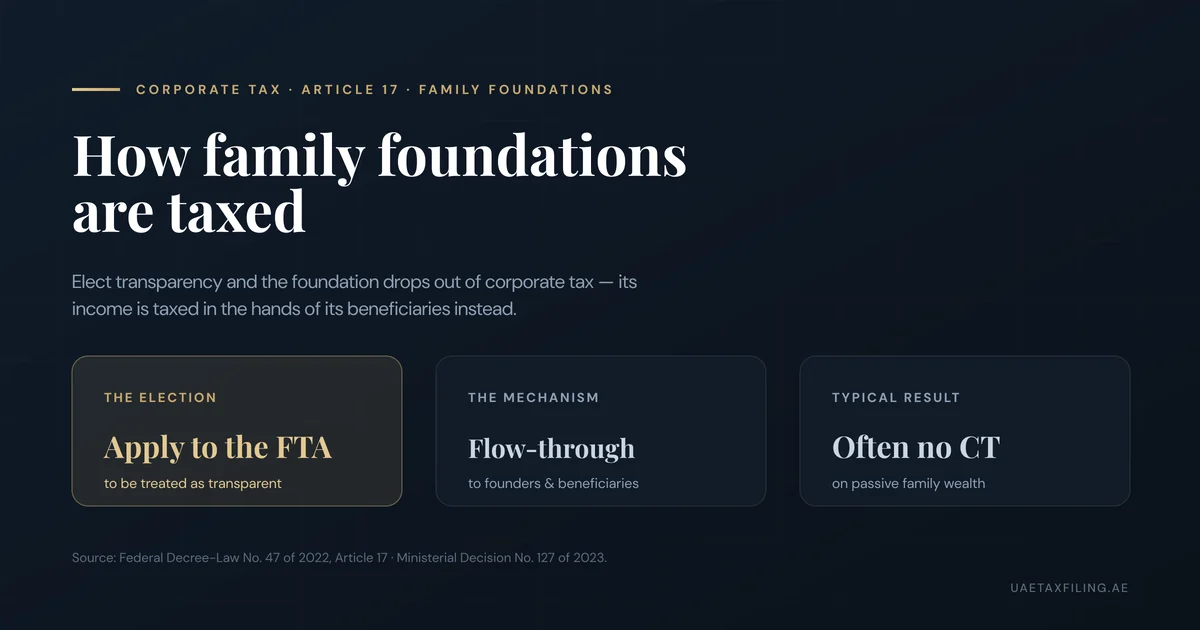
A UAE family foundation is taxed like any company by default, but it can apply to become tax-transparent under Article 17. Once the Federal Tax Authority approves the election, the foundation is treated as an unincorporated partnership: it is no longer a taxable person, and its income is taxed in the hands of its beneficiaries instead. Because those beneficiaries are usually natural persons with passive wealth, the result is often no corporate tax at all. Payments to directors and officers carry their own limits — see our guide to who counts as a director or officer.
The mistake families make is assuming a foundation is automatically outside tax because it is not a trading company. It is not — a foundation is a juridical person, and a juridical person is a taxable person. The relief comes from an election you have to make, not from the structure itself.
The short version
- By default, a foundation is taxable. As a juridical person it is a taxable person and pays 9% on income above AED 375,000.
- Article 17 offers transparency. Under Article 17 of Federal Decree-Law No. 47 of 2022, a family foundation can apply to be treated as an unincorporated partnership.
- Then income flows to beneficiaries. A transparent foundation is ignored for tax, and its income is taxed as if the beneficiaries earned it directly.
- Often that means no tax. Beneficiaries who are natural persons are usually outside corporate tax on passive investment and property income.
- Four conditions apply. The foundation must be for people, manage only wealth, run no hidden business, and not exist to avoid tax.
What this covers
- What a family foundation is
- Why families use foundations
- How a foundation is taxed by default
- The Article 17 election and its conditions
- How the flow-through works
- Taxed vs transparent
- Why it is not an “exempt person”
- What breaks the treatment
- How to elect and stay compliant
- Frequently asked questions
What a family foundation is
A family foundation is a foundation, trust or similar entity used to hold and manage family wealth across generations. In UAE Corporate Tax it has a defined meaning: any such entity that meets the conditions of Article 17 and is used to receive, hold and manage assets for identified people.
These structures are common in the UAE’s financial centres. A DIFC or ADGM foundation, a RAK ICC foundation, or a trust set up for a family typically owns investments, property and shares in the family’s companies, and distributes to the next generation. The tax question is not what the foundation is called but how it is treated: as a taxpayer in its own right, or as a transparent conduit for the people behind it. The wider set of rules these structures sit inside is mapped in our guide to every UAE tax change coming in 2026.
Key takeaway: A family foundation is a foundation, trust or similar entity holding family wealth. For Corporate Tax, what matters is not its label but whether it is taxed as a person or treated as transparent.
Why families use foundations
A family foundation is a wealth-structuring tool, used to consolidate a family’s assets and pass them on in an orderly way. Its appeal is governance and succession first, and tax treatment second.
Three motives dominate. The foundation holds the family’s shares, property and investments in one entity, so ownership does not fragment across a growing family. It sets rules for how wealth is distributed, protecting minors or spendthrift heirs and avoiding a disorderly inheritance. And it separates the family’s personal wealth from the operating risk of its businesses. A family that owns a group of companies, a share portfolio and several properties might place all of it under one foundation, and the gains on selling a substantial shareholding can then fall under the participation exemption as well. The Corporate Tax question — taxed or transparent — sits on top of that structure, and it is why the Article 17 election matters so much once the foundation is in place.
Key takeaway: Families use foundations for succession, consolidation and asset protection, not primarily for tax. The tax treatment is decided afterwards, by whether the foundation elects transparency.
How a foundation is taxed by default
By default, a family foundation is a taxable person and pays Corporate Tax like a company. As an incorporated foundation it is a juridical person, and juridical persons resident in the UAE are within the tax on their worldwide income.
That means, without any election, the foundation registers for Corporate Tax, files a return, and pays 9% on taxable income above the AED 375,000 zero-rate band. Investment income the foundation earns — dividends, rent, interest, gains — is taxed at the foundation level, before anything reaches the family. For a foundation holding a large portfolio, that is a real annual cost, and it is the default the Article 17 election is designed to remove.
Key takeaway: Left alone, a family foundation is taxed like any company — 9% above AED 375,000, at the foundation level. The election exists precisely because that default applies unless you change it.
The Article 17 election and its conditions
The Article 17 election is an application to have the family foundation treated as a tax-transparent unincorporated partnership. It is not automatic: the foundation must apply to the FTA and meet four conditions, all at once.

The conditions are cumulative:
- For people, not profit. The foundation is established for the benefit of identified or identifiable natural persons, a public benefit entity, or both.
- It only manages wealth. Its principal activity is to receive, hold, invest, disburse or otherwise manage assets and funds associated with savings or investment.
- No hidden business. It conducts no activity that would have been a business or business activity if the founder or beneficiaries had done it directly.
- Not a tax dodge. Its main purpose is not the avoidance of Corporate Tax.
Key takeaway: Transparency is an election, not a birthright. A family foundation must apply to the FTA and satisfy all four Article 17 conditions — benefit people, manage only wealth, run no hidden business, and not exist to avoid tax.
How the flow-through works
Flow-through means the transparent foundation is ignored for tax and its income is treated as earned directly by the beneficiaries. The foundation stops being a taxpayer, and each beneficiary’s share of the income is taxed — or not taxed — in their own hands.
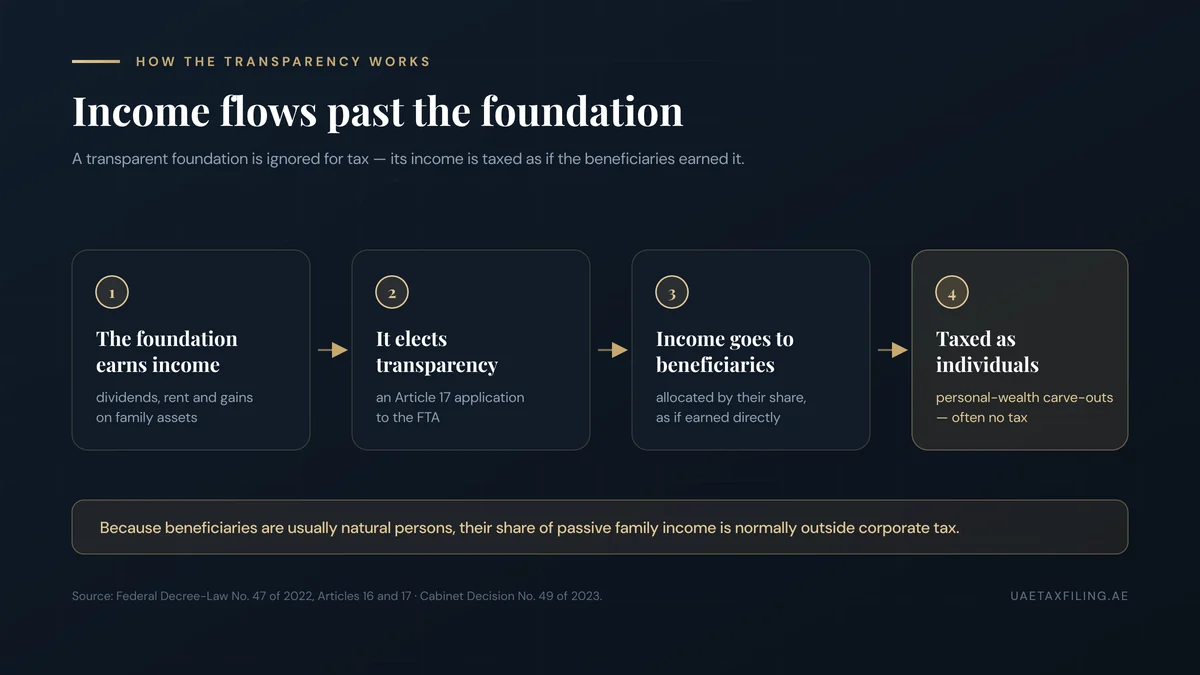
This is where the real benefit appears. Most beneficiaries are natural persons, and a natural person is only within Corporate Tax on business turnover above AED 1 million a year — their salary, personal investment income and real estate income are carved out entirely. So a beneficiary’s share of the foundation’s dividends, rent and capital gains is normally outside the tax. The detail of how individuals are taxed sits in our guide to corporate tax for individuals in the UAE.
Key takeaway: A transparent foundation pushes its income onto the beneficiaries. Because they are usually natural persons with passive wealth, that income typically falls into the personal-investment and real-estate carve-outs and is not taxed.
Taxed vs transparent
The election is the difference between a foundation that pays 9% and one that pays nothing on the same portfolio. Both hold the same assets; only the tax treatment changes.
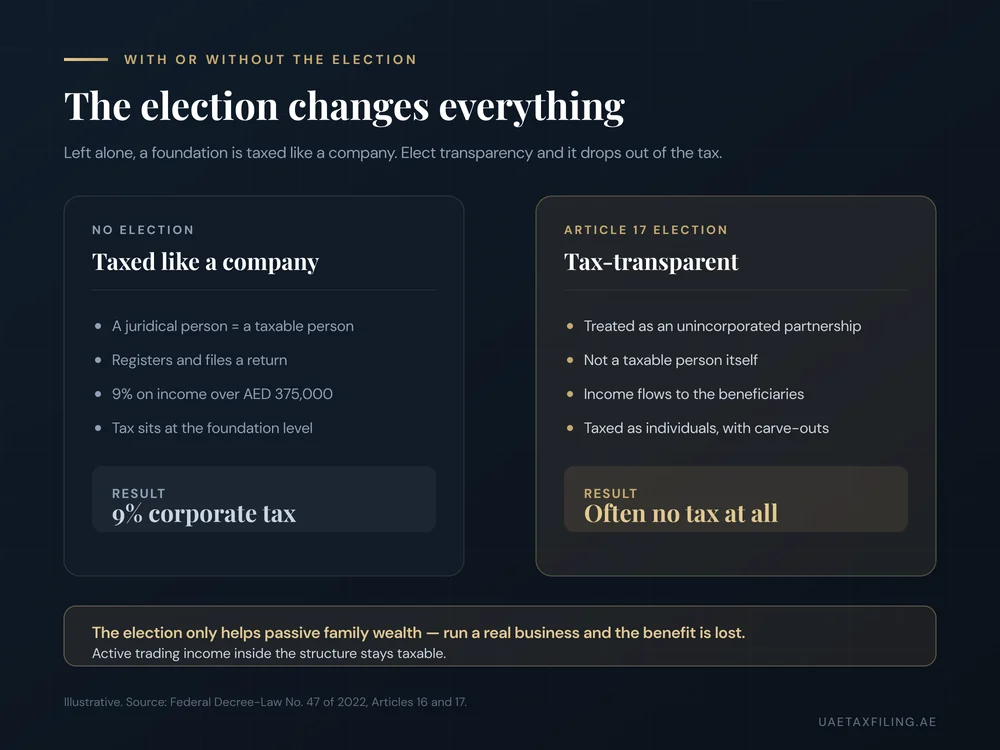
| No election (default) | Article 17 election | |
|---|---|---|
| Tax status | Taxable person | Tax-transparent partnership |
| Who is taxed | The foundation | The beneficiaries |
| Rate on passive income | 9% over AED 375,000 | Usually nil (natural-person carve-outs) |
| Files a return? | Yes, the foundation | Foundation transparent; partners report |
Key takeaway: Without the election a foundation pays 9% on its investment income; with it, that income usually reaches the family untaxed. The assets are identical — the election is the whole difference.
Why it is not an “exempt person”
A family foundation that elects transparency is not an exempt person — it uses a different mechanism. Exempt persons are the closed list in Article 4; a transparent foundation is a taxable structure that has been made fiscally see-through, not one removed from the law.
The distinction matters because the two are often confused. An exempt person, such as a qualifying investment fund, is outside Corporate Tax as a category. A transparent family foundation is not outside the tax; its income is still taxable in principle, just in the beneficiaries’ hands rather than its own, and it happens to land in carve-outs that produce no tax. If the beneficiaries were companies, or the income were business income, tax could still arise. We set out the full exempt-person list in our guide to who is exempt from UAE corporate tax.
Key takeaway: Transparency is not exemption. A family foundation is not on the Article 4 exempt list — it is a taxable structure made transparent, so the tax outcome depends on who the beneficiaries are.
What breaks the treatment
The transparent treatment holds only while the foundation stays passive — running a real business or serving a tax-avoidance purpose breaks it. Article 17 exists for family wealth, not for sheltering a trading operation behind a foundation.
Two things end the relief. The first is conducting an activity that would be a business if the founder or beneficiaries did it directly: if the foundation trades, manufactures or operates a commercial enterprise, condition three fails and that income is taxable. The second is a structure whose main purpose is to avoid Corporate Tax, which fails condition four. A foundation that owns a share portfolio and rental property is squarely within the rules; a foundation that runs the family’s import business through itself is not. Keeping active business in a separate, properly-taxed company is the usual answer.
Transparency rewards passivity. The moment a foundation stops being a wealth-holder and starts being a trader, it steps outside what Article 17 was written for — and the tax the family hoped to avoid comes straight back.
Key takeaway: Passive wealth qualifies; active business does not. Trading through the foundation, or using it mainly to avoid tax, breaks the transparency and makes the income taxable again.
How to elect and stay compliant
Electing transparency is an application to the FTA, and keeping it means holding to the conditions every year. The election takes effect from the tax period in which it is made, or a later period the FTA sets.
In practice the family confirms the foundation meets all four conditions, submits the application through the FTA’s system, and appoints someone responsible for its filings — the same EmaraTax environment used for ordinary corporate tax registration. After approval, the foundation is transparent, but the obligation does not vanish: the conditions have to keep being met, records kept, and the beneficiaries’ own positions handled. A recent extension of the rules also lets certain wholly-owned entities beneath the foundation apply for the same transparent treatment, so a whole holding structure can be aligned rather than just the top foundation.
Key takeaway: The election is an FTA application effective from the current or a future tax period, and it must be maintained. The conditions are ongoing, and underlying holding entities can now often be brought into the same transparent treatment.
Tell us how your foundation is set up — where it is registered, what it holds, and who its beneficiaries are — and we will tell you whether it qualifies for the Article 17 election, what it would save, and what it still has to file. Where you need the application or the ongoing compliance handled, we match you with an FTA-registered partner agency that does it. Message the team on WhatsApp using the button below.
Frequently asked questions
How is a family foundation taxed in the UAE?
By default it is a taxable person and pays 9% Corporate Tax on income above AED 375,000. But it can apply under Article 17 to be treated as a tax-transparent unincorporated partnership, in which case its income is taxed in the hands of its beneficiaries instead of at the foundation level.
Is a UAE family foundation exempt from corporate tax?
Not by exemption. A family foundation is not one of the Article 4 exempt persons. Instead it can elect to be tax-transparent, so its income flows to the beneficiaries — who, as natural persons, are usually outside Corporate Tax on passive wealth. The outcome can be no tax, but the mechanism is transparency, not exemption.
What is the Article 17 election?
It is an application to the Federal Tax Authority to have a family foundation treated as a tax-transparent unincorporated partnership. It requires four conditions to be met, and once approved the foundation stops being a taxable person and its income is allocated to its beneficiaries.
Do beneficiaries pay corporate tax on foundation income?
Usually not, where they are natural persons and the income is passive. A natural person is only taxed on business turnover above AED 1 million a year, while personal investment income and real estate income are carved out. A beneficiary’s share of a transparent foundation’s dividends, rent and gains normally falls outside the tax.
Can a family foundation run a business?
Not if it wants the transparent treatment. One of the four conditions is that the foundation conducts no activity that would be a business if the founder or beneficiaries did it directly. Active trading income breaks the election, so a real business belongs in a separate, taxable company.
Does a DIFC or ADGM foundation qualify?
It can, if it meets the Article 17 conditions. The rules look at what the entity does, not where it is registered, so a DIFC, ADGM or RAK ICC foundation used to hold and manage family wealth for identified people can apply for transparent treatment like any other family foundation.
How do I make my family foundation tax-transparent?
Confirm the foundation meets all four Article 17 conditions, then submit the election application to the FTA through EmaraTax and appoint a responsible person for its filings. The transparency takes effect from the tax period of the application, or a later period the FTA determines.
Is a trust treated the same as a foundation?
Yes, for this purpose. The definition of a family foundation covers any foundation, trust or similar entity that meets the Article 17 conditions. A trust holding family wealth can therefore elect the same tax-transparent treatment as a foundation.
Can the foundation’s underlying companies also be transparent?
Often, yes. The rules were extended so that certain wholly-owned entities beneath a family foundation can also apply to be treated as transparent. This lets a family align a whole holding structure rather than only the top foundation, subject to the conditions and FTA approval.
How we verified this: the election, the four conditions and the transparent treatment are taken from Articles 16 and 17 of Federal Decree-Law No. 47 of 2022, with the application governed by Ministerial Decision No. 127 of 2023. Confirm current guidance in the FTA legislation library. This article is general information, not tax advice.
Last updated: 25 August 2026 · Reviewed by Jazim, CEO, UAE Tax Filing LLC (Dubai)