Last updated: 12 August 2026 · Written by the UAE Tax Filing editorial team · Reviewed by Jazim, CEO, UAE Tax Filing LLC (Dubai)
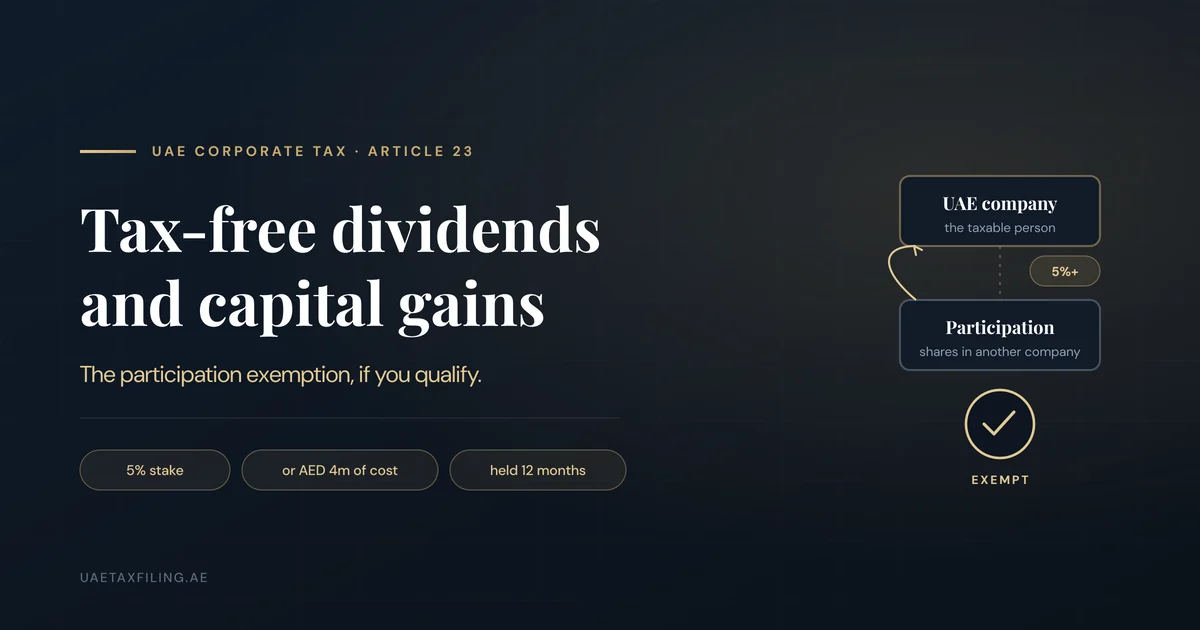
The participation exemption is a UAE Corporate Tax relief that makes dividends and capital gains from a qualifying shareholding tax-free. It applies where a business holds at least 5% of another company — or shares that cost at least AED 4 million — for twelve months, and the company held is taxed at 9% or more. Meet the conditions and the income never enters your taxable base.
A dividend from a UAE company is tax-free with no strings. A dividend from a foreign company, or a gain on selling any shareholding, is only tax-free if it passes the participation test. Those are two different rules, and confusing them is where the mistakes start.
The short version
- It exempts dividends and gains from qualifying shares. Under Article 23 of Federal Decree-Law No. 47 of 2022, income from a Participating Interest is outside taxable income.
- The gateway is 5% or AED 4 million. A Participating Interest is a 5% ownership stake — or, under Ministerial Decision No. 302 of 2024, a stake that cost at least AED 4 million.
- Two conditions do the heavy lifting. The stake must be held for an uninterrupted twelve months, and the company held must be subject to tax at 9% or more.
- Domestic dividends are simpler. A dividend from a UAE-resident company is exempt under Article 22 with no conditions at all — the participation exemption is really about foreign dividends and every capital gain.
- There is a clawback. Drop below 5% before the twelve months are up and the income you treated as exempt is pulled back into tax.
What this covers
- What the participation exemption is
- Domestic dividends: the easy case
- The gateway: 5% or AED 4 million
- The five conditions in full
- What income the exemption covers
- The twelve-month clawback
- Where the exemption does not apply
- Why it matters for holding companies
- Frequently asked questions
What the participation exemption is
The participation exemption is the mechanism that keeps returns on a substantial shareholding out of Corporate Tax. It exists so that profits are not taxed twice — once in the company that earned them and again in the shareholder that receives them — which is the standard design of every developed tax system that taxes corporate groups.
Article 23 states the principle in one line: income from a Participating Interest is exempt from Corporate Tax, subject to the conditions of the Article. A Participating Interest is a qualifying stake in another company, and the "income" it shelters is broad: dividends, the gain on selling the shares, foreign-exchange movements on the holding, and impairment gains or losses. When the conditions are met, none of that reaches your taxable income.
Compare it with an ordinary investment return, which is fully taxable. Interest on a bond, or profit on trading shares you hold briefly, is taxed at 9% above the threshold. A dividend from a company you own 20% of and have held for two years is not taxed at all. The difference is not the size of the return — it is whether the shareholding qualifies as a participation.
Key takeaway: the participation exemption removes dividends and capital gains on a qualifying shareholding from tax entirely. It is about the quality of the stake, not the size of the return.
Domestic dividends: the easy case
A dividend from a UAE-resident company is exempt from Corporate Tax with no conditions attached. This sits in Article 22, not Article 23, and it is the simplest relief in the whole regime: if a UAE company pays you a dividend, it is tax-free, full stop — no minimum stake, no holding period, no subject-to-tax test.
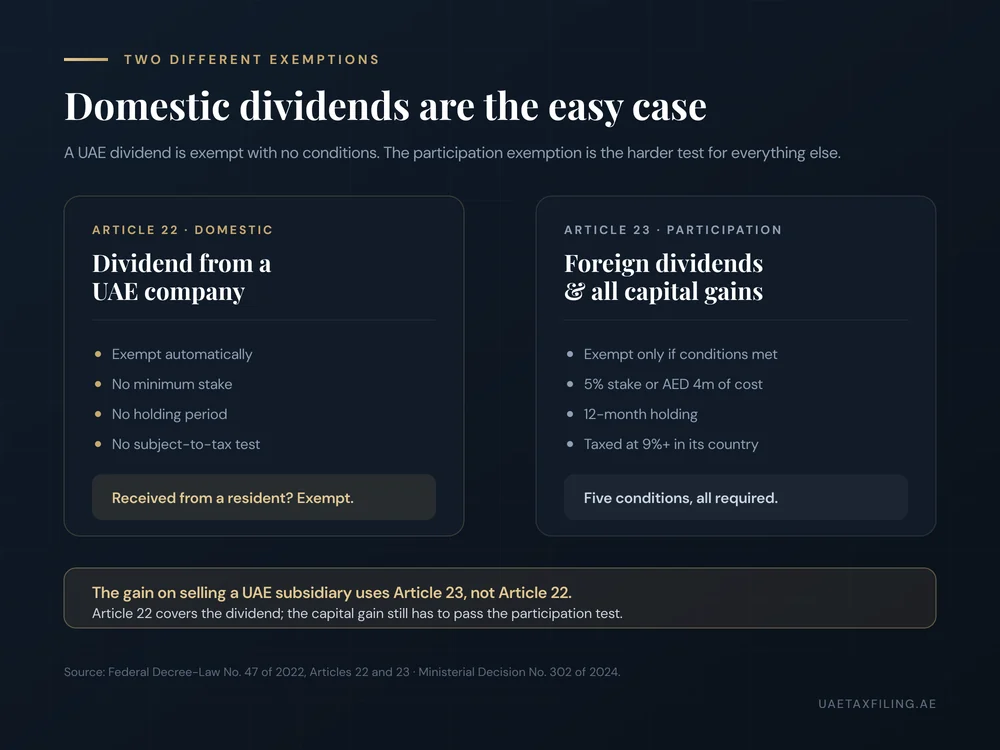
This matters because it removes most ordinary UAE group structures from the participation-exemption analysis altogether. A UAE parent receiving dividends from its UAE subsidiaries does not need to count percentages or holding periods for those dividends; Article 22 exempts them outright. The participation exemption only becomes necessary when the income falls outside that simple domestic-dividend rule — which means foreign dividends, and capital gains of any kind.
If your dividend comes from a UAE company, stop here: it is exempt under Article 22. The participation exemption is the tool you reach for when the dividend is foreign, or when you are selling shares rather than receiving a dividend.
The line catches people on disposals. Selling a UAE subsidiary at a profit is not a dividend, so Article 22 does not help — the capital gain has to pass the Article 23 participation test to be exempt. A UAE group can receive domestic dividends tax-free for years and still find its exit gain taxable if the shareholding never met the participation conditions.
Key takeaway: UAE-resident dividends are exempt unconditionally under Article 22; the participation exemption is for foreign dividends and all capital gains, including gains on UAE subsidiaries.
The gateway: 5% or AED 4 million
A shareholding qualifies as a Participating Interest if it is at least 5% of the company's shares or capital, or if it cost at least AED 4 million. The 5% test is the headline, but the acquisition-cost alternative is the one that rescues smaller percentage stakes in large companies.
The two routes are alternatives, not cumulative. A 6% stake qualifies on the percentage test regardless of what it cost. A 2% stake in a large listed company does not meet the 5% test, but if you paid AED 4 million or more for it, Ministerial Decision No. 302 of 2024 treats it as a Participating Interest anyway. That AED 4 million cost threshold is measured on the aggregate acquisition cost of the interest, so it is the total invested that counts, not the price of a single tranche.
An example shows why the alternative exists. A UAE investment company takes a 3% position in a foreign operating business for AED 6 million. On the percentage test it fails — 3% is below 5%. On the cost test it passes, because AED 6 million exceeds AED 4 million, so the dividends and any future gain can be exempt. Without the cost route, meaningful minority investments would be shut out of the relief purely on a percentage.
Key takeaway: you qualify through either a 5% stake or an aggregate acquisition cost of AED 4 million or more. The cost route is what brings high-value minority stakes inside the exemption.
The five conditions in full
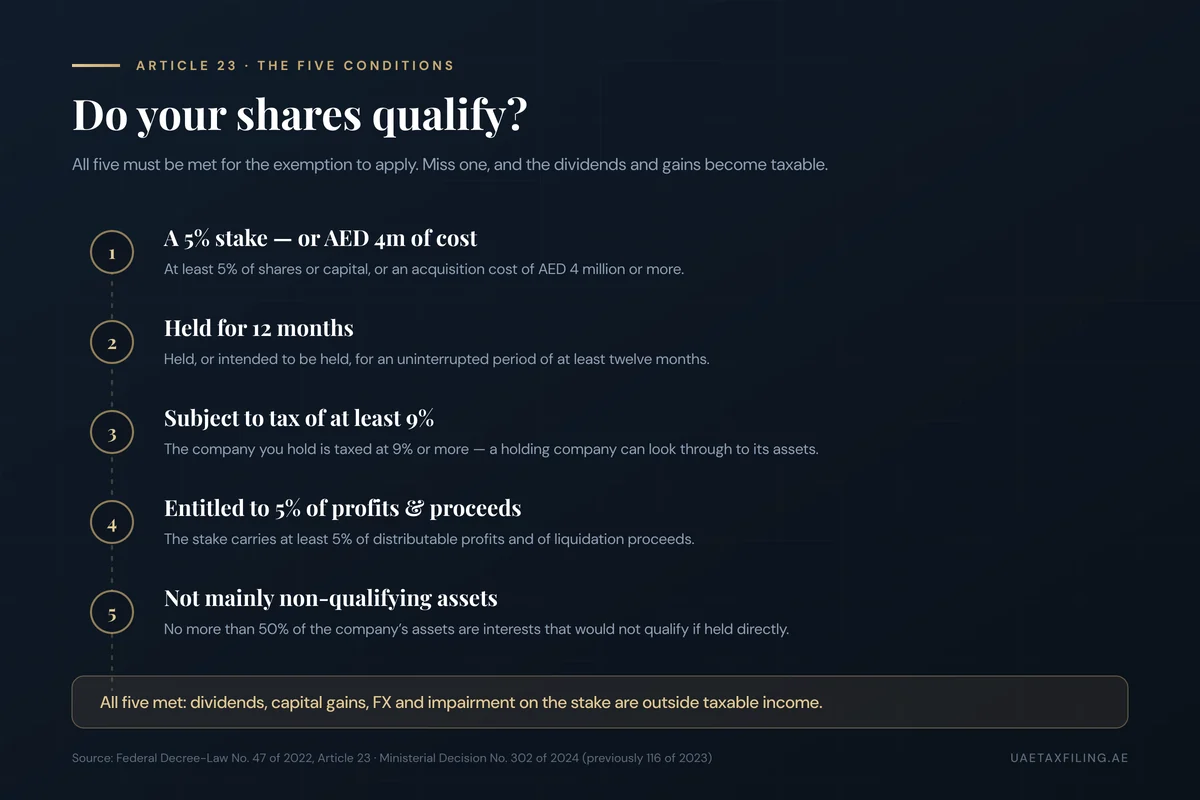
The participation exemption applies only when all five conditions in Article 23 are satisfied together. Meeting the gateway is the first; four more sit behind it, and every one has to hold for the income to be exempt.
| # | Condition | The test |
|---|---|---|
| 1 | Minimum interest | 5% of shares or capital, or AED 4m of acquisition cost |
| 2 | Holding period | Held, or intended to be held, 12 uninterrupted months |
| 3 | Subject-to-tax | The company held is taxed at 9% or more (or a look-through applies) |
| 4 | Profit entitlement | Right to at least 5% of distributable profits and of liquidation proceeds |
| 5 | Asset test | No more than 50% of its assets are interests that would not qualify if held directly |
Condition three, the subject-to-tax test, is the one that trips up international structures. The company you hold must face Corporate Tax, or a comparable foreign tax, at a rate of at least 9%. A pure holding company that earns almost nothing itself is not disqualified automatically: Article 23 lets it look through to its own participations, so a holding vehicle whose income substantially consists of income from qualifying participations is treated as meeting the test. A stake in a Qualifying Free Zone Person or an Exempt Person is also treated as meeting the subject-to-tax condition. If you are testing a free zone holding, the interaction with Qualifying Free Zone Person status is worth checking first.
Key takeaway: all five conditions must hold at once. The subject-to-tax test at 9% is the usual sticking point, softened by a look-through for genuine holding companies and a deeming rule for QFZPs and exempt persons.
What income the exemption covers
Once the conditions are met, the exemption covers four kinds of income arising on the participation. Article 23 lists them, and the breadth is the point: it is not just dividends.
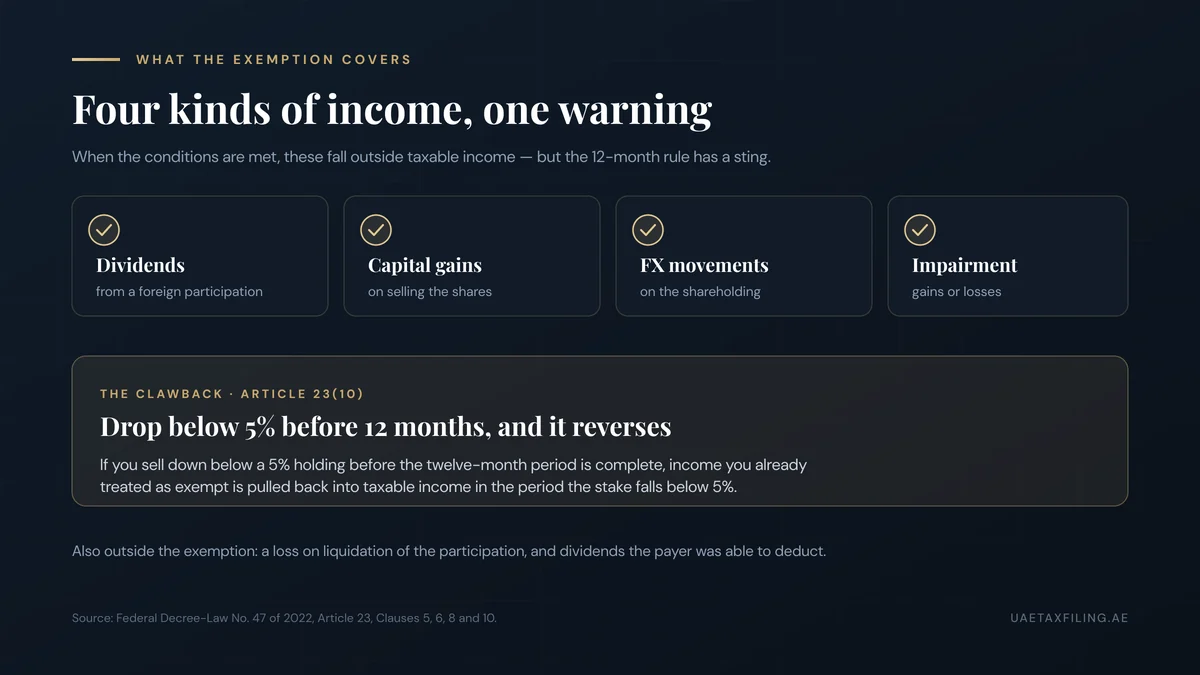
The exempt income is: dividends and other profit distributions received from a foreign participation; gains or losses on the transfer, sale or disposal of the participating interest after the holding period; foreign-exchange gains or losses on the interest; and impairment gains or losses on the interest. That means the return you receive while you hold the shares and the gain you make when you sell them are both sheltered, along with the accounting noise — currency and impairment movements — in between.
Note that it cuts both ways on gains and losses. Because a gain on disposal is exempt, a loss on disposal is equally non-deductible — you cannot claim relief for a loss on selling a qualifying participation, just as you would not be taxed on the gain. The exemption is a two-way door: it removes the upside from tax and the downside from relief.
Key takeaway: the exemption covers dividends, disposal gains, FX and impairment on the participation — and because gains are exempt, matching losses are not deductible.
The twelve-month clawback
The twelve-month holding period is not just an entry test — break it and the exemption reverses. Article 23 lets you treat income as exempt on the strength of an intention to hold for twelve months, which is generous, but it backs that generosity with a clawback if the intention does not hold.
The rule is specific. If you fail to hold a 5% or greater interest for an uninterrupted twelve months, any income you previously left out of taxable income under the exemption is added back in the tax period in which the stake falls below 5%. So a company that takes a dividend exempt in month three, then sells its holding down to 2% in month eight, has to bring that dividend back into tax in the period of the sale. The exemption was provisional all along; the twelve-month hold is what makes it final.
The practical discipline is to be honest about intention and to watch partial disposals. Selling part of a large stake is fine as long as you stay at or above 5% for the full twelve months; selling enough to drop below 5% early is what triggers the clawback. This is the kind of timing point that belongs in the same planning as the interest deduction rules when a group is financing or restructuring its holdings.
Key takeaway: the exemption can be claimed on an intention to hold twelve months, but dropping below 5% before the period is complete claws the previously exempt income back into tax.
Where the exemption does not apply
The participation exemption is switched off in several specific situations, even when the shareholding otherwise qualifies. These carve-outs stop the relief being used where it would create a mismatch or a double benefit.
The main exclusions are three. First, the exemption does not apply to a dividend that the paying company was able to deduct in its own country — because exempting income that was never taxed at the other end would leave it untaxed everywhere. Second, it does not apply where a deductible impairment loss on the interest, or on a related-party loan to it, has already been claimed — you cannot take the loss and then exempt the recovery. Third, the exemption does not apply to a loss realised on the liquidation of a participation, which stays available as a deduction rather than being locked out with the exempt gains.
The exemption is not a blanket. It is switched off wherever it would let the same income escape tax on both sides of a transaction, or let a business claim a loss and an exemption on the same holding.
There is also a two-year restriction where the participation was acquired in exchange for transferring an interest that did not itself qualify, or under a group-relief or restructuring transfer. In those cases the exemption is suspended for two years, to stop non-qualifying assets being converted into exempt ones through an internal reshuffle.
Key takeaway: the exemption is disapplied for deductible dividends, previously claimed impairment losses, and liquidation losses, and is suspended for two years after certain non-qualifying or restructuring transfers.
Why it matters for holding companies
The participation exemption is the single most important reason the UAE works as a holding-company location. A holding company's whole economic purpose is to own shares and receive the returns on them, so a regime that taxed those returns would make the structure pointless — and a regime that exempts them makes it efficient.
For a UAE holding company with foreign subsidiaries, the exemption means dividends flow up and are received tax-free, and the eventual sale of a subsidiary is a tax-free gain, provided the participation conditions are met on each holding. That is what lets a UAE parent sit over an international group without adding a layer of tax between the operating businesses and the ultimate owners. The comparison that decides where groups place their holding company — against Singapore, the Netherlands or elsewhere — turns heavily on how clean each country's participation exemption is, a point we cover in our analysis of where to base an international business. It also interacts with the treaty and withholding position on the way funds move across borders.
Key takeaway: the participation exemption is what makes a UAE holding company efficient — tax-free dividends up and a tax-free exit — and it is a core factor in choosing a holding-company jurisdiction.
Frequently asked questions
Is a dividend from my UAE subsidiary taxable?
No. A dividend from a UAE-resident company is exempt from Corporate Tax under Article 22, with no minimum stake, holding period or other condition. This is separate from the participation exemption, which is needed only for foreign dividends and for capital gains.
What is a Participating Interest?
A Participating Interest is a qualifying shareholding in another company: at least 5% of its shares or capital, or a stake that cost at least AED 4 million. Holding a Participating Interest that meets the further Article 23 conditions is what makes the related dividends and gains exempt.
Do I get the exemption on a stake below 5%?
Only through the acquisition-cost route. A holding below 5% does not meet the percentage test, but if its aggregate acquisition cost is AED 4 million or more it is still treated as a Participating Interest under Ministerial Decision No. 302 of 2024, so the exemption can apply.
Does my foreign subsidiary have to pay tax for me to get the exemption?
Broadly yes. The subject-to-tax condition requires the company you hold to face Corporate Tax, or a comparable foreign tax, at a rate of at least 9%. A genuine holding company can meet the test by looking through to its own qualifying participations, and a stake in a Qualifying Free Zone Person or an Exempt Person is deemed to satisfy it.
Is the capital gain on selling shares exempt?
Yes, if the shares are a Participating Interest and the conditions are met. The gain on the transfer, sale or disposal of a participating interest, made after the twelve-month holding period, is exempt. This applies to gains on UAE and foreign shareholdings alike, provided they qualify.
What happens if I sell my shares within twelve months?
If you drop below a 5% holding before completing twelve uninterrupted months, the clawback in Article 23 applies. Any income you previously treated as exempt is added back into taxable income in the tax period in which your stake falls below 5%.
Can I deduct a loss on selling a qualifying shareholding?
No. Because the gain on a qualifying participation is exempt, a loss on it is not deductible. The exemption is symmetrical: it removes the gain from tax and the loss from relief. A loss on the liquidation of a participation is a specific exception that remains deductible.
Does the participation exemption apply to a UAE holding company?
Yes, and it is central to why the UAE suits holding companies. A qualifying UAE holding company receives foreign dividends tax-free and realises tax-free gains on selling its participations, so no extra layer of tax sits between its subsidiaries and its owners.
Which decision governs the participation exemption now?
Ministerial Decision No. 302 of 2024 governs the participation exemption for tax periods commencing on or after 1 January 2025, replacing Ministerial Decision No. 116 of 2023. The earlier decision continues to apply to tax periods that began before that date. The Article 23 conditions themselves sit in the Corporate Tax Law.
Not sure if your shareholding qualifies?
The participation exemption looks simple — 5%, twelve months, tax-free — until a stake sits below 5% but above AED 4 million, a foreign subsidiary is taxed below 9%, or a mid-year sale threatens a clawback. Each of those turns a tax-free return into a taxable one, and the amounts on dividends and exit gains are usually large.
Tell us three things — the size and cost of your stake, how long you have held it, and whether the company is UAE or foreign — and we will tell you whether the participation exemption applies to your dividends and gains, and where the clawback or subject-to-tax test could catch you. If it needs a full working, we will match you with an FTA-registered partner agency that prepares it and files the return around it. Message the team on WhatsApp using the button below, or see how the filing works on our Corporate Tax return filing service page.
Last reviewed on 12 August 2026 by Jazim, CEO of UAE Tax Filing LLC, Dubai. Methodology: the conditions and treatments in this article were verified against the published text of Federal Decree-Law No. 47 of 2022 (Article 23, and Article 22 for domestic dividends) and Ministerial Decision No. 302 of 2024 on the participation exemption, which replaced Ministerial Decision No. 116 of 2023 for tax periods from 1 January 2025. UAE Tax Filing LLC is a matching platform and is not an FTA-registered tax agent; calculations and filings are performed by the licensed partner firms we connect you with. This article is general guidance and is not a substitute for advice on your own facts.