Last updated: 12 August 2026 · Written by the UAE Tax Filing editorial team · Reviewed by Jazim, CEO, UAE Tax Filing LLC (Dubai)
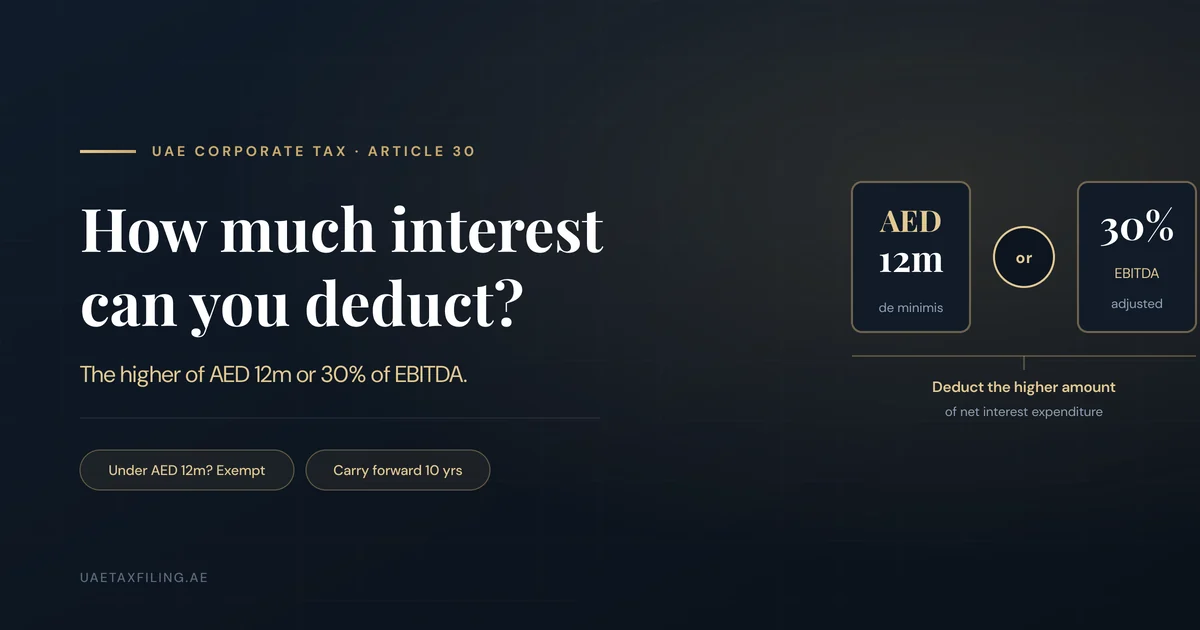
The UAE interest deduction limitation rule caps how much net interest a business can deduct for Corporate Tax at the higher of AED 12 million or 30% of adjusted EBITDA. Anything above that cap is disallowed for the year and carried forward for up to ten years. Most businesses never hit it — if your net interest is under AED 12 million, the rule does not apply to you at all.
The headline is "30% of EBITDA", but the number that actually saves most companies is AED 12 million. Below it, the whole rule switches off.
The short version
- The cap is a "higher of" test. Under Article 30 of Federal Decree-Law No. 47 of 2022, net interest is deductible up to the greater of AED 12 million or 30% of adjusted EBITDA.
- Under AED 12 million, you are out. Ministerial Decision No. 126 of 2023 sets the de minimis at AED 12 million of net interest. Most SMEs never reach it.
- Disallowed interest is deferred, not lost. The excess carries forward and stays deductible for the next ten tax periods.
- Some persons are outside the rule entirely. Banks, insurance providers and natural persons in business are excluded, and interest on debt entered into before 9 December 2022 is grandfathered.
- There is a second, harsher rule. Article 31 can disallow related-party loan interest outright — no cap, no carry-forward — when the loan funds dividends, buybacks, capital contributions or acquisitions.
What this covers
- What the interest deduction limitation rule is
- The AED 12 million de minimis
- The 30% EBITDA cap and how to work it
- What happens to disallowed interest
- Who is outside the rule
- Grandfathering: pre-9 December 2022 debt
- The specific rule: Article 31
- How it works for tax groups
- Frequently asked questions
What the interest deduction limitation rule is
The general interest deduction limitation rule is a cap on how much net interest expenditure a business can deduct when calculating its taxable income. It exists to stop companies stripping UAE profits through excessive debt, a standard feature of modern tax systems drawn from the OECD's base-erosion work.
Net interest expenditure is the key term, and it is a net figure: your interest expense for the period, minus the taxable interest income you earned. Article 30 then limits the deduction of that net figure to the higher of AED 12 million or 30% of adjusted EBITDA. If your net interest sits under the cap, everything is deductible. If it sits above, the excess is disallowed for the year.
Compare it with an ordinary business expense, which is deductible in full if it is wholly and exclusively for the business. Interest is different: even genuine, arm's-length, commercially necessary interest can be capped, purely because of its size relative to earnings. That is what makes this rule catch people who did nothing wrong — they simply borrowed heavily against modest EBITDA.

Key takeaway: the rule caps net interest, not gross, and only bites when that net figure is large relative to earnings. Genuine interest can still be limited.
The AED 12 million de minimis
The AED 12 million de minimis is the threshold below which the interest cap simply does not apply. Ministerial Decision No. 126 of 2023 sets it: if your net interest expenditure for the tax period does not exceed AED 12 million, Article 30 switches off and your interest is fully deductible.
This is the single most important number in the rule, and it is the reason the cap is a non-event for the overwhelming majority of UAE businesses. An SME with a AED 3 million bank loan at 6% pays roughly AED 180,000 of interest a year — nowhere near AED 12 million. It never has to think about EBITDA, adjustments, or carry-forwards. The rule was written for large, debt-heavy structures, not for the typical trading company.
If you take one thing from this article: check your net interest against AED 12 million first. Under it, you can stop reading. The rest of the rule is not your problem.
Note the framing. The deduction is the higher of AED 12 million or 30% of EBITDA, so the de minimis also acts as a floor. A business with weak or negative EBITDA but net interest just above AED 12 million still gets to deduct a full AED 12 million, because the higher-of test protects it.
Key takeaway: net interest under AED 12 million means the rule does not apply. It is both an exemption threshold and a minimum deductible floor.
The 30% EBITDA cap and how to work it
Above the de minimis, the cap is 30% of adjusted EBITDA. EBITDA here means accounting earnings before interest, tax, depreciation and amortisation, adjusted to exclude any exempt income under Article 22 of the Corporate Tax Law — because you cannot claim a deduction against income that is not being taxed in the first place.
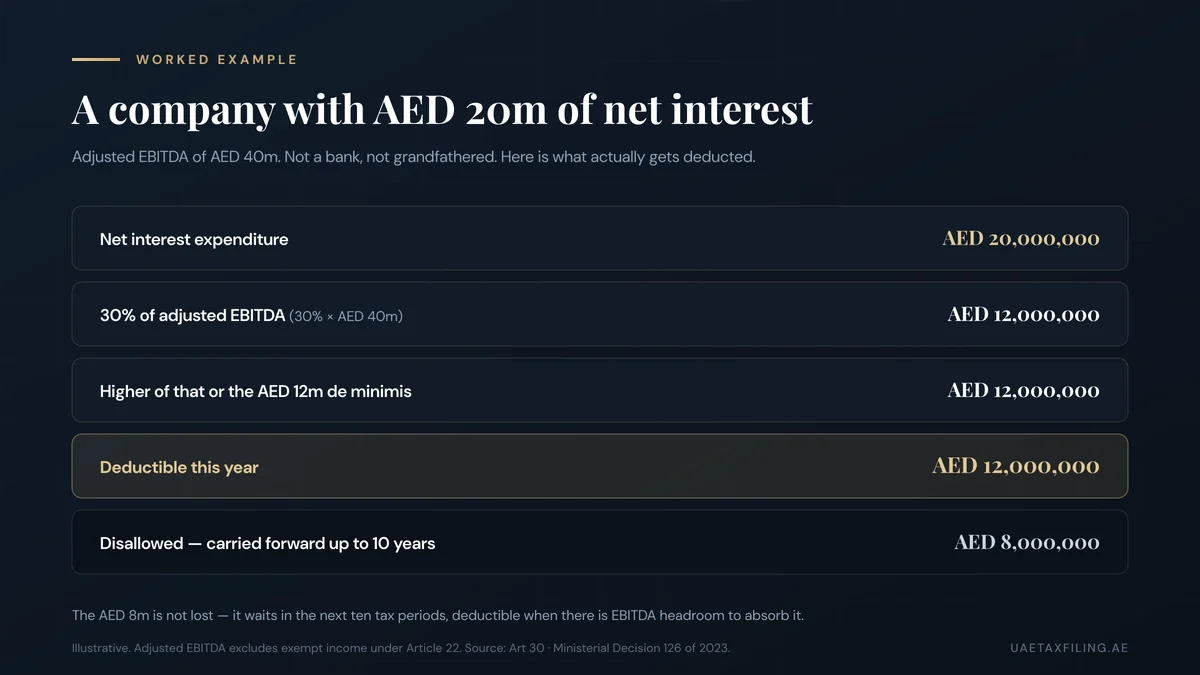
Here is a worked example. A company has AED 20 million of net interest expenditure and AED 40 million of adjusted EBITDA. It is not a bank, and none of its debt is grandfathered.
- Calculate 30% of EBITDA. 30% of AED 40 million is AED 12 million.
- Compare with the de minimis. The deductible amount is the higher of AED 12 million or that 30% figure. Here both are AED 12 million.
- Deduct up to the cap. The company deducts AED 12 million of interest this year.
- Disallow the excess. AED 20 million incurred minus AED 12 million deductible leaves AED 8 million disallowed.
- Carry it forward. That AED 8 million is not lost — it waits in the next ten tax periods.
Notice what happened: at AED 40 million of EBITDA, the 30% calculation produces exactly the AED 12 million de minimis, so the two tests converge. A company with higher EBITDA — say AED 60 million — would get 30% of AED 60 million, or AED 18 million, and could deduct more. The cap rewards earnings: the more you earn, the more interest you can carry.
Key takeaway: above AED 12 million of net interest, deduct 30% of adjusted EBITDA, disallow the rest, and carry the disallowed portion forward.
What happens to disallowed interest
Disallowed interest is carried forward, not forfeited. Article 30 lets a business deduct the disallowed net interest in the following ten tax periods, in the order it was incurred, subject to the same cap in each of those years.
This softens the rule considerably. In our worked example, the AED 8 million that was disallowed does not vanish — it becomes available in future years when the company has more EBITDA headroom to absorb it. A business that is heavily geared during a capital-intensive build-out, then earns strongly once the asset is operating, will often recover its early disallowed interest in the profitable years that follow. The rule defers the deduction; it does not usually destroy it.
The practical discipline is record-keeping. You have to track each year's disallowed amount and its age, because the ten-year clock runs separately for each tranche, and the oldest is used first. This is the kind of schedule that belongs in the same working papers as your IFRS financial statements and feeds straight into the Corporate Tax return.
Key takeaway: disallowed interest carries forward ten years and is deductible when EBITDA allows. Track each year's tranche by age; the oldest is relieved first.
Who is outside the rule
Some taxable persons are excluded from the interest deduction limitation rule entirely, regardless of how much interest they carry. Article 30(6) names them: a bank, an insurance provider, a natural person undertaking a business in the UAE, and any other person the Minister specifies.
The logic is that debt is the raw material of banking and insurance — capping their interest would misread how those businesses work — and that natural persons running a business are dealt with elsewhere in the regime. A licensed UAE bank with billions in interest expense is simply not subject to Article 30. A freelancer paying interest on a business loan is also outside it, because the rule targets juridical persons, not individuals in business.
There is also a carve-out for a Qualifying Infrastructure Project person under Ministerial Decision No. 126 of 2023, aimed at long-life public-interest assets financed with heavy long-term debt. That is a narrow relief with its own conditions, but it matters for the utilities, transport and social-infrastructure projects it was written for.
Key takeaway: banks, insurers and natural persons in business are outside the rule, and qualifying infrastructure projects have a dedicated carve-out.
Grandfathering: pre-9 December 2022 debt
Interest on debt entered into before 9 December 2022 is grandfathered out of the cap. That date is when the Corporate Tax Law was published, and Ministerial Decision No. 126 of 2023 protects financing arrangements that pre-date it from the interest limitation.
This is a real planning point for debt-heavy businesses. A company that took on a large shareholder or bank loan in early 2022, before anyone knew the final shape of the rules, does not have that interest dragged into the 30% cap. The relief attaches to the original arrangement, so the terms matter: where a pre-9-December-2022 facility included undrawn principal, only the amount the lender was legally obliged to advance at that date is grandfathered. Draw down more later on fresh terms, and the new money is inside the rule.
Key takeaway: financing in place before 9 December 2022 is grandfathered, but only to the extent of what the lender was already committed to advance. New drawdowns fall under the current rule.
The specific rule: Article 31
The specific interest deduction limitation rule is a separate, harsher anti-avoidance rule that can disallow related-party loan interest outright. Where the general rule in Article 30 caps the amount, Article 31 can deny the deduction entirely, with no de minimis and no carry-forward.
| Article 30 — general cap | Article 31 — specific rule | |
|---|---|---|
| What it does | Limits the amount deductible | Disallows the interest outright |
| Applies to | All net interest, any lender | Related-party loans only |
| Trigger | Net interest over AED 12m | Loan funds a distribution, buyback, contribution or acquisition |
| De minimis | AED 12m | None |
| Carry-forward | 10 tax periods | None — the deduction is denied |
| Escape | Higher EBITDA raises the cap | No tax motive, or lender taxed at 9%+ |
| Order | Applied second | Applied first |
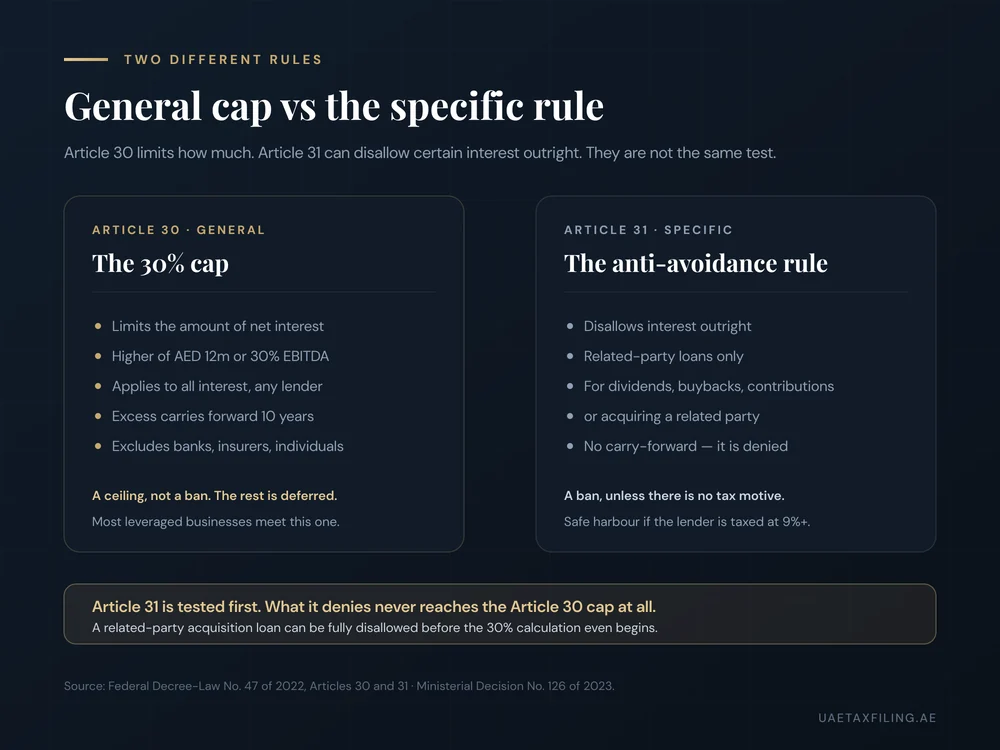
Article 31 targets interest on a loan obtained, directly or indirectly, from a related party where the money funds one of four things: a dividend or profit distribution to a related party, a redemption or reduction of share capital to a related party, a capital contribution to a related party, or the acquisition of an ownership interest in a person who is or becomes a related party. These are the classic debt-pushdown and profit-extraction structures, and the rule switches off their interest deduction.
There is a defence. The disallowance does not apply if the business can show the main purpose of the loan and the transaction was not to gain a Corporate Tax advantage. The law also gives a safe harbour: no tax advantage is deemed to arise where the related-party lender is subject to Corporate Tax — or a comparable foreign tax — on the interest at a rate of at least 9%. If the interest is being properly taxed in the lender's hands, the anti-avoidance concern falls away.
This rule matters most in group structures and real estate acquisitions funded by intra-group debt, where shareholder loans are common. It is tested before the Article 30 cap, so interest it denies never reaches the 30% calculation at all.
Key takeaway: related-party loan interest funding distributions, buybacks, contributions or acquisitions can be disallowed in full under Article 31, unless there is no tax motive or the lender is taxed at 9% or more.
How it works for tax groups
For a tax group, the interest deduction limitation rule is applied to the group as a single taxable person. A tax group files one Corporate Tax return, so the AED 12 million de minimis and the 30% EBITDA cap are tested on the group's consolidated figures, not company by company.
This cuts both ways. Grouping can help, because a subsidiary with high interest but low EBITDA can shelter under the group's combined earnings, using EBITDA generated elsewhere to lift the cap. But it can also hurt, because the single AED 12 million de minimis is shared across the whole group rather than available to each member separately — five companies that would each sit under AED 12 million on their own are tested on their combined net interest once grouped. The interaction with the wider deduction rules is exactly the kind of thing to model before electing to form a group, not after.
Key takeaway: a tax group is tested as one person, so it shares a single AED 12 million de minimis but can pool EBITDA to raise the cap. Model both effects before grouping.
Frequently asked questions
Does the interest deduction limitation rule apply to my small business?
Almost certainly not. The rule only engages once your net interest expenditure exceeds AED 12 million in a tax period. A typical SME paying interest on a normal business loan is far below that threshold, so the rule does not apply and its interest is fully deductible.
Is the AED 12 million threshold based on gross or net interest?
Net. You take your interest expense for the period and subtract your taxable interest income. Only if that net figure exceeds AED 12 million does the cap come into play, so businesses that also earn interest income test against the netted-down number.
What counts as EBITDA for the 30% cap?
Accounting earnings before interest, tax, depreciation and amortisation, adjusted to exclude any exempt income under Article 22 of the Corporate Tax Law. Exempt income such as qualifying dividends is stripped out, because you cannot deduct interest against income that is not being taxed.
What happens to interest I cannot deduct this year?
It is carried forward for up to ten tax periods and remains deductible in those years, subject to the cap in each one. Disallowed interest is deferred, not permanently lost, and the oldest disallowed amount is relieved first.
Are shareholder loans caught by the rule?
They can be caught by both rules. Interest on a shareholder loan counts toward the AED 12 million de minimis and the 30% cap under Article 30. Separately, if the shareholder loan funds a dividend, capital reduction, contribution or a related-party acquisition, Article 31 can disallow that interest outright.
Are banks and insurance companies subject to the cap?
No. Article 30(6) excludes banks and insurance providers from the general interest deduction limitation rule entirely, along with natural persons undertaking a business in the UAE. Debt is intrinsic to how banks and insurers operate, so capping their interest would not make sense.
Does the rule apply to loans I took out before Corporate Tax existed?
Interest on debt entered into before 9 December 2022 is grandfathered and sits outside the cap. The relief is limited to the principal the lender was already legally committed to advance at that date; amounts drawn down later on new terms fall under the current rule.
What is the difference between Article 30 and Article 31?
Article 30 is the general cap: it limits net interest to the higher of AED 12 million or 30% of EBITDA and carries the excess forward. Article 31 is a specific anti-avoidance rule: it disallows related-party loan interest used for distributions or acquisitions outright, with no cap and no carry-forward. Article 31 is applied first.
How does the de minimis work for a tax group?
A tax group is treated as a single taxable person, so it has one AED 12 million de minimis shared across all members and tests the 30% cap on consolidated EBITDA. Companies that would each be under the threshold alone can be pushed over it once their net interest is combined in a group.
Can I still be denied interest even if I am under AED 12 million?
Yes, through Article 31. The AED 12 million de minimis only switches off the general cap in Article 30. The specific rule on related-party loans has no de minimis, so interest on a related-party loan funding a distribution or acquisition can be disallowed even when your total net interest is small.
Not sure which rule catches you?
The interest deduction limitation rule is simple at the edges and awkward in the middle. If your net interest is under AED 12 million, you are out and can move on. If it is well above, you are into an EBITDA calculation, a carry-forward schedule, and the related-party question in Article 31 — and that is where a wrong assumption turns into a disallowed deduction the FTA can assess.
Send us three figures — your net interest for the year, your adjusted EBITDA, and whether any of your borrowing is from a related party — and we will tell you whether either rule bites and how much interest you can actually deduct. If the numbers need a full working, we will match you with an FTA-registered partner agency that prepares it and files the return around it. Message the team on WhatsApp using the button below, or see how the filing itself works on our Corporate Tax return filing service page.
Last reviewed on 12 August 2026 by Jazim, CEO of UAE Tax Filing LLC, Dubai. Methodology: every threshold and rule in this article was verified against the published text of Federal Decree-Law No. 47 of 2022 (Articles 30 and 31) and Ministerial Decision No. 126 of 2023 on the General Interest Deduction Limitation Rule. UAE Tax Filing LLC is a matching platform and is not an FTA-registered tax agent; calculations and filings are performed by the licensed partner firms we connect you with. This article is general guidance and is not a substitute for advice on your own facts.