Last updated: 8 September 2026 · Written by the UAE Tax Filing editorial team · Reviewed by Jazim, CEO, UAE Tax Filing LLC (Dubai) · 12 min read
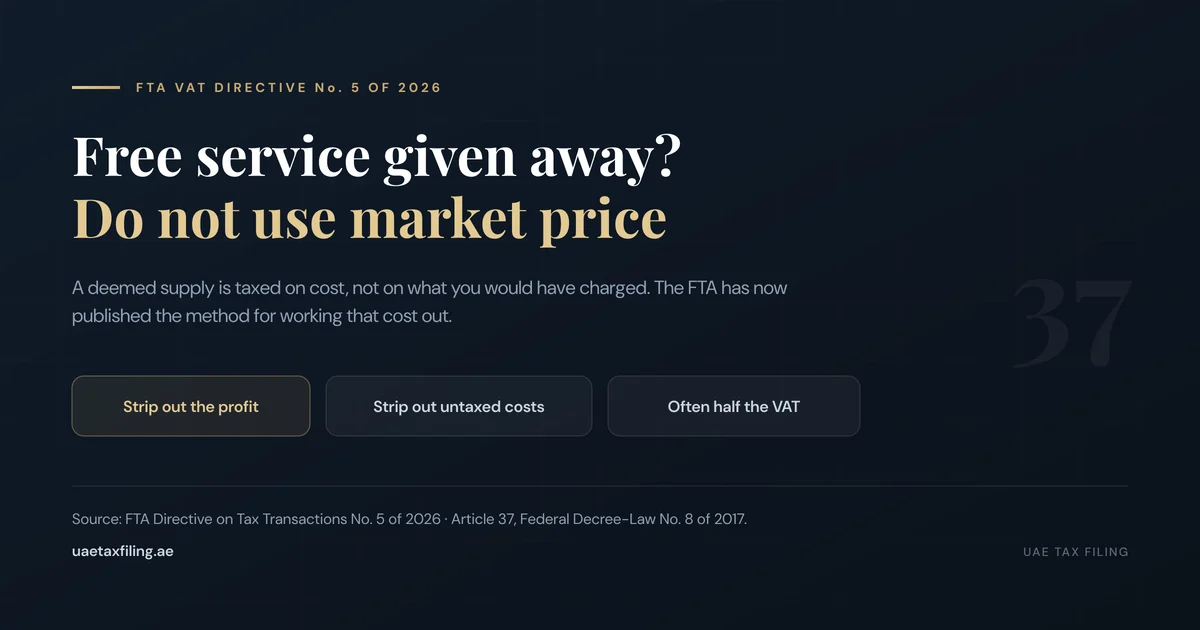
A deemed supply of services is valued at the cost you incurred to provide it, not at the price you would have charged. FTA Directive No. 5 of 2026 sets out how to reach that cost: take the open market value, divide it by one plus your net profit margin, then apply the share of your costs that carried input tax. On a service worth AED 100,000, that can halve the VAT.
Almost every business that gives a service away accounts for VAT on the market price. That is the intuitive answer and it is the wrong one — it taxes profit you never earned, and costs that never carried input tax in the first place.
The short version
- The rule: Article 37 of the VAT Law values a deemed supply at the total cost incurred to make it — never at the selling price.
- The problem it solves: for services, that cost is rarely traceable to an invoice, so the FTA has published a method.
- Step one strips profit: divide the open market value by (1 + net profit margin), taken from last year’s financial statements.
- Step two strips untaxed costs: apply the percentage of your prior-year costs that actually carried input tax.
- The effect is material. At a 20% margin with 60% of costs input-taxed, VAT on a AED 100,000 service is AED 2,500 — half the AED 5,000 the market price implies.
What this covers
- What a deemed supply is
- Why cost, not market price
- The four-step method
- A worked calculation
- How much your numbers move it
- Services versus goods
- Putting it into practice
- Common mistakes
- Frequently asked questions
What a deemed supply is
A deemed supply is a transaction the VAT law treats as a taxable supply even though no consideration changed hands. It exists to stop input tax being recovered on something that is then consumed outside the business without any output tax ever being accounted for.

The everyday situations are familiar even where the label is not. A consultancy writes off a block of advisory hours for a prospective client. A firm provides services to its own staff free of charge. A business uses its own service capacity for a private purpose. In each case the business recovered input tax on the costs behind that service, and no invoice was ever raised — so VAT is due on a deemed basis. The same logic applies on deregistration to assets you keep, which is why our VAT deregistration guide deals with it too.
One condition sits underneath all of it, and it is worth stating plainly: a deemed supply arises because input tax was recovered on the underlying costs. Where no input tax was ever claimed, the mechanism has nothing to reverse. That is why the calculation later strips out costs that never carried input tax — the two ideas are the same principle applied at different stages. It is also why a service delivered almost entirely by salaried staff produces a much smaller deemed supply than one delivered through subcontractors, even where both would have been billed at the same price.
Key takeaway: A deemed supply is a supply without consideration that still attracts VAT, because input tax was recovered on the underlying costs. Giving something away does not remove the VAT — it changes how the VAT is measured.
Why cost, not market price
Article 37 of Federal Decree-Law No. 8 of 2017 values a deemed supply at the total cost incurred to make that supply. That is a deliberate choice: the purpose is to reverse the input tax recovered, not to tax a sale that never happened.
The distinction has real money attached. If you would have charged a client AED 100,000 for a piece of work, that price contains your profit margin and it contains costs that never carried input tax — salaries being the largest, since employment costs are outside the scope of VAT. Taxing the AED 100,000 would collect VAT on both. The law asks only that you give back what you took, which is the VAT on the input-taxed costs actually consumed.
Key takeaway: A deemed supply is taxed on cost because the point is to reverse recovered input tax, not to tax an imaginary sale. Using the market price overstates the liability on two counts at once.
The four-step method
FTA Directive No. 5 of 2026 gives taxable persons a defined mechanism for calculating the total costs on which input tax was incurred, where the deemed supply is a service. There are four steps and each strips something out.
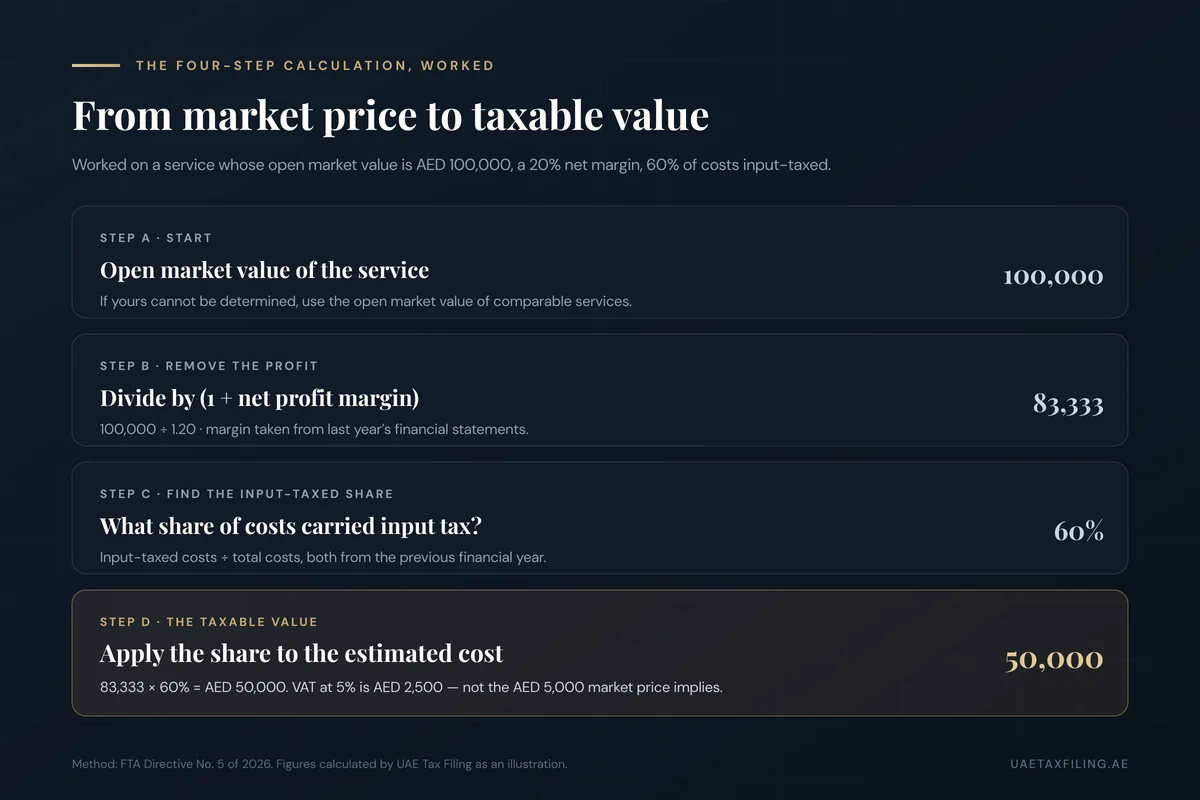
First, determine the open market value of the services constituting the deemed supply; where that cannot be determined, the open market value of comparable services is used. Second, calculate the estimated total cost by excluding the profit element — done by dividing the open market value by one plus the net profit margin, with that margin taken from the taxable person’s financial statements for the preceding financial year. Where the person’s own margin cannot be determined, the average net profit margin prevailing in their sector may be used.
Third, calculate the percentage that costs carrying input tax represent of the total costs incurred during the previous financial year. Fourth, apply that percentage to the estimated total cost from step two. The result is the total costs on which input tax was incurred, and that figure is the value of the deemed supply.
Key takeaway: Start from open market value, divide by one plus your net margin to remove profit, then multiply by your input-taxed cost ratio to remove costs that never bore VAT. What remains is the taxable value.
A worked calculation
The method is easier to trust once you put numbers through it. Take a professional service whose open market value is AED 100,000, provided by a business with a 20% net profit margin, where 60% of last year’s costs carried input tax.
- Open market value: AED 100,000.
- Remove the profit: 100,000 ÷ 1.20 = AED 83,333 estimated total cost.
- Input-taxed share of costs: 60%, from the prior year’s accounts.
- Taxable value: 83,333 × 60% = AED 50,000.
- VAT at 5%: AED 2,500.
Account for that same service at market price and you declare AED 5,000. The correct method produces AED 2,500. On one engagement that is a rounding error; run it across a year of written-off hours and it is a real overpayment.
Both reductions matter and they compound. Removing the profit took AED 16,667 out of the base. Removing the costs that never carried input tax — principally payroll — took out a further AED 33,333. Neither alone gets you to the right answer.
Key takeaway: On a AED 100,000 service at a 20% margin with 60% input-taxed costs, the deemed supply value is AED 50,000 and the VAT AED 2,500 — half what the market price would suggest.
If you have been accounting for free-of-charge services at market value, the gap is worth quantifying before your next return. Send us your margin and cost split and we will work the correct figure with you, then match you with an FTA-registered partner agency to handle the filing and any correction. Message the team on WhatsApp below.
How much your numbers move it
The taxable value is driven by two inputs from your own accounts: the net profit margin and the share of costs that carried input tax. They pull in opposite directions.
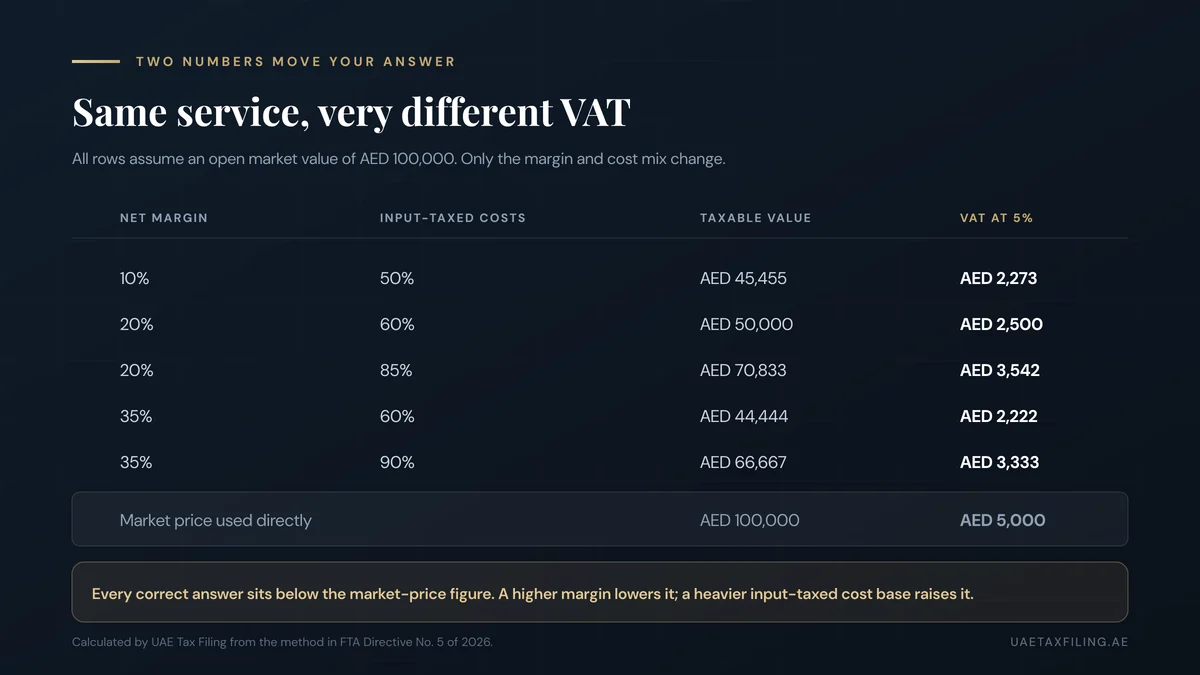
| Net profit margin | Costs carrying input tax | Taxable value | VAT at 5% |
|---|---|---|---|
| 10% | 50% | AED 45,455 | AED 2,273 |
| 20% | 60% | AED 50,000 | AED 2,500 |
| 20% | 85% | AED 70,833 | AED 3,542 |
| 35% | 60% | AED 44,444 | AED 2,222 |
| 35% | 90% | AED 66,667 | AED 3,333 |
| Market price used directly | AED 100,000 | AED 5,000 | |
We calculated every row above from the directive’s own formula on a constant open market value of AED 100,000. Two patterns stand out. A higher margin lowers the taxable value, because more of the market price is profit being stripped out. A heavier input-taxed cost base raises it, because more of what you spent actually carried VAT. A labour-heavy consultancy therefore lands far lower than a business that buys in most of its delivery.
Key takeaway: Margin and cost mix are the only variables. Firms with high margins and heavy payroll produce the lowest deemed-supply VAT; firms that subcontract most delivery produce the highest.
Services versus goods
This directive addresses deemed supplies of services, and that limitation is the reason it exists. For goods, the cost incurred is normally traceable directly to a purchase invoice, so Article 37 can be applied without any estimation.
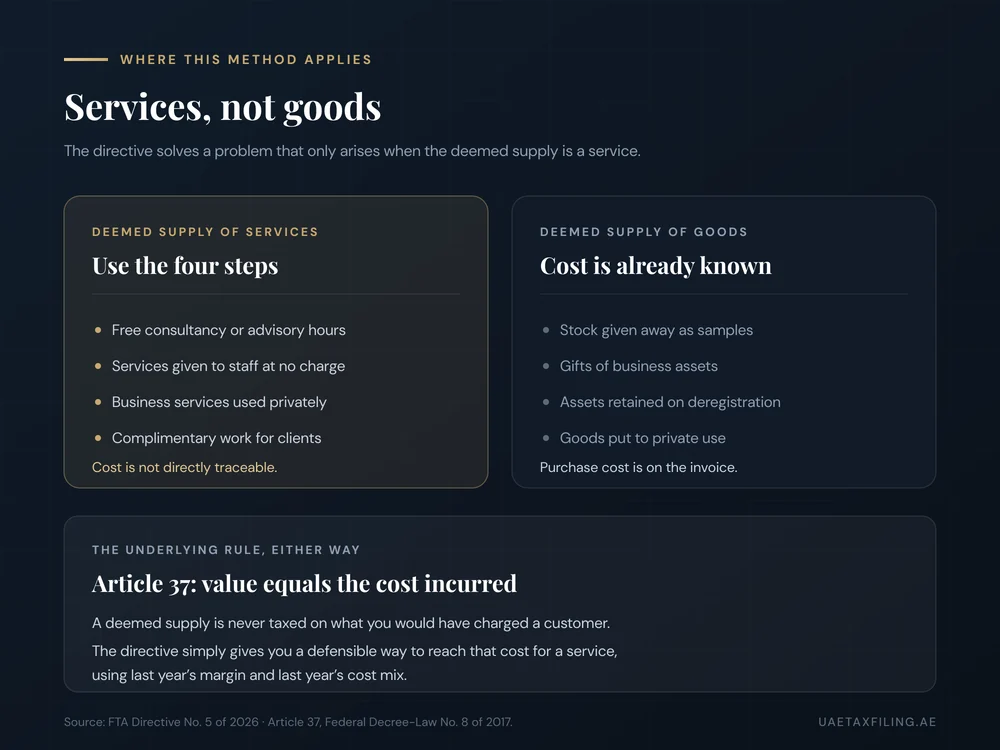
Give away a stock item and you know what it cost you. Give away twenty hours of senior advisory time and you do not — the cost is buried in payroll, overheads, software licences and premises, most of which are consumed across many engagements at once. The four-step method is an apportionment tool for exactly that situation, and it uses prior-year figures precisely because those are the only reliable cost data available at the time you file.
Key takeaway: Use the four-step method for services. For goods, take the cost from the purchase invoice, since no estimation is required to apply Article 37.
Putting it into practice
Turning this into a repeatable process is mostly about preparing two figures once a year, then applying them whenever a deemed supply arises. It is a five-minute calculation once the inputs exist.
- Pull last year’s net profit margin from the financial statements. If you cannot determine it, identify a defensible sector average and record where it came from.
- Calculate the input-taxed cost ratio. Divide costs that carried input tax by total costs for the previous financial year.
- Record both figures in your VAT working papers at the start of the year, so every deemed supply uses the same, evidenced basis.
- Log free-of-charge services as they happen with an open market value, rather than reconstructing them at year end.
- Run the calculation for each one: market value, divide by one plus margin, multiply by the ratio.
- Account for the output tax in the correct return period, alongside your other adjustments — our guide to filing the quarterly VAT return covers where these entries sit.
- Keep the workings. The margin, the ratio and their source accounts are what make the figure defensible on review.
Step four is the one that fails in practice. Free work is rarely recorded anywhere in the finance system precisely because no invoice is raised, so it surfaces only when someone remembers it. A simple log of complimentary engagements, maintained by whoever approves them, is worth more than any amount of year-end reconstruction. Those workings also fall under the ordinary retention rules set out in our guide to record-keeping requirements.
Key takeaway: Fix your margin and input-taxed cost ratio once a year, log free services as they occur, then apply the formula per event. The hard part is capturing the event, not doing the arithmetic.
Common mistakes
The errors here cost money in both directions, and most stem from reaching for the invoice price out of habit.
Five recur. First, using the market price as the taxable amount, which overstates VAT by taxing profit and untaxed costs. Second, applying only one of the two reductions — stripping profit but forgetting the input-taxed ratio, or the reverse. Third, using current-year figures when the directive points to the preceding financial year. Fourth, not recording free services at all, which understates VAT and is the version that attracts penalties under the 2026 VAT penalty regime. Fifth, treating the deregistration deemed supply the same way, when assets retained on deregistration are goods with a known cost — a point our VAT registration guide touches on.
Key takeaway: Overpayment comes from using market price; underpayment comes from never logging the service at all. Both are avoidable with two prior-year figures and a simple log.
Frequently asked questions
How is a deemed supply of services valued for UAE VAT?
At the total costs on which input tax was incurred to make the supply, under Article 37 of the VAT Law. FTA Directive No. 5 of 2026 sets the method: take the open market value, divide by one plus the net profit margin to remove profit, then apply the percentage of costs that carried input tax.
Why can I not just use the price I would have charged?
Because that price includes profit you did not earn and costs that never carried input tax, principally salaries. The purpose of a deemed supply is to reverse input tax you recovered, not to tax a sale that never took place, so the taxable amount is cost rather than price.
Which year’s figures do I use for the margin?
The preceding financial year. The directive specifies that the net profit margin is calculated from the taxable person’s financial statements for the previous financial year, and the input-taxed cost percentage is likewise based on costs incurred during that year.
What if I cannot determine my own net profit margin?
The directive allows the average net profit margin prevailing in the sector in which the taxable person carries on business to be used instead. Document which sector benchmark you applied and why your own margin could not be determined.
What if there is no open market value for the service?
Where the open market value of the services constituting the deemed supply cannot be determined, the open market value of comparable services is used as the starting point. The remaining steps of the calculation are unchanged.
Does this apply to deemed supplies of goods?
No. The directive addresses the method for services, where cost is not directly traceable. For goods the cost incurred is normally on the purchase invoice, so Article 37 can be applied directly without the estimation mechanism.
Do salaries count in the calculation?
They form part of total costs but not of the costs carrying input tax, since employment costs do not attract VAT. That is precisely why the input-taxed percentage is applied: it removes payroll and other non-taxed costs from the taxable base.
Where do I report the output tax?
As output tax in the VAT return for the period in which the deemed supply occurs, alongside your other supplies. Keep the calculation, the margin and the cost ratio in your working papers so the figure can be substantiated if the Authority reviews it.
How we verified this: the four-step mechanism, the divide-by-(1 + net profit margin) step, the sector-average fallback, the comparable-services fallback and the prior-financial-year basis are taken from the Federal Tax Authority’s Directive on Tax Transactions No. 5 of 2026 for Value Added Tax, “Method to Determine the Value of Deemed Supplies of Services” (July 2026), which we extracted directly from the Authority’s bilingual PDF rather than relying on secondary summaries. The underlying valuation rule is Article 37 of Federal Decree-Law No. 8 of 2017. All monetary figures in the worked example and the sensitivity table were calculated by UAE Tax Filing by applying that method to a constant open market value of AED 100,000, and are illustrations rather than published FTA figures. The directive is listed on the FTA legislation page; the VAT law itself is in the VAT Decree-Law. This article is general information, not tax advice.
Last updated: 8 September 2026 · Reviewed by Jazim, CEO, UAE Tax Filing LLC (Dubai)