Last updated: 1 September 2026 · Written by the UAE Tax Filing editorial team · Reviewed by Jazim, CEO, UAE Tax Filing LLC (Dubai) · 12 min read
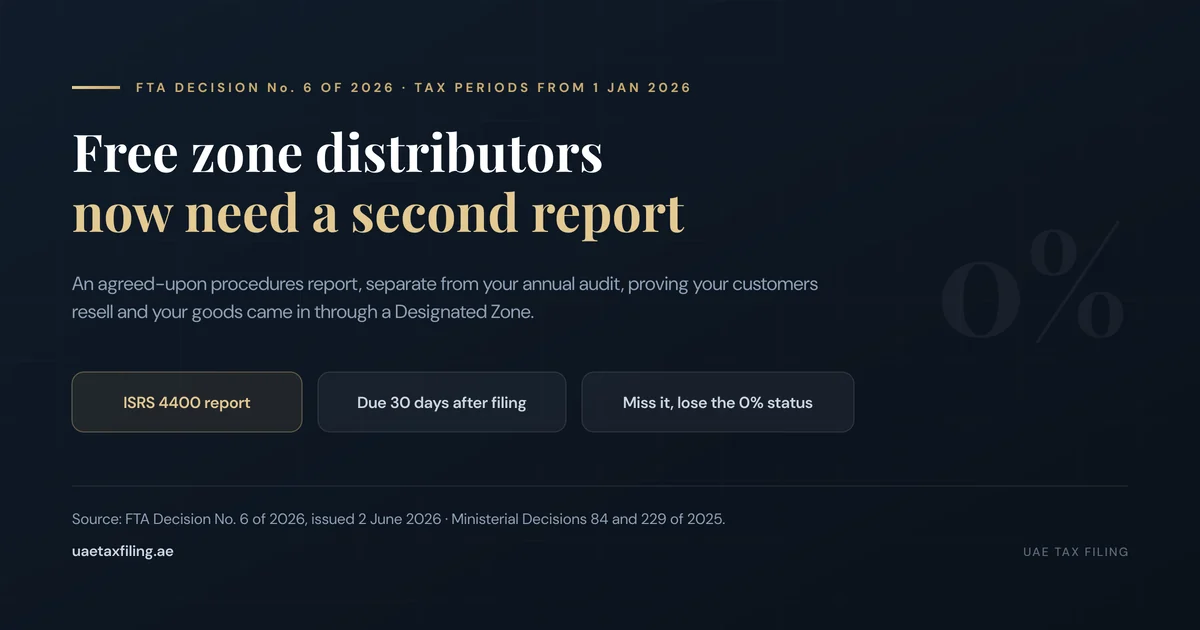
Qualifying Free Zone Persons that distribute goods in or from a Designated Zone must now obtain an agreed-upon procedures report from an independent auditor and submit it to the FTA within 30 days of their Corporate Tax return deadline. FTA Decision No. 6 of 2026 applies to tax periods starting on or after 1 January 2026. Miss it, and the distribution activity stops counting as a Qualifying Activity.
This is not part of your annual audit. It is a separate ISRS 4400 engagement with its own scope, its own sampling, and its own deadline — and the evidence it tests has to be collected while the tax period is still running.
The short version
- Who is caught: a Qualifying Free Zone Person performing the Qualifying Activity of distributing goods or materials in or from a Designated Zone.
- What is required: an agreed-upon procedures report under ISRS 4400, from your statutory auditor or another auditor licensed in the UAE.
- What it must prove: that your customers resell the goods, and that goods you imported entered the country through a Designated Zone.
- When it is due: no later than 30 days after the deadline for filing the Corporate Tax return for that period.
- What happens if you skip it: the conditions in Ministerial Decisions 84 and 229 of 2025 are treated as not met — which puts the 0% rate on that income at risk.
What this covers
- What Decision 6 of 2026 requires
- Whether it applies to you
- Proving your customers are resellers
- Proving import through a Designated Zone
- How many documents get sampled
- The deadline and what failure costs
- How to prepare
- Common mistakes
- Frequently asked questions
What Decision 6 of 2026 requires
FTA Decision No. 6 of 2026 is an additional compliance obligation requiring certain Qualifying Free Zone Persons to obtain an independent agreed-upon procedures report evidencing that their distribution activity genuinely qualifies. It was issued on 2 June 2026 and applies to tax periods commencing on or after 1 January 2026.

The report must be prepared by the independent external auditor who audits your financial statements, or another auditor licensed in the State, in accordance with the International Standard on Related Services (ISRS) 4400, Agreed-Upon Procedures Engagements, issued by the IAASB. That distinction matters commercially: an agreed-upon procedures engagement is not an audit and gives no opinion. The auditor performs defined procedures and reports factual findings. Your existing audit fee does not cover it, and your audited financial statements do not satisfy it.
Key takeaway: Decision 6 of 2026 adds a standalone ISRS 4400 report on top of the annual audit for free zone distributors, testing whether the distribution activity actually meets its qualifying conditions.
Whether it applies to you
The decision applies where three things are true at once: you are a Qualifying Free Zone Person, you carry on the activity of distributing goods or materials, and that distribution happens in or from a Designated Zone. If any of the three is absent, the obligation does not reach you.
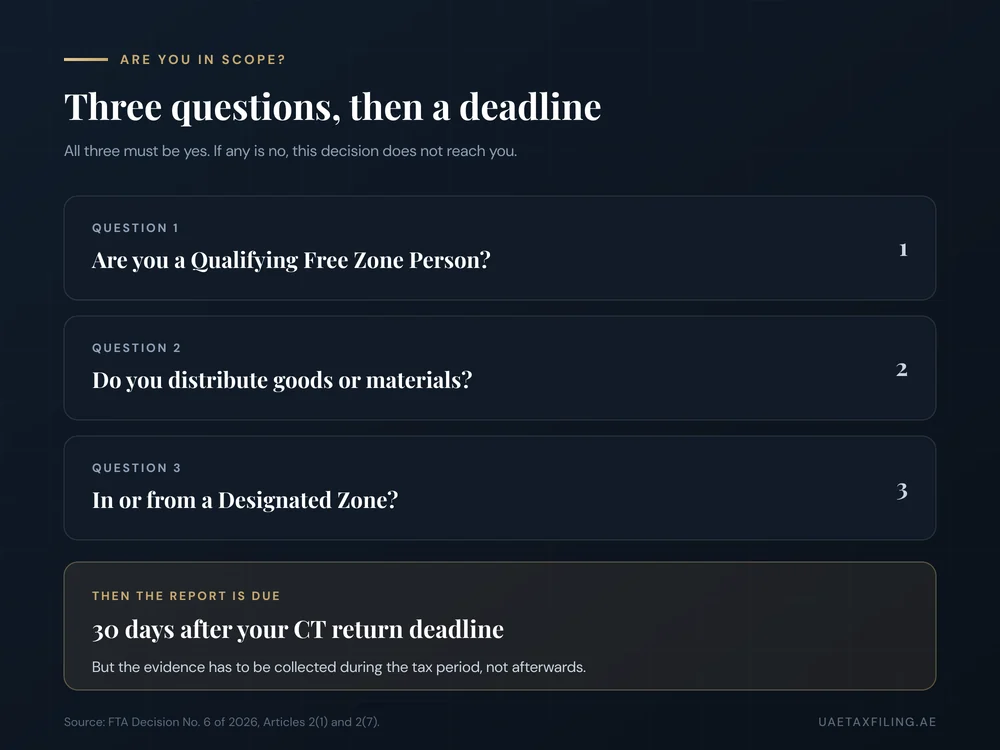
The activity in question is the Qualifying Activity described at paragraph (l) of Article 2(1) of Ministerial Decision No. 229 of 2025. A free zone company selling services, or manufacturing without a distribution activity, is outside this particular decision — though every other qualifying condition still applies to it. If you are still working out whether you meet the underlying test, our guide to qualifying for the 0% free zone rate covers the conditions in full, and the concept of a Designated Zone itself is explained in our Designated Zones guide.
Key takeaway: You need the report only if you are a QFZP distributing goods in or from a Designated Zone. Free zone service businesses and non-distributors are unaffected by this decision.
Proving your customers are resellers
The first thing the report must demonstrate is that you supply goods or materials to customers who resell them — or who process or alter them for the purpose of sale or resale. This is the substance of the distribution Qualifying Activity, and it is now something an auditor must test rather than something you assert.
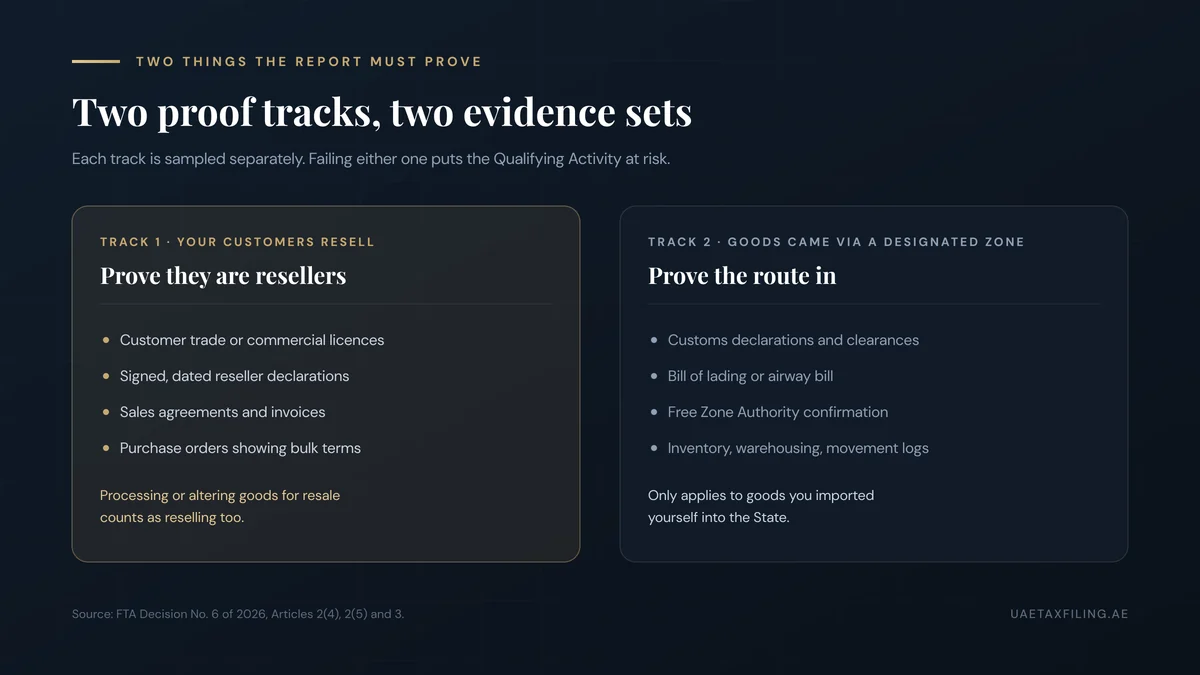
Decision 6 names the documentation you must collect, maintain and retain. It includes valid business, trade or commercial licences held by the customer whose listed activities indicate reselling; signed declarations or written confirmations from customers confirming the goods are acquired for sale or resale, or for donation to a public benefit entity; and sales agreements, invoices, purchase orders or other transactional records that collectively show onward supply. The auditor then inspects a sample of licences, a sample of declarations, and a sample of agreements, and reports factual findings on each.
The declarations are the pinch point. They must be signed, dated, and relate to the relevant tax period. A confirmation collected in 2028 about 2026 purchases does not satisfy a procedure that asks whether the declaration relates to the period under review.
Key takeaway: Collect reseller declarations that are signed, dated and tied to the tax period, alongside customer trade licences showing trading or distribution activities. Retrospective confirmations will not carry the same weight.
Proving import through a Designated Zone
The second track applies only where you imported the goods yourself: the report must show that goods or materials entering the State were imported through a Designated Zone. Where you buy locally rather than import, this limb does not engage.
Three procedures run here. The auditor inspects import documentation — customs declarations, import permits, sales contracts, bills of lading — to verify entry through a Designated Zone. Separately, the auditor confirms that the free zone, port or area named in that documentation is formally designated as a Designated Zone under the relevant Cabinet Decisions, and the decision states this should be confirmed by the relevant Free Zone Authority to you. Finally, the auditor inspects internal records: inventory logs, warehousing reports, goods movement records and logistics documentation, to verify the goods were received, handled or stored within a Designated Zone before distribution.
The third procedure is the one that catches people. It is not enough that the paperwork says Designated Zone — your own inventory and warehousing records have to corroborate that the goods were physically there.
Key takeaway: Import evidence runs on three levels: customs paperwork, formal confirmation of the zone’s designated status, and your internal stock records showing the goods actually passed through it.
If you distribute from a Designated Zone and have not yet spoken to your auditor about this engagement, send us your tax period end date and customer count — we will tell you what the sample size will be and what evidence you still need, then match you with an FTA-registered partner agency to run it. Message the team on WhatsApp below.
How many documents get sampled
The number of documents the auditor reviews is fixed by a formula, not by negotiation. Article 3(3) of the decision sets the sample size as the sample population divided by one plus the population multiplied by the margin of error squared, and Article 3(4)(c) fixes the margin of error at 10%.
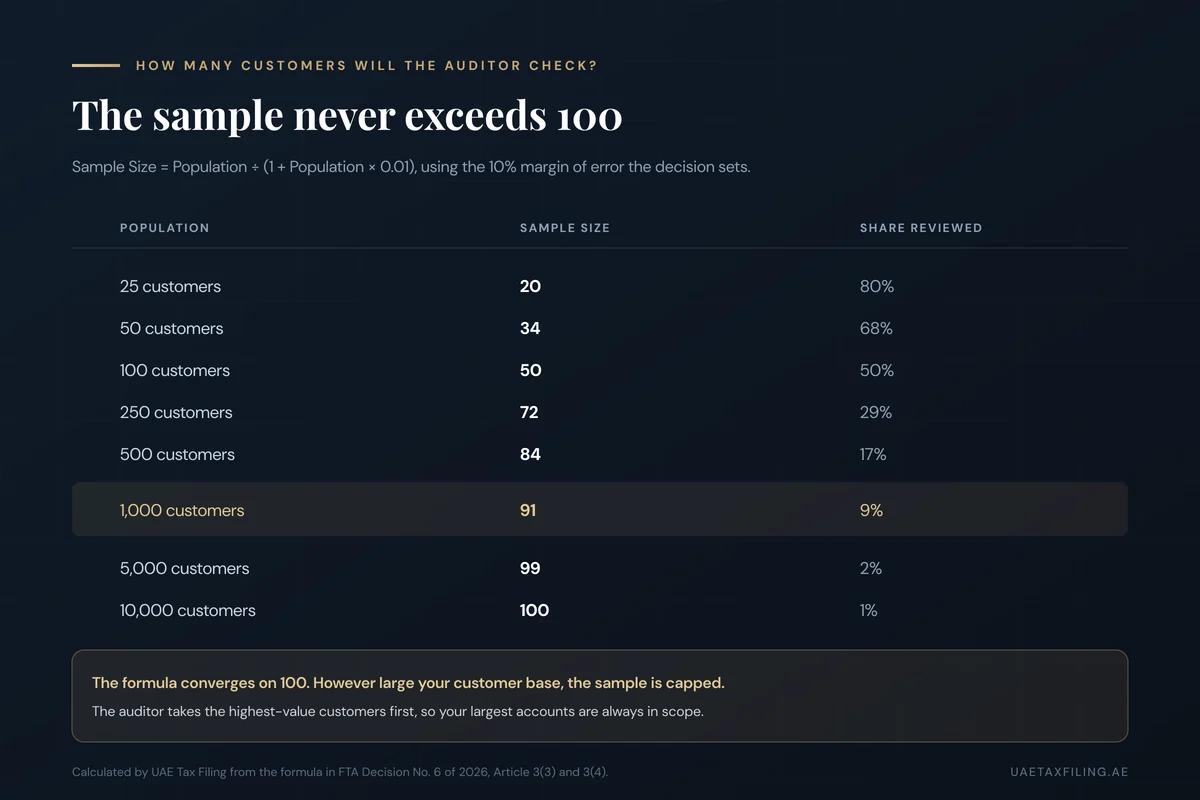
| Sample population | Sample size | Share reviewed |
|---|---|---|
| 25 | 20 | 80% |
| 50 | 34 | 68% |
| 100 | 50 | 50% |
| 250 | 72 | 29% |
| 500 | 84 | 17% |
| 1,000 | 91 | 9% |
| 10,000 | 100 | 1% |
We calculated the table above directly from the formula in the decision. It produces a result worth knowing before you budget: the sample converges on 100 and never exceeds it, however large your customer base. A distributor with 250 customers has 72 sampled; one with 10,000 has 100. The compliance cost therefore scales with your smallest populations, not your largest — and the auditor selects the customers, agreements or imports with the highest transaction values first, so your major accounts are always inside the sample regardless.
Key takeaway: Sample size follows a fixed formula with a 10% margin of error and tops out near 100 documents. Your largest customers are always tested, because selection is by transaction value.
The deadline and what failure costs
The agreed-upon procedures report must be submitted to the Authority no later than 30 days after the deadline for filing the Corporate Tax return for the relevant tax period, or another date the Authority determines. The consequence of not submitting it is unusual, and more serious than a fixed fine.
Article 2(8) states that where the report is not submitted, the conditions in Article 2(3) of Ministerial Decision No. 84 of 2025 and paragraph (l) of Article 2(1) of Ministerial Decision No. 229 of 2025 “shall not be considered to be met”. In plain terms: the distribution activity stops being treated as a Qualifying Activity. Income you expected to fall under the 0% rate is exposed, which for a distributor of any scale dwarfs any administrative penalty. Our guide to 2026 Corporate Tax deadlines sets out the filing dates this 30-day window hangs off.
Key takeaway: The report is due 30 days after your Corporate Tax filing deadline, and failing to submit it means the qualifying conditions are deemed unmet — a risk to the 0% rate itself, not merely a penalty.
How to prepare
Preparing for this obligation is largely an evidence-collection exercise that must run during the tax period, because several of the tested documents cannot be created convincingly after the fact.
- Confirm you are in scope. QFZP, distributing goods or materials, in or from a Designated Zone. If yes, the obligation applies from the tax period starting on or after 1 January 2026.
- Appoint the auditor for the engagement. It can be your statutory auditor or another licensed auditor, but it is a separate ISRS 4400 engagement and needs its own scope and fee.
- Collect customer trade licences and check the listed activities include trading, wholesaling, retailing, distributing or manufacturing.
- Get reseller declarations signed and dated during the period, referencing that period, from your highest-value customers first.
- Assemble import evidence — customs declarations, bills of lading, and written confirmation from the Free Zone Authority that the zone is a Designated Zone.
- Tidy internal stock records so inventory logs, warehousing reports and movement records corroborate physical presence in the zone.
- Calculate your expected sample from the formula and pre-assemble those files, working down from your largest accounts.
Step four is where the work concentrates. Chasing signed declarations from customers is slow, and the customers least likely to respond are usually the ones you deal with least often — which is precisely why working down from the highest transaction values pays off. The documents you gather here also fall under the ordinary retention rules; our guide to record-keeping requirements covers how long each category must survive.
Key takeaway: Start with the scope test, then collect declarations and licences from your highest-value customers during the period. The formula tells you how many files you actually need, so pre-assemble exactly that set.
Common mistakes
The errors here are ones of assumption — treating a new, standalone obligation as an extension of something familiar.
Four recur. First, assuming the annual audit covers it, when ISRS 4400 is a different engagement producing factual findings rather than an opinion. Second, collecting reseller declarations after year end, when the procedure asks whether they relate to the tax period. Third, relying on customs paperwork alone for the import track, when internal inventory and warehousing records are separately tested. Fourth, treating the deadline as the return date, when it is 30 days later — a gap that is easy to lose track of. Whether the free zone route remains the right structure at all is a wider question covered in our comparison of free zone versus mainland.
Key takeaway: The report is separate from the audit, the evidence is time-bound to the period, and the deadline sits 30 days past your filing date. Each mistake here is an assumption rather than an oversight.
Frequently asked questions
Who has to obtain the agreed-upon procedures report?
A Qualifying Free Zone Person engaged in the Qualifying Activity of distributing goods or materials in or from a Designated Zone, under paragraph (l) of Article 2(1) of Ministerial Decision No. 229 of 2025. Free zone businesses that do not carry on that distribution activity are outside this decision.
Can my existing auditor prepare it?
Yes. The decision allows the independent external auditor responsible for the annual audit of your financial statements, or any other independent auditor licensed in the State. It must be performed under ISRS 4400 as a separate agreed-upon procedures engagement, so expect a separate scope and fee.
When is the report due?
No later than thirty days following the deadline to file the Corporate Tax return for the relevant tax period, or such other date as the Authority determines. Because it hangs off the filing deadline rather than the period end, it is easy to overlook once the return itself has been submitted.
What happens if we do not submit it?
Article 2(8) provides that the conditions in Ministerial Decision No. 84 of 2025 and paragraph (l) of Ministerial Decision No. 229 of 2025 shall not be considered to be met. The practical effect is that the distribution activity is no longer treated as qualifying, which puts the 0% treatment of that income at risk.
How is the sample size calculated?
Sample size equals the sample population divided by one plus the population multiplied by the margin of error squared, with the margin of error fixed at 10%. Worked through, that gives 50 samples from 100 customers, 91 from 1,000, and 100 from 10,000 — the figure converges on 100 and does not exceed it.
Which customers does the auditor pick?
The ones with the highest distribution transaction values in the relevant tax period. The decision specifies this for each sampling procedure, so your largest accounts are always inside the sample. Preparing files in descending order of value therefore matches how the testing will run.
Does the import limb apply if we buy goods locally?
The import procedures address goods or materials entering the State that were imported by the Qualifying Free Zone Person. Where you did not import the goods yourself, that limb does not engage, though the reseller-status evidence for your customers is still required.
What if a customer processes the goods rather than reselling them as-is?
That still counts. The decision refers to customers who resell the goods or materials, or parts of them, or who process or alter them for the purposes of sale or resale. Value-added processing before onward sale does not break the qualifying distribution chain.
Do the procedures have to be worded exactly as written?
Broadly yes, but there is flexibility. Where changes are made to the specific wording of a procedure without changing the substance of the requirement, those changes should be included as an appendix to the report. Details of the samples selected must also be included in an appendix.
How we verified this: every requirement, procedure, threshold and deadline above is taken from Federal Tax Authority Decision No. 6 of 2026 on determining the additional procedures for the compliance of Qualifying Free Zone Persons engaged in the activity of distribution of goods or materials in or from a Designated Zone, issued 2 June 2026 and applying to tax periods commencing on or after 1 January 2026. We extracted Articles 1 to 6 directly from the Authority’s published PDF rather than relying on secondary summaries; the text is an unofficial translation. The sample-size table was calculated by us from the formula in Article 3(3) using the 10% margin of error fixed by Article 3(4)(c). The decision cross-refers to Cabinet Decision No. 100 of 2023 and Ministerial Decisions No. 84 and No. 229 of 2025. Confirm the current position on the FTA legislation page and in the FTA Corporate Tax section. This article is general information, not tax advice.
Last updated: 1 September 2026 · Reviewed by Jazim, CEO, UAE Tax Filing LLC (Dubai)