Last updated: 30 August 2026 · Written by the UAE Tax Filing editorial team · Reviewed by Jazim, CEO, UAE Tax Filing LLC (Dubai) · 12 min read
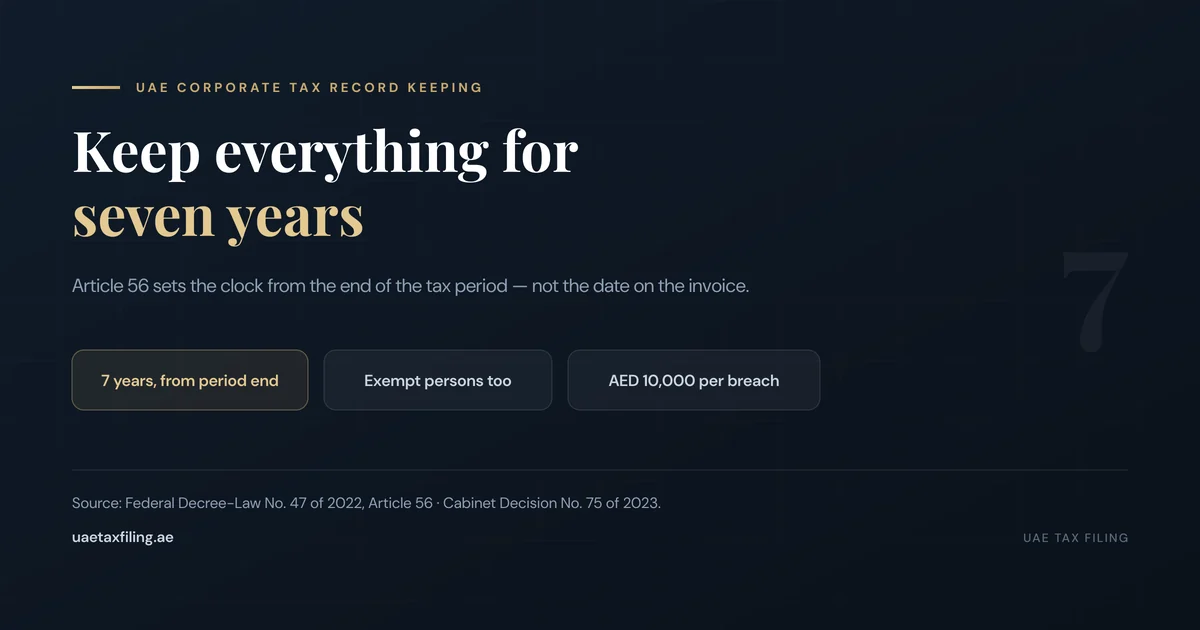
UAE Corporate Tax record-keeping requires every taxable person to keep all records and documents supporting a tax return for seven years following the end of the tax period they relate to. Exempt persons carry the same seven-year duty for records proving their exempt status. Failure to keep them costs AED 10,000 per violation, and AED 20,000 for a repeat within 24 months.
Most businesses read Article 56, see “seven years”, and file it away. The two details that actually catch people are that the clock starts at the end of the tax period rather than the invoice date, and that the Authority can demand your records in Arabic — a separate fine most firms have never budgeted for.
The short version
- Seven years, from period end. Article 56 of Federal Decree-Law No. 47 of 2022 sets the retention period, counted from the end of the tax period the record belongs to.
- Exempt persons are not excused. Article 56(2) requires them to keep records proving their exempt status for the same seven years.
- Your revenue picks the accounting standard. IFRS is the default; IFRS for SMEs is available up to AED 50 million revenue; cash basis up to AED 3 million.
- Two separate fines exist. AED 10,000 for failing to keep records (AED 20,000 on repeat), plus AED 5,000 for failing to produce records in Arabic when the Authority asks.
- Records must prove the return, not just exist. The legal test is whether the FTA can readily ascertain your taxable income from them.
What this covers
- How long you must keep records
- Which records you actually have to keep
- Exempt persons keep records too
- Which accounting standard applies to you
- The Arabic-language rule nobody budgets for
- What poor records cost
- Setting up a compliant system
- Common mistakes
- Frequently asked questions
How long you must keep records
The retention period for UAE Corporate Tax records is seven years from the end of the tax period to which the records relate. Article 56(1) of the Corporate Tax Law states that a taxable person shall maintain all records and documents “for a period of (7) seven years following the end of the Tax Period to which they relate”.

That wording matters more than the number. The clock does not start when the invoice is dated; it starts when the tax period closes. An invoice raised in March 2024, inside a financial year ending 31 December 2024, must survive until 31 December 2031 — nearly eight years after it was issued. Businesses that purge on a rolling “seven years from the document date” rule delete records while they are still legally required.
Key takeaway: Keep records for seven years counted from the end of the relevant tax period, not from the date on the document. In practice that means budgeting for close to eight years of storage on early-period documents.
Which records you actually have to keep
The records you must keep are those that support your tax return and allow the FTA to determine your taxable income. Article 56 defines the duty by function rather than by listing file types: records must support the information provided in a tax return or other filed document, and enable the taxable person’s taxable income to be readily ascertained by the Authority.
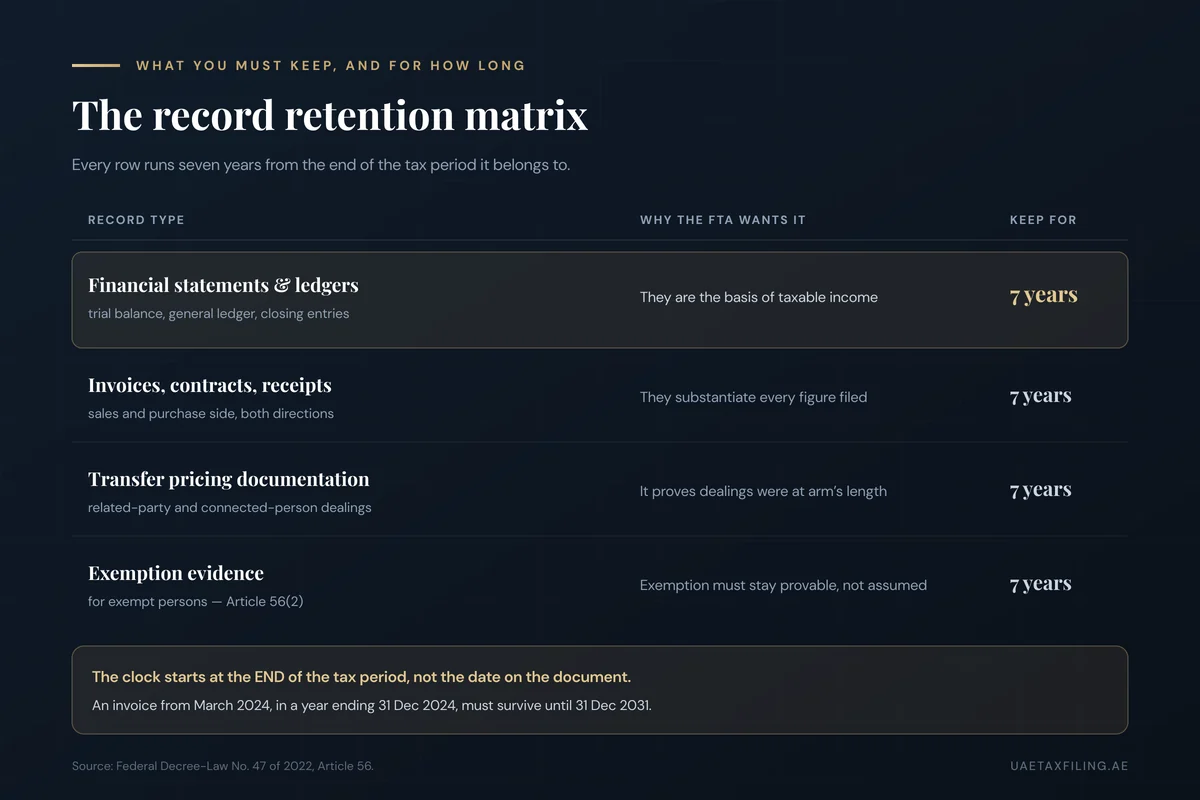
| Record type | Why the FTA wants it | Keep for |
|---|---|---|
| Financial statements, general ledger, trial balance | They are the basis on which taxable income is computed | 7 years |
| Sales and purchase invoices, contracts, receipts | They substantiate the individual figures filed | 7 years |
| Transfer pricing documentation | It evidences that related-party dealings were at arm’s length | 7 years |
| Exemption evidence (exempt persons) | Exempt status must remain provable, not assumed | 7 years |
| Fixed asset register and depreciation schedules | They explain deductions claimed over multiple periods | 7 years |
The functional test cuts both ways. A shoebox of invoices with no ledger tying them to the return fails, because taxable income cannot be readily ascertained from it. Equally, a clean set of statements with no underlying documents fails, because nothing supports the figures. You need both layers. Where related-party pricing is involved, the documentation burden is heavier still — our guide to transfer pricing in the UAE covers what that file has to contain.
Key takeaway: Keep the summary layer and the supporting layer. Records satisfy Article 56 only when they both support the return and let the Authority reconstruct taxable income without guesswork.
Exempt persons keep records too
An exempt person must keep records proving its exempt status for seven years, exactly like a taxable person. Article 56(2) states that an exempt person shall maintain all records that enable its status “to be readily ascertained by the Authority” for seven years following the end of the relevant tax period.
This is the requirement most often missed, because exemption feels like a release from obligation. It is not. A qualifying public benefit entity, a qualifying investment fund, or a government-controlled entity still has to evidence, years later, that it met the conditions in each period. Exemption is a status you must be able to prove on demand, not a permanent label — our guide to exempt persons under UAE Corporate Tax sets out which categories qualify and on what conditions.
Exemption removes the tax, not the paperwork. If your file cannot show why you qualified in 2024, the FTA is entitled to treat 2024 as if you did not.
Key takeaway: Exempt persons carry an identical seven-year retention duty for evidence of their status. Losing that evidence puts the exemption itself at risk, not just the record-keeping compliance.
Which accounting standard applies to you
The accounting standard you must use for UAE Corporate Tax is determined by your revenue in the tax period. Ministerial Decision No. 114 of 2023 specifies that the only accepted standards are IFRS and IFRS for SMEs, with cash-basis accounting available to the smallest businesses.
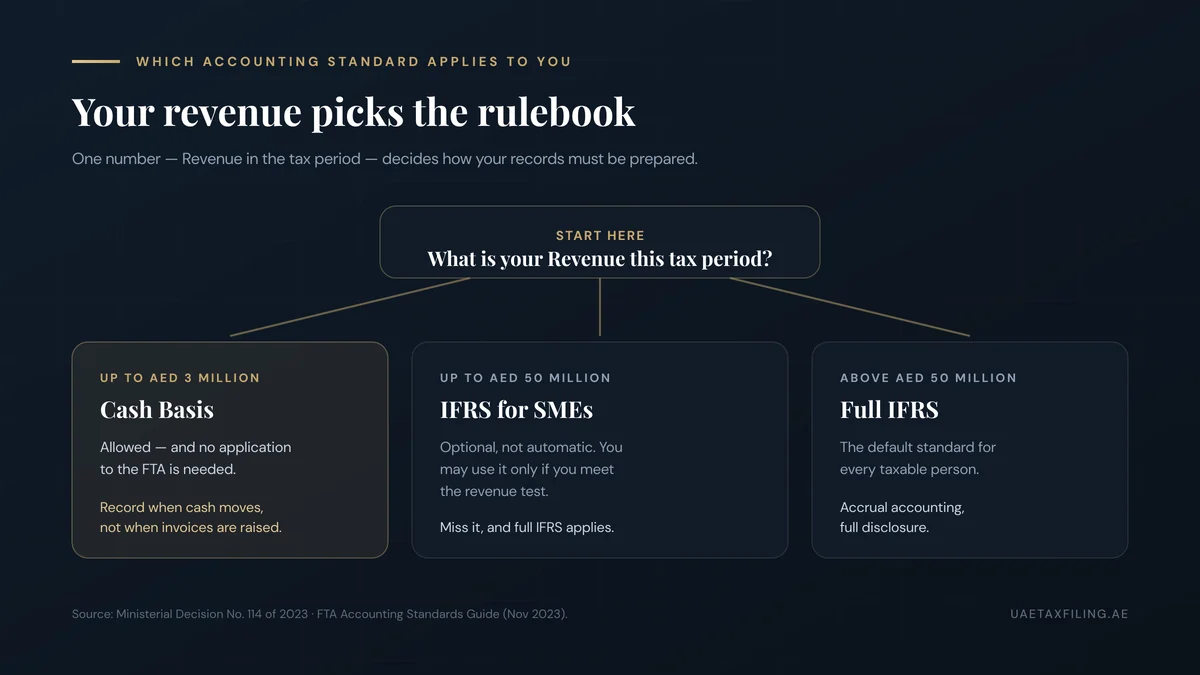
The FTA’s Accounting Standards Guide sets the thresholds precisely. Taxable persons shall use IFRS by default. IFRS for SMEs may be used only where revenue does not exceed AED 50 million in a tax period — and the guide is explicit that it “should not be used as the default”; where the revenue requirement is not satisfied, full IFRS applies. The cash basis is available where revenue does not exceed AED 3 million, and below that figure no application to the FTA is needed.
The practical consequence for record-keeping is direct. Accrual accounting under IFRS requires you to retain documents that a cash-basis business might never file — accruals, provisions, revenue-recognition support, deferred items. Crossing AED 3 million or AED 50 million mid-growth changes what your records must contain, not merely how they are presented. Our guide to IFRS financial statements for UAE Corporate Tax covers that transition in detail.
Key takeaway: Revenue up to AED 3 million allows cash basis with no FTA application; up to AED 50 million allows IFRS for SMEs; above that, full IFRS is mandatory. Growing past a threshold changes your record-keeping obligations in the same period.
The Arabic-language rule nobody budgets for
UAE tax records may be kept in English, but the Authority can require them in Arabic, and failing to supply them carries its own AED 5,000 penalty. Cabinet Decision No. 75 of 2023 lists as a separate violation the failure of a person to “submit the data, records and documents related to Tax in Arabic to the Authority when requested”.
Read the two halves of that carefully. There is no obligation to maintain your books in Arabic day to day — which is why almost every UAE business runs its accounting in English without issue. The obligation bites at the moment of request. If the FTA asks and you cannot produce an Arabic version within the time allowed, the fine applies regardless of how good your English records are. It is a translation-capability requirement disguised as a language rule, and it is the one item on this page that most finance teams have never tested.
The fix is cheap if done in advance and expensive under audit pressure. Know which provider would translate your ledgers, what it costs per page, and how long it takes — before a request arrives with a deadline attached.
Key takeaway: You may keep records in English, but you must be able to produce them in Arabic on request or face an AED 5,000 penalty. Treat it as a service you have pre-arranged, not a problem you solve during an audit.
What poor records cost
Failing to keep the required records costs AED 10,000 per violation, rising to AED 20,000 for a repeat violation within 24 months. Cabinet Decision No. 75 of 2023 lists this as violation number one on the Corporate Tax penalty schedule — ahead of late registration and late filing.
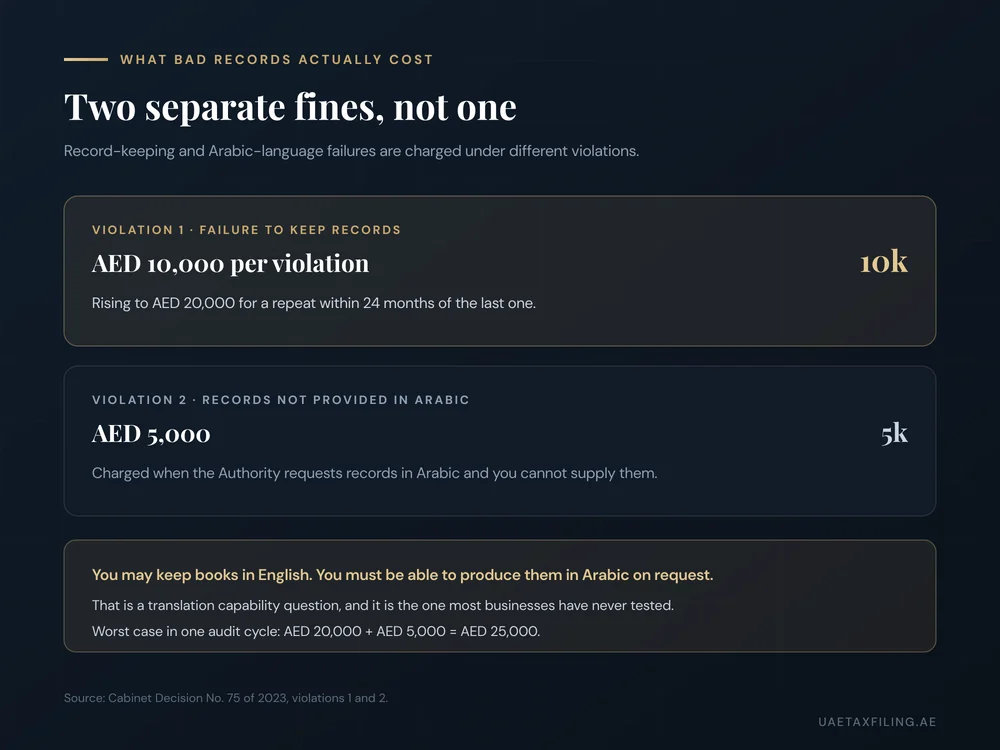
The two penalties are independent. A business that cannot produce complete records, and also cannot produce them in Arabic when asked, is exposed on both counts in the same audit cycle — AED 20,000 on a repeat record-keeping violation plus AED 5,000 for the language failure. That is before any tax adjustment the FTA makes because it could not verify a deduction. The wider Corporate Tax penalty landscape, and how self-correction changes the arithmetic, is set out in our guide to UAE Corporate Tax penalties.
Key takeaway: Record-keeping failure is AED 10,000, or AED 20,000 on repeat within 24 months, and stacks with the AED 5,000 Arabic-records penalty. The indirect cost — disallowed deductions the FTA cannot verify — is usually larger than either fine.
If your records are scattered across spreadsheets, bank portals and a former accountant’s laptop, tell us what you have and what tax periods it covers. We will map it against the seven-year requirement and match you with an FTA-registered partner agency to rebuild what is missing. Message the team on WhatsApp below.
Setting up a compliant system
A compliant record-keeping system is one that ties every figure on the return back to a retrievable source document, for seven years, in a format the FTA can inspect. Building it is a sequence, not a purchase.
- Fix your tax period end date. Every retention deadline counts from it, so it belongs at the top of the policy.
- Determine your accounting standard. Check revenue against the AED 3 million and AED 50 million thresholds, and reconfirm it each period as you grow.
- Map return line to source. For each figure you file, name the document that proves it. Gaps found here are cheap; gaps found in an audit are not.
- Centralise storage with a retention date. Tag each period’s folder with its delete-after date — period end plus seven years — so nothing is purged early.
- Arrange Arabic translation capability. Identify the provider, price and turnaround before you need them.
- Test the retrieval. Pick three figures at random from a filed return and try to produce the backing document in under an hour.
That last step is the one that separates a policy from a system. In reviews we run with clients, the failure is almost never a missing invoice — it is that nobody can find it quickly enough, because storage was organised by supplier or by month rather than by tax period. Whether you keep this in-house or outsource it, our breakdown of outsourced accounting costs in Dubai shows what the market charges.
Key takeaway: Organise records by tax period, tag each period with a delete-after date, and test retrieval before the FTA does. A system you cannot search fast is functionally the same as records you do not have.
Common mistakes
The costly record-keeping errors are structural rather than careless — they come from applying a sensible-sounding rule that does not match the law.
Five recur. First, counting seven years from the document date, which deletes records up to a year early. Second, assuming exemption ends the duty, when Article 56(2) says otherwise. Third, treating IFRS for SMEs as a default rather than an option earned by staying under AED 50 million. Fourth, never testing Arabic production until a request arrives. Fifth, keeping statements without the underlying documents, which fails the “readily ascertained” test even though the file looks complete. Where an audit is also required, thresholds and timing interact — our guide to audited financial statements covers who must have them, and our overview of FTA audits covers what inspection looks like in practice.
Key takeaway: Most record-keeping failures trace back to one of five wrong assumptions, not to negligence. Each is corrected by reading the obligation precisely rather than by working harder.
Frequently asked questions
How long must UAE Corporate Tax records be kept?
Seven years following the end of the tax period the records relate to, under Article 56 of Federal Decree-Law No. 47 of 2022. The period is counted from the close of the tax period, not from the date on the document, so an invoice from early in a financial year is held for closer to eight years in practice.
Do exempt persons have to keep records?
Yes. Article 56(2) requires an exempt person to maintain all records that enable its exempt status to be readily ascertained by the Authority, for the same seven years following the end of the relevant tax period. Exemption removes the tax liability, not the documentation duty.
Can I keep my accounting records in English?
Yes, day to day. But Cabinet Decision No. 75 of 2023 penalises failure to submit data, records and documents to the Authority in Arabic when requested, at AED 5,000. Keep your books in English if you prefer, and arrange in advance how you would produce an Arabic version if asked.
What is the penalty for not keeping proper records?
AED 10,000 for each violation, rising to AED 20,000 where the violation is repeated within 24 months of the previous one. This is the first violation listed in the Corporate Tax penalty schedule under Cabinet Decision No. 75 of 2023, and it applies separately from the Arabic-records penalty.
Which accounting standard must I use?
IFRS by default. IFRS for SMEs may be used only where revenue does not exceed AED 50 million in the tax period, and the FTA states it should not be treated as the default standard. Where the revenue condition is not met, full IFRS applies.
When can I use cash-basis accounting?
Where your revenue does not exceed AED 3 million in the relevant tax period. Below that threshold you may apply the cash basis without submitting an application to the FTA. Above it, the cash basis is available only in exceptional circumstances and on application.
Do I need audited financial statements to satisfy record keeping?
Not necessarily — audit requirements and record-keeping requirements are separate obligations. Article 56 requires you to keep records that support the return regardless of whether an audit applies to your business. An audit adds assurance; it does not replace the underlying documentation duty.
Can records be kept digitally rather than on paper?
The law defines the obligation by function, not by medium: records must support the return and let the Authority readily ascertain taxable income. Digital records satisfy that where they are complete, retrievable for the full seven years, and can be produced for inspection on request.
What happens to records if I deregister or close the company?
The seven-year retention period attaches to the tax periods, so it survives deregistration. Records for periods already closed must still be retrievable for the balance of their seven years, which means deciding who holds them and how they can be produced after the entity stops trading.
How we verified this: the seven-year retention period and the duty on exempt persons are quoted from Article 56(1) and 56(2) of Federal Decree-Law No. 47 of 2022, extracted from the Ministry of Finance PDF. The AED 10,000 / AED 20,000 record-keeping penalty and the AED 5,000 Arabic-records penalty are violations 1 and 2 of the penalty schedule in Cabinet Decision No. 75 of 2023. The accounting-standard thresholds are quoted from the Federal Tax Authority’s Accounting Standards Guide implementing Ministerial Decision No. 114 of 2023. Confirm the current text on the FTA legislation page. This article is general information, not tax advice.
Last updated: 30 August 2026 · Reviewed by Jazim, CEO, UAE Tax Filing LLC (Dubai)