
Last updated: 12 August 2026 · Written by the UAE Tax Filing editorial team · Reviewed by Jazim, CEO, UAE Tax Filing LLC (Dubai)
Audited financial statements are a set of accounts — balance sheet, profit and loss, and cash flow — prepared under IFRS and signed off by an independent licensed auditor. For UAE Corporate Tax, they are mandatory for any business over AED 50 million in revenue, every Qualifying Free Zone Person, and now every tax group. If that is you, the audit has to be finished before you can file your 30 September return.
The audit is not part of the tax return. It is the thing the tax return is built from — and it has its own lead time, its own queue, and its own deadline hiding behind the filing date.
The short version
- Three triggers, any one is enough. Under Ministerial Decision No. 84 of 2025, audited financial statements are required if your revenue exceeds AED 50 million, if you are a Qualifying Free Zone Person, or if you are part of a tax group.
- Free zone status overrides the size test. A QFZP needs audited accounts at any revenue — even at zero. Being small is not an exemption.
- Every tax group is now caught. MD 84 removed the old AED 50 million group threshold. All tax groups must now prepare audited special-purpose financial statements, whatever their size.
- It governs the returns due 30 September 2026. MD 84 applies to tax periods starting on or after 1 January 2025 — the FY2025 accounts most calendar-year businesses are filing now.
- Starting in September is starting too late. A first audit routinely takes three to six weeks, and auditors are booked out before the deadline. The queue is the constraint, not the paperwork.
What this covers
- What audited financial statements are
- Who needs them: the three triggers
- Why free zone companies are caught at any size
- The tax-group change that catches people out
- Audited accounts are not the tax return
- Which accounting standard applies
- The timing trap before 30 September
- If you are below the threshold
- Non-residents and the AED 50 million test
- Frequently asked questions
What audited financial statements are
Audited financial statements are formal accounts that an independent, UAE-licensed auditor has examined and signed an opinion on. That opinion is the whole point: it is an external professional confirming that the numbers give a true and fair view, prepared to a recognised standard rather than assembled in-house and taken on trust.
A full set contains a statement of financial position (the balance sheet), a statement of profit or loss, a statement of cash flows, a statement of changes in equity, and the notes that explain the figures. Management accounts, a bookkeeper's summary, or a bank-ready P&L are not the same thing. None of them carry an auditor's signature, and for Corporate Tax purposes that signature is what the Federal Tax Authority is looking for.
Key takeaway: the difference between accounts and audited accounts is one signature — and that signature is the obligation, not a formality you can skip.
Who needs them: the three triggers
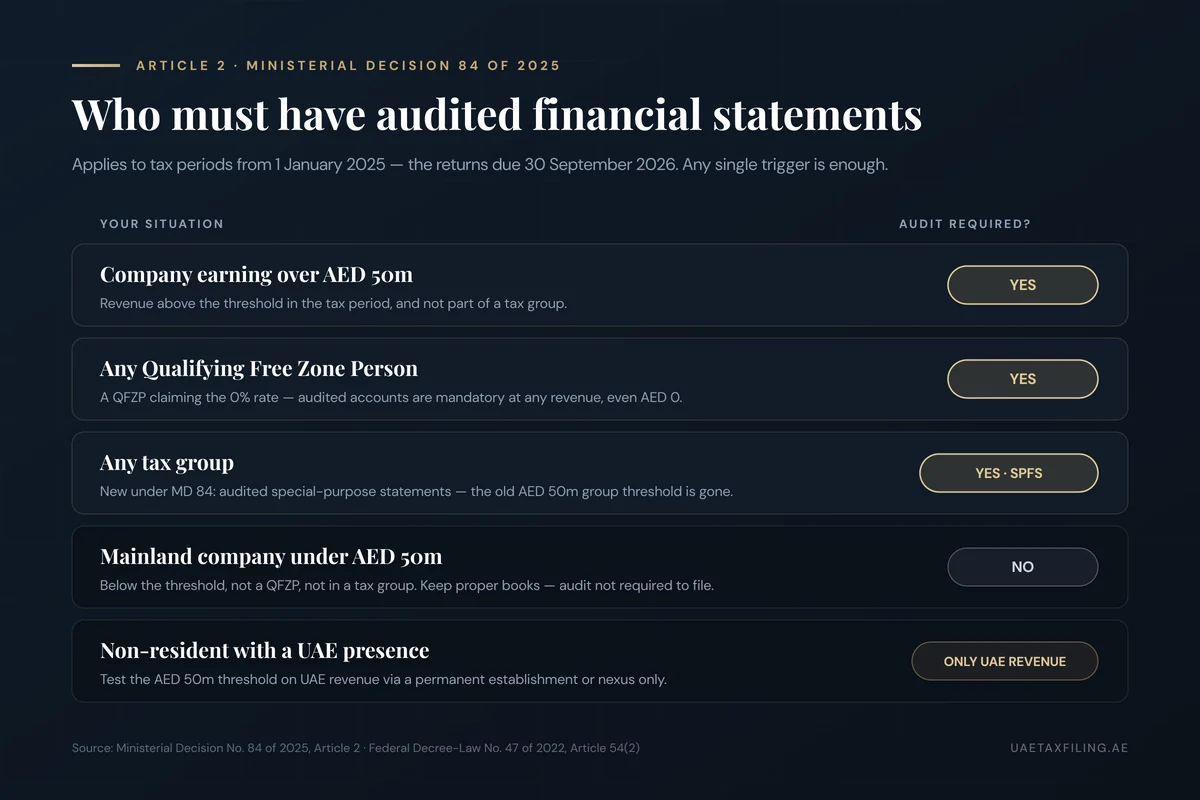
Whether you need audited financial statements for UAE Corporate Tax is decided by Article 2 of Ministerial Decision No. 84 of 2025, and it turns on three tests. Meet any one of them and the audit is mandatory.
The Decision states it plainly. A taxable person that is not a tax group and derives revenue exceeding AED 50,000,000 in the tax period must prepare and maintain audited financial statements. So must a Qualifying Free Zone Person. And separately, a tax group must prepare and maintain audited special-purpose financial statements in the form the FTA specifies. There is no discretion in any of the three. Free zone distributors now face an extra step — see our guide to the agreed-upon procedures report required by FTA Decision 6 of 2026.
| Your situation | Audited accounts? | Basis |
|---|---|---|
| Company over AED 50m revenue (not in a group) | Yes | MD 84, Art. 2(1)(a) |
| Any Qualifying Free Zone Person | Yes, at any revenue | MD 84, Art. 2(1)(b) |
| Any tax group | Yes — audited SPFS | MD 84, Art. 2(2) |
| Mainland company under AED 50m, not a QFZP, not grouped | No | Outside Art. 2 |
| Non-resident with a UAE presence | Test AED 50m on UAE revenue only | MD 84, Art. 2(4) |
The AED 50 million figure is revenue, not profit. A trading company turning over AED 70 million on thin margins is in scope even if it barely breaks even, because the test looks at the top line. This catches out high-volume, low-margin businesses — distributors, contractors, wholesalers — that think of themselves as small because their profit is small.
Key takeaway: revenue over AED 50 million, QFZP status, or membership of a tax group — any one triggers a mandatory audit. Two of the three ignore your size entirely.
Why free zone companies are caught at any size
A Qualifying Free Zone Person must have audited financial statements regardless of revenue, and this is where most free zone owners are caught off guard. The 0% Corporate Tax rate that makes free zone status worth claiming comes with the audit attached — you cannot take the benefit without meeting the condition.
The logic is straightforward once you see it. The 0% rate is a valuable concession, and the FTA needs assurance that a company claiming it genuinely earns qualifying income and stays within the de minimis limits. Audited accounts are that assurance. So a two-person consultancy in a free zone, turning over AED 800,000 and claiming 0%, needs a full audit — while a mainland company earning the same AED 800,000 does not. The trigger is not the money. It is the claim to 0%.
If you are claiming the free zone 0% rate, budget for an audit from day one. The rate and the audit are a package; you do not get to keep one and drop the other.
The trap catches new free zone companies especially hard. Owners set up on the promise of 0% tax, never register the compliance cost, and discover the audit requirement in the weeks before filing — exactly when auditors have no capacity left. If you are still working out whether you even qualify for the rate, our guide to qualifying as a Free Zone Person sets out the conditions before you commit to the audit.
Key takeaway: the free zone 0% rate is conditional on an audit. Claim the rate, and the audit is not optional at any revenue level.
The tax-group change that catches people out
Every tax group must now prepare audited special-purpose financial statements, and this is the single biggest change MD 84 introduced. The previous rule — Ministerial Decision No. 82 of 2023 — only required a tax group to be audited if its consolidated revenue passed AED 50 million. That threshold is gone.
Under MD 84, size is irrelevant for a tax group. Two small companies that a parent has grouped together for Corporate Tax now sit inside a mandatory audit obligation they did not have a year ago, even if their combined revenue is a fraction of AED 50 million. Special-purpose financial statements — SPFS — are prepared in the form and to the procedures the FTA specifies for groups, which is a distinct exercise from a standalone company audit.
| Small tax group (combined revenue AED 8m) | Under MD 82 of 2023 | Under MD 84 of 2025 |
|---|---|---|
| Below the AED 50m group threshold | No audit required | Audit required |
| Type of accounts | — | Audited special-purpose (SPFS) |
| Applies from | Periods before 1 Jan 2025 | Periods on/after 1 Jan 2025 |
The reason this catches people is that the group election was often made to simplify compliance — one return instead of several. Nobody re-checked the audit position when MD 84 landed in March 2025. If you elected to form a group in 2024 or earlier, this is worth revisiting before you file. The mechanics of grouping are covered in our guide to tax group formation in the UAE.
Key takeaway: if you are in a tax group of any size, you now need an audit. The old "we're too small" position expired for periods starting 1 January 2025.
Audited accounts are not the tax return
Audited financial statements and the Corporate Tax return are two separate documents, and confusing them is the most expensive mistake in this whole topic. The audit produces the accounts. The return is a separate filing on EmaraTax that starts from those accounts and works out the tax.
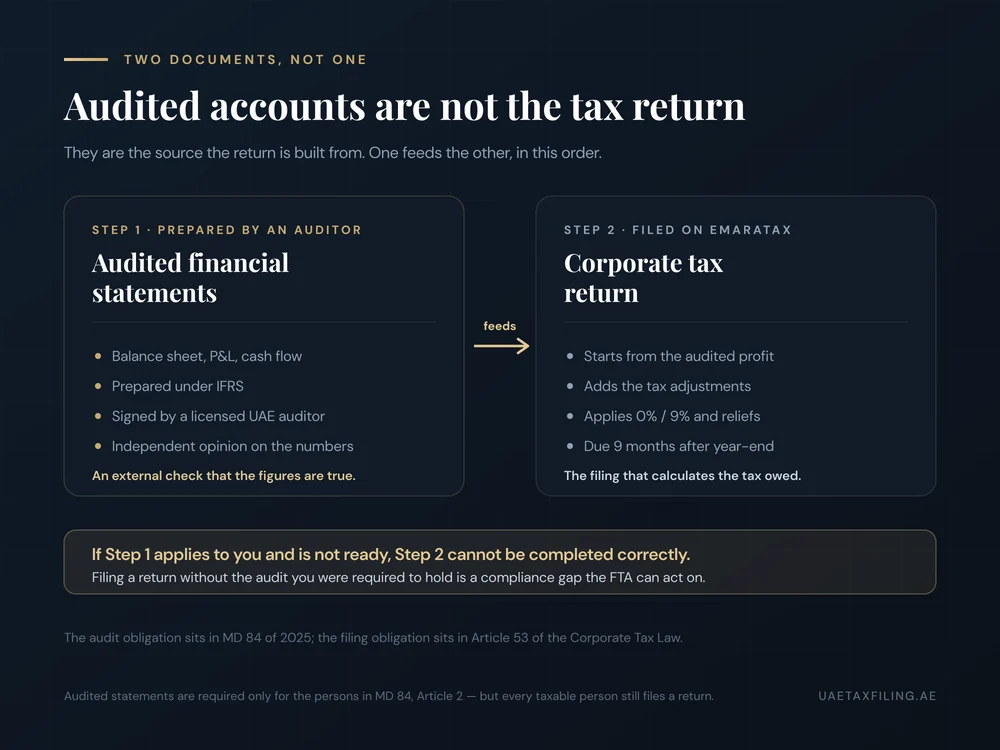
The return takes the accounting profit from your audited accounts, applies the adjustments the Corporate Tax Law requires — add-backs, exempt income, reliefs — and arrives at taxable income. If the audit is a prerequisite for you and it is not done, the return has no reliable starting number. You can see how the numbers flow through the filing itself in our EmaraTax return walkthrough, and how the accounting profit becomes taxable income in our guide to IFRS financial statements for Corporate Tax.
Filing a return without the audited accounts you were required to hold is not a clever shortcut. It is a compliance gap the FTA can act on, and it leaves the return exposed if the audited figures later differ from what you filed.
Key takeaway: the audit comes first and the return second. One is the source; the other is the calculation built on it.
Which accounting standard applies
Audited financial statements for UAE Corporate Tax must be prepared under International Financial Reporting Standards. IFRS is the accounting language the Federal Tax Authority works in, and it is what the auditor signs against.
There is one accommodation for smaller businesses. A taxable person with revenue not exceeding AED 50 million may use IFRS for SMEs, a lighter version of the full standard. Above that line, full IFRS applies. This matters because the choice of standard affects how revenue, provisions and asset values are recognised — and those recognitions feed straight into taxable income. Getting the standard right is part of getting the tax right, not a separate accounting nicety.
Key takeaway: IFRS is mandatory; IFRS for SMEs is available up to AED 50 million in revenue. Either way, the accounts must be built to the standard before they can be audited.
The timing trap before 30 September
The real risk with audited financial statements is not whether you need them — it is when you start. An audit is a process with a queue, and the queue fills up as the 30 September deadline approaches.
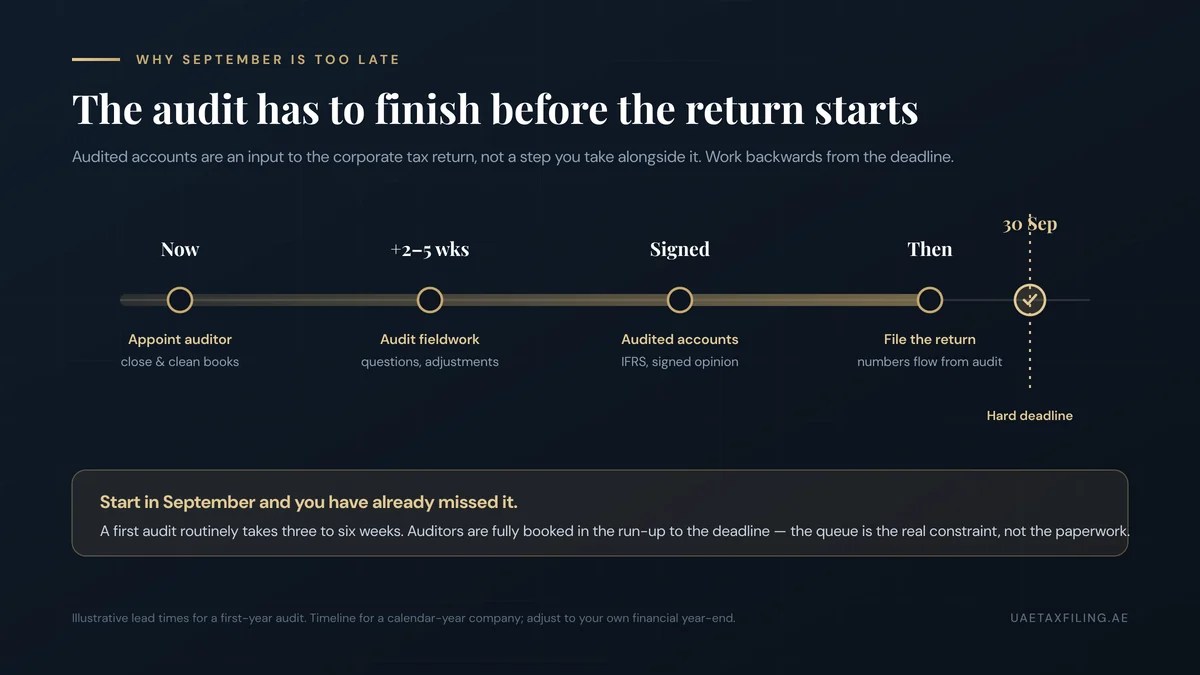
Here is the sequence, and why September is already late:
- Appoint an auditor and close your books. The auditor cannot start until your accounts are drafted, reconciled and complete. Messy books add weeks before fieldwork even begins.
- Audit fieldwork. The auditor tests the numbers, raises questions, and asks for adjustments. For a first audit this routinely runs two to five weeks, longer if the records need work.
- Signed audited accounts. Once the auditor is satisfied, they issue the signed opinion. Only now do you have the document Corporate Tax requires.
- File the return. The taxable income calculation starts from the audited profit. The return is due nine months after your year-end — 30 September 2026 for a calendar-year business.
Add it up and a clean audit still needs the best part of a month; a messy one needs two. Auditors are fully booked in August and September because every calendar-year company is trying to file at once. Starting the audit in September is not a tight timeline — it is a missed one.
The deadline everyone watches is 30 September. The deadline that actually binds you is weeks earlier: the date by which an auditor will still take your file.
Key takeaway: the audit's real deadline sits weeks before the filing date. Book the auditor now, not after the accounts are perfect.
If you are below the threshold
If you are a mainland company under AED 50 million in revenue, not a Qualifying Free Zone Person, and not part of a tax group, you do not need audited financial statements to file your Corporate Tax return. You still need proper books — the obligation to keep accurate records and calculate taxable income does not go away.
What changes is the assurance level. You prepare your accounts, apply the tax adjustments, and file — without an auditor's signature on the statements. The FTA can still ask to see your records, and they must be accurate and retained for seven years. Either way the underlying documents must survive seven years — see our guide to Corporate Tax record-keeping requirements. Many businesses just below the threshold choose to get audited anyway, because a bank, an investor or a future buyer will want it, and because it removes doubt if the FTA ever reviews the return. That is a commercial decision, not a Corporate Tax requirement.
Key takeaway: below the threshold, an audit is optional for tax but your records still have to be accurate, complete and kept for seven years.
Non-residents and the AED 50 million test
A non-resident business tests the AED 50 million threshold on its UAE revenue only. Article 2(4) of MD 84 is specific: for a non-resident person, only revenue derived through a permanent establishment or a nexus in the UAE counts toward the threshold.
This is a sensible boundary. A foreign company with global revenue of AED 500 million but a small UAE branch turning over AED 12 million tests the threshold on the AED 12 million, not the AED 500 million — so it falls below the line and is not forced into a UAE audit by its worldwide size. The question of whether a foreign business even has a taxable UAE presence is the prior one, and we cover it in our guide to the permanent establishment rules.
Key takeaway: for a non-resident, only UAE-source revenue through a permanent establishment or nexus counts toward the AED 50 million audit threshold.
Frequently asked questions
Do I need audited financial statements to file my UAE Corporate Tax return?
Only if you meet one of the three triggers in Ministerial Decision No. 84 of 2025: revenue over AED 50 million, Qualifying Free Zone Person status, or membership of a tax group. If none apply, you file from properly kept accounts without an audit, but your records must still be accurate and retained for seven years.
Does a small free zone company really need an audit?
Yes, if it is a Qualifying Free Zone Person claiming the 0% rate. Audited financial statements are mandatory for a QFZP at any revenue, including zero. The audit is a condition of the 0% rate, so a small free zone company claiming it is caught even though a mainland company of the same size is not.
What is the AED 50 million threshold based on, revenue or profit?
Revenue. The threshold looks at total revenue in the tax period, not net profit. A high-turnover, low-margin business can exceed AED 50 million in revenue while making very little profit and still be required to have audited accounts.
My companies are in a small tax group. Are we caught by the audit rule?
Yes. MD 84 of 2025 removed the old AED 50 million threshold for tax groups. Every tax group must now prepare audited special-purpose financial statements regardless of combined revenue, for tax periods starting on or after 1 January 2025.
What accounting standard must the audited accounts use?
International Financial Reporting Standards. A business with revenue up to AED 50 million may use the lighter IFRS for SMEs; above that, full IFRS applies. The auditor signs their opinion against the applicable standard.
When must the audit be done by?
Before you file the Corporate Tax return, which is due nine months after your financial year-end — 30 September 2026 for a calendar-year business. In practice the audit must start well before then, because a first audit takes several weeks and auditors are heavily booked in the run-up to the deadline.
What happens if I file without the audited accounts I was required to hold?
You have a compliance gap. The audited statements are a legal requirement for the persons named in MD 84, and filing without them leaves your return exposed if the audited figures later differ from what you reported. The FTA can act on both the missing audit and any resulting understatement.
Is a management account or a bookkeeper's report enough?
No. Management accounts and bookkeeping summaries are not audited financial statements. They carry no independent auditor's opinion, which is precisely what the requirement is about. Only accounts examined and signed by a licensed auditor meet the obligation.
Does a company that made no profit or did not trade still need an audit?
If it is a Qualifying Free Zone Person or a tax group member, yes — those triggers do not depend on profit or activity. A dormant QFZP still needs audited accounts. A non-grouped mainland company under AED 50 million with no activity does not.
Who signs the audit — can my accountant do it?
Only an independent auditor licensed in the UAE can issue the audit opinion, and independence rules mean it generally cannot be the same firm that prepared the accounts. This is why the audit is a separate engagement, and separate lead time, from your bookkeeping.
Not sure which trigger applies to you?
The three triggers are simple to state and easy to get wrong at the edges — a free zone company that assumes it is too small, a tax group elected to simplify life that quietly created an audit obligation, a distributor that never thought of AED 50 million in revenue as "large". Getting the answer right now, in August, is the difference between a calm audit and a missed deadline.
Send us three facts — your revenue, whether you hold a free zone licence and claim 0%, and whether you are in a tax group — and we will tell you whether an audit is mandatory for your 30 September return. If it is, we will match you with a licensed audit firm and an FTA-registered tax agency from our partner network that can still take your file this cycle. If it is not, we will tell you that too. Message the team on WhatsApp using the button below, or see how the return that follows is handled on our Corporate Tax return filing service page.
Last reviewed on 12 August 2026 by Jazim, CEO of UAE Tax Filing LLC, Dubai. Methodology: every threshold and obligation in this article was verified against the published text of Ministerial Decision No. 84 of 2025 (Article 2), which repeals Ministerial Decision No. 82 of 2023 for tax periods from 1 January 2025, read with Article 54 of Federal Decree-Law No. 47 of 2022. UAE Tax Filing LLC is a matching platform and is not an FTA-registered tax agent or a licensed audit firm; audits and filings are performed by the licensed partner firms we connect you with. This article is general guidance and is not a substitute for advice on your own facts.