Last updated: 9 August 2026 · Written by the UAE Tax Filing editorial team · Reviewed by Jazim, CEO, UAE Tax Filing LLC (Dubai)
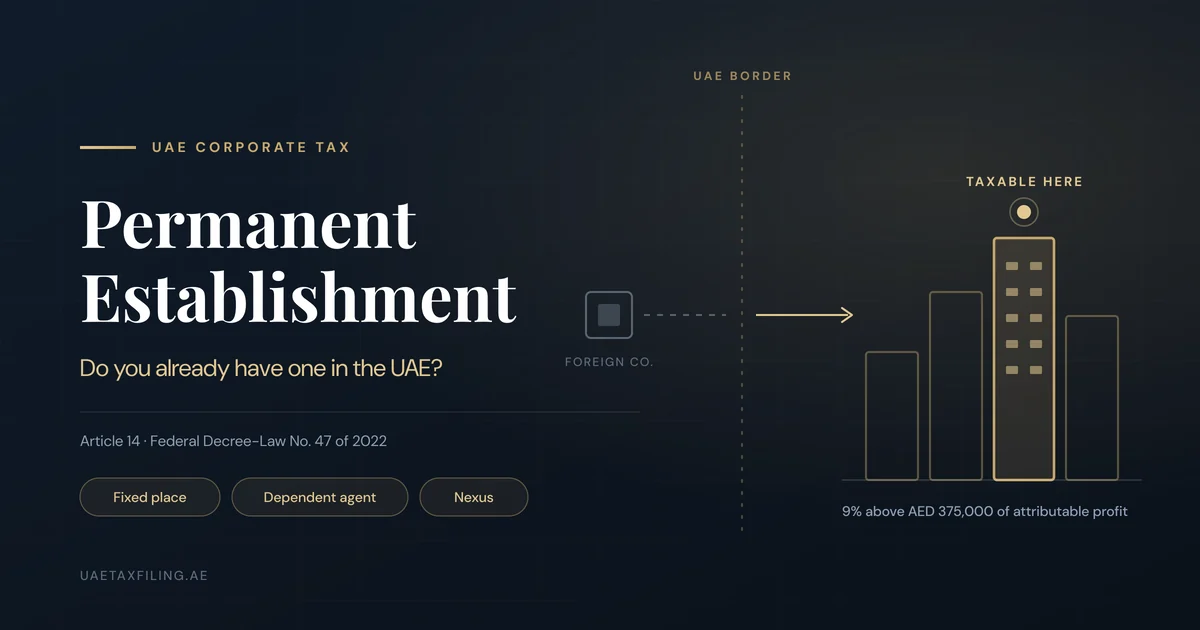
A permanent establishment in the UAE is the taxable presence a foreign company creates when it has a fixed place of business here, when someone habitually concludes contracts on its behalf, or when it holds a nexus specified by the Cabinet. Once one exists, the profit attributable to it is taxed at 9% above AED 375,000, and a registration clock starts running.
Most permanent establishments in the UAE are not created by a decision. They are created by a lease, a laptop, and a person with signing authority — and discovered eighteen months later.
The short version
- Three triggers, any one is enough. Article 14 of Federal Decree-Law No. 47 of 2022 creates a permanent establishment through a fixed place of business, a dependent agent, or a nexus specified by the Cabinet.
- A trade licence proves nothing either way. In the summary of private clarifications it published in July 2026, the Federal Tax Authority confirmed that a permanent establishment turns on the facts of each case — a licence does not create one, and the absence of a licence does not prevent one.
- Construction has a six-month fuse. A building site, project, or installation becomes a permanent establishment only once it lasts more than six months, counting connected work carried out at the site by related parties.
- The registration window is six months. A non-resident with a permanent establishment must apply for Corporate Tax registration within six months of the date the establishment came into existence — nine months where it pre-dates 1 March 2024. Missing it costs AED 10,000.
- A branch cannot elect Small Business Relief. Relief is limited to Resident Persons. On AED 1,000,000 of profit that is a AED 56,250 gap against an identical UAE subsidiary, for every tax period ending on or before 31 December 2026.
What this covers
- What a permanent establishment actually is
- Trigger one: the fixed place test
- Trigger two: the dependent agent test
- Trigger three: nexus with no presence at all
- What does not create a permanent establishment
- The remote employee question
- What the FTA clarified in July 2026
- Branch or subsidiary: what a PE actually costs
- Registering and filing once a PE exists
- When a domestic PE is not a treaty PE
- The seven-question PE self-test
- Frequently asked questions
What a permanent establishment actually is
A permanent establishment is a degree of business presence that gives the UAE the right to tax a non-resident on the profit connected to that presence. It is not a legal entity, it is not a licence, and it is not registered at a free zone authority. It is a conclusion drawn from facts.
Article 11 of the Corporate Tax Law makes a foreign company a Non-Resident Person if it has a permanent establishment in the UAE, derives State Sourced Income, or has a nexus here. Article 12 then splits the tax base: taxable income attributable to the permanent establishment is taxed at the normal rates, while State Sourced Income that is not attributable to a permanent establishment falls under Article 45 and currently carries a 0% withholding tax rate.
That single distinction is the whole commercial question. A German software company invoicing a Dubai client from Munich has State Sourced Income and pays nothing. The same company with two engineers working from a leased Business Bay office has a permanent establishment, and the profit attributable to that office is taxed at 9% above AED 375,000. The revenue is identical. The tax is not.
Key takeaway: permanent establishment is the switch between a 0% withholding position and a 9% filing position. Everything else in this article is about where that switch sits.

Trigger one: the fixed place test
A fixed place permanent establishment is a fixed or permanent place in the UAE through which the business of the non-resident, or any part of it, is conducted. Article 14(2) lists what counts, and the list is broader than most foreign boards expect.
What the law names as a fixed place
- A place of management — where management and commercial decisions necessary for the conduct of the business are, in substance, made
- A branch, an office, a factory, a workshop
- Land, buildings and other real property
- Installations or structures for exploring natural resources; mines, wells, quarries
- A building site, construction project, place of assembly or installation, or supervisory activity connected to one
The six-month construction rule
A building site becomes a permanent establishment only if the site, project, or activity lasts more than six months. The count is not per contract. Article 14(2)(i) aggregates sites, projects and activities "whether separately or together", and expressly includes connected activities conducted at the site by one or more related parties of the non-resident.
In practice this is where contractors get caught. A Saudi engineering group runs a 22-week fit-out through its own crew, then a related design entity spends another 9 weeks on site supervision. Each contract is under six months. The aggregate is 31 weeks, the related-party activity counts, and the permanent establishment existed from the start of the site — not from week 27.
Place of management is the quiet one
A place of management is defined by the substance of the decisions taken there, not by the sign on the door. A holding company incorporated offshore whose director signs board resolutions from a Dubai apartment every quarter has a defensible argument. The same director running the operating business day to day from that apartment does not. Where management and control actually sit in the UAE, the more serious question is whether the company has become a Resident Person under Article 11(3)(b) — effectively managed and controlled in the State — which taxes worldwide income, not just attributable profit.
Key takeaway: the fixed place test is about availability and use, not ownership. A desk you do not own, in an office you do not lease, used regularly for your business, can satisfy it.
Trigger two: the dependent agent test
A dependent agent permanent establishment arises where a person in the UAE has, and habitually exercises, authority to conduct business on behalf of the non-resident. Article 14(5) narrows "authority" to two behaviours: habitually concluding contracts on behalf of the non-resident, or habitually negotiating contracts that the non-resident then signs without material modification.
The second limb is the one that surprises people. Rubber-stamping from head office is not a defence. If the commercial terms are settled in Dubai and head office signs what it is sent, the agent has authority in substance.
Article 14(6) provides the escape: an independent agent acting in the ordinary course of its own business does not create a permanent establishment. That protection falls away if the agent acts exclusively or almost exclusively for the non-resident, or cannot be considered legally or economically independent of it. A UAE distributor with forty principals is independent. A UAE "consultant" with one client, one email domain, and one signatory is not.
The test is not whether the contract was signed abroad. It is whether the deal was made here.
Article 15 carves out a specific case: a regulated investment manager transacting at arm's length in the ordinary course of its business is treated as an independent agent, provided it meets all of the conditions in that Article. This is why regulated fund managers in DIFC and ADGM can trade for non-resident funds without dragging those funds into UAE Corporate Tax.
Key takeaway: a dependent agent permanent establishment needs no premises. One person with habitual authority is sufficient.
Trigger three: nexus with no presence at all
Nexus is a permanent establishment substitute created by Cabinet Decision, and it requires no people, no office, and no licence. Under Cabinet Decision No. 56 of 2023, a non-resident juridical person has a nexus in the UAE if it earns income from immovable property located here — whether the property is held as a business asset or purely as an investment.
A BVI company that owns one apartment in Dubai Marina and collects rent has a nexus, must register for Corporate Tax, and is taxed on a net basis after deductible expenditure. It has no office, no staff and no trade licence, and none of that helps. The Decision also flags that artificially transferring rights in UAE property without a valid commercial reason falls within the general anti-abuse rule.
Key takeaway: if a foreign entity holds UAE property that produces income, registration is not optional and the deadline is three months, not six.
What does not create a permanent establishment
Article 14(3) protects a defined list of activities. A fixed place used solely for any of the following is not a permanent establishment: storing, displaying or delivering the non-resident's own goods; keeping a stock of goods for processing by another person; purchasing goods or collecting information; conducting any other activity of a preparatory or auxiliary nature; or any combination of those, provided the overall activity stays preparatory or auxiliary.
Two words carry the weight. Solely means one non-qualifying activity in the same place breaks the exemption. Preparatory or auxiliary means the activity must be remote from the profit-making core. A warehouse that only stores goods is protected. The same warehouse where a manager negotiates pricing with regional buyers is not.
Article 14(4) then closes the obvious workaround. If the non-resident or a related party carries on business at the same place or another place in the UAE, and the combined activity would form a cohesive business operation had it not been fragmented, the exemption does not apply. Splitting a sales office and a delivery warehouse between two group companies does not create two exempt fragments. It creates one permanent establishment.
Key takeaway: the preparatory and auxiliary exemption is drafted narrowly and policed by an anti-fragmentation rule. Treat it as a genuinely limited carve-out.
The remote employee question
One employee working from the UAE does not automatically create a permanent establishment for a foreign employer, but the exemption is far narrower than the market assumes. Article 14(7) allows the Minister to set conditions under which a natural person's presence does not create one, in two situations: temporary and exceptional presence, and employees performing non-core activities where the employer derives no State Sourced Income.
The exceptional-circumstances route
Ministerial Decision No. 83 of 2023 defines the first route, and every one of five conditions must hold: the presence follows exceptional circumstances of a public or private nature; those circumstances could not reasonably be predicted by the individual or the employer; the individual expressed no intention to stay once they end; the employer had no permanent establishment here beforehand; and the employer did not treat the person as creating a permanent establishment under another jurisdiction's rules. The Decision defines an exceptional circumstance as an event beyond the person's control that occurred while they were already in the UAE and prevented them from leaving as planned — public health measures, travel restrictions, legal sanctions, acts of war, natural disasters, or an emergency health condition affecting them or a relative up to the fourth degree.
This is a stranded-traveller rule. It was written for someone caught here by a border closure, not for a developer who decided Dubai was a nicer place to work from.
The non-core-activity route
The second route is the workable one for planned remote hiring, and it has two cumulative conditions in Article 14(7)(b): the activities the person conducts in the UAE are not part of the core income-generating activities of the employer or its related parties, and the employer derives no State Sourced Income. A back-office analyst working from Sharjah for a European group with no UAE customers can sit inside it. A regional sales lead closing UAE accounts cannot — on either limb.
Key takeaway: remote work is safe where the role is peripheral and the employer earns nothing in the UAE. Once either condition fails, you are back to the fixed place and dependent agent tests on the ordinary facts.
What the FTA clarified in July 2026
In July 2026 the Federal Tax Authority published a consolidated summary of positions taken in private clarifications issued up to May 2026, covering exempt persons, permanent establishments, free zone qualification, the participation exemption and tax loss transfers. Four points matter for permanent establishment analysis.
- A licence is not the test. Whether a foreign business has a permanent establishment depends on the facts and circumstances of each case, not on whether it holds a UAE trade licence. A permanent establishment can arise from actual activity and presence even with no licence at all.
- Free zone branches are grouped; mainland branches are not. A legal entity and its free zone branches are assessed collectively when testing Qualifying Free Zone Person status. A mainland branch is assessed separately as a domestic or foreign permanent establishment, and its income is taxed on its own at 9% above the AED 375,000 threshold.
- Substance is measured, not asserted. The FTA looks at sufficient assets, qualified full-time employees, and operating expenditure relative to the activity claimed.
- Foreign investors in partnerships get relief. Non-resident partners in a UAE partnership do not automatically require Corporate Tax registration where they earn only UAE State Sourced Income.
The second point kills a myth still repeated across UAE advisory blogs: that a presence inside a free zone cannot be a permanent establishment. Nothing in Article 14 says that. A free zone address changes which regime you argue under; it does not switch off the permanent establishment analysis.
Key takeaway: the FTA is reasoning from activity, substance and evidence. Structure charts are the weakest form of protection available.
Branch or subsidiary: what a permanent establishment actually costs
The cash difference between running through a branch and running through a UAE subsidiary comes from residence, not from activity. A branch of a foreign company is a permanent establishment of a Non-Resident Person. A UAE-incorporated LLC is a Resident Person. Only Resident Persons can elect Small Business Relief under Ministerial Decision No. 73 of 2023.
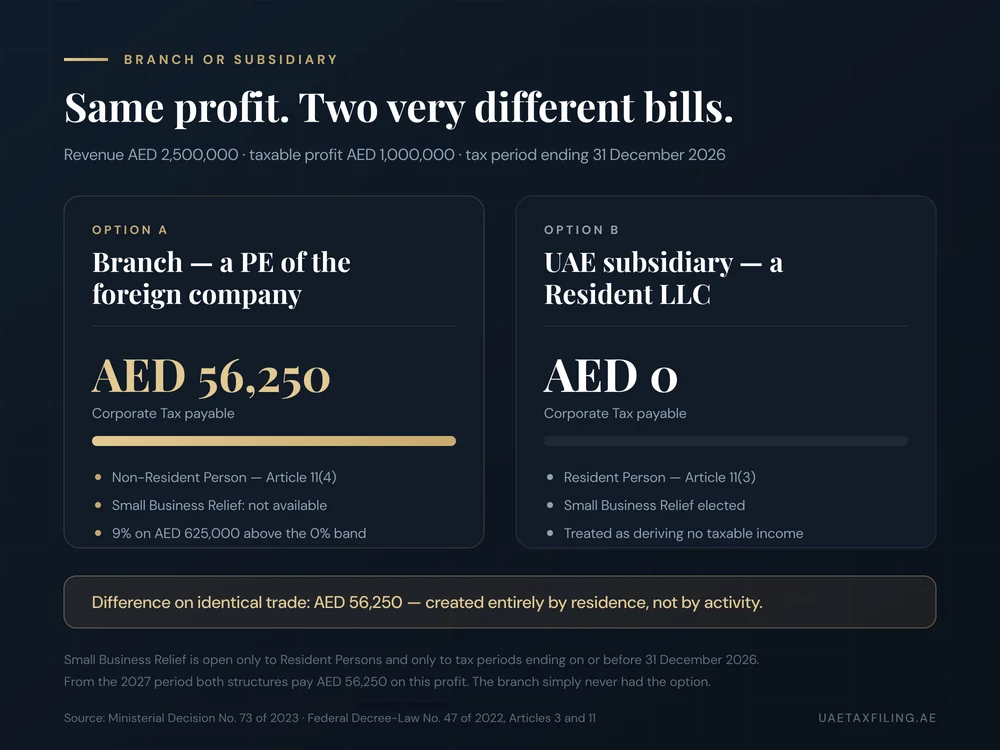
Take a foreign group with AED 2,500,000 of UAE revenue and AED 1,000,000 of taxable profit, for a tax period ending 31 December 2026.
| Branch (PE of a non-resident) | UAE subsidiary (Resident LLC) | |
|---|---|---|
| Status | Non-Resident Person — Article 11(4) | Resident Person — Article 11(3) |
| Revenue tested for relief | Not applicable | AED 2,500,000 (under AED 3m) |
| Small Business Relief | Not available | Available and elected |
| 0% band on first AED 375,000 | Yes | Not needed — relief applies first |
| Taxable at 9% | AED 625,000 | AED 0 |
| Corporate Tax payable | AED 56,250 | AED 0 |
| Transfer pricing file on head-office dealings | Required | Only for related-party dealings |
| Position from the 2027 tax period | AED 56,250 | AED 56,250 |
Two honest caveats. Small Business Relief only applies to tax periods ending on or before 31 December 2026 as the rule stands, so this AED 56,250 advantage is a closing window rather than a permanent feature. And a subsidiary carries incorporation cost, its own audit obligations and its own governance. The point is not that a subsidiary always wins. The point is that a branch never had the option, and almost nobody prices that in before signing the lease.
Key takeaway: before you set up a branch, model both structures for the periods you can actually see. Residence is a tax attribute you choose once and live with.
Deciding between a branch and a subsidiary? Send us your expected UAE revenue and profit and we will run both structures side by side for your actual tax periods, including whether the Small Business Relief window is still open to you. Ask on WhatsApp.
Registering and filing once a permanent establishment exists
Once a permanent establishment exists, the obligations are the same as for any Taxable Person, with one difference: the clock starts on the date the establishment came into existence, not on the date you noticed it.

- Fix the date the permanent establishment arose. Use the lease commencement, the first board meeting held here, the site mobilisation date, or the first contract negotiated locally — whichever came first. Document the reasoning while the evidence still exists.
- Apply for Corporate Tax registration. Under the FTA's permanent establishment rules and FTA Decision No. 3 of 2024, the deadlines are set out in the table below. The process runs through EmaraTax, and the mechanics are the same as registering any other entity for Corporate Tax.
- Attribute profit to the permanent establishment. Treat it as a separate and independent enterprise, and price dealings with head office under the arm's length standard. Head-office cost allocations are the first thing an FTA reviewer asks to see.
- Keep permanent establishment-level records. Standalone accounts for the UAE presence, in AED, retained for seven years after the end of the tax period.
- File and pay within nine months. The Corporate Tax return and the payment both fall due nine months after the end of the tax period. For a calendar-year 2025 period, that is 30 September 2026.
Registration deadlines for non-residents
| Situation | Deadline to apply | Source |
|---|---|---|
| Permanent establishment existing before 1 March 2024 | 9 months from the date of existence of the PE | FTA Decision No. 3 of 2024, Art. 4(1) |
| Permanent establishment arising on or after 1 March 2024 | 6 months from the date of existence of the PE | FTA Decision No. 3 of 2024, Art. 4(2) |
| Nexus existing before 1 March 2024 | 3 months from 1 March 2024 | FTA Decision No. 3 of 2024, Art. 4(1) |
| Nexus arising on or after 1 March 2024 | 3 months from the date the nexus is established | FTA Decision No. 3 of 2024, Art. 4(2) |
| Failure to apply on time | AED 10,000 administrative penalty | Cabinet Decision No. 75 of 2023 |
Key takeaway: the registration deadline is backdated to a factual event. By the time most foreign groups ask the question, the six months have usually already run — which makes the penalty arithmetic part of the first conversation, not the last.
When a domestic permanent establishment is not a treaty permanent establishment
A double tax treaty can override the domestic test. The UAE has one of the largest treaty networks in the world — more than 140 agreements — and where a treaty applies, its permanent establishment article governs the UAE's taxing right over a resident of the other state.
Treaty definitions are often narrower than Article 14. Many UAE treaties set the construction threshold at nine or twelve months rather than six. Some contain a services permanent establishment clause that turns on days of presence. Others exclude specific activities that domestic law would capture.
Claiming treaty protection is a documentation exercise: the foreign entity must be a resident of the treaty partner, and it needs to show it. On the outbound side, the same logic drives UAE tax residency certificates and the treatment of cross-border payments under the treaty network.
Key takeaway: run the domestic test first, then check the treaty. A treaty can rescue you from a permanent establishment finding, but only if the paperwork exists before the assessment does.
The seven-question permanent establishment self-test
This is the sequence our team runs on a first call with a foreign group. Answer honestly, in order. A single "yes" in questions one to five means the analysis has to be done properly.
- Is there any place in the UAE — leased, owned, borrowed, or a spare room — that your people use regularly for your business?
- Are management or commercial decisions necessary to run the business, in substance, taken in the UAE?
- Has any site, project, installation or supervisory activity here run more than six months in aggregate, counting related parties?
- Does anyone in the UAE habitually conclude contracts for you, or negotiate the terms of contracts you sign unchanged?
- Does the group earn income from immovable property located in the UAE?
- If you rely on the preparatory or auxiliary exemption, is the place used solely for the listed activities, and does no related party carry on connected business here?
- If you rely on the remote-worker position, is the role genuinely outside your core income-generating activity and is your UAE-sourced income actually nil?
The numbers worth memorising
| Figure | What it governs |
|---|---|
| AED 375,000 | Profit taxed at 0% before the 9% rate applies |
| 9% | Standard Corporate Tax rate above that threshold |
| 0% | Withholding tax on State Sourced Income not attributable to a PE (Article 45) |
| 6 months | Construction-site fuse, and the registration window for a post-March-2024 PE |
| 3 months | Registration window where the trigger is nexus |
| 9 months | Filing and payment deadline after the tax period ends |
| 7 years | Record retention after the end of the tax period |
| AED 10,000 | Late Corporate Tax registration penalty |
| 140+ | UAE double tax treaties that may override the domestic PE test |
If you cannot say, in one sentence and with a date, why your UAE presence is not a permanent establishment, you do not have a position. You have a hope.
Frequently asked questions
Does a UAE trade licence create a permanent establishment?
No. The FTA confirmed in its July 2026 summary of private clarifications that permanent establishment status depends on the facts and circumstances of each case, not on holding a licence. The reverse is also true: a foreign company with no UAE licence can still have a permanent establishment through its actual activity and presence.
Is a representative office a permanent establishment?
Only if it does more than represent. A representative office restricted to marketing, information gathering and liaison usually sits inside the preparatory or auxiliary exemption in Article 14(3). Once it negotiates prices, handles orders, or supports the core income-generating activity, the exemption fails and the office becomes a fixed place permanent establishment.
Can a permanent establishment claim Small Business Relief?
No. Ministerial Decision No. 73 of 2023 restricts Small Business Relief to Resident Persons, and a permanent establishment belongs to a Non-Resident Person. The permanent establishment still benefits from the 0% band on the first AED 375,000 of taxable income, but it cannot elect the relief that would otherwise remove its liability entirely.
Does one employee working remotely from Dubai create a permanent establishment?
Not automatically. It depends on what the employee does and what the employer earns here. Where the activities are outside the employer's core income-generating activity and the employer derives no State Sourced Income, Article 14(7)(b) prevents a permanent establishment. A sales or client-facing role, or any UAE revenue, takes you outside that protection.
My foreign company owns a Dubai apartment and rents it out. Do I need to register?
Yes. Cabinet Decision No. 56 of 2023 gives a non-resident juridical person a nexus in the UAE where it earns income from immovable property here, held either as a business asset or as an investment. Registration is due within three months, and the income is taxed on a net basis after deductible expenditure.
Do free zone premises protect a foreign company from a permanent establishment?
No. Nothing in Article 14 excludes free zones. What the FTA clarified in July 2026 is how branches are grouped: an entity and its free zone branches are assessed collectively for Qualifying Free Zone Person status, while a mainland branch is assessed separately as a permanent establishment and taxed on its own income at 9% above AED 375,000.
How is profit attributed to a UAE permanent establishment?
The permanent establishment is treated as a separate and independent enterprise dealing with its head office at arm's length. That means functions, assets and risks are identified, dealings with head office are priced on transfer pricing principles, and head-office cost allocations must be supportable. Attribution disputes almost always begin with unevidenced management charges.
What happens if we register late?
A late Corporate Tax registration application triggers an AED 10,000 administrative penalty under Cabinet Decision No. 75 of 2023. Registering late voluntarily is materially cheaper than being found: unpaid tax attracts its own penalties, and the FTA can assess back to the date the permanent establishment actually arose.
Can a double tax treaty stop a UAE permanent establishment?
It can. Where the foreign company is resident in a treaty partner state, the treaty's permanent establishment article governs the UAE's taxing right, and treaty thresholds are often narrower than Article 14 — nine or twelve months for construction rather than six, for example. The relief depends on evidencing treaty residence, not on asserting it.
Does a permanent establishment file its own corporate tax return?
The non-resident person files, and the return covers the taxable income attributable to its UAE permanent establishment. The return and the payment are both due within nine months of the end of the tax period, and the permanent establishment must keep standalone records supporting the attributed result for seven years.
What to do this week
If any of questions one to five in the self-test produced a "yes", the useful next step is not more reading. It is fixing a date and checking whether a registration window has already closed, because that determines whether you are managing a filing or managing a penalty.
Send us the three facts that decide it — what your UAE presence physically is, who signs contracts, and when it started — and we will tell you whether a permanent establishment exists, what date it arose from, and what the registration deadline is. Message the team on WhatsApp using the button below, or request a free consultation from the panel on this page. If the answer is that you have no permanent establishment, we will say that too, in writing.
Last reviewed on 9 August 2026 by Jazim, CEO of UAE Tax Filing LLC, Dubai. Methodology: every threshold, deadline and rate in this article was verified against the published text of Federal Decree-Law No. 47 of 2022, Cabinet Decision No. 56 of 2023, Ministerial Decision No. 83 of 2023, Ministerial Decision No. 73 of 2023 and FTA Decision No. 3 of 2024. This article is general guidance on UAE Corporate Tax and is not a substitute for advice on your own facts.