
Last updated: 20 August 2026 · Written by the UAE Tax Filing editorial team · Reviewed by Jazim, CEO, UAE Tax Filing LLC (Dubai) · 11 min read
You must deregister for UAE VAT within 20 business days of stopping taxable supplies or your taxable supplies over 12 months falling below AED 187,500. That is a legal duty, not a choice, and missing the window triggers a penalty of AED 1,000 a month up to AED 10,000. Deregistration is only approved once you have filed a final return and cleared what you owe. Where the deemed supply is a service, the value is worked out by formula — see our guide to valuing a deemed supply of services.
People treat deregistration as an afterthought when a business winds down. It is the opposite: the clock starts the moment you stop trading, the penalty runs monthly, and the FTA will not close your file until every dirham of VAT is settled.
The short version
- Deregistration can be mandatory. Under Article 21 of Federal Decree-Law No. 8 of 2017, you must apply if you stop making taxable supplies or fall below AED 187,500 over 12 months.
- Or voluntary. Under Article 22, you may apply if your taxable supplies over 12 months drop below the AED 375,000 mandatory threshold.
- The deadline is 20 business days. The application is due within 20 business days of the event that triggers it.
- Late costs money. A late application is fined AED 1,000, then AED 1,000 for each further month, capped at AED 10,000.
- You file a final return first. The FTA approves deregistration only after your final VAT return is filed and all tax and penalties are paid.
What this covers
- What VAT deregistration is
- Mandatory deregistration (Article 21)
- Voluntary deregistration (Article 22)
- The 20-business-day deadline
- How to deregister: the steps
- The late-deregistration penalty
- The dormant-company trap
- VAT vs corporate tax deregistration
- After deregistration: what changes
- Frequently asked questions
What VAT deregistration is
VAT deregistration is the process of cancelling a business’s VAT registration and its Tax Registration Number with the Federal Tax Authority. It ends the obligation to charge VAT, file VAT returns and recover input tax.
Registration and deregistration are two ends of the same system. A business joins the VAT regime when its taxable supplies cross a threshold, and it leaves when it stops making them or drops back below the line. Deregistration is not the same as simply going quiet: until the FTA cancels your TRN, you remain a registrant with full filing duties, so an inactive company that never deregisters keeps accruing return deadlines and penalties. The mechanics that brought you into the system in the first place are set out in our VAT registration guide.
Key takeaway: Deregistration cancels your VAT registration and TRN, ending your VAT duties. Until it is approved, you are still a registrant — stopping trade does not stop your filing obligations.
Mandatory deregistration (Article 21)
Mandatory deregistration is where the law requires you to apply, not where you choose to. Article 21 obliges a registrant to apply for deregistration if it stops making taxable supplies, or if its taxable supplies over 12 consecutive months fall below the voluntary registration threshold of AED 187,500.
Two situations cover most cases. The first is ceasing to trade — closing, selling or liquidating the business, or shifting entirely to activities that are not taxable supplies, such as making only exempt supplies. The second is shrinking below AED 187,500 of taxable supplies across a rolling year. In either case the word in the law is “shall”: you are required to apply, and the 20-business-day clock starts at the triggering event. A business that halves in size and dips under AED 187,500 must deregister even if the owner would rather stay registered.
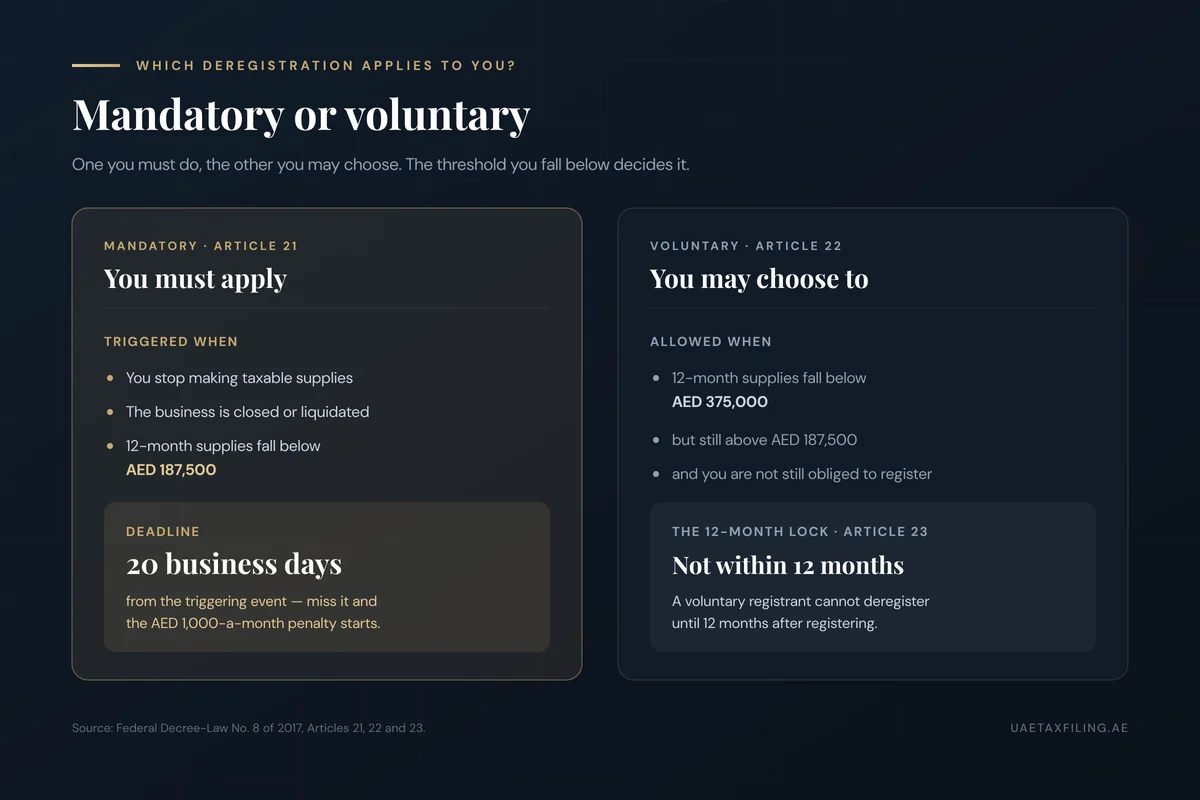
Key takeaway: Deregistration is mandatory if you stop taxable supplies or fall below AED 187,500 over 12 months. “Shall apply” means you have no discretion — the duty and the 20-day clock begin at the event.
Voluntary deregistration (Article 22)
Voluntary deregistration is where you may choose to leave the VAT system because your business has shrunk, without being forced to. Article 22 allows a registrant to apply if its taxable supplies over the past 12 months were less than the mandatory registration threshold of AED 375,000.
This sits in the band between the two thresholds. A business with taxable supplies below AED 375,000 but still above AED 187,500 is not required to deregister, but it is allowed to — useful for a small operator that no longer wants the compliance load. There is one hard limit: under Article 23, a business that registered voluntarily cannot deregister within 12 months of registering. That stops businesses from registering to recover a one-off cost and then leaving immediately.
| Mandatory (Art. 21) | Voluntary (Art. 22) | |
|---|---|---|
| Do you have to? | Yes — you must apply | No — you may apply |
| Main trigger | Stopped supplies, or below AED 187,500 | Below AED 375,000 (still above 187,500) |
| Deadline | 20 business days | When you choose (subject to the lock) |
| 12-month lock | Not applicable | No deregistration within 12 months of registering |
Key takeaway: Between AED 187,500 and AED 375,000 you may deregister voluntarily but need not. Voluntary registrants must also wait 12 months from registration before they can leave.
The 20-business-day deadline
The deadline to apply for VAT deregistration is 20 business days from the event that triggers it. Business days exclude weekends and public holidays, so the calendar window is a little longer than it sounds — but it is short.
The triggering event is what matters. For a business that ceases trading, the clock starts on the date it stops making taxable supplies; for one that falls below the threshold, it starts once the 12-month figure drops under AED 187,500. Twenty business days is roughly four working weeks, which disappears quickly when a company is being wound down and VAT is not the priority. Diarising the date the moment you stop trading is the single most effective way to avoid the penalty.
Take a concrete case. A consultancy issues its last invoice and closes on 1 March, having stopped taxable supplies. Its 20-business-day window runs to roughly the end of March, so the deregistration application should be in by then. If the owner instead files in July, the application is about four months late, and the AED 1,000-a-month penalty has already reached AED 4,000 — before the final return is even settled.
The most common deregistration penalty is not for doing it wrong — it is for doing it late. Owners assume that once the business stops, its tax obligations stop too. They do not: the 20-day clock is already running while the shutters come down.
Key takeaway: You have 20 business days from the triggering event to apply. The window opens when you stop supplies or drop below AED 187,500 — not when you get around to the paperwork.
How to deregister: the steps
VAT deregistration is a five-step process on EmaraTax that ends with the FTA cancelling your TRN. It is not instant — approval depends on your account being clean.
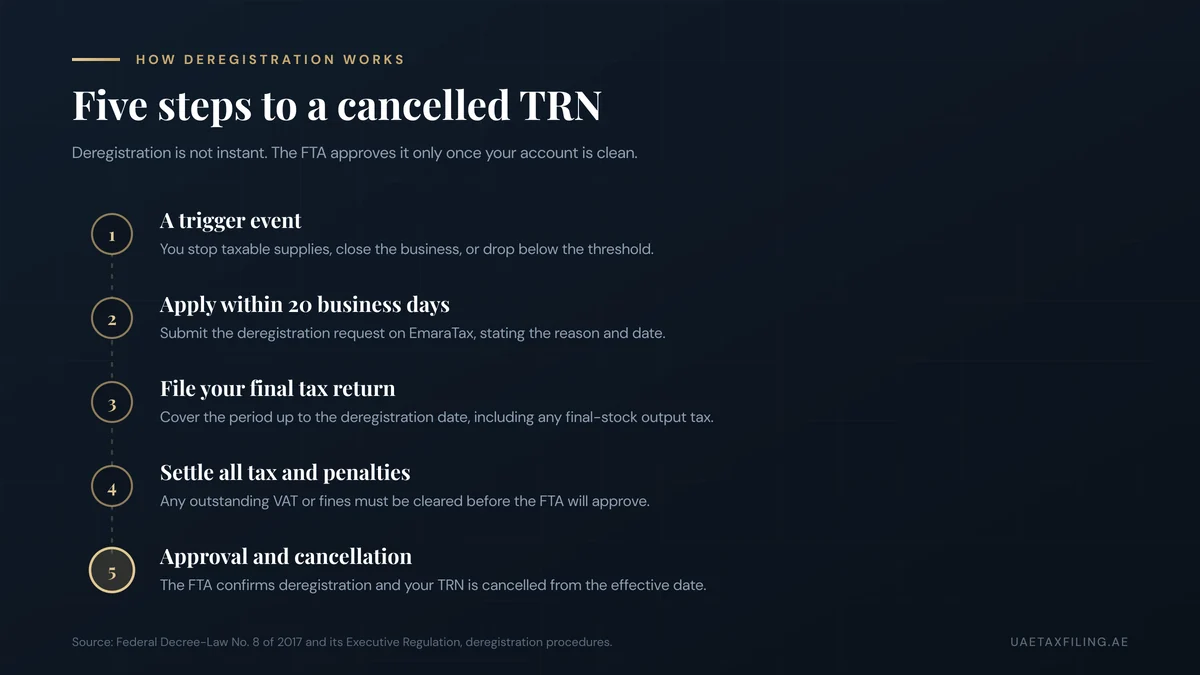
The sequence runs as follows:
- A trigger event. You stop taxable supplies, close the business, or your 12-month supplies fall below the threshold.
- Apply within 20 business days. Submit the deregistration request on EmaraTax, stating the reason and the effective date.
- File your final VAT return. Cover the period up to the deregistration date, including any output tax due on business assets you still hold — see our guide to filing a VAT return without errors.
- Settle all tax and penalties. Any outstanding VAT or fines must be paid before the FTA will approve the application.
- Approval and cancellation. The FTA confirms deregistration and cancels your TRN from the effective date.
Key takeaway: Apply on EmaraTax, file a final return, and clear every liability — only then is deregistration approved and the TRN cancelled. A balance owing keeps your registration open.
The late-deregistration penalty
The penalty for failing to apply on time is AED 1,000 for the delay, then AED 1,000 for each further month, up to a maximum of AED 10,000. It is charged for missing the 20-business-day deadline, regardless of whether any VAT is owed.
The escalation is what makes it bite. A month late is AED 1,000; five months is AED 5,000; and it caps at AED 10,000 once the delay reaches ten months. Crucially, this fine is separate from any VAT you still owe — both have to be cleared to complete deregistration, and the wider fee structure is set out in our guide to the UAE VAT penalty regime. A dormant company that was never deregistered can quietly rack up the full AED 10,000 before anyone notices.
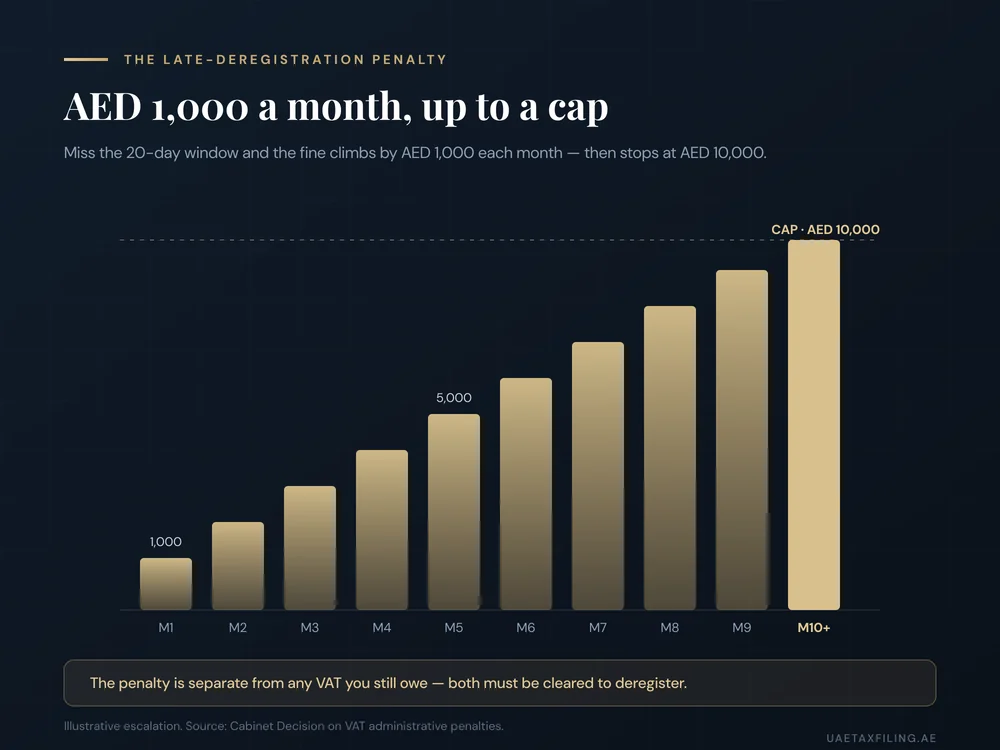
Key takeaway: Late deregistration costs AED 1,000 a month up to AED 10,000, on top of any VAT due. The fine applies for missing the deadline alone, even if your balance is nil.
The dormant-company trap
The dormant-company trap is what happens when a business stops trading but never deregisters. A registrant that goes silent stays registered, keeps every filing deadline, and quietly accumulates penalties until someone acts.
This is the most expensive deregistration mistake, and it is entirely avoidable. A registered company that has stopped trading still owes a VAT return each period; miss those, and late-filing and late-payment penalties stack on top of the AED 10,000 late-deregistration fine. Founders who move on to a new venture and leave an old company registered are the classic case — the entity is doing nothing, but the FTA account is still live and still counting. The fix is always the same: deregister as soon as the trading stops, rather than assuming an inactive company is a closed one.
An idle company is not a free company. As long as its TRN is active, it is a taxpayer with obligations — and an unfiled return on a business that earns nothing still carries a penalty. Deregistration is how you switch those obligations off.
Key takeaway: A business that stops trading but stays registered keeps accruing return deadlines and penalties. Deregister when trade stops — an inactive TRN is not a closed one.
VAT vs corporate tax deregistration
VAT deregistration and corporate tax deregistration are two separate processes with different rules, and doing one does not do the other. A business closing down usually has to deregister for both, under different laws and timelines.
They share a logic — you leave a tax when you no longer fall within it — but the triggers differ. VAT deregistration turns on taxable supplies and the AED 187,500 and AED 375,000 thresholds; corporate tax deregistration turns on ceasing business, and its own deadline and process. A company that shuts down must handle each in its own portal and its own window. The corporate-tax side is covered in full in our guide to corporate tax deregistration in the UAE.
Key takeaway: VAT and corporate tax deregistration are independent. Closing a business generally means completing both, each under its own law, deadline and penalty.
After deregistration: what changes
Once deregistration is approved, the business stops charging VAT, stops filing VAT returns and loses the right to recover input tax from that date. The TRN is cancelled and can no longer appear on invoices.
A few duties survive the cancellation. Records must still be kept for the statutory retention period, because the FTA can audit past periods after deregistration. Any VAT charged after the effective date would be charged in error and would have to be refunded or corrected. And if the business later starts making taxable supplies again above the threshold, it must register afresh — deregistration is not a pause button. For a business shifting into only exempt activity, our guide to zero-rated vs exempt supplies explains why that shift can force deregistration in the first place.
Key takeaway: After deregistration you stop charging VAT and filing returns, but you keep your records and remain open to audit. Resuming taxable trade means registering again from scratch.
Tell us where you stand — whether you have stopped trading, dropped below a threshold, or are closing the company — and we will tell you whether you must deregister, by when, and what final return is due. Where you need the deregistration and final filing handled, we match you with an FTA-registered partner agency that does it. Message the team on WhatsApp using the button below.
Frequently asked questions
When must I deregister for VAT in the UAE?
You must deregister if you stop making taxable supplies, or if your taxable supplies over 12 consecutive months fall below AED 187,500. In either case the application is due within 20 business days of the event. This is mandatory deregistration under Article 21.
What is the difference between mandatory and voluntary deregistration?
Mandatory deregistration is required when you stop taxable supplies or fall below AED 187,500. Voluntary deregistration is optional and available when your taxable supplies over 12 months drop below the AED 375,000 mandatory threshold but stay above AED 187,500. One you must do; the other you may choose.
How long do I have to apply for VAT deregistration?
You have 20 business days from the event that triggers deregistration. For a business that ceases trading, the clock starts on the date it stops making taxable supplies. Business days exclude weekends and public holidays.
What is the penalty for late VAT deregistration?
The penalty is AED 1,000 for the initial delay, then AED 1,000 for each subsequent month, up to a maximum of AED 10,000. It applies for missing the 20-business-day deadline and is separate from any VAT you still owe.
Can I deregister for VAT right after registering?
Not if you registered voluntarily. Under Article 23, a voluntary registrant cannot apply for deregistration within 12 months of the date of registration. A business that was required to register does not face this 12-month lock.
Do I need to file a final VAT return before deregistering?
Yes. The FTA approves deregistration only after you file a final VAT return covering the period up to the deregistration date and settle all outstanding tax and penalties. The final return may include output tax on business assets you still hold.
What happens to my TRN after deregistration?
Your Tax Registration Number is cancelled from the effective date and must no longer appear on invoices. You stop charging VAT and filing returns, but you must keep your records for the retention period, as past periods can still be audited.
Is VAT deregistration the same as corporate tax deregistration?
No. They are separate processes under different laws, with different triggers and deadlines. A business closing down usually has to deregister for both VAT and corporate tax, each in its own EmaraTax process.
What if my turnover drops below AED 375,000 but stays above AED 187,500?
You are not required to deregister, but you may choose to. That band is the voluntary deregistration zone under Article 22. If your taxable supplies fall further, below AED 187,500, deregistration then becomes mandatory.
How we verified this: the deregistration conditions and thresholds are taken from Articles 21, 22 and 23 of Federal Decree-Law No. 8 of 2017 and its Executive Regulation; the penalty follows the Cabinet Decision on VAT administrative penalties. Confirm current text in the FTA VAT Decree-Law. This article is general information, not tax advice.
Last updated: 20 August 2026 · Reviewed by Jazim, CEO, UAE Tax Filing LLC (Dubai)