Last updated: 20 August 2026 · Written by the UAE Tax Filing editorial team · Reviewed by Jazim, CEO, UAE Tax Filing LLC (Dubai) · 11 min read
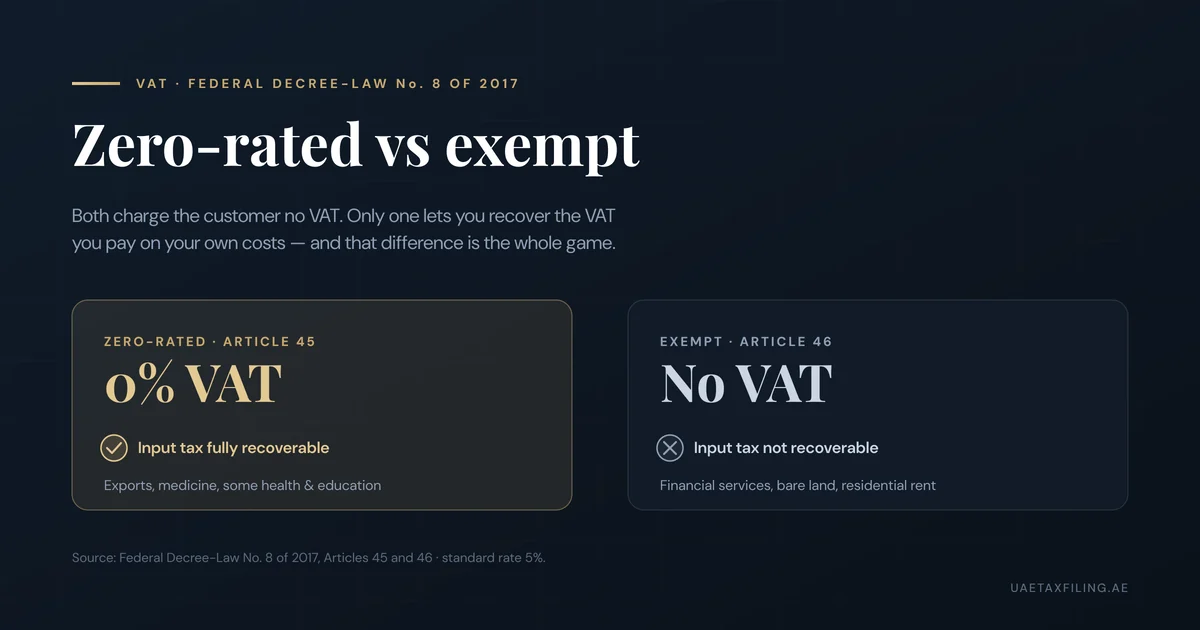
Zero-rated and exempt supplies both mean the customer pays no VAT, but they are not the same. A zero-rated supply is taxable at 0%, and the business can still recover the VAT it paid on its own costs. An exempt supply carries no VAT at all, and the business cannot recover that input tax — so it becomes a real cost. That single difference decides which one helps you and which one quietly hurts.
To a customer, a zero-rated invoice and an exempt invoice look identical: both show no VAT. To the business issuing them, they are opposites. One keeps you inside the VAT system with full recovery; the other locks you out of it.
The short version
- Zero-rated is taxable at 0%. Under Article 45 of Federal Decree-Law No. 8 of 2017, the supply is taxed — just at a zero rate — and input tax is recoverable.
- Exempt carries no VAT. Under Article 46, the supply is outside the tax, and the related input tax cannot be recovered.
- Input tax is the whole difference. Zero-rated lets you reclaim VAT on your costs; exempt does not, which turns that VAT into a cost.
- They count differently for registration. Zero-rated sales count toward the AED 375,000 threshold; exempt sales do not.
- Property is where people slip. The first supply of a new home is zero-rated; later sales and residential rent are exempt.
What this covers
- What zero-rated and exempt mean
- The one difference that matters: input tax
- What is zero-rated: the Article 45 list
- What is exempt: the Article 46 list
- Input tax recovery: the real cost
- Registration: what counts and what does not
- The residential-property trap
- Mixed supplies and partial recovery
- Which is better for your business
- Frequently asked questions
What zero-rated and exempt mean
Zero-rated and exempt are the two ways a UAE supply can carry no VAT for the customer. A zero-rated supply is a taxable supply on which VAT is charged at 0%; an exempt supply is one that sits outside VAT entirely.
The wording matters more than it looks. “Taxable at 0%” keeps the supply inside the VAT system: it is still a taxable supply, it still appears on the VAT return, and the business retains the right to recover input tax. “Exempt” removes the supply from the system: no output tax, no input-tax recovery, and it does not count as a taxable supply for registration. The UAE standard rate is 5%; zero-rated and exempt are the two exceptions to it, and they behave very differently despite both showing zero to the buyer.
Key takeaway: Zero-rated is taxed at 0% and stays inside VAT; exempt is outside VAT altogether. The customer sees no VAT either way, but only the zero-rated business keeps its recovery rights.
The one difference that matters: input tax
The defining difference between zero-rated and exempt supplies is input-tax recovery. A zero-rated business recovers the VAT it pays on costs; an exempt business cannot, so that VAT becomes part of its expenses.
Everything else follows from this. Because a zero-rated supplier stays in the system, it reclaims input VAT on rent, stock, software and services in the normal way, and often receives net refunds. An exempt supplier charges nothing and reclaims nothing, so every dirham of VAT on its costs is absorbed. The table sets the three treatments against each other.
| Treatment | VAT on sale | Recover input tax? | Counts for registration? |
|---|---|---|---|
| Standard-rated | 5% | Yes | Yes |
| Zero-rated | 0% | Yes | Yes |
| Exempt | None | No | No |
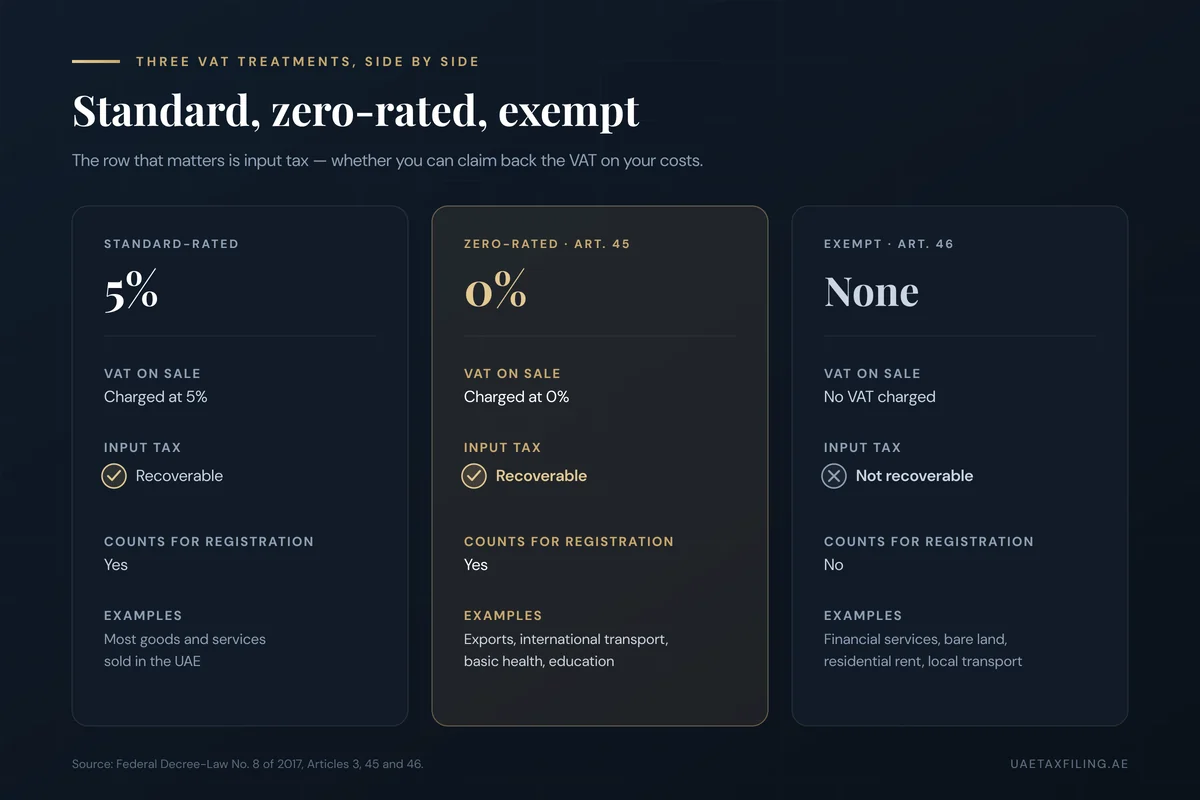
Key takeaway: Zero-rated and exempt differ on one line: input-tax recovery. Zero-rated recovers it and standard-rated recovers it; exempt does not, which is why exempt is the costly one to sit in.
What is zero-rated: the Article 45 list
Zero-rated supplies are the specific goods and services the law taxes at 0%, listed in Article 45. There are fourteen categories, and anything outside them is not zero-rated.
The main categories are: exports of goods and services outside the GCC implementing states; international transport of passengers and goods and related services; the supply of air, sea and land means of transport and goods related to their operation; investment-grade precious metals; the first supply of new residential buildings within three years of completion; buildings for charities and converted residential buildings; crude oil and natural gas; government-funded education and related supplies; and preventive and basic healthcare and related supplies. Exports are the one most businesses meet — sell to a customer outside the implementing states and, subject to evidence, the supply is zero-rated while your input tax stays recoverable. The evidence part is not optional: to zero-rate an export you need proof the goods left the country, such as customs documentation and commercial evidence retained for the record. Without it, the FTA can treat the supply as standard-rated and claw back the 5% you did not charge, so exporters keep export files as carefully as they keep invoices.
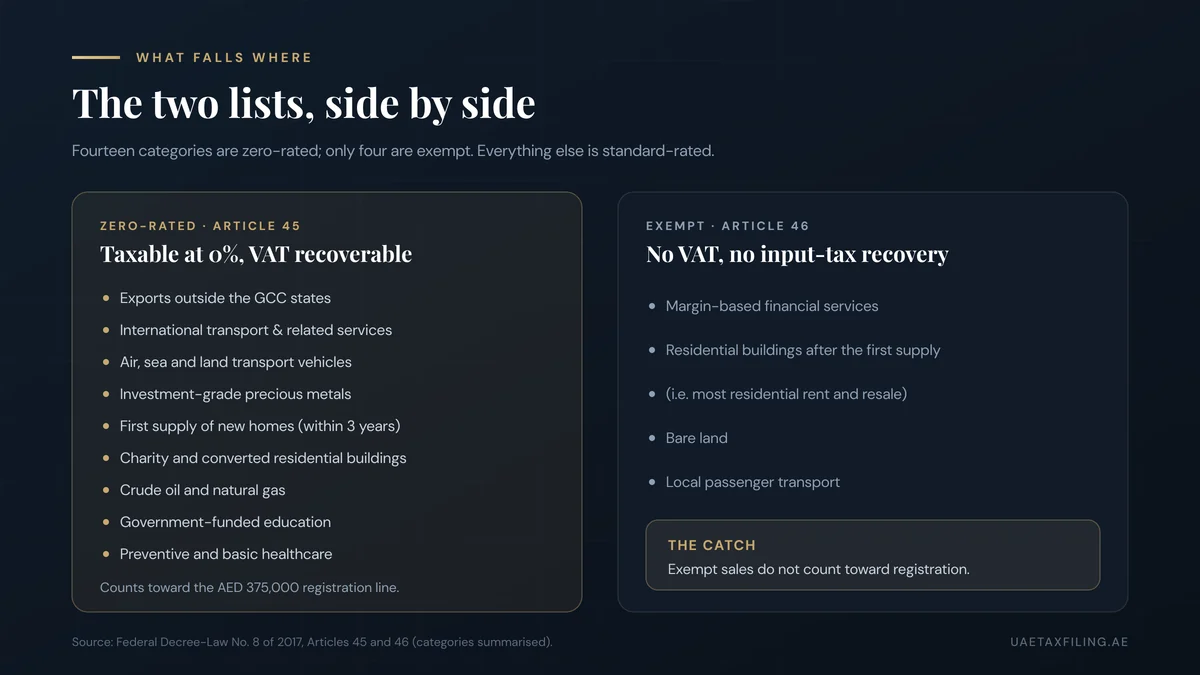
Key takeaway: Zero-rating is a defined list of fourteen categories — exports, transport, precious metals, new homes, oil and gas, government education and basic healthcare. If a supply is not on the list, it is standard-rated, not zero-rated.
What is exempt: the Article 46 list
Exempt supplies are the four categories the law places outside VAT, listed in Article 46. They carry no VAT and no input-tax recovery.
The four are: margin-based financial services; the supply of residential buildings by sale or lease, other than the first supply that is zero-rated; bare land; and local passenger transport. Financial services and residential property are the two that matter to most people — a bank’s interest margin and a landlord’s residential rent are both exempt. Because these fall outside VAT, the provider cannot recover the VAT on its own costs, which is the sting that catches new exempt businesses.
Exempt sounds like a benefit and often is not. A residential landlord charges no VAT on rent, which looks clean — until you realise the 5% VAT on agent fees, maintenance and furniture cannot be reclaimed. That unrecovered VAT is a permanent cost of being exempt.
Key takeaway: Only four categories are exempt — financial services, residential property after the first supply, bare land, and local passenger transport. Exempt means no VAT charged and no VAT recovered.
Input tax recovery: the real cost
Input tax is the VAT a business pays on its own purchases, and recovery is the right to claim it back. Zero-rated businesses recover input tax in full; exempt businesses cannot recover the input tax attributable to their exempt supplies.
The consequence is easiest to see with a number. Take two businesses that each pay AED 5,000 of VAT on their costs in a period. The zero-rated exporter reclaims the full AED 5,000, so its real VAT cost is zero. The exempt landlord reclaims nothing, so the AED 5,000 stays as a cost and usually ends up in the price the tenant pays. Same costs, opposite results — and the mechanism for actually claiming the recoverable side is the ordinary VAT return, with genuine refunds handled as set out in our guide to VAT refund claims.
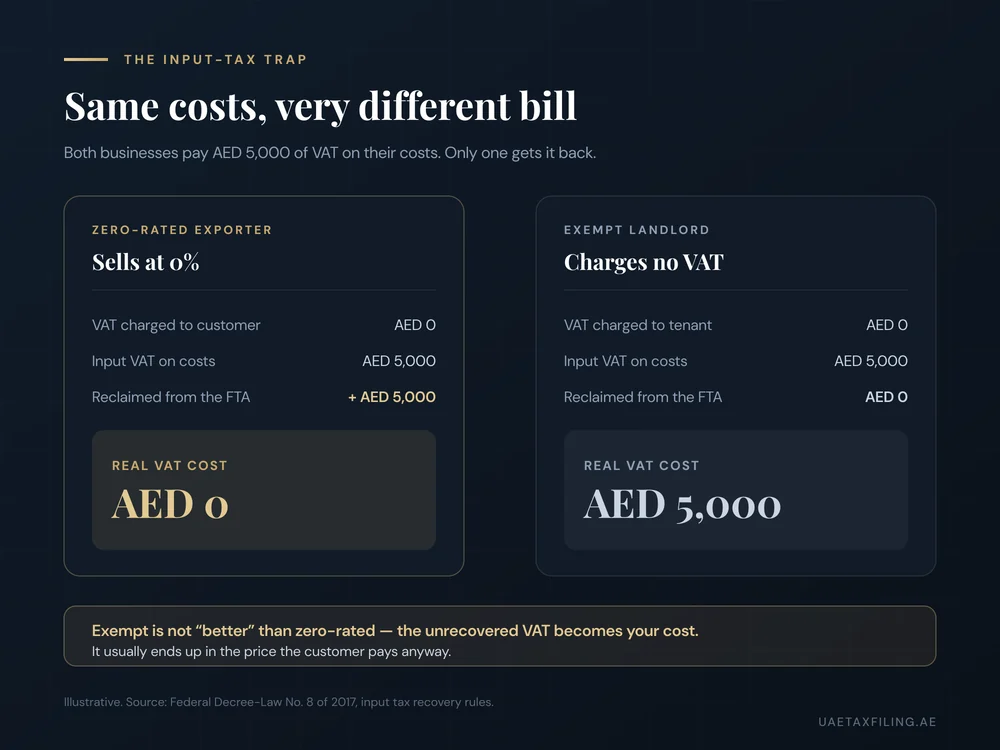
Key takeaway: Recovery is where zero-rated wins. The same input VAT is refunded to a zero-rated business and absorbed by an exempt one, which is why “exempt” can cost more than being taxed.
Registration: what counts and what does not
Zero-rated and exempt supplies are treated differently for VAT registration. Zero-rated supplies are taxable supplies, so they count toward the registration thresholds; exempt supplies do not count at all.
Mandatory registration is triggered at AED 375,000 of taxable supplies over a rolling 12 months, with voluntary registration available from AED 187,500. A business whose sales are entirely zero-rated still crosses that line and must register — though it can apply for an exception from registration, since it would only ever be in a refund position. A business making only exempt supplies never reaches the threshold on those supplies and generally cannot register at all. The full mechanics are in our VAT registration guide.
Key takeaway: Zero-rated sales count toward the AED 375,000 registration threshold; exempt sales do not. An all-zero-rated business must register but can seek an exception; an all-exempt business usually cannot register.
The residential-property trap
Residential property is the classic place where zero-rated and exempt collide. The first supply of a new residential building — sold or leased within three years of completion — is zero-rated; every supply after that is exempt.
This split has real consequences for developers and landlords. A developer selling brand-new units makes zero-rated supplies and recovers the VAT on construction costs. The moment the building is sold on, or rented out beyond that first supply, it becomes exempt, and input-tax recovery stops. That is why a developer’s VAT position and a buy-to-let landlord’s are completely different, even for the same flat. We cover the property rules in depth in our guide to VAT on real estate in the UAE.
Key takeaway: The first supply of a new home is zero-rated with full recovery; later sales and residential rent are exempt with none. The same building changes VAT character after its first supply.
Mixed supplies and partial recovery
A mixed business is one that makes both taxable supplies — standard-rated or zero-rated — and exempt supplies. Where a business has this mix, it can recover input tax in full on costs tied to its taxable supplies, none on costs tied to its exempt supplies, and a proportion of its shared overheads.
The shared costs are the hard part. Rent, software, accounting and management time serve the whole business, so the VAT on them is recovered by apportionment — usually the share of taxable supplies in total supplies. A property firm that both sells new units (zero-rated) and rents out older flats (exempt) is the textbook case: it recovers input tax on the development side, nothing on the letting side, and a calculated slice of head-office VAT. Getting that split right depends on clean records and correctly classified invoices, which is exactly why the tax invoice fields and supply coding matter so much. A small annual adjustment then trues up the estimate used through the year.
Partial recovery is where audits bite. Businesses that treat every input as fully recoverable, ignoring the exempt side, over-claim — and the correction, with any penalty, lands later. If part of your income is exempt, part of your input tax is not yours to take.
Key takeaway: A mixed business recovers input tax in full on taxable costs, none on exempt costs, and a proportion of shared overheads. The apportionment has to be calculated and documented, not assumed.
Which is better for your business
Zero-rated is almost always the better position, because it combines a 0% charge to the customer with full input-tax recovery. Exempt gives the same 0% to the customer but strips the recovery, so it is the weaker of the two whenever you incur VAT on costs.
You rarely get to choose, though — the treatment follows the supply, not your preference. What you can control is getting the classification right, because misclassifying an exempt supply as zero-rated leads to over-claimed input tax and a correction later, while the reverse leaves money on the table. If your mix includes both taxable and exempt supplies, you can only recover input tax in proportion to the taxable part, which is where apportionment and careful record-keeping earn their place. The routine that surrounds all of this — classifying supplies correctly and filing cleanly — is covered in our guide to filing your quarterly VAT return.
Key takeaway: Zero-rated beats exempt whenever you carry input VAT, but you cannot pick — the law assigns the treatment. The win is classifying each supply correctly and apportioning recovery where you have a mix.
Tell us what you sell — your main supplies, whether you export, and whether property or financial services are involved — and we will tell you how each line is treated, what you can recover, and whether you must register. Where you need registration or ongoing VAT filing, we match you with an FTA-registered partner agency that handles it. Message the team on WhatsApp using the button below.
Frequently asked questions
What is the difference between zero-rated and exempt supplies?
A zero-rated supply is taxable at 0% and the business can recover the input tax on its costs. An exempt supply carries no VAT and the business cannot recover that input tax. The customer pays no VAT either way, but only the zero-rated business keeps its recovery rights.
Can I recover input VAT on exempt supplies?
No. Input tax attributable to exempt supplies is not recoverable, so the VAT on your related costs becomes an expense. This is the main reason exempt status can cost a business more than being taxed at the standard rate.
Is rent zero-rated or exempt in the UAE?
Residential rent is exempt, while commercial rent is standard-rated at 5%. The one exception is the first supply of a new residential building within three years of completion, which is zero-rated. Ordinary residential leasing after that first supply is exempt.
Do zero-rated sales count toward VAT registration?
Yes. Zero-rated supplies are taxable supplies, so they count toward the AED 375,000 mandatory registration threshold. A business with only zero-rated sales must register, although it can apply to the FTA for an exception from registration.
Is a zero-rated supply the same as tax-free?
Not quite. A zero-rated supply is still within the VAT system and taxed, only at a rate of 0%, which is what preserves input-tax recovery. “Tax-free” usually describes exempt or out-of-scope supplies, where there is no recovery.
What are examples of zero-rated supplies in the UAE?
Exports outside the GCC implementing states, international transport, investment precious metals, the first supply of new residential buildings, crude oil and natural gas, government-funded education, and preventive and basic healthcare. These are set out in Article 45 of the VAT law.
What are examples of exempt supplies?
Margin-based financial services, residential buildings after the first supply, bare land, and local passenger transport. These four categories, listed in Article 46, carry no VAT and no input-tax recovery.
Is education zero-rated or exempt in the UAE?
Education owned or funded by federal or local government, along with related goods and services, is zero-rated. Private education that does not meet those conditions is generally standard-rated at 5%, not exempt.
Which is better for my business, zero-rated or exempt?
Zero-rated is better, because it charges the customer 0% while still allowing full input-tax recovery. Exempt gives the same 0% but blocks recovery. In practice you cannot choose — the treatment is fixed by the type of supply.
How we verified this: the treatments, categories and recovery rules are taken from Articles 3, 45 and 46 of Federal Decree-Law No. 8 of 2017 and its Executive Regulation. Confirm current text in the FTA VAT Decree-Law. This article is general information, not tax advice.
Last updated: 20 August 2026 · Reviewed by Jazim, CEO, UAE Tax Filing LLC (Dubai)