Last updated: 12 August 2026 · Written by the UAE Tax Filing editorial team · Reviewed by Jazim, CEO, UAE Tax Filing LLC (Dubai)
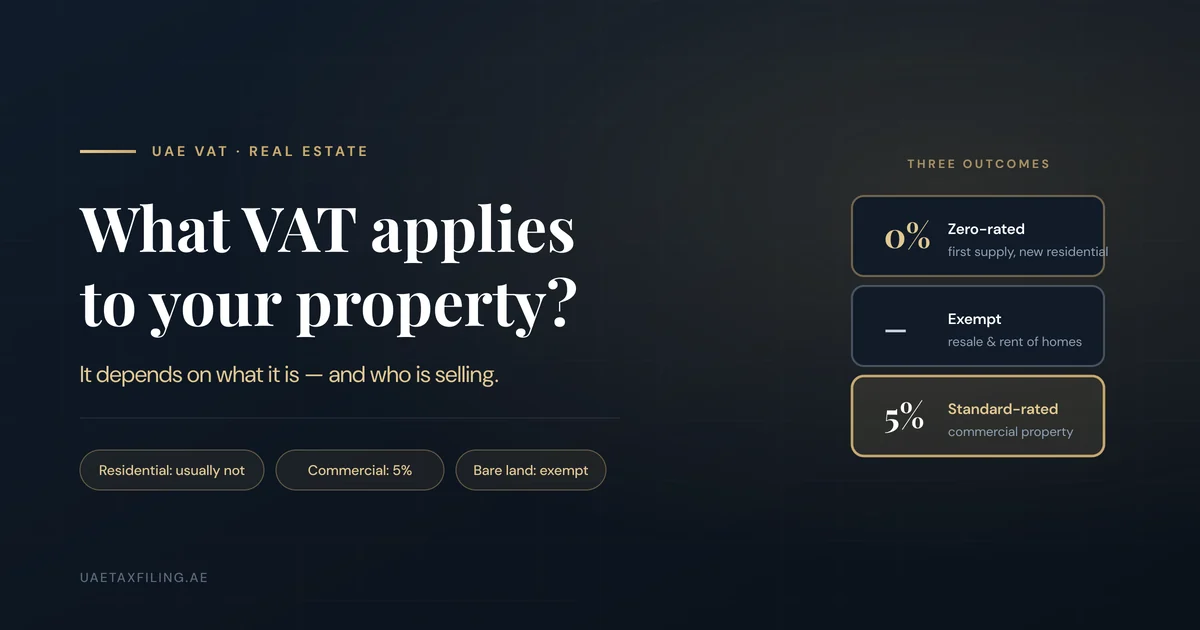
VAT on real estate in the UAE depends entirely on what the property is and who is supplying it. The first sale of a new home is zero-rated, later sales and rentals of homes are exempt, commercial property carries 5%, and bare land is exempt. Most residential deals never attract a VAT charge — but the wrong classification quietly costs landlords the VAT they could have reclaimed. UAE nationals building their own home use a separate scheme — see our guide to the new residence VAT refund.
The question everyone asks is "what rate?" The question that actually costs money is "can I get my input VAT back?" For property, those two answers do not always point the same way.
The short version
- New homes: 0%. The first supply of a new residential building within three years of completion is zero-rated, and the developer recovers the VAT on the build.
- Resale and rent of homes: exempt. Every residential supply after the first carries no VAT — and no input-VAT recovery for the owner.
- Commercial property: 5%. Offices, shops and warehouses are standard-rated on both sale and lease. A registered buyer using it for business recovers the 5%.
- Bare land: exempt; built land: 5%. Undeveloped land is outside VAT; once it carries buildings or infrastructure it is not.
- On a commercial resale, the buyer pays the FTA directly. The Special Payment Mechanism routes the 5% to the Federal Tax Authority, and the Land Department will not transfer title without proof.
What this covers
- How VAT works on UAE property
- Residential: zero-rated, then exempt
- Commercial property and the 5%
- Bare land and mixed-use buildings
- The input-VAT trap for landlords
- The Special Payment Mechanism on a commercial sale
- Selling a tenanted building as a going concern
- When a property owner must register for VAT
- Frequently asked questions
How VAT works on UAE property
VAT on UAE property is not a single rate — it is a set of outcomes decided by the type of property and the nature of the supply. The Federal Tax Authority applies the rules in Federal Decree-Law No. 8 of 2017 on VAT and its Executive Regulations, and real estate gets its own treatment because a building can be a home, a business asset, or raw land, and each is taxed differently.
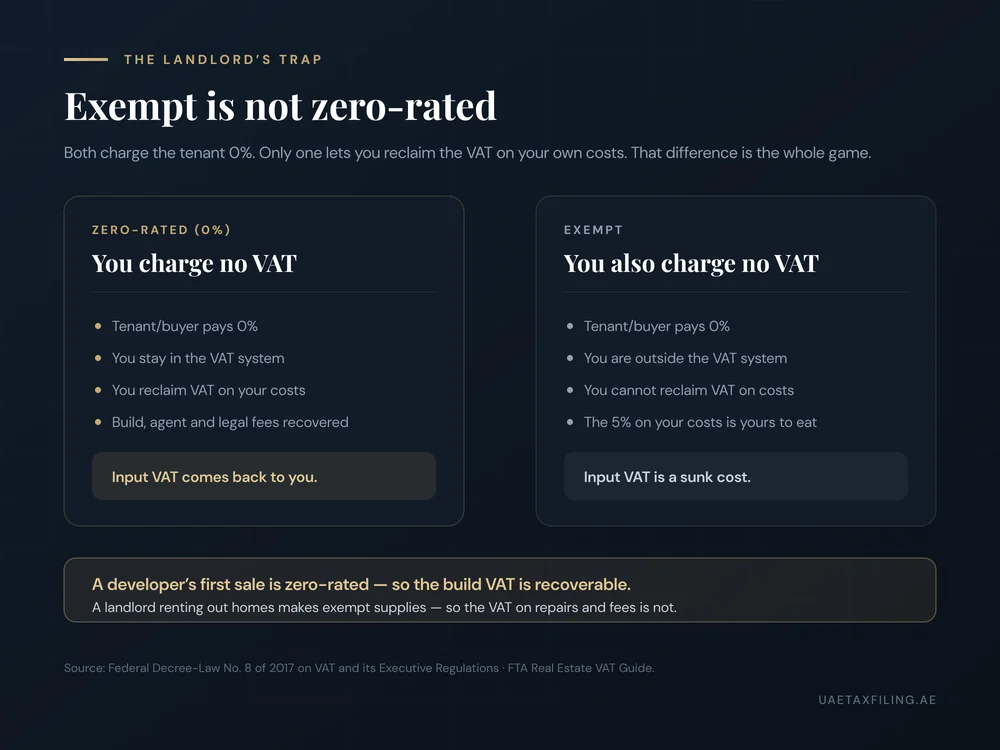
There are three possible outcomes for any property supply: standard-rated at 5%, zero-rated at 0%, or exempt. Standard and zero-rated are both "taxable" supplies — the difference is the rate. Exempt is outside the tax: no VAT is charged, and crucially no related input VAT can be reclaimed. That distinction between zero-rated and exempt is the single most misunderstood point in UAE property tax, and it is where owners lose money without noticing.
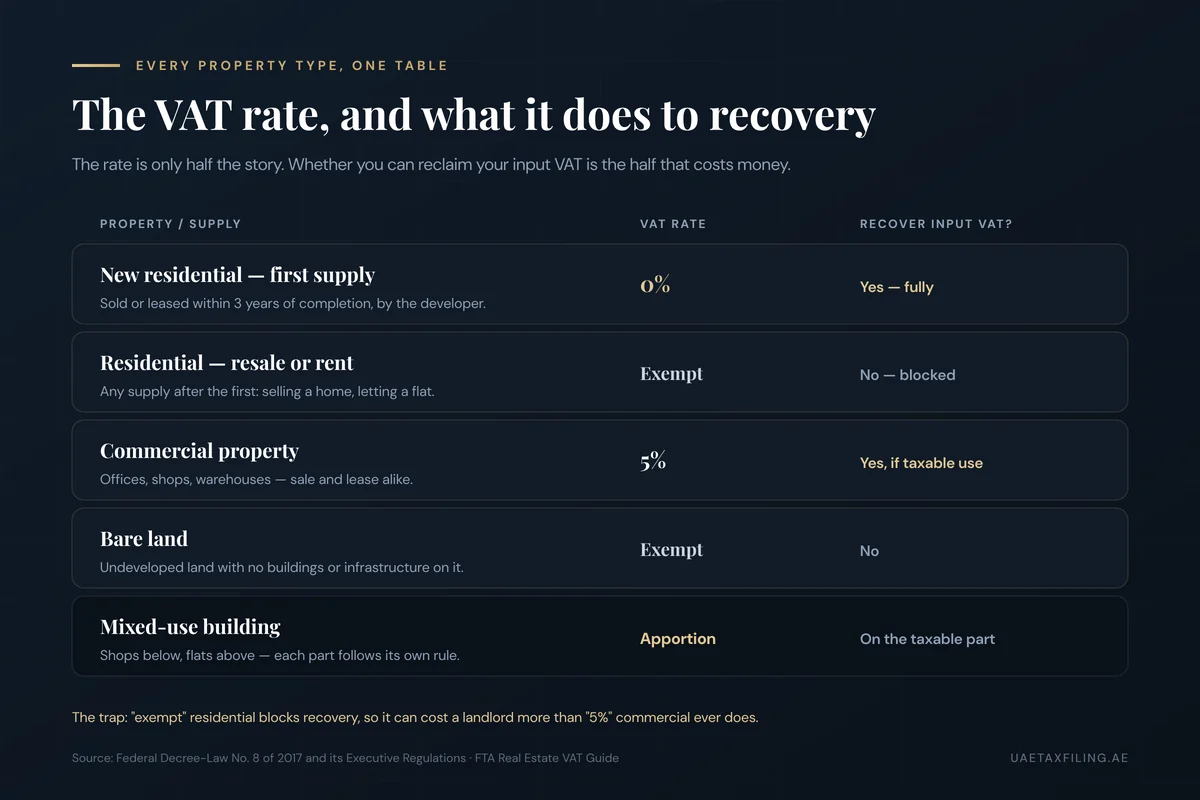
| Property / supply | VAT rate | Recover input VAT? |
|---|---|---|
| New residential — first supply (within 3 years) | 0% zero-rated | Yes — fully |
| Residential — resale or rent | Exempt | No — blocked |
| Commercial property (sale & lease) | 5% standard | Yes, if taxable use |
| Bare land | Exempt | No |
| Developed / built-on land | 5% standard | Yes, if taxable use |
| Mixed-use building | Apportioned | On the taxable part |
| Serviced / hotel accommodation | 5% standard | Yes, if registered |
Key takeaway: the rate is only half the answer. Whether a supply is zero-rated or exempt decides whether the owner can reclaim their own VAT costs, and that is often the bigger number.
Residential: zero-rated, then exempt
Residential property is zero-rated on its first supply and exempt on every supply after that. The first sale or lease of a new home — made within three years of the building's completion — is zero-rated at 0%. Any later sale or lease of that home is exempt.
The logic rewards construction. By zero-rating the first supply, the FTA lets a developer recover all the VAT incurred building the property, while charging the first buyer nothing. Once the home enters the ordinary market, VAT steps back entirely: when you sell your villa to another family, or rent out your apartment, you charge no VAT because the supply is exempt. A landlord letting flats is making exempt supplies, month after month, and never adds VAT to the rent.
If you are an individual buying, selling or renting a home, you almost never see a VAT charge. Residential property is the part of the market VAT was designed to leave alone.
"First supply" is a specific idea, not just "a sale". It is the first time the completed building is sold or leased, and the three-year window ties it to newness. Sell an off-plan apartment on completion and that is a zero-rated first supply; sell the same apartment five years later and it is an exempt second supply. The distinction matters most to developers, who need the zero rate to recover their construction VAT.
Key takeaway: the first supply of a new home is zero-rated so the developer recovers build VAT; every later residential sale or rent is exempt and carries no VAT at all.
Commercial property and the 5%
Commercial property is standard-rated at 5% on both sale and lease. Offices, shops, warehouses, showrooms and industrial units all attract VAT when they are sold or let, with no first-supply distinction and no exemption for later transfers.
Because commercial supplies are taxable, VAT flows the way it does for any business input: the seller or landlord charges 5%, and a VAT-registered buyer or tenant who uses the property for their taxable business recovers that 5% as input tax. A trading company leasing a warehouse pays 5% on the rent and reclaims it on its next VAT return, so the cost is cash-flow, not a permanent expense. That is the opposite of the residential landlord, whose exempt rent gives the tenant nothing to reclaim and the landlord no recovery on costs.
Serviced and short-stay accommodation sits on the commercial side of the line, not the residential one. A hotel, a serviced apartment or a holiday-let operation is treated as making standard-rated 5% supplies, because it is a commercial hospitality business rather than a residential letting. Owners who convert homes into short-term rentals move themselves from the exempt world into the taxable one, which changes both their VAT charge and their recovery position.
Key takeaway: commercial property is 5% on sale and lease, recoverable by a registered business user — and serviced or hotel accommodation counts as commercial, not residential.
Bare land and mixed-use buildings
Bare land is exempt from VAT; land with buildings or infrastructure on it is not. "Bare land" means undeveloped land with no completed buildings, partially completed buildings, or civil engineering works on it. Sell a genuinely empty plot and there is no VAT. Sell land that carries a building or has been developed with infrastructure, and the supply is standard-rated at 5%.
This is a common trap in land deals, because the classification turns on the physical state of the plot at the moment of supply, not on its zoning or intended use. A plot marketed as a development site but already carrying foundations or roadworks is not bare land, and the 5% applies. The safest position is to establish the land's status in writing before contracts, because getting it wrong turns a supposedly exempt sale into an under-declared taxable one.
A mixed-use building — shops on the ground floor, apartments above — is apportioned. The commercial portion follows the 5% rule, the residential portion follows the residential rules, and input VAT on shared costs is split between the taxable and exempt parts. Owners of mixed-use buildings that combine retail and residential space need a defensible apportionment method, because the FTA expects the split to reflect genuine use.
Key takeaway: bare land is exempt, developed land is 5%, and mixed-use buildings are apportioned between the two — classified by the property's actual state, not its label.
The input-VAT trap for landlords
The most expensive mistake in UAE property VAT is treating "exempt" as good news. Exempt and zero-rated both mean the customer pays no VAT, so they look identical from the tenant's side. The difference is entirely on the owner's side: a zero-rated supplier can reclaim the VAT on their own costs, while an exempt supplier cannot.
Play it out for two owners. A developer makes a zero-rated first supply, so the VAT on construction, professional fees and agents' commissions all comes back as input tax — the build is effectively VAT-neutral. A residential landlord makes exempt supplies, so the VAT on maintenance, agency fees, service charges and refurbishment is not recoverable at all. That 5% on every cost is a permanent expense the landlord absorbs, invisible on any rent invoice but very real in the accounts.
Exempt is not a lighter version of taxable. It removes you from the VAT system, and with it your right to reclaim the tax you pay on your own costs.
This is why the residential-versus-commercial choice has a hidden dimension. A commercial landlord charging 5% can recover input VAT on the building's running costs; a residential landlord charging nothing cannot. Neither is automatically better — it depends on the tenant mix and the cost base — but a landlord who assumes "exempt means I win" has usually not counted the recovery they are giving up. It is the same recovery logic that governs a business's wider VAT registration decision.
Key takeaway: zero-rated lets you reclaim input VAT; exempt does not. For a landlord, "exempt" can quietly cost more than a 5% charge would.
The Special Payment Mechanism on a commercial sale
When a commercial property is resold, the buyer usually pays the 5% VAT directly to the Federal Tax Authority rather than to the seller. This is the Special Payment Mechanism, and it exists to stop large VAT amounts going missing between a seller collecting the tax and remitting it.

The mechanism runs in a fixed order:
- The sale is agreed. A commercial building is sold by a VAT-registered seller who is not the original developer.
- The buyer pays the 5% to the FTA. The VAT goes directly to the authority, not to the seller.
- The FTA issues a Payment Transaction Number. This is the proof that the VAT has been settled.
- The buyer shows the Land Department. The property registration will not proceed without that proof of payment.
- The buyer recovers it later. If registered and using the property for taxable business, the 5% comes back as input VAT on the next return.
The mechanism is specific. It does not apply to residential sales, to commercial leases, to a sale by the original developer, or to a transfer that qualifies as a going concern. For those, VAT is handled the ordinary way — or not at all. But for the typical office-or-warehouse resale between businesses, the buyer paying the FTA first, then registering the title, is the standard route.
Key takeaway: on a commercial resale, the buyer pays the 5% to the FTA, collects a Payment Transaction Number, and only then can the Land Department transfer the title.
Selling a tenanted building as a going concern
A transfer of a going concern is a sale of a business, or part of one, that falls outside VAT entirely. When a commercial property is sold together with the letting business attached to it — tenants, leases and all — and the buyer continues that same business, the transfer can qualify as a going concern and no VAT is charged at all.
This matters because commercial property values are large, and 5% of a large number is a large number. A tenanted office block sold as an investment, with its leases transferring to a buyer who keeps running it as a rental business, is not a supply of the building — it is a supply of the business, which VAT does not tax. The conditions are strict: the assets transferred must be capable of running as a business on their own, and the buyer must intend to carry on the same kind of business. Get the conditions right and 5% of the sale price simply does not arise; get them wrong and the parties are exposed to VAT they assumed away.
Key takeaway: a tenanted commercial building sold as an ongoing letting business can transfer outside VAT as a going concern, removing the 5% entirely — but only if the strict conditions are met.
When a property owner must register for VAT
A property owner must register for VAT once their taxable supplies pass AED 375,000 in a rolling twelve months. Taxable supplies here means standard-rated and zero-rated supplies — so commercial rents and first-supply residential sales count toward the threshold, but exempt residential rents and exempt land sales do not.
This produces a clean split. A landlord who only lets homes makes exempt supplies, so they generally have nothing to register for and cannot recover input VAT. A landlord with commercial units making standard-rated supplies counts those rents toward the AED 375,000 threshold and must register once over it — which then lets them recover input VAT on the commercial side. A developer selling new homes makes zero-rated supplies that also count toward the threshold and support full recovery. The mechanics of getting registered are the same as for any business, and are set out in our UAE VAT registration guide, while the corporate tax side of holding property is covered in our guide to corporate tax for property investors.
Key takeaway: only standard-rated and zero-rated supplies count toward the AED 375,000 registration threshold. Pure residential landlords making exempt supplies usually neither register nor recover.
Frequently asked questions
Do I pay VAT when I buy a home in the UAE?
Usually not. The first supply of a new home by the developer is zero-rated at 0%, and every later sale of a home is exempt. Either way, the buyer of a residential property does not pay 5% VAT on the purchase.
Do I charge VAT when I rent out my apartment?
No. Leasing residential property is an exempt supply, so you charge your tenant no VAT on the rent. The trade-off is that you cannot recover the VAT you pay on maintenance, agency fees or service charges, because exempt supplies carry no input-tax recovery.
Is commercial property really taxed at 5%?
Yes. The sale and lease of commercial property are standard-rated at 5% VAT, with no exemption for later transfers. A VAT-registered buyer or tenant who uses the property for their taxable business can recover that 5% as input tax, so for them it is a cash-flow cost rather than a permanent one.
What is the difference between zero-rated and exempt for property?
Both mean the customer pays no VAT, but only zero-rated lets the supplier recover input VAT on their own costs. A developer's first residential sale is zero-rated, so the build VAT is recoverable. A landlord's residential rent is exempt, so the VAT on their costs is not recoverable. The difference sits entirely with the owner.
Is bare land subject to VAT?
No. Bare land — undeveloped land with no buildings or infrastructure on it — is exempt from VAT. Once the land carries a completed or partially completed building, or civil engineering works, it is no longer bare land and its supply is standard-rated at 5%.
Who pays the VAT when a commercial property is sold?
On a resale by a registered seller who is not the developer, the buyer pays the 5% directly to the Federal Tax Authority under the Special Payment Mechanism. The buyer receives a Payment Transaction Number as proof and must present it before the Land Department will transfer the title.
How is a mixed-use building treated for VAT?
It is apportioned. The commercial portion is standard-rated at 5% and the residential portion follows the residential rules, with input VAT on shared costs split between the taxable and exempt parts. The apportionment has to reflect the building's genuine use.
Does a holiday home or serviced apartment count as residential?
No. Serviced accommodation, hotels and short-stay holiday lets are treated as commercial supplies taxed at 5%, because they are hospitality businesses rather than residential lettings. Converting a home into a short-term rental moves it from the exempt residential category into the taxable commercial one.
Can I sell a tenanted commercial building without charging VAT?
Potentially, as a transfer of a going concern. If the property is sold together with its letting business and the buyer continues that same business, the transfer can fall outside VAT, so no 5% arises. The conditions are strict and worth confirming in advance, because the amounts are large.
Do I have to register for VAT as a residential landlord?
Generally no. Residential rents are exempt supplies, which do not count toward the AED 375,000 registration threshold, so a landlord letting only homes usually has nothing to register for. A landlord with commercial units making standard-rated supplies counts those toward the threshold and must register once over it.
Not sure how your property is classified?
Property VAT looks simple until a plot has foundations on it, a home becomes a holiday let, or a commercial sale needs the buyer to pay the FTA before the title moves. The classification decides the rate, the recovery, and who hands the money to whom — and getting it wrong turns an assumed-exempt deal into an under-declared taxable one.
Tell us three things — what the property is, whether you are buying, selling or letting, and whether it is residential or commercial — and we will tell you the VAT rate, whether you can recover input VAT, and whether the Special Payment Mechanism applies. If it needs handling, we will match you with an FTA-registered partner agency that runs the VAT treatment and the filing. Message the team on WhatsApp using the button below, or see how VAT filing works on our VAT return filing service page.
Last reviewed on 12 August 2026 by Jazim, CEO of UAE Tax Filing LLC, Dubai. Methodology: the treatments in this article were verified against Federal Decree-Law No. 8 of 2017 on VAT and its Executive Regulations, and the Federal Tax Authority guidance on real estate. UAE Tax Filing LLC is a matching platform and is not an FTA-registered tax agent; VAT treatment and filing are performed by the licensed partner firms we connect you with. This article is general guidance and is not a substitute for advice on your own facts.