
Last updated: 4 September 2026 · Written by the UAE Tax Filing editorial team · Reviewed by Jazim, CEO, UAE Tax Filing LLC (Dubai) · 12 min read
UAE nationals who build a new home can reclaim the VAT paid on construction. The Federal Tax Authority approved roughly 4,000 refunds worth AED 353.5 million in the first half of 2026 alone. You must hold a Family Book, the property must be your private residence, and the claim must reach the FTA within 12 months of your Building Completion Certificate.
The scheme is generous and the money is real — the average approved claim this year works out at AED 88,375. What loses people the refund is almost never eligibility. It is the twelve-month clock, and invoices that do not carry the right name.
The short version
- Who can claim: a UAE national holding a Family Book, building a private residence for themselves or their family.
- The deadline: the refund request must be submitted within 12 months from the issuing date of the Building Completion Certificate.
- What comes back: VAT on contractor, builder, architect and engineer services, plus materials and fittings built into the home.
- What does not: furniture, landscaping, swimming pools, carpets and removable appliances such as a fridge, oven or washing machine.
- A second, separate claim exists for VAT on the retention payment, due within 6 months of making that payment.
What this covers
- What the scheme is
- Who qualifies
- What the average claim is worth
- What you can and cannot claim
- The two deadlines
- The invoice rules that cause rejections
- How to apply, step by step
- Common mistakes
- Frequently asked questions
What the scheme is
The new residence VAT refund is a service allowing UAE nationals to reclaim VAT incurred on certain expenses relating to the construction of a private home. It operates under Article 66 of Cabinet Decision No. 52 of 2017, the Executive Regulation of the VAT law, together with the Authority’s own procedures.

It is worth being precise about what this is not. It is not a grant, and it is not the business VAT recovery route that registered companies use through their returns. A UAE national building a family home is not VAT-registered and has no return to offset against, so the Authority operates a standalone refund request instead. Businesses reclaiming input tax follow an entirely different path, set out in our guide to VAT refund claims for businesses.
Key takeaway: The scheme refunds VAT already paid on building a private home, under Article 66 of Cabinet Decision 52 of 2017. It is a separate process from business input-tax recovery and requires no VAT registration.
Who qualifies
Eligibility rests on two conditions: you must be a UAE national holding a Family Book, and the request must be submitted within 12 months from the issuing date of the Building Completion Certificate. Both are stated directly in the Authority’s guidance for home builders.
The property itself must meet the definition of a residence. The FTA describes this as any building — including townhouses and villas — used predominantly as the private home of a natural person, including fixtures and fittings, comprising at least cooking facilities, washroom or bathroom facilities, and sleeping quarters. Those three elements are the test.
That definition carries a consequence people rarely anticipate. Any subsequent attachment to the residence, or a detached structure later built on the same plot, is not treated as a residence for this scheme unless it independently meets all three criteria. A majlis or annexe with no kitchen and no sleeping quarters falls outside the claim, however integral it feels to the property.
Key takeaway: You need a Family Book, a private home with cooking, bathroom and sleeping facilities, and a claim filed within twelve months. Annexes and later additions qualify only if they meet the residence definition on their own.
What the average claim is worth
The typical approved refund in the first half of 2026 was approximately AED 88,375. That figure is not published directly — we calculated it from the two official numbers the Authority released: roughly 4,000 approved applications with a total refund value of AED 353.5 million.
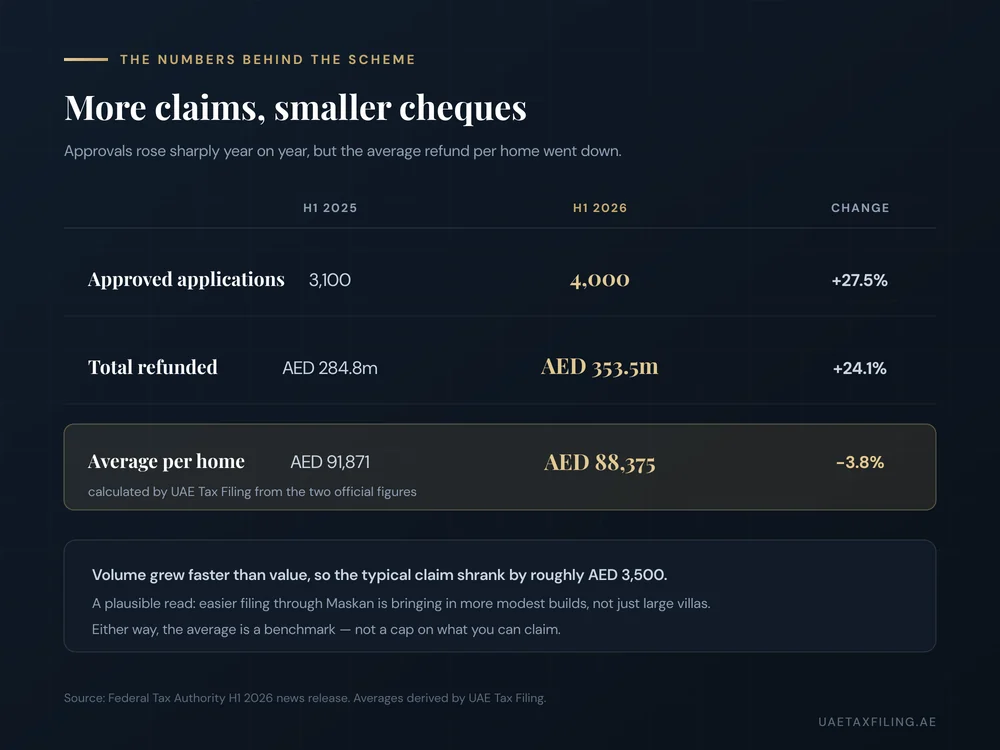
Comparing the two halves is where it gets interesting. In the first half of 2025 the FTA approved 3,100 applications worth AED 284.8 million, an average of AED 91,871. Approved applications then rose 27.5% and the value refunded rose 24.1% — but because volume grew faster than value, the average claim per home fell by roughly AED 3,500, or 3.8%.
A plausible reading is that easier filing is drawing in more modest builds rather than only large villas. Whatever the cause, treat the average as a benchmark for what a typical home recovers — not as a ceiling on what you are entitled to claim.
Key takeaway: The average approved refund was about AED 88,375 in H1 2026, down 3.8% from AED 91,871 a year earlier even as approvals rose 27.5%. Your own entitlement depends on your invoices, not on the average.
What you can and cannot claim
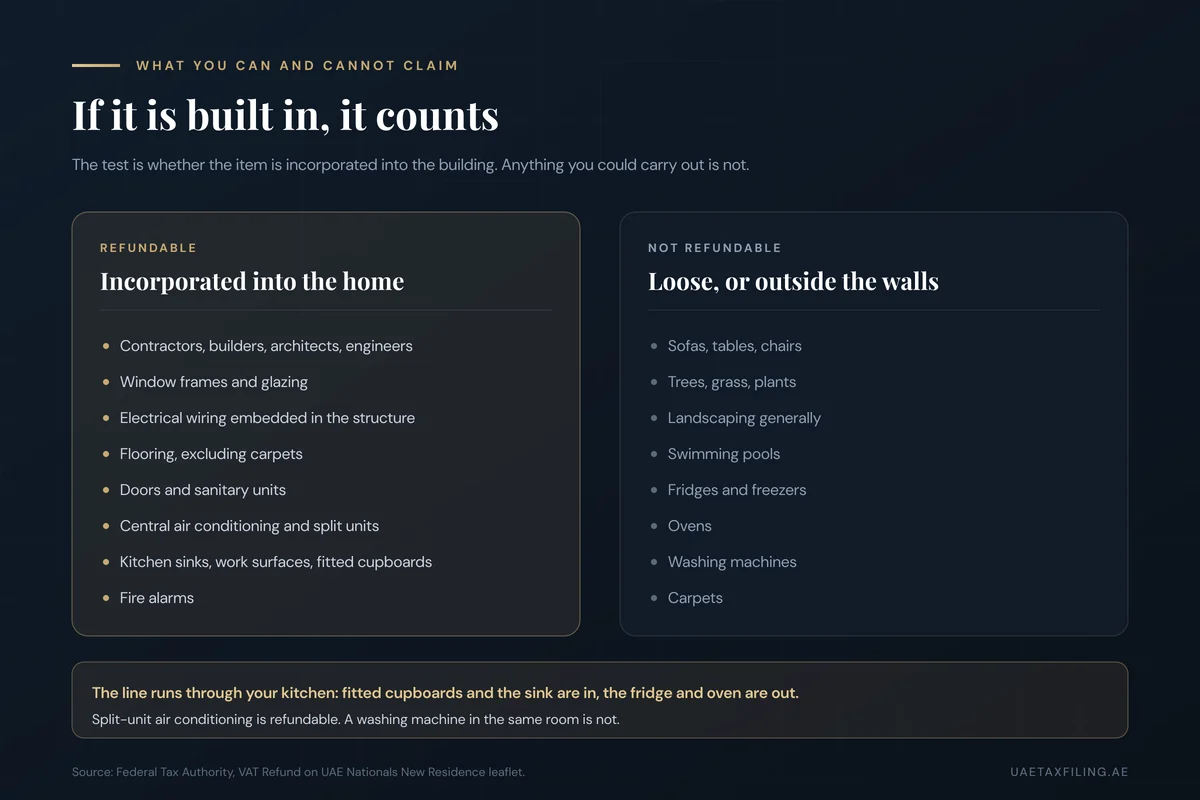
The dividing line is whether an item is incorporated into the building. Goods built into the structure are refundable; anything you could carry out of the house is not.
| Refundable | Not refundable |
|---|---|
| Services from contractors, builders, architects, engineers | Furniture — sofas, tables, chairs |
| Window frames and glazing | Landscaping — trees, grass, plants |
| Electrical wiring embedded in the structure | Swimming pools |
| Flooring, excluding carpets | Carpets |
| Doors and sanitary units | Removable appliances — fridge, oven, washing machine |
| Central air conditioning and split units | |
| Kitchen sinks, work surfaces and fitted cupboards | |
| Fire alarms |
Two comparisons make the rule intuitive. In the kitchen, the sink, the work surfaces and the fitted cupboards are all refundable, while the fridge and oven standing beside them are not. In climate control, a split-unit air conditioner is refundable because it is installed into the building, yet a washing machine plumbed into the same wall is not, because it can be disconnected and removed.
Key takeaway: Ask whether the item stays with the house if you move out. Fitted cupboards, sanitary units and split-unit air conditioning qualify; fridges, ovens, carpets, pools and planting do not.
Not sure whether specific invoices in your build qualify? Send us your completion certificate date and a summary of your contractor invoices — we will tell you what is claimable and how long you have left, then match you with an FTA-registered partner agency to prepare the submission. Message the team on WhatsApp below.
The two deadlines
There are two separate clocks, and most guidance mentions only the first. The main refund request must be submitted within 12 months from the issuing date of the Building Completion Certificate. Separately, VAT on the retention payment can be reclaimed in a subsequent claim, made within 6 months from the date the retention is paid.

The retention rule matters because retention is typically released months after completion, often once a defects period ends. Without the second claim, that VAT is simply lost. The Authority also warns that all construction expenses should be completed before you submit, and that invoice dates must not fall after the date you file — so filing too early costs you as much as filing too late.
One further development changes the practical timing. The FTA now creates the refund application automatically through the Maskan smart application once municipalities issue the building completion certificate, sending notifications by SMS and email and populating invoices into the applicant’s account. The clock still runs from the certificate date, but the paperwork starts itself.
Key takeaway: File the main claim within twelve months of the completion certificate, after the work is finished, and file a second claim for the retention within six months of paying it. Maskan now opens the application for you when the certificate is issued.
The invoice rules that cause rejections
A valid tax invoice for this scheme must satisfy seven specific criteria, and failing any one of them puts the associated VAT at risk. This is the most common practical reason claims are reduced.
The Authority requires that the words “tax invoice” appear on the document; that it carries the full name of the owner or of the applicant; the plot number; the supplier’s name and valid Tax Registration Number; a serial number; the issuing date; and a clear description of the goods or services supplied. The requirements mirror the general rules explained in our guide to UAE tax invoice requirements, with the plot number added.
The name condition is the one that bites. Where an invoice does not carry the applicant’s name — because a relative or an agent dealt with the supplier — a notarised power of attorney must be attached, drawn up to cover representation before the FTA, receipt of the refund, and the plot address. Getting suppliers to reissue invoices correctly during the build is far easier than assembling powers of attorney afterwards.
Key takeaway: Every claimed invoice needs the words “tax invoice”, your name, the plot number, the supplier’s TRN, a serial number, a date and a clear description. Fix the naming while the build is running, not at submission.
How to apply, step by step
The application runs in two stages: an eligibility submission to the FTA, then a documentation review by a verification body. Preparing for both at once shortens the process considerably.
- Wait until the work is genuinely finished. Submitting before final invoices are issued forfeits the VAT on anything invoiced later.
- Note your certificate date. Twelve months runs from the issuing date of the Building Completion Certificate, not from when you moved in.
- Open the application through the FTA eServices portal or the Maskan app, where it may already have been created for you.
- Submit the first-stage documents: Emirates ID, Family Book, completion or occupancy certificate from the municipality, building permit, and an IBAN confirmation letter.
- Assemble the second-stage pack for the verification body: the first municipality-approved architectural plan, the first building permit, contractor and consultant contracts, the bill of quantities, the table of materials, all relevant tax invoices, and proof of payment.
- Check every invoice against the seven criteria before submitting, and obtain a notarised power of attorney where a name does not match.
- Diarise the retention claim for six months after you release the retention payment.
Step five is where timelines slip in practice. Bills of quantities and material tables usually sit with the contractor or consultant rather than the homeowner, and requesting them a year after handover is slower than requesting them at handover. Ask for a complete document pack when the project closes, while the relationship is still active.
Key takeaway: Apply after completion but well inside twelve months, submit identity and property documents first, then the full contractor pack. Collect the bill of quantities and material tables at handover rather than chasing them later.
Common mistakes
The refunds that shrink or fail rarely do so on eligibility. They fail on timing and paperwork.
Five recur. First, missing the twelve-month window, which cannot be reopened. Second, filing too early, before final invoices exist, since invoice dates must not exceed the submission date. Third, ignoring the retention claim and losing that VAT outright. Fourth, invoices in the wrong name without a notarised power of attorney. Fifth, claiming excluded items such as the pool, the landscaping or the kitchen appliances, which delays the whole review. If your home is an investment property rather than a private residence, the treatment is different again — our guide to VAT on UAE real estate covers where residential supplies sit, and corporate tax on property investment covers the income side.
Key takeaway: Nearly every failed claim is a timing or documentation failure. Watch the two deadlines, get invoice names right during the build, and leave excluded items out of the submission entirely.
Frequently asked questions
Who can claim the new residence VAT refund?
UAE nationals who hold a Family Book and have built a new private residence for themselves or their family. The claimant must be a natural person, and the building must be used predominantly as a private home rather than as a commercial or investment property.
How long do I have to submit the claim?
Twelve months from the issuing date of the Building Completion Certificate. The period runs from the certificate date rather than from occupation, and the Authority expects the construction expenses to be complete before you submit, with no invoices dated after your submission date.
Can I claim VAT on the swimming pool or the garden?
No. Swimming pools and landscaping, including trees, grass and plants, are treated as not incorporated into the building and fall outside the refund. The same applies to furniture and to removable appliances such as a fridge, oven or washing machine.
Is a split-unit air conditioner refundable?
Yes. Central air conditioning and split units are listed among the goods considered incorporated into the building, alongside kitchen sinks, work surfaces, fitted cupboards, sanitary units and fire alarms. The distinction is installation into the structure rather than the appliance category.
What is the retention payment claim?
Contractors commonly hold back a retention sum until a defects period ends. You may submit a subsequent claim to recover the VAT on that retention, and it must be made within six months from the date the payment is made. It is separate from the main twelve-month claim.
What if the invoices are not in my name?
You will need a notarised power of attorney. It must cover representation before the Federal Tax Authority regarding recovery of VAT on the residence, receipt and collection of the refund including the plot number, and deposit of the refund into the authorised person’s account. It has to be signed before a notary.
Does an annexe or majlis on the same plot qualify?
Only if it independently meets the residence definition. A subsequent attachment or a detached structure built later on the same plot is not treated as a residence unless it has cooking facilities, washroom or bathroom facilities, and sleeping quarters of its own.
What is the Maskan application?
It is the smart application through which the Authority now creates refund applications automatically once municipalities issue the building completion certificate. Applicants receive notification by SMS and email, and invoices are populated into their account, reducing the manual work at the start of the process.
How much do most people get back?
The average approved refund in the first half of 2026 works out at roughly AED 88,375, based on approximately 4,000 approved applications totalling AED 353.5 million. That is an average across all builds; your own refund depends entirely on the qualifying VAT on your invoices.
How we verified this: the eligibility conditions, the twelve-month deadline, the residence definition, the refundable and excluded item lists, the retention-payment rule, the document requirements and the seven tax-invoice criteria are taken from the Federal Tax Authority’s VAT Refund on UAE Nationals New Residence leaflet, which we extracted directly from the published PDF rather than relying on secondary summaries. The scheme operates under Article 66 of Cabinet Decision No. 52 of 2017. The H1 2026 and H1 2025 figures come from the Authority’s own news release; the average refund per application is our own calculation from those published totals and is labelled as such. Scheme details are on the FTA’s home builders service page. This article is general information, not tax advice.
Last updated: 4 September 2026 · Reviewed by Jazim, CEO, UAE Tax Filing LLC (Dubai)