Last updated: 24 August 2026 · Written by the UAE Tax Filing editorial team · Reviewed by Jazim, CEO, UAE Tax Filing LLC (Dubai) · 21 min read
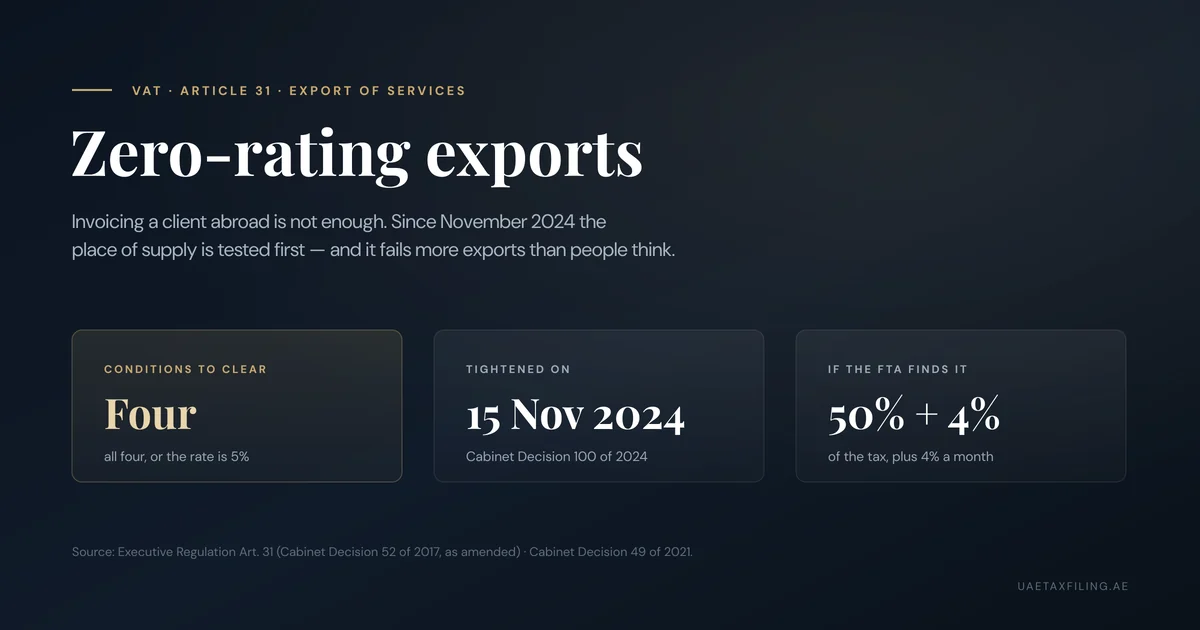
A UAE service can be zero-rated for export only if four conditions hold at once: the supply is not pulled into the UAE by a special place-of-supply rule, the recipient has no place of residence in an Implementing State, the recipient is outside the UAE while the work is performed, and the service is not connected with UAE real estate or goods. Miss one and the correct rate is 5%.
The single most common error we see in export files is not a bad invoice. It is a good invoice attached to the wrong test. Businesses check where the client is and stop there, when the law now asks where the supply is first.
The short version
- Four conditions, not one. Article 31 of the Executive Regulation sets cumulative conditions. A foreign client address satisfies none of them on its own.
- Place of supply is now tested first. Cabinet Decision 100 of 2024, effective 15 November 2024, blocks Article 31 zero-rating where the special rules in Articles 30(3) to 30(8) and 31 of the Decree-Law place the supply in the UAE.
- A visit does not always break it. A recipient is still “outside the State” if their presence here is under one month and is not effectively connected with the supply.
- Zero-rated is not exempt. Zero-rated exports stay inside the VAT system, count toward the AED 375,000 registration threshold, and preserve input tax recovery.
- The cost of being wrong compounds. On AED 500,000 of wrongly zero-rated fees, self-correcting in year one runs about AED 27,250. An FTA assessment in year two runs about AED 61,000.
Zero-rating exports since before November 2024?
The condition added on 15 November 2024 applies to supplies made from that date. If nobody has re-tested your export invoices since, the exposure sits in open VAT periods right now. We will match you with an FTA-registered tax agency that reviews your last four quarters of export invoices against all four conditions and tells you where you stand.
Get my export invoices reviewedWhat this covers
- What an export of services is
- The four gates, in order
- Gate 1: place of supply decides first
- Gate 2: where the recipient resides
- Gate 3: outside the State and the one-month test
- Gate 4: real estate and moveable goods
- The second route: services performed abroad
- What getting it wrong costs
- The evidence pack an FTA reviewer asks for
- Five “exports” that are not exports
- Reporting a zero-rated export in the VAT 201
- Fixing it if you have been getting it wrong
- Frequently asked questions
What an export of services is
An export of services is a service supplied by a UAE taxable person that meets the conditions in Article 31 of the Executive Regulation and therefore carries VAT at 0% instead of 5%. It is a treatment you qualify for, not a category your invoice falls into because the customer is abroad.
That distinction decides most disputes. The word “export” suggests something crossing a border, and for goods that is close to true, because a customs exit certificate proves it. Services leave no trace. So the law substitutes a set of tests about the recipient and the supply, and the burden of showing those tests were met sits with the supplier, not the Federal Tax Authority.
Zero-rated is also not the same as exempt, and the difference is money. A zero-rated export is a taxable supply at 0%, so the input tax on everything you bought to deliver it stays recoverable. An exempt supply blocks that recovery. We set out the mechanics in our guide to zero-rated and exempt supplies, and it is worth being certain which one you are applying.
Key takeaway: zero-rating is a conclusion you must earn under Article 31, not a default that follows a foreign billing address.
The four gates, in order
The four gates are the conditions of Article 31(1)(a) arranged in the order the law now tests them: place of supply, residence, presence, and connection to property. Every gate must clear, and the first failure ends the analysis.
Order matters more than most guidance admits. Before November 2024 you could start with the customer and usually land in the right place. Since Cabinet Decision 100 of 2024, a supply caught by the special place-of-supply rules never reaches the export test at all, so starting with the customer can produce a confident answer to the wrong question. Run the gates top to bottom and the failure shows up early, before you have built an argument on it.
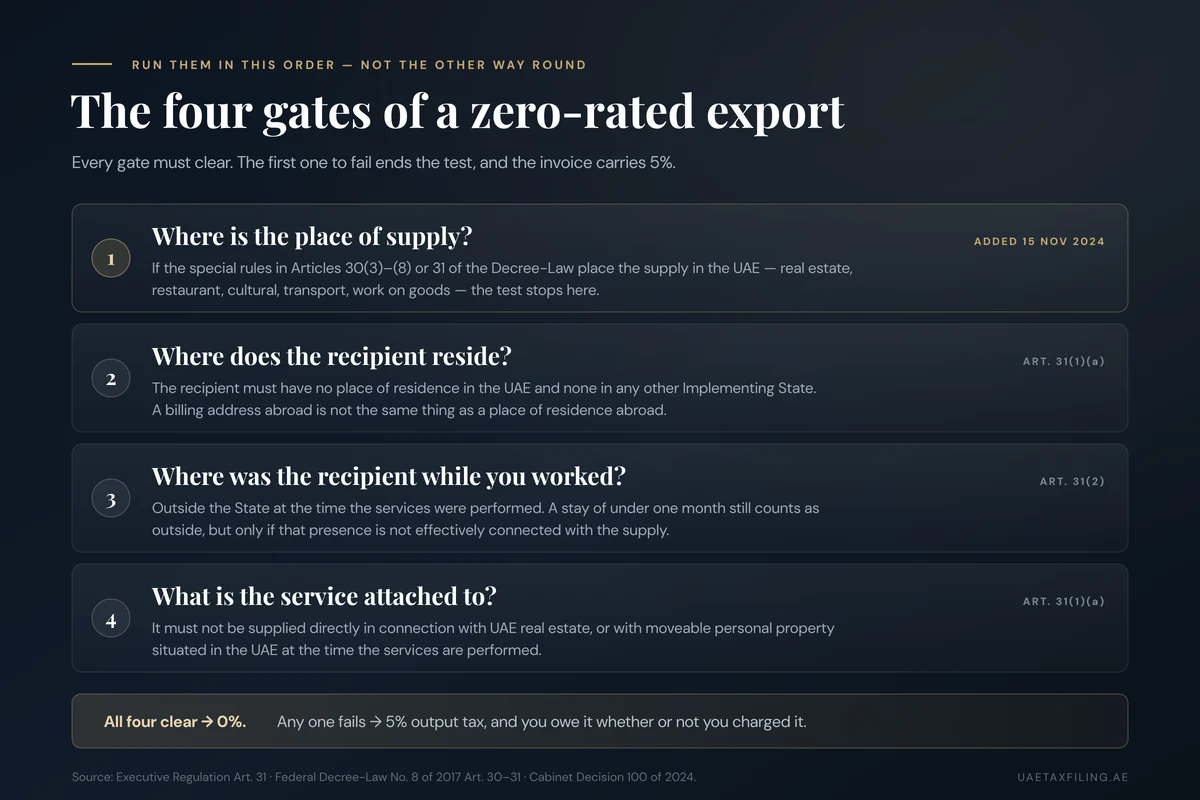
Key takeaway: test place of supply first. If the supply is in the UAE, nothing the client does or where they live can rescue the 0% rate.
Gate 1: place of supply decides first
Place of supply is the rule that decides which country has the right to tax a service. Under the amendment effective 15 November 2024, a service whose place of supply falls in the UAE under the special rules in Articles 30(3) to 30(8) or Article 31 of Federal Decree-Law No. 8 of 2017 cannot be zero-rated as an export, whatever the customer's status.
The special rules cover categories where the service is tied to a place rather than to a customer. Services connected with real estate are supplied where the property sits. Restaurant, hotel and catering services are supplied where they are performed. Cultural, artistic, sporting and educational services are supplied where they take place. Services relating to goods, such as installation or repair, follow the goods. Transport and transport-related services follow the route.
Take a Dubai engineering consultancy invoicing a Singapore fund for structural design on a tower in Business Bay. The client is foreign, has no UAE presence and pays from Singapore. Before the amendment, firms routinely zero-rated that fee. It is a service connected with UAE real estate, so the place of supply is the UAE, and Gate 1 fails at the first question. The invoice carries 5%.
Key takeaway: if a special place-of-supply rule puts the service in the UAE, the export route is closed before you look at the client at all.
Gate 2: where the recipient resides
The residence condition requires that the recipient of the services has no place of residence in the UAE and none in any other Implementing State. Place of residence means where a person has a place of establishment or a fixed establishment, which is a wider idea than where the invoice is addressed.
The trap is the group structure. A German manufacturer with a Dubai branch is not, for this test, simply German. If the branch is the establishment most closely connected with the supply, the recipient has a place of residence here and the export test fails. The same applies where a foreign holding company contracts on paper while its UAE subsidiary receives and uses the work.
Ask two questions the billing address cannot answer. Which legal entity is contracting, and does that entity hold any establishment in the UAE? A written confirmation from the client that it has no branch, office or fixed establishment in the UAE costs nothing to obtain at engagement and is one of the few documents that speaks directly to this condition.
Key takeaway: a foreign billing address is evidence of nothing. Establishment, not correspondence, decides residence.
Gate 3: outside the State and the one-month test
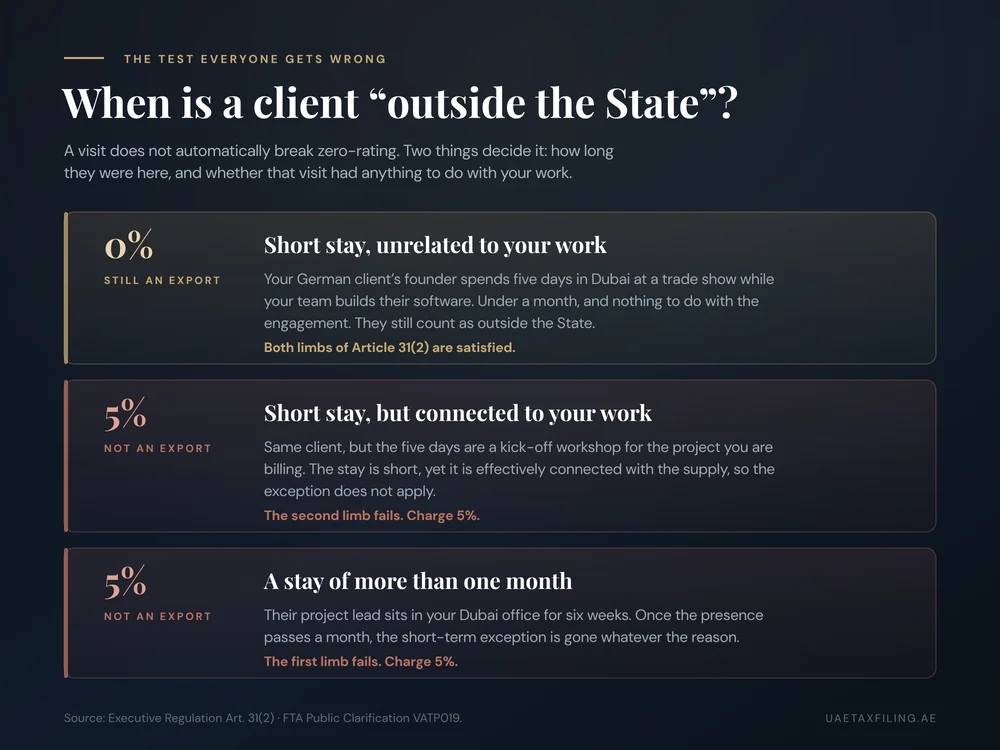
The presence condition requires the recipient to be outside the UAE at the time the services are performed. Article 31(2) then softens it: a person is still treated as outside the State if they only have a short-term presence in the UAE of less than a month, and that presence is not effectively connected with the supply.
Both limbs must hold. Under a month is not enough on its own, and unrelated is not enough on its own. This is the part of the rule that most often surprises people, because a three-day workshop feels too small to change a tax treatment, and it does not feel like a presence at all. Under Article 31(2) it is decisive, because the workshop is connected with the very supply being billed.
Practical consequence: a delivery log is a tax document. If you cannot say when the work was performed and where the client was during that window, you cannot answer the question an FTA reviewer will ask, and an unanswerable question is decided against the supplier.
Key takeaway: short and unrelated keeps the 0% rate. Short but connected to your engagement does not.
Gate 4: real estate and moveable goods
The final condition is that the services must not be supplied directly in connection with real estate situated in the UAE, or with moveable personal property situated in the UAE at the time the services are performed. It closes the gap that residence and presence leave open.
“Directly in connection with” is narrower than any link at all. Valuing, designing, surveying, managing or arranging work on a specific UAE property is directly connected. General investment advice to a client who happens to own UAE property is not. The test attaches to a specific asset, not to a sector.
Moveable property is the limb that catches technical businesses. A Dubai workshop calibrating a machine that sits in a Jebel Ali warehouse is working on moveable personal property located in the UAE, even where the machine's owner is a foreign company that never sets foot here. The service is performed on something physically present, so it is not an export.
Key takeaway: if the work targets a specific thing sitting in the UAE, whether a building or a machine, it is not an exported service.
The second route: services performed abroad
Article 31(1)(b) offers an alternative route to 0%: services that are actually performed outside the Implementing States, or the arranging of such services, are zero-rated. This route looks at where the work happens rather than at who receives it.
It is narrower than it reads. “Actually performed” means the activity itself takes place abroad, so a Dubai team doing the work from Dubai does not qualify merely because the benefit lands overseas. Where it does apply is physical work carried out abroad by your staff, and arranging services that will be performed abroad, such as booking a foreign venue or a foreign contractor for a client.
Compare the two routes. A Dubai consultancy writing a report in its Dubai office for a Paris client relies on Article 31(1)(a) and must clear all four gates. The same consultancy sending two staff to run a two-week audit at the client's Paris factory can rely on Article 31(1)(b), because the work is performed outside the Implementing States.
Key takeaway: route (a) tests the customer, route (b) tests the location of the work. You only need one of them, so check both before accepting 5%.
What getting it wrong costs
A wrongly zero-rated export is an understatement of output tax, and the UAE penalty regime prices it by how long it stays uncorrected and by who finds it. Correcting it yourself is materially cheaper than an FTA assessment, and the gap widens every month.
The arithmetic below applies the penalty rates in Cabinet Decision 49 of 2021 to a single figure: AED 500,000 of service fees invoiced at 0% that should have carried 5%, giving AED 25,000 of understated tax. The voluntary disclosure rows use the percentage that applies to the tax difference by the year of disclosure, plus the fixed first-time penalty. The assessment row assumes the FTA raises an assessment 24 months after the due date.
| When it surfaces | Route | Tax due | Penalties | Total | vs self-correcting early |
|---|---|---|---|---|---|
| Within 12 months | Voluntary disclosure | AED 25,000 | AED 1,250 (5%) + AED 1,000 fixed | AED 27,250 | — |
| Second year | Voluntary disclosure | AED 25,000 | AED 2,500 (10%) + AED 1,000 fixed | AED 28,500 | 1.05× |
| Third year | Voluntary disclosure | AED 25,000 | AED 5,000 (20%) + AED 1,000 fixed | AED 31,000 | 1.14× |
| Fourth year | Voluntary disclosure | AED 25,000 | AED 7,500 (30%) + AED 1,000 fixed | AED 33,500 | 1.23× |
| Year 2, found in an FTA audit | Tax assessment | AED 25,000 | AED 12,500 (50%) + AED 23,500 late payment | AED 61,000 | 2.24× |
The late payment column follows the standard mechanic: 2% of the unpaid tax once payment is late, then 4% monthly from one month after the due date, which is 23 monthly charges over a 24-month window. Total administrative penalties are capped at 300% of the unpaid tax, so a long-running error stops compounding but does so at a number far above the original liability. Our breakdown of the current VAT penalty regime sets out each category.
The number that matters is not the penalty rate. It is the gap between AED 28,500 and AED 61,000 for the identical error in the identical year, decided only by whether you found it or the FTA did.
Key takeaway: on this worked example, an FTA assessment in year two costs 2.24 times what disclosing the same error yourself in year two costs.
The exposure sits in your open periods
Every quarter that passes moves your exports up the penalty ladder and closer to the assessment column. A review takes a few days; an assessment takes years off your cash position. We will match you with an FTA-registered tax agency that quantifies your export exposure period by period and tells you whether a voluntary disclosure is the right call. Same working day reply, Sunday to Thursday, and a fixed fee quoted before anything starts.
Quantify my export exposureThe evidence pack an FTA reviewer asks for
The evidence pack is the set of documents that proves each Article 31 condition was met at the time of supply. A reviewer does not ask for a folder of paperwork; they ask which condition each document proves, and a document that proves nothing specific carries no weight.
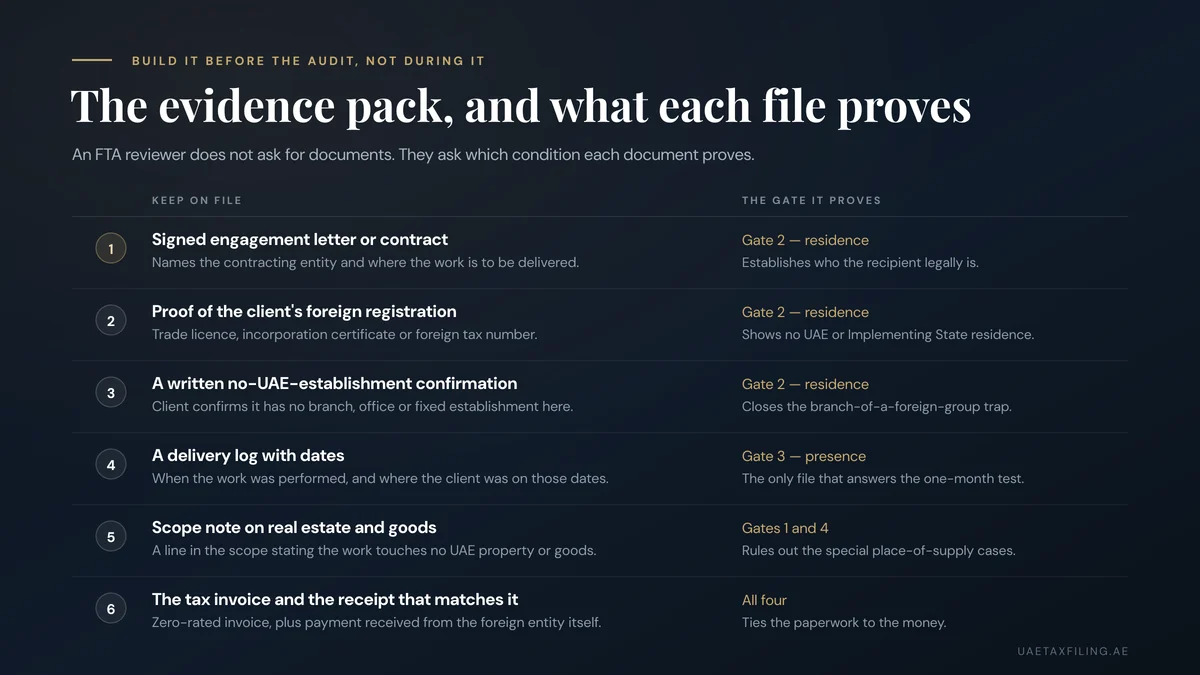
Assemble it in this order at the start of an engagement, not after a notification arrives:
- The signed contract or engagement letter. It names the contracting entity and where delivery happens. Everything else hangs off which entity this document names.
- Proof of the client's foreign registration. A trade licence, certificate of incorporation or foreign tax number, showing the entity exists outside the UAE.
- A written no-establishment confirmation. One paragraph from the client stating it holds no branch, office or fixed establishment in the UAE. This is the document that closes the group-structure trap in Gate 2.
- A delivery log with dates. When the work was performed, and where the client was during that window. Without it, Gate 3 is unprovable.
- A scope note on property and goods. A line in the scope confirming the work is not connected with UAE real estate or with goods located in the UAE.
- The tax invoice and the matching receipt. A compliant zero-rated invoice, plus evidence that payment came from the foreign entity itself rather than a local affiliate.
In files we have reviewed, items 3 and 4 are the ones almost always missing, and they are the two that map to the conditions most likely to be challenged. They also cost nothing to collect at the start and are close to impossible to reconstruct two years later.
Key takeaway: collect the no-establishment confirmation and the delivery log at engagement. They are cheap on day one and unobtainable on day seven hundred.
Five “exports” that are not exports
Most failed export claims are not aggressive positions. They are ordinary invoices where one gate quietly fails while the other three clear, which is exactly what makes them feel safe.
| What was invoiced | Why it looked like an export | Gate that fails | Correct rate |
|---|---|---|---|
| Structural design for a Business Bay tower, billed to a Singapore fund | Foreign client, foreign payment, no UAE presence | Gate 1 — real estate places the supply in the UAE | 5% |
| Marketing retainer contracted with a foreign parent, used by its Dubai branch | The contracting party is overseas | Gate 2 — the branch is the establishment connected with the supply | 5% |
| Advisory delivered around a two-week client kick-off in Dubai | The client is normally abroad and the visit was short | Gate 3 — the presence was effectively connected with the supply | 5% |
| Calibration of a machine stored in Jebel Ali for a Swiss owner | The owner has never set foot in the UAE | Gate 4 — moveable property situated in the UAE | 5% |
| Facilitating a conference at a Dubai hotel for an overseas association | Organiser and delegates are all foreign | Gate 1 — event services are supplied where they take place | 5% |
Key takeaway: three gates clearing is the normal pattern in a failed claim. It is why self-review by feel does not work and a gate-by-gate check does.
Reporting a zero-rated export in the VAT 201
A zero-rated export is reported in box 4 of the VAT 201 return, the line for zero-rated supplies. You report the net value of the supply with no tax amount, because the tax is 0% rather than absent.
Two reporting habits cause avoidable questions. The first is leaving exports out of the return entirely on the reasoning that no tax is due, which understates total supplies and breaks the reconciliation between your VAT returns and your financial statements. The second is putting exports in box 5, the exempt line, which quietly suggests your input tax should have been restricted. Our walkthrough on filing a quarterly VAT return without errors covers the box-by-box detail.
The mirror image is worth checking at the same time. Where you buy services from abroad rather than sell them, the reverse charge mechanism applies and you account for the tax yourself. Businesses that export services usually import a few as well, and the same review should cover both directions.
Key takeaway: box 4, at net value, every period. Exports omitted from the return are the fastest way to trigger a reconciliation query.
Fixing it if you have been getting it wrong
Correcting a wrongly zero-rated export is a tax-period exercise, not an invoice exercise. You are amending the output tax declared for each affected period, so the work is organised by return, not by customer.
- Pull every export invoice in your open periods. Start with supplies made from 15 November 2024, then work backwards, because the newest rule catches the invoices most likely to be mispriced.
- Run all four gates on each one and record which gate fails and why. A one-line reason per invoice is what turns a spreadsheet into a defence file.
- Total the understated tax by tax period. The threshold that decides your route is per return, not across the whole exercise.
- Pick the correction route. Where the tax difference for a period is AED 10,000 or less, it can generally be corrected in your next return. Above that, a voluntary disclosure is required within 20 business days of becoming aware of the error.
- Settle within 20 business days of submitting the disclosure to avoid the late payment penalty stacking on top of the disclosure penalty.
- Change the intake, not just the ledger. Add the no-establishment confirmation and the delivery log to your engagement checklist so the same error cannot repeat next quarter.
Our guide to making a voluntary disclosure to the FTA covers the EmaraTax mechanics and the timing rules in detail. The sequencing above is what turns that process into a defensible file rather than a set of amendments with no reasoning attached.
Key takeaway: organise the correction by tax period and by gate. Both are how the FTA will read it back to you.
Frequently asked questions
Do I have to register for VAT if all my sales are exports?
Yes, once you cross the threshold. Zero-rated exports are taxable supplies, so they count toward the AED 375,000 mandatory registration threshold even though no tax is charged. A business making only zero-rated supplies may apply to the FTA for an exception from registration, which removes the filing obligation but also the ability to recover input tax. The mechanics are in our VAT registration guide.
Is an export of services zero-rated or out of scope?
Zero-rated, provided the place of supply is the UAE and the Article 31 conditions are met. Out of scope means the UAE has no taxing right at all, which happens when a place-of-supply rule puts the supply in another country. The practical difference is reporting: a zero-rated export goes in box 4 of your return, while an out-of-scope supply does not.
Do I charge VAT to a client in Saudi Arabia or another GCC country?
In practice they are treated like any other foreign customer. The law refers to Implementing States, meaning GCC countries applying the common VAT framework and recognised as such by the UAE. The FTA has not been treating other GCC states as Implementing States for these purposes, so supplies to them follow the ordinary export rules. Confirm the current position before relying on it, as this is the one input in the test that can change without the article text changing.
Does my client need to give me a tax registration number to zero-rate?
No. There is no requirement for the recipient to hold a TRN or any foreign VAT number, and a foreign registration number does not by itself prove the conditions are met. It is useful supporting evidence of the client's foreign registration, which is one input into the residence condition, but it does not answer the presence test or the property test.
Do I need an export declaration or customs paperwork for services?
No. Customs documentation applies to goods, which physically cross a border and generate an exit certificate. Services generate no customs trail, which is precisely why the law substitutes the Article 31 conditions and why your contract, delivery log and client confirmations carry the evidential weight instead.
What if my client pays from a UAE bank account?
Payment source does not decide the treatment, but it invites questions. The conditions turn on residence, presence and the nature of the supply, not on where the money sits. That said, a foreign entity settling through a local account is a common marker of an undisclosed UAE establishment, so keep an explanation on file alongside the invoice.
Is a client in a UAE free zone an export customer?
No. Free zone companies are established in the UAE and have a place of residence here, so supplies of services to them are domestic and standard-rated unless another relief applies. Designated zone rules can change the treatment of goods, but they do not turn a service supplied to a free zone entity into an export.
What exchange rate do I use on a foreign currency export invoice?
Amounts must be converted into AED using the UAE Central Bank exchange rate applicable at the date of supply, and it is the AED figure that goes into your return. Keep the rate used with the invoice. Reconciling exports at year-end using an average rate is a common source of differences between the VAT returns and the financial statements.
Can I recover input VAT on costs used to deliver zero-rated exports?
Yes. That is the defining advantage of zero-rating over exemption. Because a zero-rated export is a taxable supply, the input tax on subcontractors, software, rent and other costs used to make it stays fully recoverable, which is why an exporter often sits in a permanent refund position.
Does the November 2024 change apply to invoices I issued before then?
The added condition applies to supplies made from 15 November 2024. Earlier supplies are tested against the rules in force at the time. In practice this means a review has two eras in it, and treating every open period under one rule set is itself an error.
Where this leaves you
If you invoice overseas clients from the UAE, there are only two honest states to be in: you have tested your exports against all four gates since November 2024, or you have not. There is no third position where the treatment is probably fine because the client is abroad.
The review itself is finite work. It is your export invoices for the open periods, four questions each, and a written reason attached to every one. What makes it urgent is that the cost of the answer is set by the calendar, not by the size of the error, and the assessment column of that table is roughly double the disclosure column for the identical mistake.
Start with the invoices, not the law
Send us what you invoice and who you invoice it to. We will match you with an FTA-registered tax agency that runs your export invoices through all four Article 31 gates, tells you which periods are exposed, and quotes a fixed fee before any work begins. Same working day reply, Sunday to Thursday, and no obligation.
Check my export VAT treatmentHow we verified this: the conditions are taken from Article 31 of the Executive Regulation of Federal Decree-Law No. 8 of 2017 (Cabinet Decision 52 of 2017 and its amendments), including the condition added by Cabinet Decision 100 of 2024 with effect from 15 November 2024, and from the FTA public clarification on zero-rating the export of services (VATP019). Penalty rates follow Cabinet Decision 49 of 2021; the worked totals are our own arithmetic on the stated assumptions, not published figures. Confirm the current text in the consolidated Executive Regulation. This article is general information, not tax advice.
Last updated: 24 August 2026 · Reviewed by Jazim, CEO, UAE Tax Filing LLC (Dubai)