
Last updated: 9 August 2026 · Written by the UAE Tax Filing editorial team · Reviewed by Jazim, CEO, UAE Tax Filing LLC (Dubai)
Corporate Tax deregistration is the process of closing your Federal Tax Authority registration when the business stops existing. A juridical person must apply within three months of the date it ceases to exist, is dissolved, or is liquidated. Miss that window and the penalty is AED 1,000, then AED 1,000 every month, capped at AED 10,000.
Cancelling your trade licence does not close your tax file. It is the other way round: the Federal Tax Authority has to release you before the licensing authority will let you go.
The short version
- Three months, from cessation. FTA Decision No. 6 of 2023 gives a natural person three months from ceasing the business, and a juridical person three months from the date it ceases to exist, is dissolved or is liquidated.
- The clock is independent of the paperwork. The application deadline runs whether or not your final return is ready. Apply first; finish the filing afterwards.
- Nothing closes while anything is owed. Article 52(2) of the Corporate Tax Law blocks deregistration until every return is filed and every dirham of tax and penalty is paid.
- Stopping trading changes nothing on its own. A dormant but still-registered company keeps filing Corporate Tax returns, keeps filing VAT returns, and keeps accruing late-filing penalties on both.
- Corporate Tax and VAT penalties stack. Two separate AED 10,000 caps, so a business registered for both can reach AED 20,000 on deregistration failures alone.
What this covers
- What Corporate Tax deregistration actually is
- Who has to deregister, and when the clock starts
- The clearance chain: the only order that works
- Deregistering on EmaraTax, step by step
- The final return nobody budgets for
- Dormant or deregistered: the trap
- What late deregistration costs
- VAT deregistration runs on a different clock
- Free zone closures and the QFZP loose end
- Why applications get rejected
- Frequently asked questions
What Corporate Tax deregistration actually is
Corporate Tax deregistration is the formal cancellation of a Tax Registration Number when the business behind it ends. It is not a notification and it is not automatic. It is an application, made on EmaraTax, that the Federal Tax Authority either approves or refuses.
Article 52 of Federal Decree-Law No. 47 of 2022 sets the obligation: a person with a Tax Registration Number must file a deregistration application where there is a cessation of its business, whether by dissolution, liquidation, or otherwise. The same Article then adds the condition that catches people out — the person will not be deregistered unless it has paid all Corporate Tax and administrative penalties due, and filed every return due, including the return for the tax period up to and including the date of cessation.
Compare it with registration, which the FTA processes as an administrative formality. Deregistration is a closing of accounts. The authority is checking that it is owed nothing before it lets go, which is why a clean file closes in weeks and a messy one drags for months.
Key takeaway: registration is a form. Deregistration is a settlement. Treat it as the end of a financial process, not the end of an admin task.
Who has to deregister, and when the clock starts
Every person holding a Corporate Tax registration must deregister once the business ends, and the trigger date differs by person type. FTA Decision No. 6 of 2023 draws the line cleanly: a natural person files within three months of the date of cessation of the business or business activity, and a juridical person files within three months of the date the entity ceases to exist, cessation of the business, dissolution, liquidation or otherwise.
The distinction matters more than it looks. A freelancer who stops invoicing has a clear cessation date. A company being wound up has several candidate dates — the shareholders' resolution, the final trading day, the liquidator's appointment, the final deregistration from the licensing authority — and the earliest of them is usually the one the FTA works from. In our experience the shareholders' resolution to dissolve is the date that holds up best under scrutiny, because it is notarised and dated and it is what the licensing authority itself relies on.
Pick the date, write down why you picked it, and keep the document that proves it. That one page is the difference between a rejected application and an approved one.
Key takeaway: the deadline is measured from a factual event, not from the day you decide to deal with it. By the time most owners ask the question, part of the three months has already gone.
The clearance chain: the only order that works
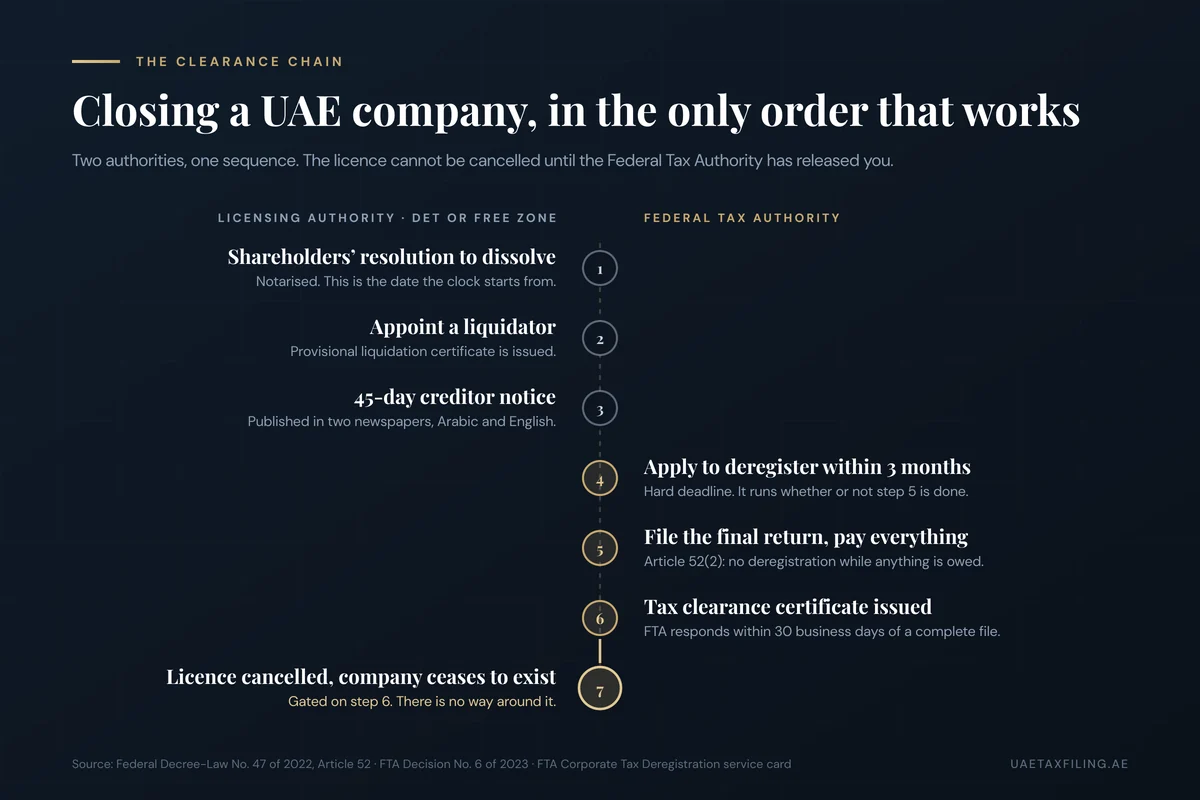
The clearance chain is the sequence in which tax deregistration and licence cancellation have to happen, and it is fixed. The licensing authority — Dubai's Department of Economy and Tourism for mainland companies, or the relevant free zone authority — will not issue a final cancellation without an FTA tax clearance certificate. The FTA will not issue that certificate until the final return is filed and every liability is settled.
Most closures we are asked to rescue went wrong the same way. The owner treats the trade licence as the thing being cancelled, gets to the end of the liquidation, and only then discovers the FTA file is still open with two unfiled returns behind it. The liquidation stalls, the liquidator keeps billing, and the deregistration penalty has been running the whole time.
Running it in the right order costs nothing extra. Running it backwards adds months.
The licence is the last thing to be cancelled, not the first. Everything else is upstream of it.
Key takeaway: start the FTA side on the day of the resolution, in parallel with the liquidator, not after the liquidation is finished.
Deregistering on EmaraTax, step by step
Deregistration is filed through EmaraTax, the FTA's online portal, and the service is free of charge. The authority's own Corporate Tax deregistration service card puts the submission at around twenty minutes and commits to a response within thirty business days of a complete application.
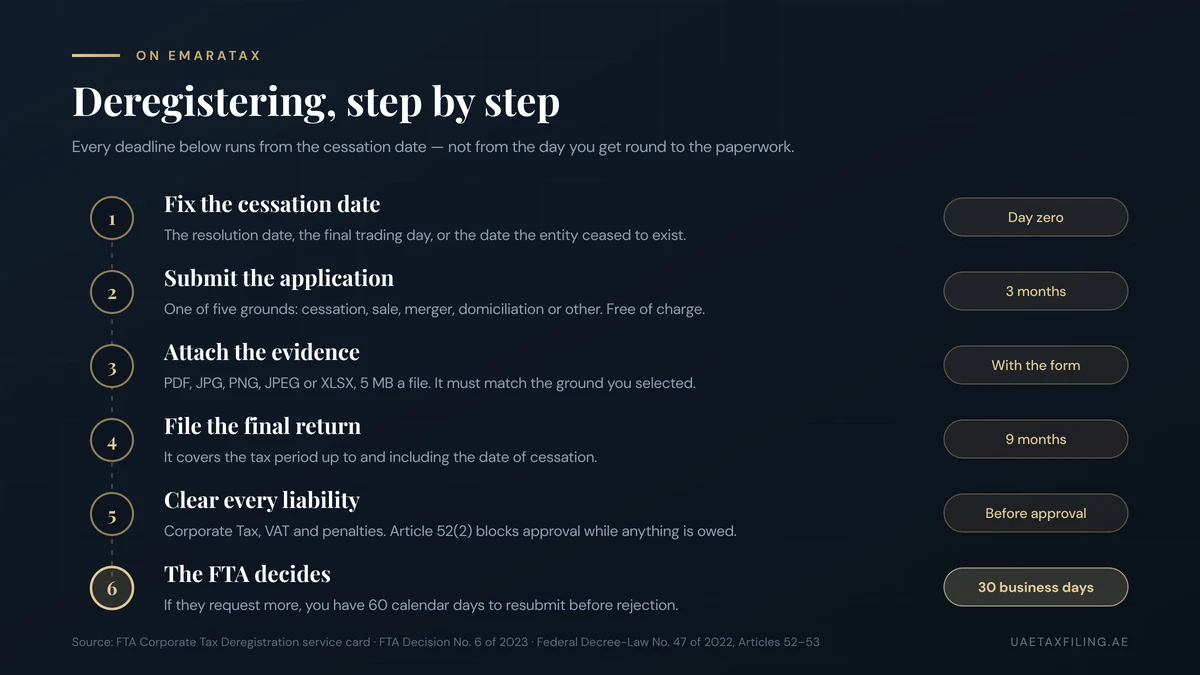
- Fix the cessation date and evidence it. Notarised resolution, liquidator appointment letter, or the final invoice issued. Whichever you choose, it has to be a document, not a recollection.
- Submit the deregistration application. EmaraTax asks for the ground: cessation of business, sale of business, merger, domiciliation, or other. Pick the one that matches your evidence, because the FTA cross-checks them.
- Attach documentary evidence. PDF, JPG, PNG, JPEG or XLSX, up to 5 MB per file. Thin evidence is the single most common reason for a clarification request.
- File the final Corporate Tax return. It covers the tax period up to and including the cessation date, and it is due within nine months of the end of that period like any other return. Our EmaraTax return walkthrough covers the mechanics.
- Clear every liability. Corporate Tax, VAT, and any administrative penalties already sitting on the account. Anything outstanding stops the approval under Article 52(2).
- Wait for the decision. Thirty business days from a complete file. If the FTA asks for more, you have sixty calendar days to resubmit before the application can be rejected outright.
Key takeaway: submit inside three months even if the final return is not ready. The application deadline and the filing deadline are separate obligations with separate penalties.
The final return nobody budgets for
The final Corporate Tax return covers a short, irregular tax period running from the start of the financial year to the cessation date. It is the return most owners forget exists, because they assume the last full year they filed was the last one due.
A Dubai company with a 31 December year-end that passes a dissolution resolution on 30 April 2026 has a final tax period of 1 January to 30 April 2026 — four months. That return still has to be prepared on the normal basis, with accounts, adjustments and any relief claims, and it is due nine months after that period ends. Closing balances matter here: assets distributed to shareholders, written-off receivables and released provisions all land in this return, and they can turn a loss-making wind-down into a taxable event.
This is also the last opportunity to fix anything historic. If earlier returns contain errors, correcting them through a voluntary disclosure before deregistration is materially cheaper than having them surface while the FTA reviews your closing file.
Key takeaway: budget for one more set of accounts and one more return than you think you need. The short final period is a real return, not a formality.
Dormant or deregistered: the trap
A dormant company is one that has stopped trading but remains registered, and in UAE Corporate Tax terms it is not a lighter category — it is the same category with no revenue. Registration obligations attach to the registration, not to the activity. Zero revenue produces a zero return, and a zero return that is not filed produces a penalty exactly like any other.
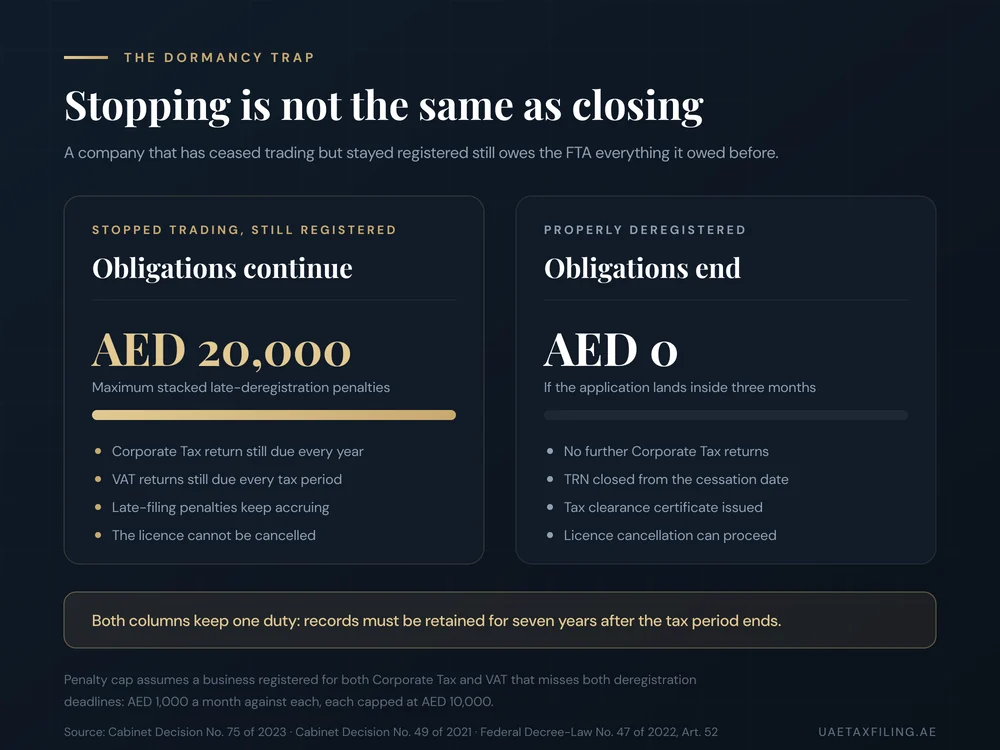
| Obligation | Stopped trading, still registered | Properly deregistered |
|---|---|---|
| Annual Corporate Tax return | Still due, even at nil | Ends at the cessation date |
| VAT returns | Still due each tax period | Ends on VAT deregistration |
| Late-filing penalties | Keep accruing | Stop |
| Tax Registration Number | Live | Closed |
| Trade licence cancellation | Blocked | Can proceed |
| Record retention | 7 years | 7 years |
Note the last row. Deregistration ends the filing obligations; it does not end the record-keeping one. Books, invoices and supporting documents still have to be retained for seven years after the end of the relevant tax period, which means a company that closed in 2026 has records to keep into the 2030s. Shredding the files on closure is a mistake that only becomes visible if the FTA opens a review.
Key takeaway: there is no dormant status that pauses UAE Corporate Tax. Either the business is registered and filing, or it is deregistered. Nothing sits in between.
What late deregistration costs
Late Corporate Tax deregistration carries a AED 1,000 penalty at the point the three-month window closes, and a further AED 1,000 on the same date each month, capped at AED 10,000. The cap is reached ten months after the deadline, and it is a cap on this specific failure — not on everything else the account may be accruing.
Here is the sequence for a Dubai company that passed its dissolution resolution on 31 January 2026 and did nothing.
| Date | Event | Deregistration penalty |
|---|---|---|
| 31 Jan 2026 | Dissolution resolution — the clock starts | AED 0 |
| 30 Apr 2026 | Three-month deadline missed | AED 1,000 |
| 30 Jun 2026 | Two further months | AED 3,000 |
| 31 Oct 2026 | Six further months | AED 7,000 |
| 28 Feb 2027 | Cap reached | AED 10,000 |
| Any later date | Penalty stops growing | AED 10,000 |
Reaching the cap does not make the problem static. Unfiled returns carry their own penalties, unpaid tax attracts its own charges, and the licence stays uncancellable throughout, which means licence renewal fees and, for a mainland company, a liquidator still on the clock. Our FTA penalty calculator models the combined exposure, and the full schedule sits in our guide to UAE Corporate Tax penalties.
If a penalty has already been imposed and there were genuine circumstances behind the delay, it can be challenged — the route is set out in our guide to the FTA reconsideration and appeal process.
Key takeaway: the AED 10,000 cap is the floor of the problem, not the ceiling. The expensive part is everything the open file keeps blocking.
VAT deregistration runs on a different clock
VAT deregistration is a separate application with a separate deadline, and the two are routinely confused. Where Corporate Tax gives three months, VAT gives twenty business days from the event that triggers it — ceasing to make taxable supplies, or taxable supplies over the previous twelve months falling below the AED 187,500 voluntary registration threshold.
The penalty structure mirrors Corporate Tax: AED 1,000 at the deadline, AED 1,000 monthly thereafter, capped at AED 10,000. Because the caps are separate, a business registered for both taxes that misses both deadlines can accumulate AED 20,000 on deregistration failures alone, before a single unfiled return is counted.
The twenty-business-day window is short enough that it usually expires before the owner has finished telling their accountant the business is closing. If you are unwinding a VAT-registered entity, that application goes first. The thresholds and mechanics are covered in our UAE VAT registration guide.
Key takeaway: VAT first at twenty business days, Corporate Tax second at three months. Diarise them as two separate deadlines, because that is what they are.
Free zone closures and the QFZP loose end
A free zone company deregisters from Corporate Tax on exactly the same terms as a mainland company, because the obligation attaches to the registration rather than the licence type. What differs is the licensing side and one substantive tax question that closure forces into the open.
Free zone liquidations are usually faster — commonly two to four months against three to six for a mainland LLC, largely because the mainland route carries the 45-day newspaper notice and the DET procedures. The free zone authority still requires FTA clearance before final cancellation, so the chain is unchanged.
The substantive issue is Qualifying Free Zone Person status in the final period. A company winding down often does things it never did while trading: selling assets to a mainland buyer, settling intra-group balances, disposing of stock at a discount. Any of that can be non-qualifying income, and breaching the de minimis threshold removes the 0% rate for that tax period and the four that follow — which, for a company that is closing, means the final return is the one that matters. Our guide to qualifying for the 0% free zone rate sets out the conditions.
Key takeaway: test QFZP status on the wind-down transactions, not on the trading year. Closures generate exactly the kind of income that breaks it.
Why applications get rejected
An FTA deregistration application is rejected or stalled when the file does not stand on its own, and the reasons repeat. The authority is not looking for a narrative; it is looking for a date, a document, and a zero balance.
The five we see most often:
- Outstanding returns. One unfiled period, usually the short final one, is enough to stop everything under Article 52(2).
- An unpaid penalty balance. Often small, often from an old late filing, and always blocking.
- Evidence that contradicts the ground selected. Choosing "cessation of business" and attaching a share sale agreement invites a clarification request.
- A cessation date nobody can evidence. If the date on the form is not on a document, expect to be asked for one.
- Missing the sixty-day resubmission window. Clarification requests expire. Applications that go quiet get rejected, and the three-month clock does not restart.
Key takeaway: assemble the file before you submit. A complete application clears in thirty business days; an incomplete one can consume the whole sixty-day resubmission window and still fail.
Frequently asked questions
Can I cancel my trade licence first and deal with the FTA later?
No, and attempting it is what turns a straightforward closure into a long one. The licensing authority requires an FTA tax clearance certificate before final cancellation, and the FTA will not issue one while returns or liabilities are outstanding. The tax side has to be resolved for the licence side to complete.
My company never traded. Do I still have to file a final return?
Yes. Registration creates the filing obligation, not activity. A company that never traded files a nil return for the final period, and deregistration will not be approved until it is submitted. The return is straightforward, but it is not optional.
What happens if I just stop filing and let the company lapse?
The registration stays live and the penalties keep accruing. The FTA can also deregister a taxable person on its own initiative under Article 52(4), effective from the later of the last day of the tax period in which the conditions became apparent, or the date the person ceased to exist. That is not a clean exit, and it leaves the liabilities in place.
How long does deregistration take in practice?
The FTA commits to thirty business days from a complete application. Where clarification is requested, add the time you take to respond plus a further thirty business days after resubmission. A file with everything filed and paid before submission typically closes inside two months.
Is there a fee to deregister for Corporate Tax?
No. The FTA provides the Corporate Tax deregistration service free of charge through EmaraTax. Costs arise from the work around it — preparing the final accounts and return, the liquidator, and the licensing authority's own cancellation fees.
Do I have to keep the records after the company is closed?
Yes. Record retention survives deregistration. Books, invoices and supporting documents must be kept for seven years after the end of the relevant tax period, so a company closing in 2026 has retention obligations running into the 2030s. Nominate someone to hold them before the entity disappears.
We sold the business rather than closing it. Does that still count?
It can. EmaraTax lists sale of business, merger and domiciliation as separate deregistration grounds alongside cessation. Which one applies depends on what actually happened to the legal entity: a share sale usually leaves the company and its registration intact, whereas a business transfer followed by dissolution does not.
Can I be deregistered if I dispute a penalty on the account?
Not while the balance is outstanding. Article 52(2) requires administrative penalties to be paid, not merely disputed. If you intend to challenge a penalty, run the reconsideration in parallel and expect the deregistration to wait on the outcome, because the FTA will not close a file with an open balance.
Does deregistration wipe out tax the FTA later finds I owed?
No. Deregistration closes the registration going forward; it does not extinguish liabilities for periods already ended. The FTA retains its assessment powers over those periods, which is why the record-retention rule survives closure and why fixing historic errors before you submit is the cheaper order.
What is the difference between deregistration and liquidation?
Liquidation is a company-law process run by a liquidator under the licensing authority, ending in cancellation of the trade licence. Deregistration is a tax process run through the FTA, ending in closure of the Tax Registration Number. Both are required to close a UAE company, and the tax one has to complete first.
Closing this year? Start with the date
If a resolution to dissolve has already been signed, the useful next step is not more reading. It is establishing the cessation date, checking whether the three-month window is still open, and finding out what is sitting unfiled behind the account — because that determines whether you are managing a closure or managing a penalty.
Send us three things: the date of your resolution, your financial year-end, and whether you are registered for VAT as well as Corporate Tax. We will tell you which deadlines have already passed, what the final return period is, and what the file needs before it will clear. See what the work involves on our Corporate Tax deregistration service page for Dubai, or message the team on WhatsApp using the button below.
Last reviewed on 9 August 2026 by Jazim, CEO of UAE Tax Filing LLC, Dubai. Methodology: every deadline, penalty and condition in this article was verified against the published text of Federal Decree-Law No. 47 of 2022 (Article 52), FTA Decision No. 6 of 2023, the FTA's Corporate Tax Deregistration service card, Cabinet Decision No. 75 of 2023 and Cabinet Decision No. 49 of 2021. This article is general guidance on UAE Corporate Tax and is not a substitute for advice on your own facts.