Last updated: 19 August 2026 · Written by the UAE Tax Filing editorial team · Reviewed by Jazim, CEO, UAE Tax Filing LLC (Dubai) · 11 min read
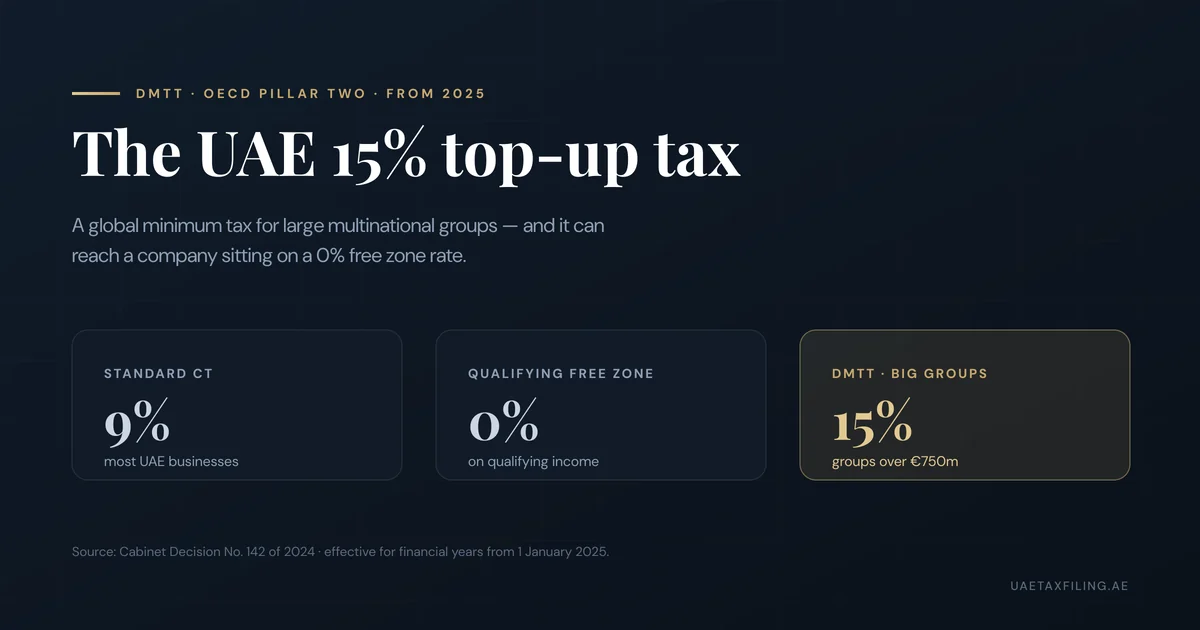
The UAE Domestic Minimum Top-up Tax (DMTT) is a 15% minimum tax on the UAE profits of large multinational groups. It applies from financial years starting on or after 1 January 2025 to any group with consolidated revenue of €750 million or more, and it works by topping up the group’s UAE tax to 15% wherever its effective rate falls short — including profits that a free zone company pays 0% on.
Most UAE businesses will never touch the DMTT. It is aimed squarely at the giants — groups with global revenue above €750 million. But for those groups, a 0% free zone rate no longer guarantees a 0% result, and that single fact is where the planning starts.
The short version
- It is a 15% floor, not a new headline rate. Under Cabinet Decision No. 142 of 2024, the DMTT lifts a large group’s effective UAE tax rate up to 15% and collects the difference.
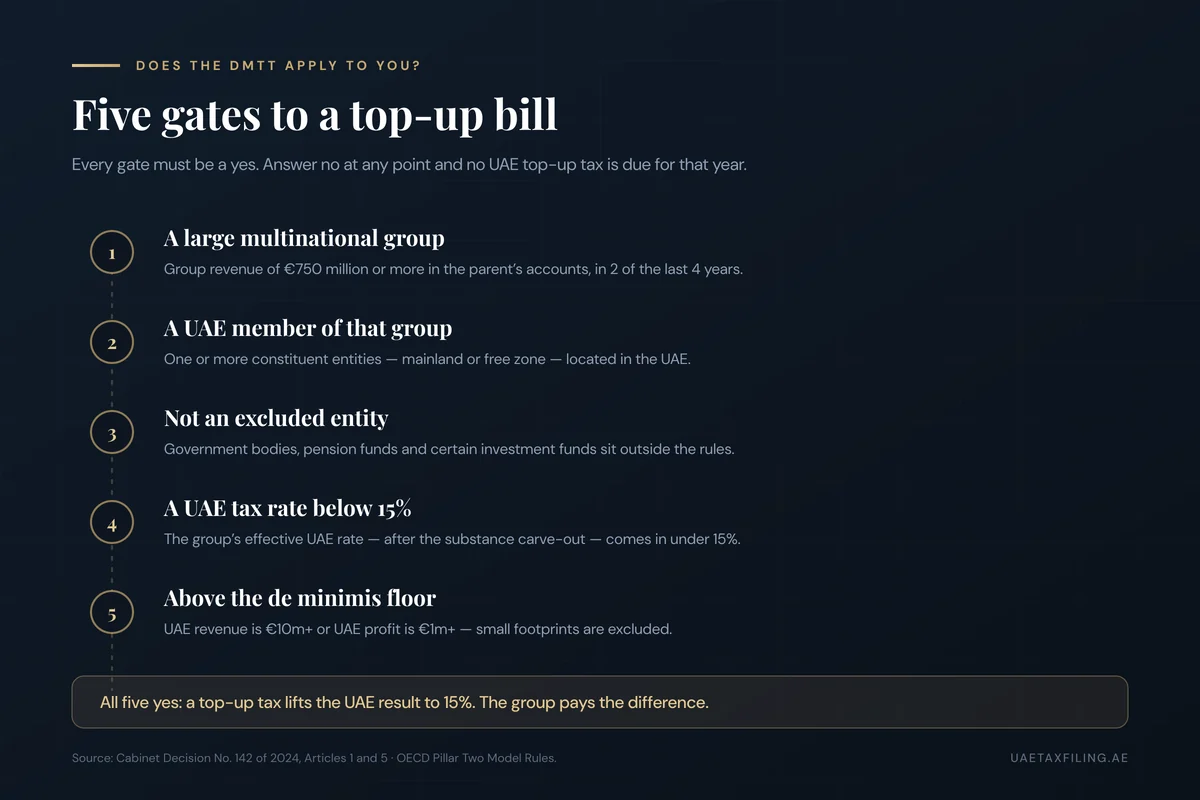
- Only €750 million groups are in scope. The test is consolidated revenue of €750 million or more in at least two of the four years before the one being tested.
- The 0% free zone rate still stands — but can be topped up. A Qualifying Free Zone Person keeps its 0%, yet if it sits inside an in-scope group, a top-up can still bring the group’s UAE result to 15%.
- Substance earns a carve-out. A 5% deduction for payroll and a 5% deduction for tangible assets is stripped out before the top-up is calculated, so real operations are taxed more lightly than paper profit.
- The clock has started. An in-scope group with a 31 December 2025 year-end registers by 30 November 2026 and files its first Top-up Tax Return by 30 June 2027.
What this covers
- What the DMTT is
- Who is in scope: the €750 million test
- How the 15% is worked out
- The substance carve-out
- The 0% free zone trap
- Who escapes: de minimis and excluded entities
- Why Transitional Qualified Status matters
- Registering and filing: the dates
- Frequently asked questions
What the DMTT is
The Domestic Minimum Top-up Tax is the UAE’s version of the OECD’s global minimum tax, known as Pillar Two. It is a rule that guarantees the largest multinational groups pay at least 15% on the profit they book in the UAE, no matter what reliefs or rates would otherwise apply.
Pillar Two is an international agreement, signed by more than 135 countries, that sets a 15% floor under corporate tax for big groups. If a country does not collect that 15% itself, another country in the group’s chain is entitled to collect the shortfall. The DMTT is how the UAE keeps that revenue at home: by charging its own top-up first, it removes the reason for a foreign tax authority to reach in. This is part of the same wave of change described in our guide to every UAE tax change coming in 2026.
It sits on top of the ordinary 9% Corporate Tax rather than replacing it. A group first works out its normal UAE tax, then tests whether the result reaches 15%. If it does, nothing more is due. If it does not — because of the 0% free zone rate, incentives, or timing differences — the DMTT charges the gap.
Key takeaway: the DMTT does not raise the 9% rate for ordinary businesses. It sets a separate 15% floor that only large multinational groups have to clear.
Who is in scope: the €750 million test
The DMTT applies to a multinational enterprise group whose ultimate parent reports consolidated revenue of €750 million or more. The threshold is measured in the parent’s consolidated financial statements, and it must be met in at least two of the four fiscal years immediately before the year being tested.
Two details catch people out. First, the €750 million is group revenue, not UAE revenue — a UAE subsidiary with modest local turnover is fully in scope if its worldwide parent clears the line. Second, the two-of-four-years rule stops a single spike or dip from switching a group in and out year by year. Whether the parent’s accounts actually reach the threshold is a question the group’s audited consolidated financial statements answer directly.
A useful contrast: a UAE family business with AED 200 million of revenue and no foreign parent is nowhere near the threshold and can ignore the DMTT entirely. A UAE trading arm of a listed European group with €3 billion of global sales is in scope on day one, even if its own books are small.
Key takeaway: scope is decided by the parent group’s global revenue, not by how much the UAE entity earns. If the group clears €750 million, every UAE member is in the net.
How the 15% is worked out
The DMTT charges the difference between 15% and the group’s effective tax rate (ETR) in the UAE. The effective tax rate is the group’s UAE covered taxes divided by its UAE Pillar Two income, calculated across all its UAE entities together, not company by company.
The mechanics run in three steps. The group totals the profit its UAE entities earned under the Pillar Two rules. It totals the tax those entities actually paid. It divides one by the other to get the ETR. Where that rate lands below 15%, the top-up tax is the percentage gap multiplied by the profit that remains after the substance carve-out. Because the calculation blends every UAE entity, a highly taxed mainland company and a 0% free zone company in the same group are averaged into one UAE figure.
| Outcome | Rate | Who it hits | On what |
|---|---|---|---|
| Standard Corporate Tax | 9% | Most UAE businesses | Taxable income above AED 375,000 |
| Qualifying Free Zone Person | 0% | Free zone entities meeting the conditions | Qualifying income |
| Domestic Minimum Top-up Tax | 15% floor | Groups over €750 million | UAE profit where the effective rate is under 15% |
Key takeaway: the DMTT is a blended, jurisdiction-wide calculation. It looks at the whole UAE result of the group at 15%, not at each company’s own rate.
The substance carve-out
The substance-based income exclusion is a deduction that removes a slice of profit from the top-up calculation to reward real activity. Under Cabinet Decision No. 142 of 2024, it equals 5% of eligible payroll costs plus 5% of the carrying value of eligible tangible assets located in the UAE.
The logic is deliberate: Pillar Two aims at profit that is taxed too lightly relative to where it is actually earned, so genuine substance — people and physical assets — is carved out before the floor bites. A group with large UAE payroll and warehouses shelters more profit from the top-up than a group holding the same profit in a company with no staff and no premises.
A worked example. Say a UAE group has AED 100 million of Pillar Two profit, AED 40 million of eligible payroll and AED 60 million of eligible tangible assets. The carve-out is 5% of each — AED 2 million plus AED 3 million, so AED 5 million. Only the remaining AED 95 million is exposed to any top-up. If the group’s UAE effective rate is 8%, the top-up is 7% of that AED 95 million, roughly AED 6.65 million.
Key takeaway: substance is rewarded. The more real payroll and tangible assets a group runs in the UAE, the smaller the base the 15% floor can reach.
The 0% free zone trap
A Qualifying Free Zone Person keeps its 0% rate under the DMTT, but that 0% no longer settles the question for a large group. If the free zone company belongs to an in-scope multinational, the group’s blended UAE rate is tested against 15%, and a 0% result pulls that blend down — inviting a top-up.
This is the single most misread part of the rules. Free zone status is not switched off, and the entity is not billed 15% directly. Instead, the shortfall is collected as a top-up on the group’s UAE result. The incentive still exists; the DMTT simply closes the gap between a 0% UAE outcome and the global 15% minimum for groups big enough to be in scope. The rules that make an entity a Qualifying Free Zone Person are unchanged — our guide on how to qualify for the 0% free zone rate still applies in full.
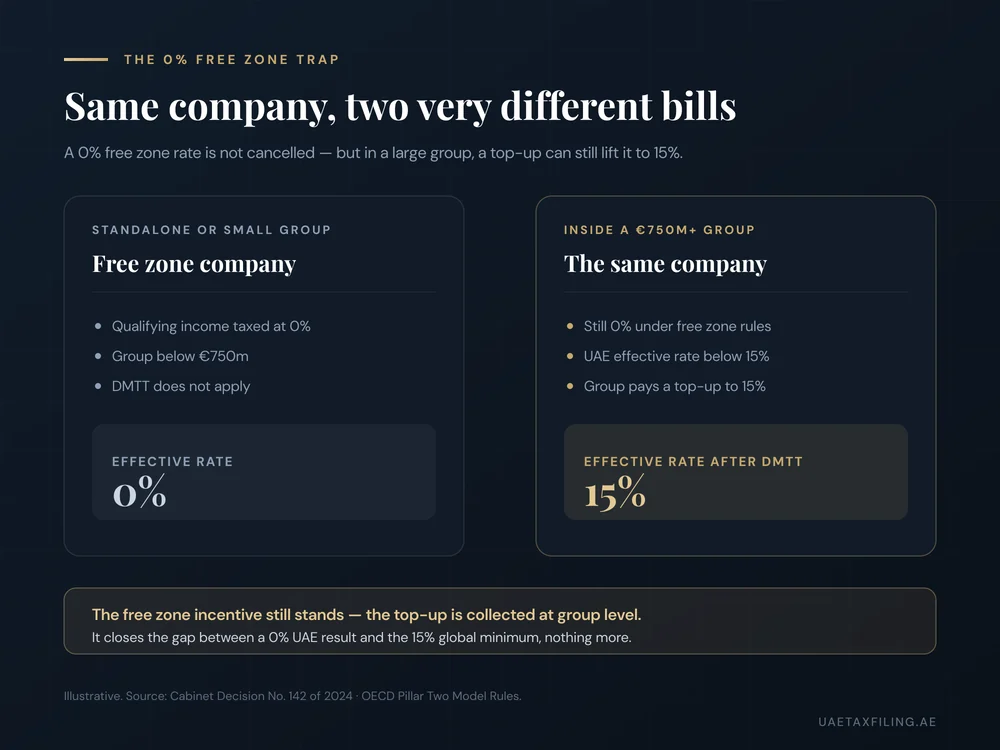
Compare two identical free zone companies. One is owned by a UAE family and its group turns over AED 300 million — it stays at 0%, untouched. The other is a subsidiary of a €2 billion group — it still reports 0% under free zone rules, but the group tops up its UAE result to 15%. Same company, same activity, opposite outcome, decided entirely by the size of the group above it.
Key takeaway: for a large group, 0% is the starting point, not the finish. The free zone rate survives, but the DMTT can still lift the group’s UAE tax to 15%.
Who escapes: de minimis and excluded entities
Not every in-scope group pays a top-up, because two relief routes take small footprints and specific bodies out of the charge. The de minimis exclusion removes a UAE result that is genuinely small, and the excluded-entity list removes organisations that were never the target.
The de minimis exclusion applies where the group’s average UAE revenue is below €10 million and its average UAE profit is a loss or below €1 million. Both limbs must hold, measured on a three-year average, and where they do the UAE top-up for that year is treated as zero. Separately, excluded entities — government bodies, international organisations, non-profits, pension funds, and investment funds or real estate vehicles that sit at the top of a group — fall outside the rules altogether.
Key takeaway: a large group with only a tiny UAE presence can still land below the de minimis floor and owe nothing. Government, pension and fund structures are carved out by definition.
Why Transitional Qualified Status matters
Transitional Qualified Status is an OECD recognition that a country’s domestic top-up tax is designed correctly. In August 2025 the UAE Ministry of Finance confirmed the DMTT had been entered on the OECD’s central record with that status and had met the Pillar Two safe harbour conditions.
The practical effect protects in-scope groups from double work and double tax. When the UAE’s DMTT is recognised, other countries in the group’s chain accept the UAE top-up as final and do not re-run their own calculation on the same UAE profit under the Income Inclusion Rule. Without that status, a parent country could tax the shortfall again, and the group would fight two authorities over one number. This is why the qualified label is more than a formality — it is what keeps the UAE’s 15% the only 15% a group pays on its UAE profit.
Key takeaway: the UAE’s DMTT is OECD-recognised, so the top-up paid here is respected abroad. Groups compute the UAE floor once, in the UAE.
Registering and filing: the dates
Being in scope brings its own registration and filing duties, separate from the ordinary Corporate Tax return. An in-scope group registers for the DMTT through EmaraTax and later files a dedicated Top-up Tax Return.
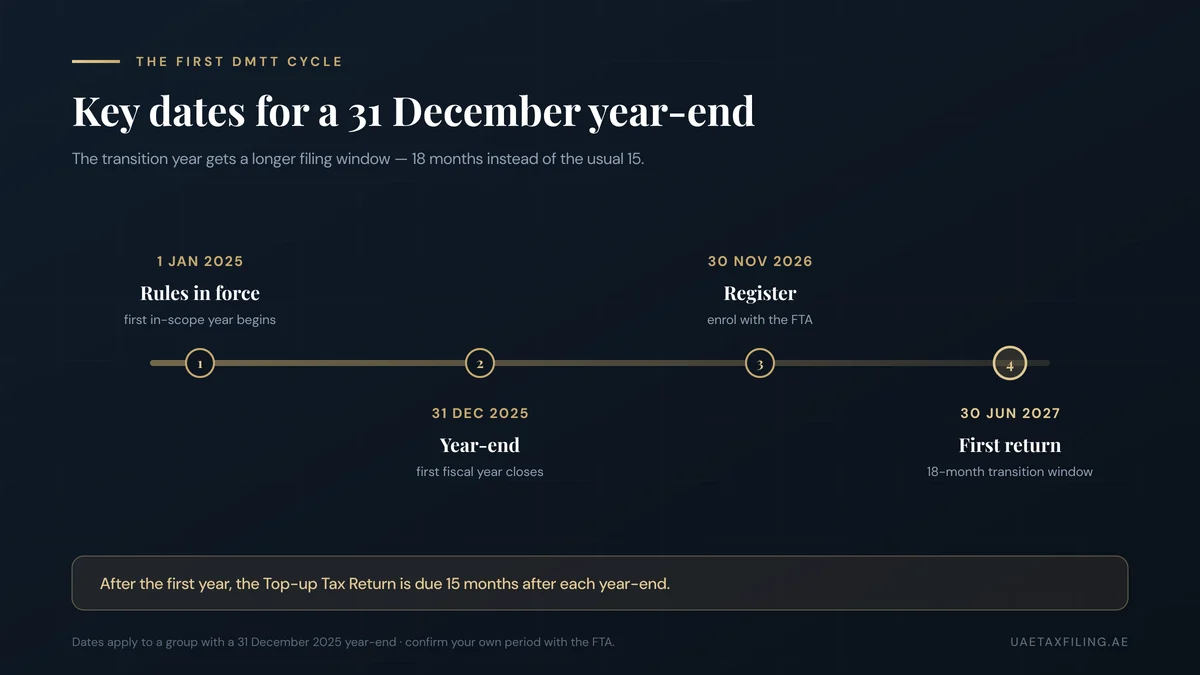
For a group with a 31 December year-end, the sequence runs as follows:
- Rules in force — 1 January 2025. The first in-scope fiscal year begins.
- Year-end — 31 December 2025. The first period to test against the 15% floor closes.
- Register — by 30 November 2026. The group enrols for the DMTT with the Federal Tax Authority.
- First return — by 30 June 2027. The Top-up Tax Return is due 18 months after the transition year-end; later years get 15 months.
- Pay the top-up. Any top-up tax for the period is settled alongside the return.
These duties run in parallel with the group’s standard filings. The ordinary 9% return still follows the normal calendar set out in our guide to UAE corporate tax deadlines in 2026, and the group still enrols for Corporate Tax as covered in our EmaraTax registration guide. The DMTT adds a second track, it does not merge with the first.
Key takeaway: registration for an in-scope 31 December group closes on 30 November 2026, with the first Top-up Tax Return due 30 June 2027. Diarise both now.
The workings behind a single Top-up Tax Return — the ETR blend, the substance carve-out, the currency and accounting adjustments — are heavier than an entire ordinary Corporate Tax return. Groups that start the data-gathering in 2026 file calmly; groups that wait until 2027 do not.
Frequently asked questions
What is the UAE Domestic Minimum Top-up Tax?
The Domestic Minimum Top-up Tax is a 15% minimum tax on the UAE profits of large multinational groups, introduced by Cabinet Decision No. 142 of 2024. It applies to financial years starting on or after 1 January 2025 and lifts a group’s effective UAE tax rate up to 15% where it would otherwise fall short.
Who has to pay the DMTT?
Only multinational enterprise groups with consolidated revenue of €750 million or more are in scope, measured in at least two of the four preceding fiscal years. A UAE entity of any size is caught if its worldwide parent group clears that threshold. Standalone UAE businesses and smaller groups are not affected.
Is the €750 million threshold group revenue or UAE revenue?
It is group revenue, taken from the ultimate parent’s consolidated financial statements. UAE turnover is irrelevant to the scope test — a UAE subsidiary with small local revenue is still in scope if the global group is above €750 million.
Does the DMTT cancel the 0% free zone rate?
No. A Qualifying Free Zone Person keeps its 0% rate, but if it belongs to an in-scope group, the group’s blended UAE effective rate is tested against 15%. Where the blend falls below 15%, a top-up is charged at group level, so a 0% free zone result can still lead to a 15% outcome for a large group.
Does the DMTT replace the 9% corporate tax?
No. The 9% Corporate Tax continues to apply as normal. The DMTT is a separate 15% floor that only affects large multinational groups, and it sits on top of the ordinary rules rather than replacing them.
What is the substance-based income exclusion?
It is a carve-out that removes part of the profit from the top-up calculation to reward real activity. It equals 5% of eligible UAE payroll costs plus 5% of the carrying value of eligible UAE tangible assets, and only the profit left after that deduction can be topped up.
When does an in-scope group have to register and file?
A group with a 31 December 2025 year-end registers for the DMTT by 30 November 2026 and files its first Top-up Tax Return by 30 June 2027. The transition year allows 18 months to file; later years allow 15 months after the year-end.
Is a small UAE business affected by the DMTT?
Almost never. If your business is not part of a group with €750 million or more of global revenue, the DMTT does not apply to you and the 9% Corporate Tax rules are all you need to follow. The rule is designed for the largest multinationals, not for local companies or SMEs.
What is Transitional Qualified Status and does it matter?
It is an OECD confirmation that the UAE’s DMTT is a properly designed top-up tax. Because the UAE received it in 2025, other countries accept the UAE top-up as final and do not tax the same UAE profit again, which spares in-scope groups from duplicate calculations and double taxation.
Working out whether a group is over the €750 million line, blending the UAE effective rate, applying the substance carve-out, and filing the Top-up Tax Return is specialist work that runs alongside the ordinary return. Tell us the shape of your group — global revenue, which UAE entities you hold, and your year-end — and we will tell you whether the DMTT reaches you and what the deadlines are. Where it does, we match you with an FTA-registered partner agency that builds the GloBE workings and files the return. Message the team on WhatsApp using the button below.
How we verified this: figures and dates are taken from Cabinet Decision No. 142 of 2024 as published by the Federal Tax Authority, and from the Ministry of Finance’s 2025 confirmation of the DMTT’s OECD Transitional Qualified Status. Where a date depends on your fiscal year, confirm it against the FTA legislation library. This article is general information, not tax advice.
Last updated: 19 August 2026 · Reviewed by Jazim, CEO, UAE Tax Filing LLC (Dubai)