Last updated: 29 August 2026 · Written by the UAE Tax Filing editorial team · Reviewed by Jazim, CEO, UAE Tax Filing LLC (Dubai) · 11 min read
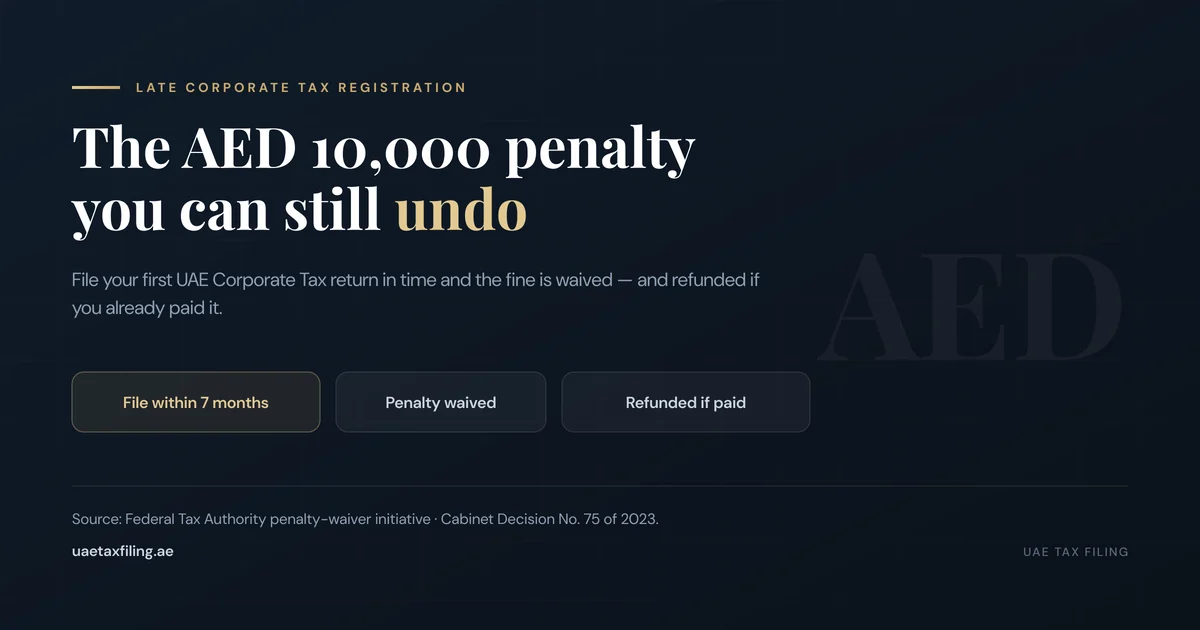
If you were fined AED 10,000 for registering late for UAE Corporate Tax, you can still have it waived — and refunded if you already paid. The Federal Tax Authority erases the penalty for your first tax period if you file your first Corporate Tax return within seven months of the period’s end, instead of the usual nine. No separate application is needed; the waiver is automatic once you file in time.
The fine feels final because it lands automatically, with no hearing and no warning. It is not final. For most first-year businesses there is a clean, built-in way to make the AED 10,000 disappear — but it runs on a deadline that is two months tighter than the one you think you have.
The short version
- The penalty is AED 10,000 for late Corporate Tax registration, set by Cabinet Decision No. 10 of 2024, which added it to the Corporate Tax penalty schedule, and it applies even if your business will pay 0% tax.
- The main fix is a filing deadline, not a form. File your first Corporate Tax return within seven months of the end of your first tax period and the penalty is waived.
- Already paid it? It comes back. A penalty you have already paid is refunded and credited to your account with the Authority once you meet the condition.
- It covers the first tax period only. This is a one-time relief tied to your very first return or annual declaration.
- Missed the window? Three fallback routes remain: the penalty-waiver committee, a reconsideration request, or a voluntary disclosure — each for a different situation.
What this covers
- The AED 10,000 penalty, explained
- The seven-month waiver that erases it
- Who the waiver covers
- If you already paid: the refund
- How to actually get it waived
- If you don’t qualify: three other routes
- The penalty-waiver committee
- Reconsideration and appeal
- Common mistakes
- Frequently asked questions
The AED 10,000 penalty, explained
The late-registration penalty is a fixed AED 10,000 administrative fine for failing to register for Corporate Tax by your deadline. It was added to the Corporate Tax penalty schedule by Cabinet Decision No. 10 of 2024 (amending Cabinet Decision No. 75 of 2023), and the Federal Tax Authority applies it automatically when a registration is filed after the due date — there is no assessment meeting and no discretion in how it is issued.
Two things make it sting. First, it is flat: the same AED 10,000 whether you are a large trading company or a dormant holding entity, and it applies even to businesses whose taxable income sits below the threshold and who will ultimately pay nothing. Second, the registration deadlines were staggered by licence-issue month during the first-year rollout, so many owners genuinely did not know their date had passed until the fine appeared in EmaraTax. If you need to get the underlying registration itself right, our Corporate Tax registration guide walks through the EmaraTax steps.
Key takeaway: The penalty is a fixed AED 10,000 under Cabinet Decision No. 75 of 2023, charged automatically for late registration and owed regardless of whether your business actually pays any tax.
The seven-month waiver that erases it
The waiver is a Federal Tax Authority initiative that cancels the AED 10,000 late-registration penalty if you file your first Corporate Tax return early. Specifically, the taxable person — or an exempt person that was required to register — must submit its first Corporate Tax return, or its first annual declaration, within seven months from the end of its first tax period, rather than the standard nine months.
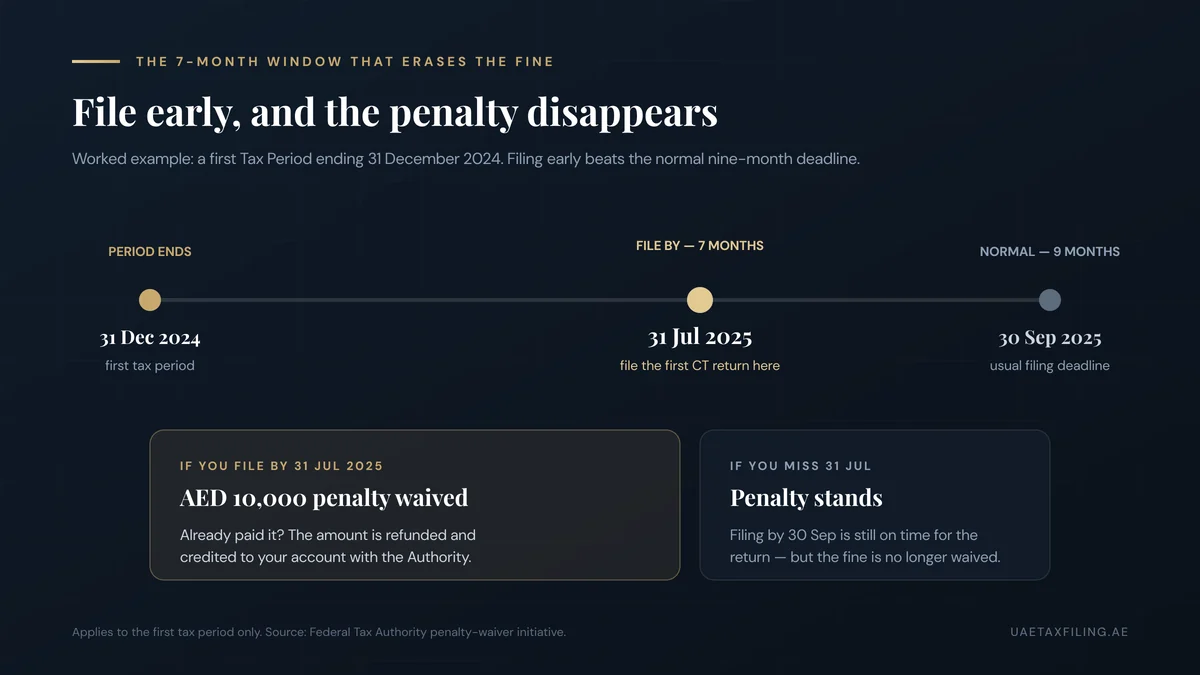
A worked example makes the trade-off concrete. Say your first tax period runs to 31 December 2024. Your normal filing deadline is nine months later, on 30 September 2025. To secure the waiver, you must instead file by 31 July 2025 — the seven-month mark. You give up two months of preparation time, and in exchange a AED 10,000 penalty is cancelled. For almost every business, filing two months early is the cheapest AED 10,000 it will ever save. The mistake we see most often is not a refusal to file — it is filing on the nine-month deadline, which is on time for the return but two months too late for the waiver. The Authority has confirmed this applies whether the return’s due date falls before or after the initiative began, so earlier first-period filers are not shut out.
Read the condition carefully: it is tied to the return deadline, not the registration date. You cannot un-register late. What you can do is file the first return early enough that the Authority sets the penalty aside.
Key takeaway: File your first Corporate Tax return or annual declaration within seven months of your first tax period ending, and the AED 10,000 penalty is waived. The relief hinges entirely on that earlier filing date.
Who the waiver covers
The waiver is not limited to ordinary companies — it reaches every category of person that was required to register for Corporate Tax, whether or not they had already registered or been fined. The Federal Tax Authority applies it across taxable persons, exempt persons that must still register, and tax groups, provided each files on the seven-month clock.
Three groups qualify in practice, each with its own version of the same early-filing condition:
- Taxable persons who registered late, or had not registered at all, and then file their first Corporate Tax return within seven months of the end of their first tax period.
- Exempt persons required to register — including Qualifying Public Benefit Entities, Qualifying Investment Funds, and public or private pension and social security funds — who submit their first annual declaration within seven months of the end of their first financial year.
- Tax groups, where the group files its return within seven months of the end of its first tax period, including entities that formed or joined a group after first registering.
The reach is deliberately wide. The Authority has said the relief extends to late-registration penalties arising from 1 June 2023 onward, and it expects tens of thousands of businesses to benefit. If you assumed your entity was excluded because it is exempt or sits inside a group, that assumption is usually wrong.
Key takeaway: The waiver covers taxable persons, registration-required exempt persons such as public benefit entities, investment funds and pension funds, and tax groups alike — each qualifying by filing its first return or annual declaration within seven months.
If you already paid: the refund
A penalty you have already paid is not lost. Where a taxable person has paid the AED 10,000 late-registration penalty and then meets the seven-month filing condition, the Authority refunds the amount and credits it to that person’s account with the Authority. You do not choose between waiver and refund — the outcome simply follows whether money had already changed hands.
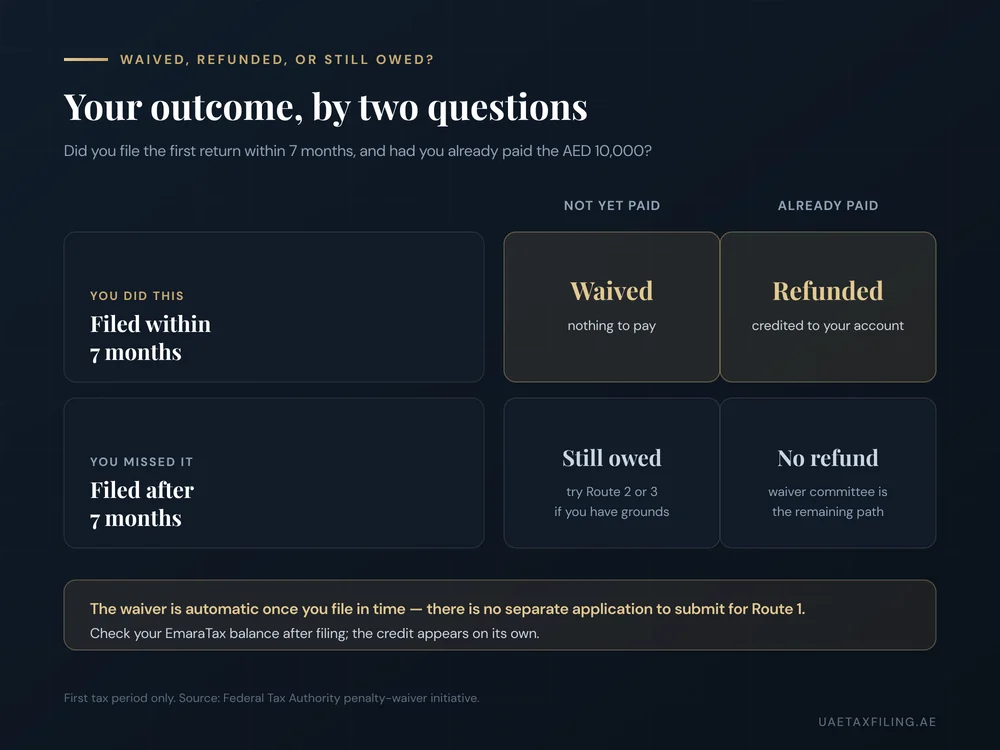
The practical point is that there is nothing to fill in. Because the credit is processed once your qualifying return is filed, the right move after filing is simply to open EmaraTax and check your balance: a credit of AED 10,000 should appear against your account without any refund form. If it has not appeared after your return is accepted, that is the moment to raise it with the Authority, not before.
Key takeaway: If you paid the penalty and then filed within seven months, the AED 10,000 is refunded to your Authority account automatically. Check your EmaraTax balance after filing rather than submitting a separate refund request.
How to actually get it waived
Getting the waiver is a sequence, not a negotiation. The steps below assume the penalty relates to your first tax period, which is the only period the initiative covers.
- Confirm the penalty is the late-registration one. In EmaraTax, check that the AED 10,000 sitting against your account is for late registration, not a separate late-payment or late-filing penalty — those follow different rules.
- Find your first tax period end date. This is usually the last day of your first financial year as a taxable person. Everything keys off it.
- Count seven months forward. That date is your waiver deadline. Mark it as hard, and note it is two months before your normal nine-month return deadline.
- Prepare and file the first return early. Get the financials and the return ready to submit by the seven-month date. Our EmaraTax return walkthrough covers the filing itself.
- Submit before the deadline, not on it. Leave room for EmaraTax validation errors or missing figures; a rejected submission on the last day does not count as filed.
- Check your balance afterward. Once the return is accepted, confirm the penalty is cleared, or the paid amount credited back, on your account.
Filing early is the entire strategy, so the risk is not the paperwork — it is the calendar. Missing the underlying deadlines is the single most common trigger for Corporate Tax fines, as our 2026 Corporate Tax deadlines guide lays out.
Key takeaway: Verify the penalty type, find your first-period end date, count seven months, and file before that date. The waiver is earned by hitting a calendar, and it clears without any application.
Not sure whether your penalty qualifies, or when your first tax period actually ended? Send us the details and we will map your exact seven-month date and whether the waiver, a refund, or a fallback route applies — and where filing needs handling, we match you with an FTA-registered partner agency to file it in time. Message the team on WhatsApp using the button below.
If you don’t qualify: three other routes
If the seven-month window has closed, or the penalty is not the first-period registration fine, the waiver initiative will not help — but three other routes exist, each suited to a different situation. Choosing the wrong one wastes a deadline, so match the route to your facts before you act.
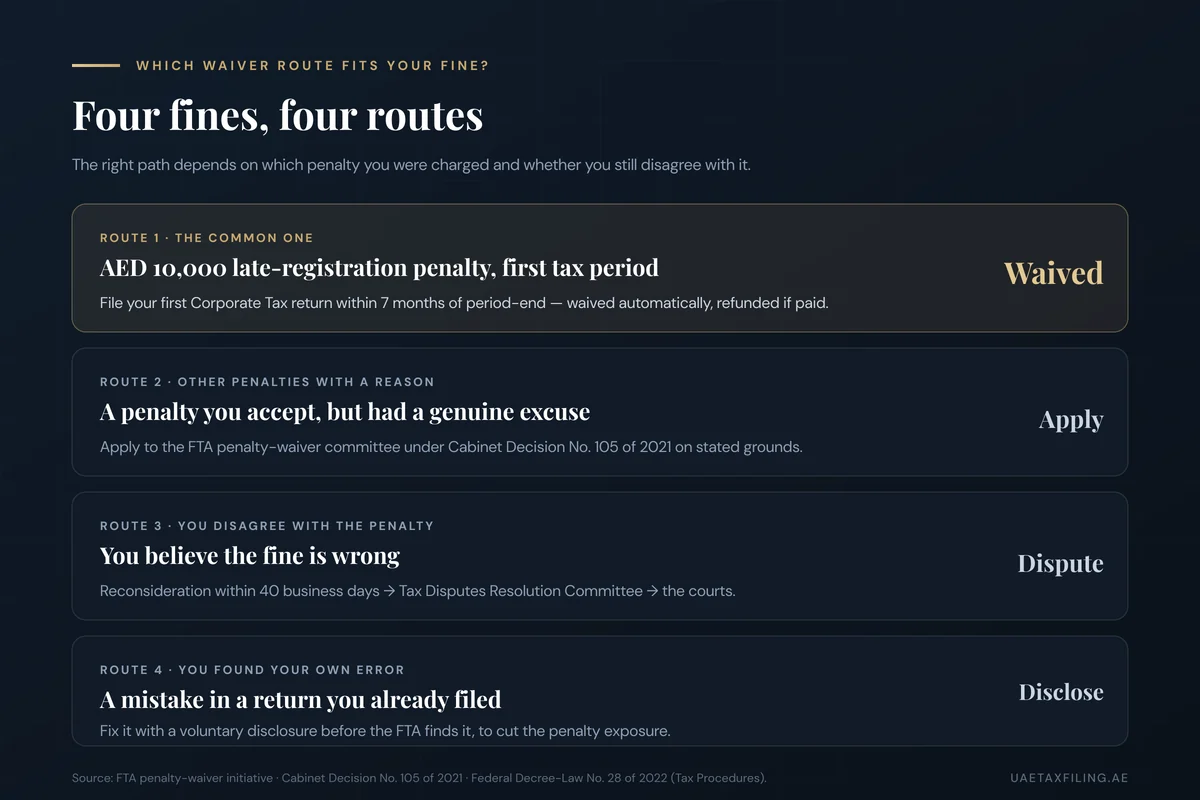
In short: if you had a genuine reason for the default, the penalty-waiver committee can reduce or cancel the fine. If you think the penalty is simply wrong, the reconsideration and appeal chain is your route. And if the underlying problem is an error in a return you already filed, a voluntary disclosure is the tool — explained in our guide to fixing tax errors with the FTA. These are not interchangeable, and only one will usually fit.
Key takeaway: Outside the seven-month initiative, use the waiver committee for a fine you had an excuse for, reconsideration for a fine you believe is wrong, and a voluntary disclosure for your own filing error.
The penalty-waiver committee
The penalty-waiver committee is the Authority’s formal mechanism for cancelling, reducing, or refunding administrative penalties on stated grounds. It operates under Cabinet Decision No. 105 of 2021 on the controls and procedures for penalty instalments, waivers, and refunds, in force since 1 March 2022, and it is a request you actively submit rather than an automatic relief.
Unlike the seven-month initiative, this route turns on justification. You submit a request to the Authority setting out the grounds for the waiver or refund, together with an undertaking that you have corrected the violation and will not repeat it, plus any documents the committee asks for. The Authority’s published service timeline for a decision runs up to 110 business days, and where a waiver is approved on a penalty already paid, the amount is credited back to your account — or paid in cash if you have since cancelled your tax registration.
Approval depends on the reason, not on hardship stated in the abstract. The decision recognises specific grounds, and a request anchored to one of them, with evidence, stands a far better chance than a general plea. The grounds it recognises include:
- Death or serious illness of the business owner or the natural-person registrant.
- Death, illness, or resignation of a key employee responsible for the tax obligations of the business.
- Restrictions or preventive measures imposed on the taxable person by a local government authority.
- A general malfunction in the Authority’s systems, payment gateways, or telecommunications services that directly caused the obligation to be missed.
Key takeaway: The Cabinet Decision No. 105 of 2021 committee can waive or refund a penalty when your request is tied to a recognised ground — such as death, serious illness, an official restriction, or an Authority system failure — backed by evidence and an undertaking to correct the violation. It is application-based and discretionary, not automatic.
Reconsideration and appeal
Reconsideration is the route for a penalty you believe was issued incorrectly. Under the Tax Procedures Law (Federal Decree-Law No. 28 of 2022), you may ask the Authority to reconsider a decision within 40 business days, setting out why the penalty should not stand, and the Authority reviews the request against the facts and the law.
The chain escalates if the answer does not satisfy you. A rejected reconsideration can be taken to the Tax Disputes Resolution Committee, again within 40 business days, and a committee decision can in turn be challenged before the competent courts. Each step is time-boxed, so a missed 40-day window can end an otherwise strong case — the deadlines are as important as the arguments. The full escalation is covered in our guide on how to challenge an FTA penalty.
Key takeaway: If a penalty is simply wrong, file a reconsideration within 40 business days, then escalate to the Tax Disputes Resolution Committee and the courts if needed. Every stage runs on a strict 40-business-day clock.
Common mistakes
The errors that cost businesses the waiver are almost all about the calendar and the category, not the merits. Each is avoidable once you know the rule.
Four recur. First, assuming the nine-month return deadline is the one that matters — it governs the return, but the waiver needs the seven-month date, and people miss it by relying on the later figure. Second, waiting to file because tax is nil, when a 0% or below-threshold business still has to file to trigger the waiver. Third, confusing penalty types, and trying to use the initiative on a late-payment or late-filing fine it does not cover. Fourth, paying the penalty and assuming it is gone for good, when filing in time would have refunded it. If a fine has already stacked up alongside others, our overview of UAE Corporate Tax penalties shows how the different fines interact.
Key takeaway: Most lost waivers come from watching the wrong deadline, not filing because tax is zero, or mixing up penalty types. The relief is generous, but it is unforgiving on dates.
The waiver rewards speed, so the costliest move is to sit on the penalty. Tell us your first tax period end date and we will confirm whether the seven-month window is still open, whether a refund is due, or which fallback route fits — and where filing needs handling, we match you with an FTA-registered partner agency to complete it in time. Message the team on WhatsApp below to start.
Frequently asked questions
Can the AED 10,000 late Corporate Tax registration penalty be waived?
Yes. The Federal Tax Authority waives the AED 10,000 late-registration penalty for your first tax period if you file your first Corporate Tax return, or annual declaration, within seven months of the end of that period instead of the usual nine. The waiver is automatic once you file in time, with no separate application to submit.
I already paid the penalty. Can I get it refunded?
Yes. If you paid the AED 10,000 and then filed your first return within the seven-month window, the Authority refunds the amount and credits it to your account. There is no refund form to complete — check your EmaraTax balance after your return is accepted and the credit should appear against your account.
What is the deadline to qualify for the waiver?
Seven months from the end of your first tax period. For a first tax period ending 31 December 2024, that means filing your first Corporate Tax return by 31 July 2025, rather than the normal nine-month deadline of 30 September 2025. Filing after the seven-month date keeps the return on time but loses the waiver.
Does the waiver apply if my company owes no tax?
Yes, and this is where businesses slip. The AED 10,000 penalty applies even to companies below the taxable-income threshold or taxed at 0%, and the waiver still requires you to file the first return within seven months. A nil or zero-rated position does not remove the need to file to secure the relief.
Does the waiver cover more than my first tax period?
No. The initiative is a one-time relief tied to your first tax period only — the first Corporate Tax return, or first annual declaration for an exempt person that was required to register. Penalties relating to later periods are not covered and must be handled through the other routes.
Does the waiver apply to exempt persons and tax groups?
Yes. Beyond ordinary taxable persons, the waiver covers exempt persons that are still required to register — such as Qualifying Public Benefit Entities, Qualifying Investment Funds, and pension or social security funds — as well as tax groups. Each qualifies by filing its first Corporate Tax return, or annual declaration, within seven months of the end of its first tax period or financial year.
What if I missed the seven-month window?
Three routes remain. If you had a genuine reason for the default, apply to the penalty-waiver committee under Cabinet Decision No. 105 of 2021. If you believe the penalty is wrong, file a reconsideration within 40 business days and escalate if needed. If the issue is an error in a filed return, use a voluntary disclosure.
Do I need to submit an application for the seven-month waiver?
No. Unlike the waiver committee, the seven-month initiative has no application. The relief is applied automatically once your qualifying first return is filed within the window, and any penalty already paid is credited back to your account with the Authority.
How long does a penalty refund take?
For the seven-month initiative, the credit follows your accepted return and appears on your Authority account. For a waiver approved by the committee under Cabinet Decision No. 105 of 2021, refunds are processed within 90 business days, or paid in cash if you have since cancelled your tax registration.
Does registering late affect anything besides the penalty?
The direct cost is the AED 10,000 penalty, but late registration also compresses the time you have to prepare a correct first return, and the seven-month waiver condition tightens that further. Registering and filing early keeps both the penalty and the filing pressure off, which is why the deadline discipline matters beyond this single fine.
How we verified this: the seven-month filing condition, the automatic waiver, and the refund of an already-paid penalty are taken from the Federal Tax Authority’s penalty-waiver announcement for late Corporate Tax registration. The AED 10,000 amount was added to the Corporate Tax penalty schedule by Cabinet Decision No. 10 of 2024 (amending Cabinet Decision No. 75 of 2023); the committee-based waiver and refund mechanism by Cabinet Decision No. 105 of 2021; and the reconsideration and appeal chain by Federal Decree-Law No. 28 of 2022 on Tax Procedures. Confirm the current position on the FTA announcement and the FTA’s penalty-waiver service page. This article is general information, not tax advice.
Last updated: 29 August 2026 · Reviewed by Jazim, CEO, UAE Tax Filing LLC (Dubai)