
Last updated: 29 August 2026 · Written by the UAE Tax Filing editorial team · Reviewed by Jazim, CEO, UAE Tax Filing LLC (Dubai) · 13 min read
Qualifying Group Relief lets you move an asset or liability between two UAE companies under at least 75% common ownership with no gain or loss for corporate tax. Business Restructuring Relief does the same for a whole business transferred in exchange for shares. Both defer the 9% tax rather than removing it: sell the asset outside the group, or break the ownership, within two years and the deferred gain becomes taxable.
Reorganising a group feels like an internal housekeeping exercise — you are only moving things between companies you already own. The corporate tax law does not see it that way. Every transfer is a disposal at market value unless you actively claim a relief, and the gain you did not think existed is suddenly on the return.
The short version
- Two reliefs, one idea. Article 26 (Qualifying Group Relief) and Article 27 (Business Restructuring Relief) both let you transfer value between companies at net book value, so no taxable gain arises on the move.
- Qualifying Group Relief moves assets. One or more assets or liabilities, between two taxable persons under 75% or more common ownership.
- Restructuring Relief moves businesses. A whole business, or an independent part, transferred in exchange for shares — the mechanism behind mergers and incorporations.
- Neither is automatic. The transferor must elect for the relief. Miss the election and the transfer is taxed at market value.
- Hold for two years. If the asset leaves the group, or the parties stop being a group, within two years, the relief is clawed back and the gain is taxed.
What this covers
- What these reliefs are
- Qualifying Group Relief: moving assets
- Business Restructuring Relief: moving businesses
- Which relief fits your deal
- Group Relief vs Restructuring vs Tax Group
- The election trap
- The two-year clawback
- Who cannot use these reliefs
- Common mistakes
- Frequently asked questions

What these reliefs are
Group relief and restructuring relief are corporate tax mechanisms that let a business reorganise without an immediate tax charge on the internal transfer. The UAE charges corporate tax at 9% on taxable income above AED 375,000, and a disposal of an asset for more than its tax value normally produces a taxable gain. When the “disposal” is just a move between companies under common ownership, taxing it would penalise ordinary reorganisation, so the law switches the gain off — on conditions.
There are two reliefs, and they solve two different problems. Qualifying Group Relief, in Article 26 of Federal Decree-Law No. 47 of 2022, covers moving individual assets and liabilities inside a commonly owned group. Business Restructuring Relief, in Article 27, covers moving an entire business in exchange for shares — the legal shape of a merger, an incorporation, or a spin-off. Both work by carrying the transferred item across at its net book value, so the transferee inherits the old tax cost and no gain crystallises on the day.
Key takeaway: Both reliefs defer, not delete. The gain is parked in the transferred asset’s carried-over book value and will surface on a future real sale — or immediately, if a two-year condition is broken.
Qualifying Group Relief: moving assets
Qualifying Group Relief is a no-gain-no-loss treatment for the transfer of assets or liabilities between two taxable persons in the same Qualifying Group. Under Article 26, no gain or loss is taken into account in the taxable income of either party, the item is treated as transferred at net book value, and any consideration is deemed to equal that same book value. It is the tool for shifting a property, a piece of intellectual property, plant, or even a loan from one group company to another.
Two companies form a Qualifying Group only when all of these are true: both are juridical persons that are UAE residents (or non-residents with a UAE permanent establishment); one holds at least 75% of the other, or a third person holds at least 75% of both, directly or indirectly; neither is an Exempt Person; neither is a Qualifying Free Zone Person; both share the same financial year-end; and both use the same accounting standards. Miss one condition and the transfer is an ordinary taxable disposal.
The 75% test is about ownership, not control on paper. It can run directly or indirectly and can sit in a common parent, so two sister companies each 80%-held by the same holding company qualify — but a 70% stake, however tight the working relationship, does not.
Key takeaway: Qualifying Group Relief moves single assets or liabilities at book value between companies under 75%-plus common ownership, provided the year-ends and accounting standards match and neither party is exempt or a free zone person.
Business Restructuring Relief: moving businesses
Business Restructuring Relief is a no-gain-no-loss treatment for the transfer of a whole business, or an independent part of it, in exchange for shares. Article 27 applies where a taxable person transfers its entire business (or an independent part) to another taxable person for shares or ownership interests, or where one or more businesses are rolled into another and the transferors cease to exist — the classic merger. The assets and liabilities move at net book value, and the shares received are capped at that same net value.
The conditions echo Article 26 but add two of their own. The transfer must comply with the applicable UAE legislation; both parties must be residents or have a UAE permanent establishment; neither can be an Exempt Person or a Qualifying Free Zone Person; year-ends and accounting standards must match; and — the extra test — the restructuring must be for valid commercial or non-fiscal reasons that reflect economic reality. A reorganisation engineered only to save tax fails that last condition. In return, Article 27 offers something Article 26 does not: unutilised tax losses of the transferor can carry forward to the transferee, subject to conditions set by the Minister.
Key takeaway: Business Restructuring Relief moves an entire business for shares with no gain or loss, needs a genuine commercial rationale, and — uniquely — can carry the transferor’s tax losses across to the buyer.
Which relief fits your deal
The right relief is decided by what crosses between the companies, not by how the group thinks of the deal. Assets move under Article 26; businesses-for-shares move under Article 27; and if nothing needs to move at all, a Tax Group may be the better answer. Getting this wrong — claiming restructuring relief on a bare asset sale, or vice versa — means claiming a relief whose conditions you do not meet.
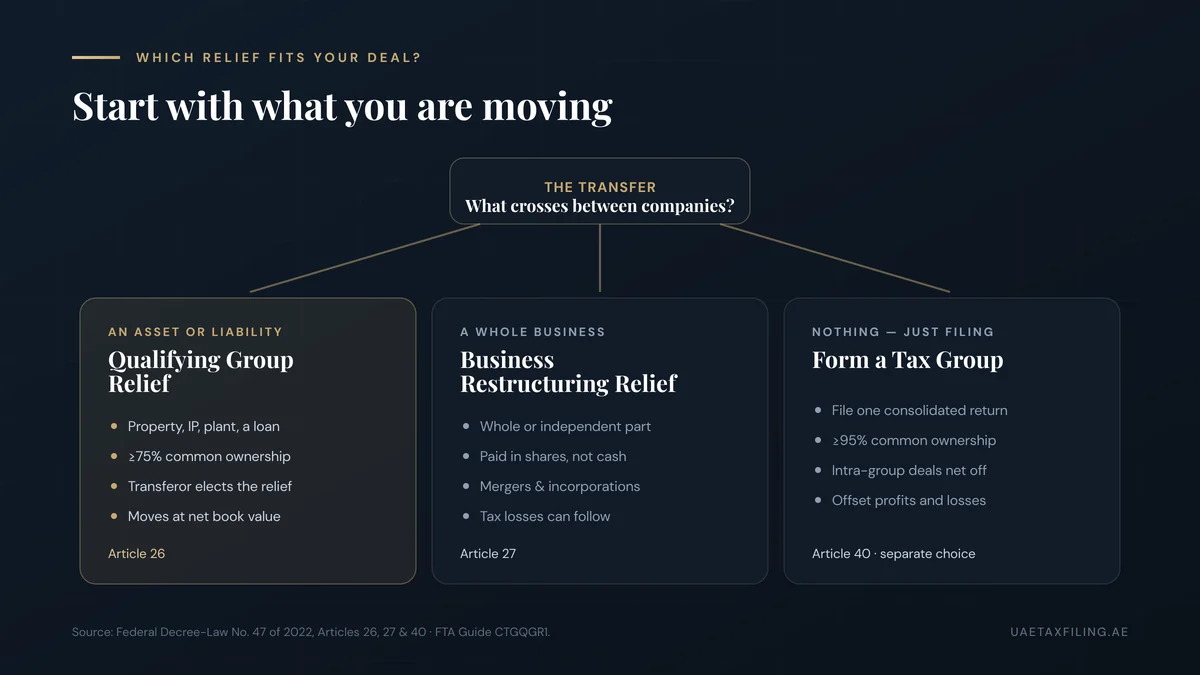
In practice, three questions settle it:
- Is a single asset or liability moving? A building, a trademark, machinery, or a receivable going from one group company to another points to Qualifying Group Relief.
- Is a whole business or an independent part moving for shares? Incorporating a sole establishment, merging two subsidiaries, or hiving off a division in exchange for equity points to Business Restructuring Relief.
- Is nothing really moving — you just want one tax return? Then neither transfer relief applies; you are looking at forming a Tax Group instead.
Key takeaway: Let the object of the transfer choose the relief. Assets take Article 26, businesses-for-shares take Article 27, and a pure filing simplification is a Tax Group question, not a relief question.
Group Relief vs Restructuring vs Tax Group
These three are the “group” mechanisms of UAE corporate tax, and they are constantly confused because they share a word, not a function. Two are reliefs that switch off the gain on a transfer; the third is a filing structure that treats several companies as one taxable person. They can even be used together — a group can hold a transfer relief and file as a Tax Group.
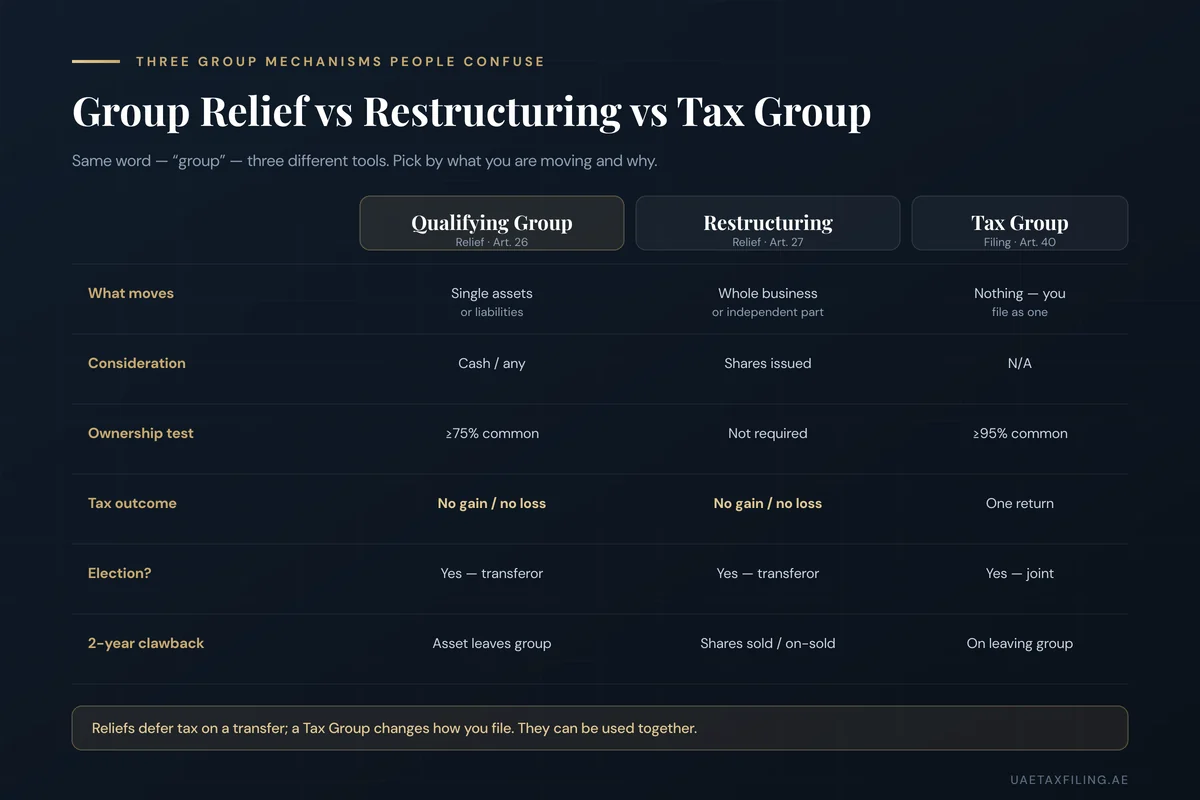
| Qualifying Group Relief | Restructuring Relief | Tax Group | |
|---|---|---|---|
| Law | Article 26 | Article 27 | Article 40 |
| What moves | Assets or liabilities | A whole business, for shares | Nothing — you file as one |
| Ownership test | 75% common | Not an ownership threshold | 95% common |
| Tax effect | No gain, no loss | No gain, no loss | One consolidated return |
| Tax losses | Stay with transferor | Can follow the business | Shared within the group |
| Must elect? | Yes — transferor | Yes — transferor | Yes — joint application |
| Two-year clawback | Yes | Yes | Rules on leaving apply |
Key takeaway: Reliefs change the tax on a one-off transfer; a Tax Group changes how a set of companies files every year. If your question is “how do I move this without tax,” it is a relief; if it is “how do we file together,” it is a Tax Group.
The election trap
Neither relief applies by default — the transferor has to elect for it. The FTA’s Qualifying Group Relief guide is explicit that the relief is only available where the transferor has elected, and Ministerial Decision No. 133 of 2023 requires an election, in the form and manner set by the Authority, before Business Restructuring Relief applies. If you complete an internal transfer, book it as an ordinary sale, and never make the election, the default rule wins: the transfer is a disposal at market value and the gain is taxed.
The practical discipline is straightforward, and it starts before the assets move:
- Confirm the conditions at the transfer date. Ownership percentage, residence, non-exempt and non-free-zone status, matching year-ends and accounting standards.
- Value the transfer at net book value. The gain you are deferring is the difference between that book value and market value — know it before you file.
- Make the election in the return. The transferor elects for the relief for the relevant tax period; without it, there is no relief to claim.
- Keep the records. Both parties must retain the transfer agreement and evidence of the values — the paperwork that survives a later FTA review.
The election is the whole game. The reliefs are generous, but they are opt-in, and the FTA is entitled to tax the transfer at market value where no valid election was made. A missed checkbox is not a technicality here — it is the difference between a nil charge and a taxable gain.
Key takeaway: Treat the election as the deliverable, not the afterthought. Map the conditions, fix the book value, elect in the return, and keep the agreement and valuations on file.
The two-year clawback
The clawback is the rule that reverses the relief if the group unwinds the position within two years. For Qualifying Group Relief, Article 26 withdraws the relief where, within two years of the transfer, the asset is transferred outside the group or the two companies stop being members of the same Qualifying Group — the transfer is then treated as having happened at market value. Business Restructuring Relief carries a mirror rule: relief falls away if, within two years, the shares are sold outside the group or the transferred business is itself passed on.
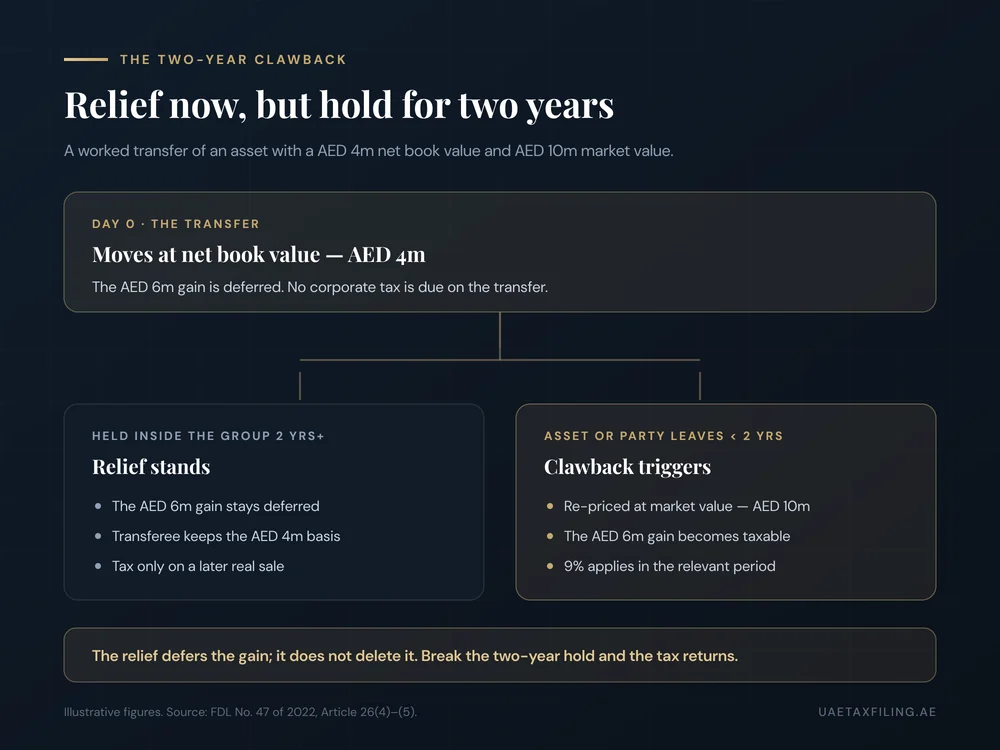
A worked example shows the stakes. Company A transfers an asset with a net book value of AED 4 million and a market value of AED 10 million to sister Company B under Qualifying Group Relief. On the day, nothing is taxed — the asset moves at AED 4 million and the AED 6 million gain is deferred. Hold it inside the group for two years and the deferral stands; the gain only surfaces on a genuine later sale. But if Company B sells the asset to an outside buyer, or leaves the group, 14 months in, the clawback re-prices the original transfer to AED 10 million, and that AED 6 million gain becomes taxable at 9% in the relevant period. This is why the participation and holding structure around a transfer matters as much as the transfer itself — a point that connects to the participation exemption when shares, rather than assets, are in play.
Key takeaway: The relief is conditional on a two-year hold. Breaking it — by selling the asset out, disposing of the shares, or dismantling the group — re-prices the transfer to market value and taxes the deferred gain.
Who cannot use these reliefs
Some businesses are shut out of these reliefs by status, not by the shape of the deal. Article 26 and Article 27 both exclude Exempt Persons and Qualifying Free Zone Persons from either side of the transfer, and both require the parties to be UAE residents or to hold a UAE permanent establishment. A group with a 0%-rated free zone entity cannot fold that entity’s assets into a mainland company under group relief and keep the relief.
Cross-border structures hit a further wall. The FTA’s guidance confirms that Qualifying Group Relief is not available for transfers between a UAE permanent establishment and its head office abroad, nor where a non-resident transfers assets that are not attributable to a UAE permanent establishment. The reliefs are built for reorganisations that stay inside the UAE tax net; move value across the border and the relief does not follow. Where value does leave the country, the questions shift to permanent establishment and group boundaries, and the transfer is measured at market value.
Key takeaway: Exempt persons, qualifying free zone persons, and transfers between a UAE branch and its foreign head office are outside both reliefs. Status and residence decide eligibility before the deal structure does.
Common mistakes
The expensive errors here are procedural, not conceptual — groups understand the reliefs and still lose them on the paperwork. Four recur. First, not electing: booking the transfer and assuming the relief is automatic, when it must be claimed by the transferor. Second, mismatched year-ends or accounting standards, which quietly break the Qualifying Group conditions even when the ownership is fine. Third, tripping the clawback by selling the asset or the shares, or restructuring again, inside the two-year window. Fourth, thin records — no transfer agreement, no net-book-value evidence — which leaves nothing to defend the treatment when the FTA asks.
All four are avoidable with sequencing: confirm the conditions and the book value first, register and file correctly through EmaraTax, make the election in the return, and diarise the two-year date. A reorganisation planned around the relief keeps the relief; one that treats it as a formality after the fact usually does not. The mechanics of getting the election and the numbers into the return sit inside the wider corporate tax return process.
Key takeaway: The reliefs are lost on process, not principle — a missing election, a mismatched year-end, a broken two-year hold, or absent records. Plan the transfer around the conditions and the relief holds.
If you are moving property, a subsidiary, or a whole business between UAE companies, tell us what is moving, who owns what, and why — and we will tell you which relief applies, whether you meet the 75% and other conditions, and what the election and two-year exposure look like. Where you want the corporate tax registration, the election, and the filing handled, we match you with an FTA-registered partner agency that does the work. Message the team on WhatsApp using the button below.
Frequently asked questions
What is Qualifying Group Relief in the UAE?
Qualifying Group Relief is a corporate tax treatment that lets two UAE companies under at least 75% common ownership transfer assets or liabilities between them with no gain or loss. Under Article 26 of the corporate tax law, the item moves at its net book value, so no taxable gain arises on the transfer. The transferor must elect for the relief, and a two-year holding condition applies.
What is Business Restructuring Relief?
Business Restructuring Relief lets a taxable person transfer its whole business, or an independent part, to another taxable person in exchange for shares with no gain or loss. It is the mechanism behind mergers, incorporations, and spin-offs under Article 27. The restructuring must have valid commercial reasons, and unutilised tax losses of the transferor can carry to the transferee, subject to conditions.
Do I have to elect for the relief, or is it automatic?
You have to elect. Neither Qualifying Group Relief nor Business Restructuring Relief applies by default — the transferor makes an election in the form and manner set by the FTA. If no valid election is made, the transfer is treated as an ordinary disposal at market value and any gain is taxed. The election is the single most missed step.
Can I move property between my two companies without paying corporate tax?
Often yes, if the companies form a Qualifying Group and you elect for the relief. Where one company holds at least 75% of the other, or a common parent holds 75% of both, and the other conditions are met, the property transfers at net book value with no taxable gain. The deferral only holds if the property stays inside the group for two years.
What is the two-year clawback?
The two-year clawback reverses the relief if the group unwinds the transfer too soon. If, within two years, the transferred asset is sold outside the group, the shares are disposed of outside the group, or the companies stop being a group, the transfer is re-priced to market value and the previously deferred gain becomes taxable. It exists to stop the relief being used as a step in an onward sale.
What is the difference between a Qualifying Group and a Tax Group?
A Qualifying Group is an ownership relationship (75% common) that unlocks no-gain-no-loss transfer relief on assets; a Tax Group is a separate election (95% common) that lets companies file one consolidated return as a single taxable person. One is about moving assets tax-neutrally; the other is about how the group files each year. They are different thresholds and different purposes, and a group can use both.
Can free zone companies use group relief?
No, not while they are Qualifying Free Zone Persons. Both Article 26 and Article 27 exclude a Qualifying Free Zone Person from either side of the transfer, along with Exempt Persons. A group that wants to reorganise assets held by a 0%-rated free zone entity cannot do so under these reliefs without losing the free zone company’s status or the relief.
Do tax losses transfer with a business restructuring?
They can under Business Restructuring Relief, but not under Qualifying Group Relief. Article 27 allows unutilised tax losses of the transferor to become carried-forward losses of the transferee, subject to conditions set by the Minister, and only the losses attributable to an independent part transfer with that part. Qualifying Group Relief leaves the transferor’s losses where they are.
Does group relief apply between a UAE branch and its foreign head office?
No. The FTA’s guidance confirms that Qualifying Group Relief is not available for transfers between a UAE permanent establishment and its head office outside the UAE, nor where a non-resident moves assets not attributable to a UAE permanent establishment. The reliefs are designed for reorganisations that remain within the UAE corporate tax net.
How we verified this: the transfer conditions, election requirement, loss carry-forward, and two-year clawback are taken from Articles 26 and 27 of Federal Decree-Law No. 47 of 2022, Ministerial Decisions No. 132 and No. 133 of 2023, and the FTA Qualifying Group Relief Guide (CTGQGR1). Figures in the clawback example are illustrative. This article is general information, not tax advice.
Last updated: 29 August 2026 · Reviewed by Jazim, CEO, UAE Tax Filing LLC (Dubai)