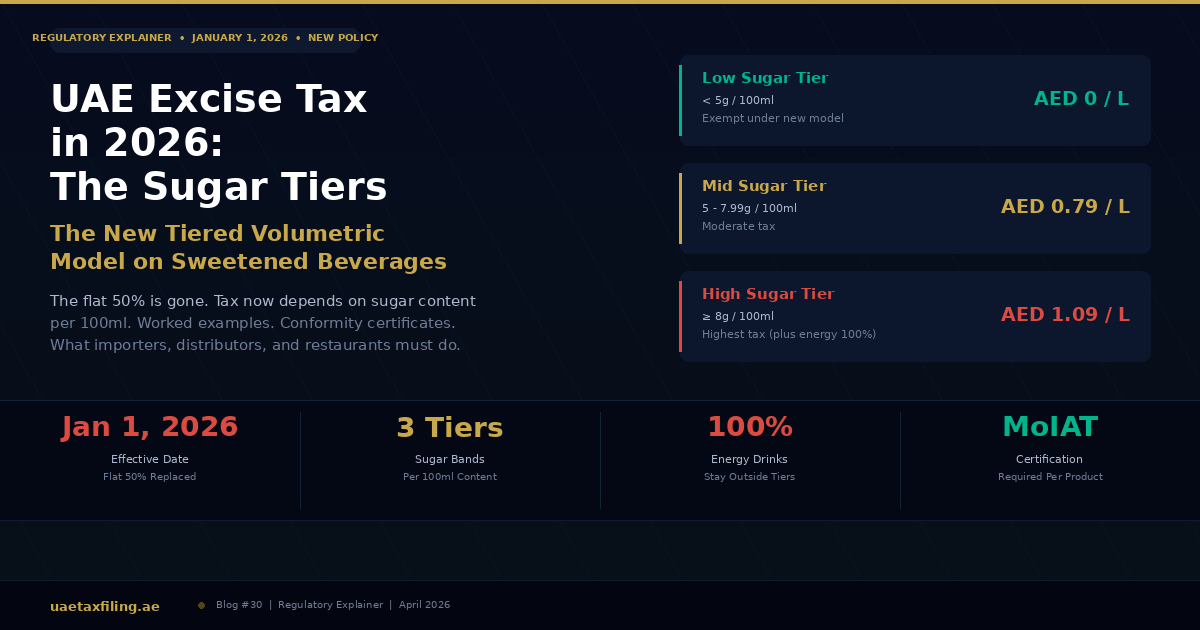
On January 1, 2026, the UAE replaced the flat 50% excise tax on sweetened beverages with a tiered volumetric model. The change is fundamental. Before 2026, every sugar-sweetened drink carried the same tax rate regardless of how much sugar it contained: a bottle of water with a trace of sweetener and a full-sugar cola paid the same 50% of retail price. After January 1, 2026, two drinks on the same shelf can pay completely different amounts of excise tax, not because their prices differ, but because their formulation differs.
The new system is called the 'tiered volumetric model' and it links the excise tax per litre to the sugar content per 100 millilitres of the finished beverage. As the UAE Ministry of Finance confirmed in its official announcement, beverages containing less than 5 grams of sugar per 100ml are exempt (AED 0 per litre), those with 5 grams or more but less than 8 grams are taxed at AED 0.79 per litre, and those with 8 grams or more per 100ml are taxed at AED 1.09 per litre. Energy drinks remain outside the tiered system and continue to pay 100% excise tax under the existing rule.
This article explains what changed on January 1, 2026, which products are affected, how to calculate the new tax on specific beverages with worked AED examples, what the MoIAT conformity certificate process involves, and what importers, distributors, and restaurants must do to stay compliant. The excise change is one of several regulatory shifts this year, covered in our complete 2026 tax changes guide. If your business imports, distributes, manufactures, or sells sweetened beverages in the UAE, the old compliance framework no longer applies. Everything on your shelves now needs to be reclassified.
"The old 50% excise was simple. Price times 0.5 equals tax. The new model is formulation-based, which means every product needs a laboratory test, a conformity certificate, and ongoing documentation. Businesses that sold the same bottle of soda for years without ever thinking about excise compliance are now learning that the entire process is different. The products did not change. The compliance framework did."
Jazim, CEO, UAE Tax Filing LLC
What Changed on January 1, 2026
Until December 31, 2025, the UAE excise framework applied a flat 50% ad valorem tax to all sweetened beverages. The calculation was simple: the excise price was 50% of the higher of the published retail price or the FTA-determined price. A can of cola priced at AED 3 paid AED 1.50 in excise, regardless of whether it contained 5 grams or 15 grams of sugar per 100ml. A premium reformulated low-sugar drink and a full-sugar original paid identical excise as long as they sold at the same price.
From January 1, 2026, the model changed entirely. Excise is now calculated on a volumetric basis (per litre of beverage) with the rate determined by sugar content per 100ml. The Federal Tax Authority's clarification confirmed that the tax is charged per litre of the finished beverage, and the rate depends on the sugar and sweetener content as certified by an accredited laboratory report.
The three tiers, confirmed by the Ministry of Finance
Low sugar tier (below 5g per 100ml): AED 0 per litre. These beverages are exempt from excise tax under the new model. This is the rate designed to incentivize reformulation toward lower-sugar products. A drink sitting at 4.9g per 100ml pays nothing. A drink at 5.0g per 100ml moves into the next tier.
Mid sugar tier (5g to below 8g per 100ml): AED 0.79 per litre. Beverages in this range pay a moderate volumetric rate. For a 330ml can, the excise is approximately AED 0.26 (0.33 litres x AED 0.79). For a 1.5 litre bottle, the excise is approximately AED 1.19.
High sugar tier (8g or more per 100ml): AED 1.09 per litre. This is the highest rate under the tiered model, applied to beverages with sugar content at or above the 8g/100ml threshold. For a 330ml can, the excise is approximately AED 0.36. For a 1.5 litre bottle, the excise is approximately AED 1.64. Most popular full-sugar carbonated drinks fall into this tier. As ClearTax's analysis confirmed, the shift to a volumetric model means cheaper high-sugar drinks may feel more expensive than before while premium-priced drinks are less heavily taxed in absolute terms compared to the old ad valorem system.
Energy drinks: 100% of the excise price. Energy drinks remain outside the tiered volumetric model and continue to pay the existing 100% rate. As Middle East Briefing confirmed, energy drinks are not reclassified into the sugar tiers; they remain the most heavily taxed beverage category regardless of their actual sugar content.
Which Products Are In Scope, and Which Are Exempt
The tiered volumetric model applies to a broader category than just fizzy soft drinks. Any product that becomes a drink when consumed, whether directly or after dilution, can fall within scope. This is a deliberate design choice: the old system had loopholes around concentrates and powdered drink mixes that the new framework closes.
Products covered by the tiered model: ready-to-drink carbonated beverages (cola, lemon-lime, orange), sweetened non-carbonated beverages (flavored waters, iced teas, lemonades), sweetened dairy-based drinks below the 75% milk threshold, concentrates and syrups that produce a sweetened beverage when diluted (per-litre calculation based on the diluted volume), powdered drink mixes that become sweetened beverages when reconstituted, and liquid drink enhancers and flavoring concentrates.
Products exempt from excise entirely: As KPMG's tax alert documented, the following are excluded from the sweetened drinks definition and pay no excise: beverages containing at least 75% milk by volume, baby formula and infant food products, drinks for special medical and dietary needs (certified medical nutrition), 100% natural fruit juices with no added sugar or sweeteners, and freshly prepared beverages (coffee or tea made and served directly to the customer in a café or restaurant, not bottled).
Products using only artificial sweeteners: Beverages sweetened exclusively with artificial sweeteners (aspartame, sucralose, stevia, acesulfame K) and containing no natural or added sugar above the 5g/100ml threshold fall into the low-sugar tier at AED 0 per litre. This is a significant commercial advantage for zero-sugar product lines: they can be imported, distributed, and sold without any excise tax, while their sugar-containing counterparts pay the mid or high tier rate.
The concentrate calculation trap: For concentrates, syrups, and powders, the excise is charged on the final diluted volume, not the concentrate volume. A 750ml bottle of cola syrup that produces 7.5 litres of finished drink when diluted pays excise on 7.5 litres, not 0.75 litres. At the high tier rate (AED 1.09/L), that is AED 8.18 per bottle of syrup, not AED 0.82. Importers who have been using the syrup volume for excise calculation under informal interpretations will face significant reassessments once the new system is properly audited.
The Sugar Math: What the New Excise Costs Per Bottle
Abstract rate tables are hard to apply. Here is the same math calculated for products you will recognize from any Dubai supermarket or restaurant shelf.
Example 1: A 330ml can of standard cola (10.6g sugar per 100ml)
Standard full-sugar colas typically contain around 10.6g of sugar per 100ml. This places them firmly in the high-sugar tier (8g or more). Under the old flat 50% model, a can priced at AED 3 paid AED 1.50 in excise. Under the new model, the calculation is 0.330 litres x AED 1.09 per litre = AED 0.36. The excise per can dropped from AED 1.50 to AED 0.36, a reduction of AED 1.14 per can. For a distributor importing 100,000 cans per month, the monthly excise burden decreased from AED 150,000 to AED 36,000. That is a significant commercial impact.
Example 2: A 1.5 litre bottle of the same cola
Same product, larger format. The old flat 50% model taxed the retail price, so a 1.5L bottle priced at AED 7 paid AED 3.50 in excise. Under the new model, the calculation is 1.5 litres x AED 1.09 per litre = AED 1.64. The excise per bottle dropped from AED 3.50 to AED 1.64, a reduction of AED 1.86 per bottle. Large-format sugar-sweetened drinks benefit disproportionately from the change because the old system scaled tax with retail price while the new system scales with volume.
Example 3: A 500ml bottle of flavored iced tea (7.2g sugar per 100ml)
Many popular iced teas and fruit-flavored beverages contain around 6 to 7g of sugar per 100ml, placing them in the mid-sugar tier. For a 500ml bottle with 7.2g per 100ml, the calculation is 0.5 litres x AED 0.79 per litre = AED 0.40. Under the old 50% model, a bottle priced at AED 5 paid AED 2.50 in excise. The new rate saves AED 2.10 per bottle. This category sees one of the largest percentage reductions under the new system, which may incentivize further investment in mid-sugar beverage lines.
Example 4: A 330ml can of zero-sugar cola
Artificially sweetened beverages with no added sugar fall below the 5g/100ml threshold and pay AED 0 per litre. Under the old model, a zero-sugar can priced at AED 3 still paid AED 1.50 in excise, because the flat 50% applied to all sweetened beverages regardless of actual sugar content. Under the new model, the same can pays AED 0. This is the largest commercial advantage in the entire tiered system: zero-sugar product lines move from paying full excise to paying none. Beverage companies with strong zero-sugar portfolios (Coca-Cola Zero, Pepsi Max, Diet 7UP, and similar) benefit substantially.
Example 5: A 250ml energy drink
Energy drinks are outside the tiered model. They continue to pay 100% of the excise price regardless of sugar content. A 250ml can priced at AED 10 continues to pay AED 10 in excise. This is the same as before 2026. The FTA has made clear that energy drinks are not reclassified under the new framework: they remain the most heavily taxed beverage category, and the 100% rate continues to apply to the full retail value.
Example 6: A 1 litre carton of fresh orange juice (100% natural, no added sugar)
100% natural fruit juice with no added sugar or sweeteners is exempt from excise entirely, even though fresh orange juice contains approximately 8 to 10g of naturally occurring sugar per 100ml (from the fruit itself). The exemption applies because the sugar is naturally present, not added. The carton pays AED 0 in excise. This exemption is significant for juice producers and importers: a product that appears sugar-heavy by gram content is commercially untaxed.
Calculating the new excise for a specific product or portfolio is not straightforward. Our accounting team helps importers and distributors reclassify their product ranges under the new tiered model, identify reassessment opportunities on existing stock, and coordinate MoIAT conformity certificates. Message us on WhatsApp.
The MoIAT Conformity Certificate: Proof of Your Sugar Tier
Under the new model, every product registered for excise must be backed by a Conformity Certificate issued by the Ministry of Industry and Advanced Technology (MoIAT). The certificate specifies the total sugar content of the beverage (natural sugars plus added sugars plus other sweeteners) and confirms whether the product contains artificial sweeteners. As the FTA's official clarification explained, the conformity certificate is based on testing conducted by laboratories accredited under ENAS or ISO/IEC 17025 standards.
Why the certificate matters: Without a valid Conformity Certificate, the FTA automatically classifies the product as a high-sugar beverage. This is not a theoretical default; it is the legislated treatment. A drink that actually contains 6g of sugar per 100ml (mid-tier at AED 0.79/L) but has no valid certificate is taxed as if it contained 8g or more (high tier at AED 1.09/L). The difference of AED 0.30 per litre becomes AED 300 per 1,000 litres, AED 3,000 per 10,000 litres, and significantly more at distributor scale. Missing certificates directly cost money.
How to obtain the certificate: Applications are submitted through MoIAT's electronic portal. The process requires: a laboratory test report from an accredited facility showing the sugar content per 100ml (including breakdown of natural vs added sugars and any sweeteners), product packaging and labeling documentation, production or import records, and the completed application form on the MoIAT platform. Processing time is typically 2 to 4 weeks for standard applications. Certificates are product-specific: a single company with 20 beverage SKUs needs 20 certificates.
Certificate validity and retesting: The legislation does not prescribe a fixed retesting frequency, but audit practice expects retesting when the product formulation changes, when raw material sources change materially, at portfolio reviews following regulatory updates, and when the product sits near a tier boundary (for example, 4.9g or 5.0g per 100ml, where a small variation in sugar content moves the product between tiers). Certificates from two or more years ago are generally considered stale and may be rejected by the FTA during audits.
The tier boundary risk: Products sitting exactly at the 5g or 8g per 100ml boundary face disproportionate risk. A small change in ingredient sourcing, a production batch variation, or measurement error can push the product from one tier to the next. A drink at 7.9g per 100ml pays AED 0.79/L. The same drink at 8.0g per 100ml pays AED 1.09/L. Importers with boundary products should retest more frequently and maintain buffer margins in their formulation.
Who Is Affected and What They Must Do
Importers of sweetened beverages
Importers bear the most immediate compliance burden. Every product imported into the UAE must be classified under the new tiered model, and excise is paid at the point of customs clearance based on the tier classification. For importers with extensive portfolios (multiple beverage brands, various pack sizes, different formulations across markets), this means obtaining conformity certificates for every SKU before the product can clear customs under the new rate. Without the certificate, the product is taxed at the high-sugar tier regardless of actual content. For e-commerce businesses that import directly and sell to UAE consumers, the excise treatment affects landed cost and margin modeling.
The transitional relief period from January 1, 2026 to June 30, 2026 allows importers to apply for deductions on excise tax paid in excess during the transition. If you paid excise under the old flat 50% model for stock that would have qualified for the low or mid tier under the new model, the relief window provides a mechanism to recover the difference. This is analogous to the VAT refund process, but specific to excise tax and time-limited to six months. If you discover errors in excise already paid and filed, a voluntary disclosure is the correct mechanism to self-correct before an FTA audit notice arrives. The inventory adjustments also need to be reflected in your IFRS financial statements because excise paid on stock on hand is part of the inventory cost base for CT purposes.
Distributors and wholesalers
Distributors receive products from importers or local producers and sell them to retailers, restaurants, hotels, and direct to consumers. Under the new model, distributors need to reclassify their existing inventory based on the sugar content of each product, update pricing to reflect the new excise rates, and coordinate with their importer partners to ensure conformity certificates are in place. The pricing change is not automatic: a product that previously carried AED 1.50 in excise and now carries AED 0.36 (for example, the 330ml cola) represents a margin opportunity or a pass-through saving to the retail channel. Distributors need to decide how to allocate that AED 1.14 per can between their own margin and the downstream retail price.
Restaurants, cafés, and hotels
For hospitality businesses, the impact varies by product mix. Restaurants selling popular full-sugar sodas benefit from lower excise on each unit sold. Cafés with significant mid-sugar beverage sales (iced teas, flavored lattes, sweetened specialty drinks) see moderate reductions. Hotels with extensive beverage portfolios, including zero-sugar options in minibars and room service, benefit on both the zero-sugar side (full exemption) and the full-sugar side (lower per-unit excise). Our CT deductions guide covers how beverage costs flow through the restaurant P&L, and the excise changes feed directly into the cost of goods sold line. This is a natural checkpoint for year-end tax planning: adjusting your inventory valuation and updating beverage cost assumptions before the September 30 CT filing deadline.
Freshly prepared beverages made on-premises (espresso drinks, fresh juices made behind the bar, tea brewed to order) are exempt from excise entirely regardless of sugar content, because they fall under the 'freshly prepared' exemption. This is a key distinction: a bottled sweetened iced tea pays excise, but a fresh iced tea made by the server from brewed tea and sugar syrup does not. For restaurants outsourcing their accounting and bookkeeping, this exemption needs to be reflected in how beverage revenue is categorized in the POS and accounting system, otherwise the records may show excise on products that are genuinely exempt.
The excise changes interact with VAT, CT, and record-keeping obligations. Our accounting team handles the full picture: excise reclassification, VAT input recovery on beverage inputs, CT treatment of inventory adjustments, and the transitional relief process for excess excise paid during the transition. Talk to us on WhatsApp.
The Ongoing Compliance Framework
Excise registration. Any business that produces, imports, or stockpiles sweetened beverages must be registered for excise tax with the FTA. Registration is separate from VAT registration. A business can be registered for both (most are) or for excise only. Registration requires entity details, product portfolio information, bank account details for tax payments, and warehouse information if the business operates as a designated zone.
Product registration and reclassification. Under the new model, every product must be registered in the FTA's excise product database with its tier classification and supporting Conformity Certificate. Products that were registered under the old flat 50% model need to be reclassified. The FTA provided a transitional process through the first half of 2026 to facilitate reclassification, but by mid-2026, all active products should be properly classified under the tiered model.
Monthly excise tax returns. Excise tax returns are filed monthly, unlike quarterly VAT returns. The return reports all excise goods released from designated zones, imported, produced, or stockpiled during the month, along with the excise tax payable by tier. Returns are submitted through EmaraTax and payment is due by the 15th of the following month. Late filing and late payment penalties apply under the same framework as VAT, covered in our penalties guide.
Record-keeping for five years. All records supporting excise calculations must be retained for at least five years. This includes Conformity Certificates, laboratory test reports, import declarations, production records, sales records, inventory movements, and monthly return working papers. These records are subject to FTA audit, and the audit practice for excise is generally more hands-on than for VAT because the FTA physically inspects warehouses and inventory as part of audit procedures. Once e-invoicing becomes mandatory in phases from July 2026, the transmission data from your Accredited Service Provider will add another cross-reference layer for excise compliance: the invoices you issue through the e-invoicing system must reconcile with the excise amounts you report on your monthly excise returns.
The excise transition is technical, time-sensitive, and closes on June 30, 2026 for the relief window. We match you with an FTA-registered partner agency that handles product reclassification, MoIAT certificate coordination, monthly excise return filing, and the reconciliation between excise, VAT, and CT records. Start the conversation on WhatsApp.
Five Mistakes Businesses Are Making in the Transition
1. Not obtaining Conformity Certificates for all SKUs. Every product needs its own certificate. A portfolio-level certificate or a category assumption is not acceptable. Products without valid certificates are taxed at the high-sugar tier by default, regardless of actual sugar content. If your portfolio includes 20 SKUs and you have certificates for 12, the 8 uncertified products are all being taxed at the highest rate, even the ones that genuinely qualify for the low or mid tier.
2. Relying on outdated laboratory reports. A test report from 2023 showing 6g of sugar per 100ml may not accurately reflect the current product if the formulation has been adjusted. The FTA expects current, traceable, and consistent documentation. Retesting is expected when formulation changes, ingredient sources change, or the product is near a tier boundary.
3. Forgetting the concentrate calculation. For syrups, powders, and drink mixes, the excise applies to the diluted final volume, not the concentrate volume. A 750ml bottle of cola syrup that produces 7.5 litres of finished drink owes excise on 7.5 litres. Calculating on 0.75 litres understates the tax by a factor of 10 and creates significant audit exposure.
4. Missing the transitional relief window. Businesses that paid excess excise between the old and new systems have until June 30, 2026 to apply for deductions. After that date, the relief window closes and any excess paid is permanently lost. This is similar in principle to the VAT credit expiration framework, but specific to excise and with a much shorter window.
5. Not updating accounting systems and POS databases. Your ERP, accounting software, and POS systems likely have the old flat 50% excise baked into product configurations. Under the new model, each product needs its tier-specific excise rate updated in the system. Restaurants and retailers that failed to update their POS systems are either over-charging customers (passing on the old excise on top of the new lower amounts) or under-reporting excise to the FTA (if the POS still calculates at the old rate but the business pays the new rate). Both scenarios create compliance problems.
The Commercial Implications Beyond Compliance
The tiered model is not just a tax change. It is a policy designed to incentivize product reformulation. As Gulf News reported, the Ministry of Finance explicitly stated that the amendments align with the government's commitment to promoting public health and reducing diseases linked to excessive sugar consumption. The tax structure rewards beverages with lower sugar content and penalizes high-sugar formulations through higher per-litre rates. Businesses that reformulate to move products into lower tiers gain a direct tax advantage.
Reformulation economics. A beverage at 8.2g per 100ml (just inside the high tier) pays AED 1.09 per litre. Reformulating to 7.8g per 100ml moves it to the mid tier at AED 0.79 per litre, saving AED 0.30 per litre. For a product selling 500,000 litres per year, that is AED 150,000 in annual tax savings. Reformulating further to below 5g per 100ml moves the product to AED 0 per litre, saving AED 1.09 per litre or AED 545,000 per year on the same volume. The economic case for reformulation is directly proportional to volume, and for high-volume beverage lines, the savings can fund the R&D cost of reformulation within a single year.
Zero-sugar product lines become structurally advantaged. Brands with strong zero-sugar portfolios enjoy a permanent competitive advantage over brands that remained focused on full-sugar versions. Coca-Cola Zero, Pepsi Max, and similar artificially sweetened products pay AED 0 in excise, while their full-sugar counterparts pay AED 1.09 per litre. Distributors and retailers can now offer zero-sugar versions at a meaningfully lower effective price, creating genuine consumer incentive to switch. The tax change does what health regulations alone could not: it makes the healthier option cheaper.
Pass-through and margin decisions. For products where the new excise is lower than the old (most full-sugar drinks in small formats), businesses must decide whether to pass the savings through to consumers or retain them as margin. Different players in the value chain will make different choices: some distributors will retain the savings, some retailers will pass them to shelf price, and some brands will absorb the change into promotional spending. The commercial dynamics around this AED 1.14 per can (using the cola example) will play out over the course of 2026 as the market adjusts.
Frequently Asked Questions
When did the tiered volumetric model take effect?
January 1, 2026. The old flat 50% excise on sweetened beverages ended on December 31, 2025.
What are the new excise tax rates?
Below 5g sugar per 100ml: AED 0 per litre. 5g to below 8g per 100ml: AED 0.79 per litre. 8g or more per 100ml: AED 1.09 per litre. Energy drinks remain at 100% of the excise price, outside the tiered system.
Are energy drinks affected by the new model?
No. Energy drinks continue to pay 100% excise under the existing rule. They are explicitly excluded from the tiered volumetric model.
What products are exempt from the excise tax?
Beverages with at least 75% milk content, baby formula, medical and dietary nutrition drinks, 100% natural fruit juices with no added sugar or sweeteners, and freshly prepared beverages served directly to customers.
Do zero-sugar drinks pay excise?
No. Artificially sweetened beverages with no natural or added sugar above the 5g/100ml threshold fall into the low-sugar tier and pay AED 0 per litre.
How are concentrates and syrups taxed?
Excise applies to the final diluted volume, not the concentrate volume. A 750ml concentrate producing 7.5 litres of finished drink owes excise on 7.5 litres.
What is a MoIAT Conformity Certificate and why do I need one?
It is an official certificate issued by the Ministry of Industry and Advanced Technology confirming the sugar content of a beverage based on accredited laboratory testing. Without a valid certificate, the product is automatically taxed at the high-sugar tier regardless of actual content.
How often do products need to be retested?
The law does not prescribe a fixed frequency, but retesting is expected when formulation changes, when ingredient sources change, and for products near tier boundaries. Certificates older than two years may be challenged during audits.
Can I recover excise paid in excess during the transition?
Yes. The FTA introduced a transitional relief period from January 1, 2026 to June 30, 2026 for deductions on excise tax paid in excess. After June 30, the relief window closes.
Does the new excise tax replace VAT?
No. Excise and VAT are separate taxes. Excise is added to the base price, and 5% VAT is then charged on the total (including excise). VAT rules remain unchanged.
A Policy Built Around Sugar, Not Price
The old flat 50% excise was blunt. It treated every sweetened beverage identically and scaled with retail price, penalizing expensive premium products while treating cheap high-sugar drinks lightly. The new tiered volumetric model is precise. It taxes sugar content directly, makes zero-sugar options cheaper than full-sugar ones, and gives manufacturers a direct economic incentive to reformulate toward lower sugar levels.
For compliance, the change is operationally significant. Every product needs a laboratory test, a MoIAT Conformity Certificate, a tier classification, and an updated POS or ERP configuration. For pricing, the change is commercially significant. Some products pay substantially less excise than before. Others pay about the same. A few pay more. The tier boundaries matter. The formulation matters. The documentation matters.
The transitional window closes June 30, 2026. Full compliance under the new model is not optional. The framework exists, the rates are set, and the FTA is enforcing it. If your business touches sweetened beverages in any form, reclassify now.