Last updated: 27 August 2026 · Written by the UAE Tax Filing editorial team · Reviewed by Jazim, CEO, UAE Tax Filing LLC (Dubai) · 12 min read
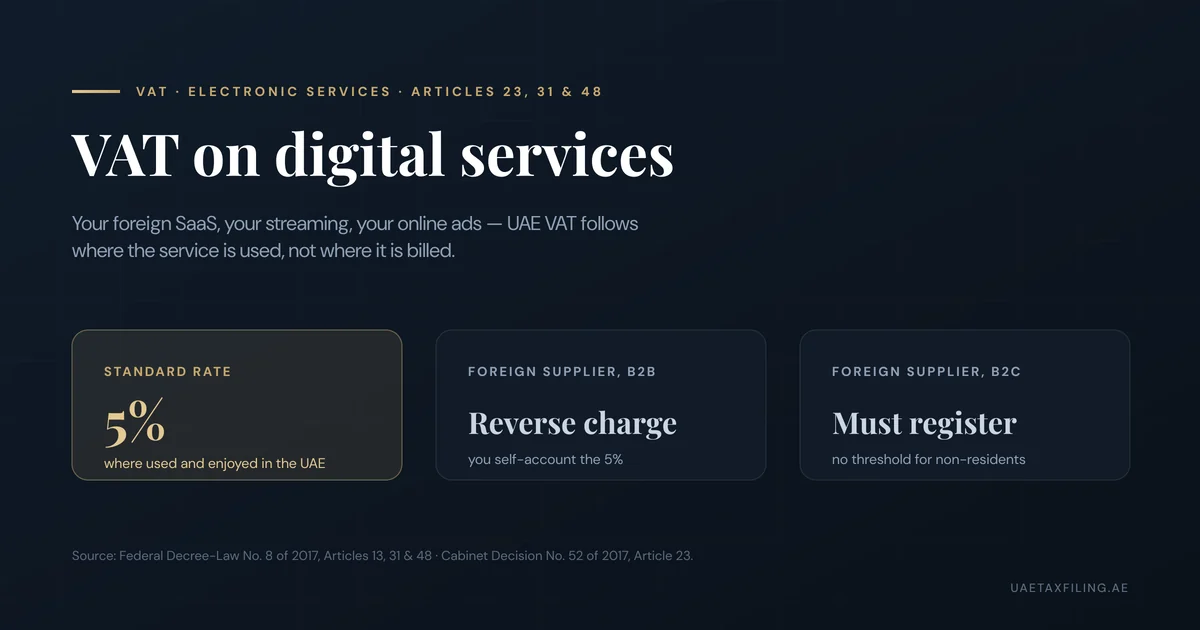
UAE VAT on digital services is charged at 5% where the service is used and enjoyed in the UAE, regardless of where the supplier sits or where the invoice is paid. If you buy foreign software or ads for your UAE business, you usually self-account for that 5% under the reverse charge. If a foreign provider sells digital services to UAE consumers, it must register for UAE VAT with no threshold.
The instinct is that a service bought from a company in California or Ireland is outside UAE tax. It is not. VAT follows use, not the supplier’s address — so your AWS, Adobe or Zoom subscription is inside the UAE’s 5%, and you are the one who has to account for it.
The short version
- Place of supply follows use. Under Article 31 of Federal Decree-Law No. 8 of 2017, electronic services are supplied where they are used and enjoyed — not where they are contracted or paid.
- Buying foreign SaaS? Reverse charge. A UAE-registered business importing digital services self-accounts for the 5% on its return.
- Selling to UAE consumers from abroad? Register. A non-resident provider making B2C digital supplies into the UAE must register for VAT, with no threshold.
- Selling digital services overseas? Zero-rated. Where the service is used outside the implementing states, it is an export of services at 0%.
- “Electronic services” is a defined list. Software, hosting, streaming, e-books, online ads, distance learning and more.
What this covers
- What counts as a digital service
- Where VAT is charged: used and enjoyed
- The four scenarios, decided
- Foreign SaaS you buy: reverse charge
- Foreign providers: when they must register
- Selling your digital service abroad
- What this means for consumers
- Common mistakes
- Frequently asked questions
What counts as a digital service
A digital, or electronic, service is one delivered automatically over the internet or an electronic network with minimal human involvement. The definition in the VAT Executive Regulation is a specific list, not a vague category, so a supply either fits it or it does not.
Article 23 of Cabinet Decision No. 52 of 2017 defines electronic services to include: domain names, web hosting and remote maintenance of software and equipment; the supply and updating of software; images, text and information supplied electronically, such as photos, e-books and files; music, films and games on demand; online magazines; advertising space on a website; cultural, artistic, sporting, educational and entertainment broadcasts; live streaming; and distance learning. The common thread is automation over a network. A bespoke consulting report emailed as a PDF is a professional service, not an electronic service; a self-serve software subscription is.
Key takeaway: Electronic services are automated supplies over the internet — software, hosting, streaming, e-books, online ads and distance learning. If a human delivers the work and the file is just the delivery method, it is an ordinary service, not an electronic one.
Where VAT is charged: used and enjoyed
The place of supply of an electronic service is where it is actually used and enjoyed, not where the supplier or customer is based. Article 31 of the VAT law puts the service in the UAE to the extent it is used in the UAE, and outside to the extent it is used outside — regardless of the place of contract or payment.
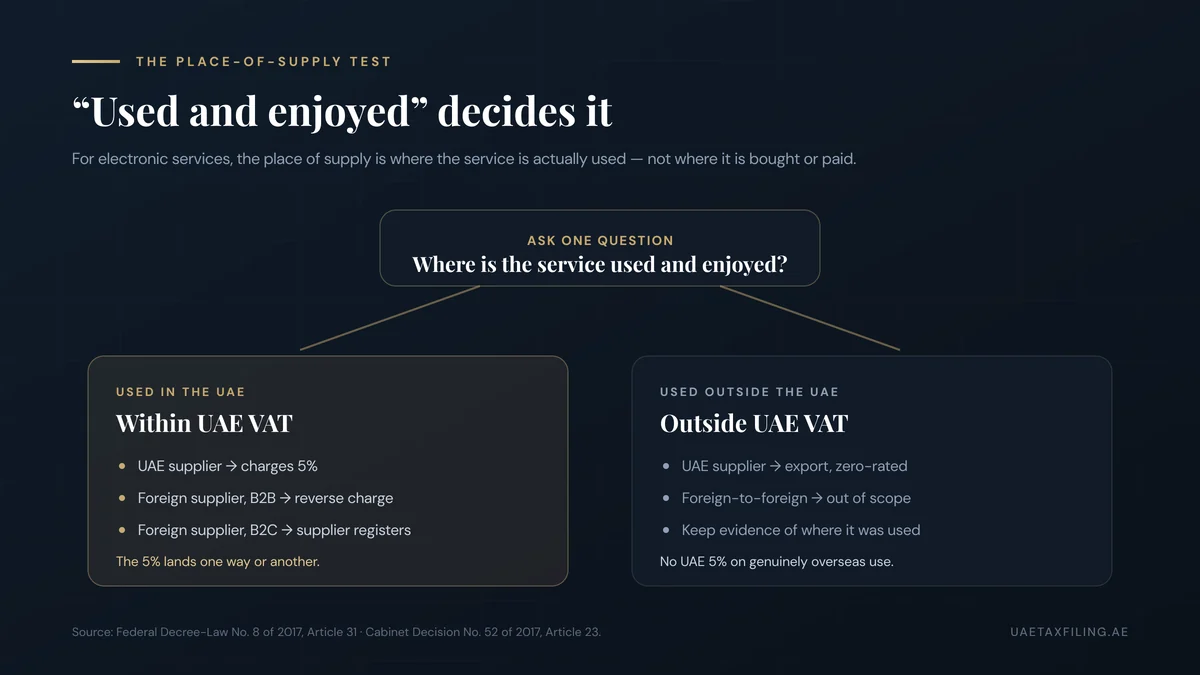
This is the rule that surprises people. A UAE company paying a US software firm cannot argue the supply is American because the vendor is American; the software is used by staff in Dubai, so it is used and enjoyed in the UAE and falls within the 5%. The same logic works in reverse: a UAE developer whose app is used entirely by customers in Europe is supplying outside the UAE. Keeping evidence of where a service is genuinely used — user location, billing country, IP — is what supports the treatment if the FTA asks.
Key takeaway: Use decides the place of supply, not the supplier’s country or the payment route. A foreign service used by your UAE team is a UAE supply; your service used only abroad is not.
The four scenarios, decided
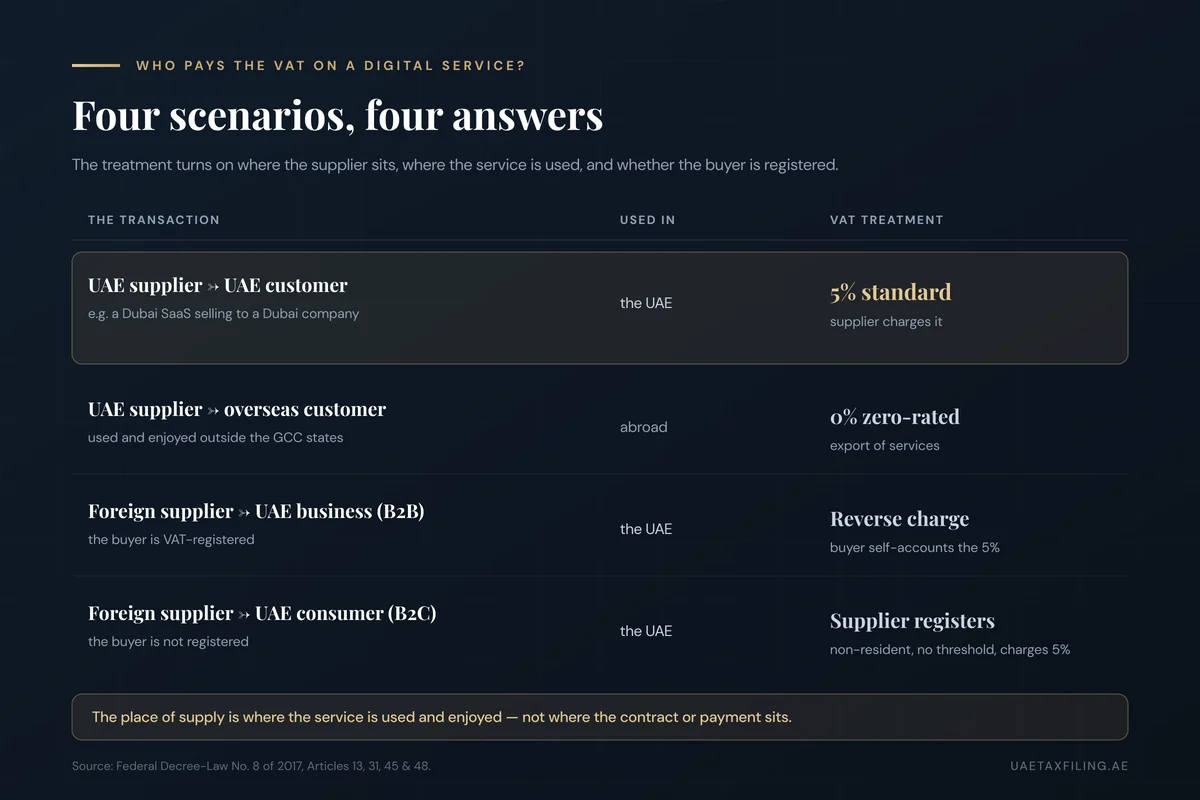
Every digital-service transaction resolves into one of four VAT outcomes, set by three facts: where the supplier sits, where the service is used, and whether the buyer is VAT-registered. Getting those three straight tells you who charges, who pays, and who registers.
| The transaction | Used in | VAT treatment |
|---|---|---|
| UAE supplier → UAE customer | the UAE | 5% standard — supplier charges it |
| UAE supplier → overseas customer | abroad | 0% zero-rated (export of services) |
| Foreign supplier → UAE VAT-registered business | the UAE | Reverse charge — buyer self-accounts the 5% |
| Foreign supplier → UAE consumer (not registered) | the UAE | Supplier registers (no threshold) and charges 5% |
Key takeaway: There are only four outcomes: 5% charged by a UAE supplier, 0% on exports, reverse charge on imports by a registered business, and registration by a non-resident selling to consumers. The 5% is always collected — the variable is who accounts for it.
Foreign SaaS you buy: reverse charge
The reverse charge is the mechanism that makes a UAE business account for VAT on a service it imports, instead of the foreign supplier. Under Article 48 of the VAT law, a taxable person importing a digital service is treated as making the supply to itself and must account for the 5%.
In practice this is a paper entry, not a cash cost, for a business that recovers input tax. You add 5% as output tax on the imported service and, in the same return, claim the same 5% as input tax — a net zero if the service relates to taxable activity. The catch is that many businesses simply ignore imported digital services and declare neither side, which is an error the FTA looks for. The mechanics of the mechanism are covered in our guide to the reverse charge mechanism, and the general registration duty in our VAT registration guide.
To handle an imported digital service correctly:
- Identify it as an imported service. A foreign supplier, a digital supply, used by your UAE business.
- Value it in AED. Convert the invoice at the Central Bank rate on the date of supply.
- Declare output tax. Add 5% of that value as reverse-charge output tax in the return.
- Claim input tax. Recover the same 5% to the extent the cost relates to taxable supplies.
- Keep the invoice. Retain the supplier’s bill as evidence for both entries.
Reverse charge feels like extra work for no tax, and for a fully taxable business it usually nets to zero. But skipping it is still a filing error — the return is wrong even when the tax is nil, and a partly-exempt business genuinely owes the unrecovered portion.
Key takeaway: When you buy foreign digital services for your UAE business, you self-account for the 5% under reverse charge — output and input tax in the same return. It usually nets to zero, but declaring neither side is still an error.
Foreign providers: when they must register
A non-resident digital provider must register for UAE VAT when it sells to UAE customers who cannot account for the tax themselves. Article 13 of the VAT law requires a person with no UAE establishment to register if it makes supplies in the State and no other person is obligated to pay the tax — and there is no registration threshold for that non-resident.
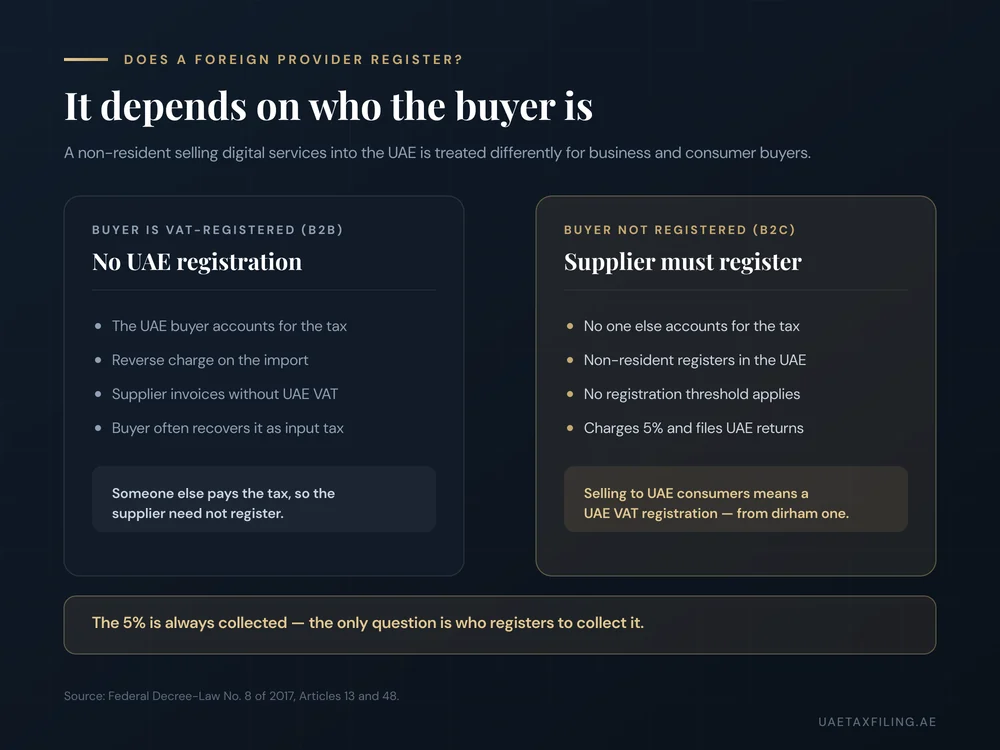
The split is about who else can account for the tax. Sell to a VAT-registered UAE business and that buyer reverse-charges the tax, so the foreign supplier need not register. Sell the same subscription to a UAE consumer or an unregistered business and no one else accounts for it — so the non-resident must register, charge 5%, and file UAE returns, from the first dirham. This is why global streaming, app and software platforms serving UAE consumers hold UAE VAT registrations.
Key takeaway: A foreign provider selling digital services to UAE businesses relies on the buyer’s reverse charge and need not register. Selling to UAE consumers, it must register with no threshold, because no one else can account for the tax.
Selling your digital service abroad
A UAE business selling digital services to customers who use them outside the implementing states is making a zero-rated export of services. The supply is taxable, but at 0%, so no VAT is charged while input tax stays recoverable.
This is the mirror image of the import rule. Because the place of supply is where the service is used, a Dubai SaaS whose users are in Europe or North America is supplying outside the UAE and zero-rates those sales, provided it holds evidence of the customer’s overseas use. The difference between 0% and exempt matters here — zero-rated keeps input-tax recovery, which we explain in our guides to zero-rated versus exempt supplies and the export of services. Mixed user bases need apportioning: the UAE-used share is 5%, the overseas share is 0%.
Key takeaway: Digital services used abroad are a zero-rated export — 0% charged, input tax still recovered — if you can evidence overseas use. A mixed user base is split between 5% for UAE use and 0% for the rest.
What this means for consumers
UAE consumers pay 5% VAT on digital subscriptions used in the UAE, the same as on any standard-rated supply. Whether the platform is local or foreign, the price you pay for streaming, apps, cloud storage or an e-book includes the tax where the service is consumed here.
For an individual there is nothing to file — the platform collects the VAT, either because it is a UAE supplier or because it registered as a non-resident. The practical effect is that the “foreign” feel of a global app makes no difference: a UAE-based subscriber to an overseas streaming service is paying UAE VAT within that price. Businesses, by contrast, must actively reverse-charge the same subscriptions, which is why the treatment feels invisible to consumers and very visible to finance teams.
Key takeaway: Consumers simply pay 5% inside the subscription price and file nothing. The compliance work sits with businesses buying digital services and with the platforms selling to consumers.
Common mistakes
The costly errors on digital services are the ones the FTA can spot from your return, and they cluster around imported services. Each is avoidable with a simple habit.
Four recur in practice. First, ignoring imported SaaS — declaring neither the reverse-charge output tax nor the input tax on foreign software, so the return is understated. Second, treating a foreign supplier as out of scope because the invoice has no VAT, when the reverse charge still applies. Third, zero-rating without evidence — claiming an export on digital sales without proof the customer used the service abroad. Fourth, missing the invoice rules when you do charge, which our guide to tax invoice requirements covers. None of these is exotic; they are the routine slips of a finance team that has not mapped its digital supplies.
Key takeaway: Most digital-service errors are imported-service errors — skipping the reverse charge, or exporting without evidence. Map your recurring digital suppliers and customers once, and the treatment becomes mechanical.
Tell us how digital services flow through your business — the foreign tools you buy, whether you sell digital products, and where your customers use them — and we will tell you what carries 5%, what reverse-charges, and whether you or a supplier needs to register. Where you need the registration or the VAT filing handled, we match you with an FTA-registered partner agency that does it. Message the team on WhatsApp using the button below.
Frequently asked questions
Do I pay UAE VAT on foreign software subscriptions?
Yes, if your UAE business uses the software here. Because the place of supply follows use and enjoyment, a foreign SaaS used by your UAE team is within UAE VAT. As a registered business you account for the 5% yourself under the reverse charge, rather than the foreign supplier charging it.
What counts as an electronic service for UAE VAT?
Services delivered automatically over the internet or an electronic network: software and updates, web hosting, streaming of music, film and games, e-books, online magazines, website advertising, broadcasts and distance learning. The defining feature is automation with minimal human involvement. A bespoke report a person prepares and emails is an ordinary service, not an electronic one.
How is the place of supply of digital services decided?
By where the service is actually used and enjoyed, under Article 31 of the VAT law. It is in the UAE to the extent it is used in the UAE and outside to the extent used outside, regardless of where the contract is signed or the payment is made. Evidence of the user’s location supports the treatment.
Do I charge VAT if I sell digital services to customers abroad?
No, you zero-rate them. A digital service used and enjoyed outside the implementing states is an export of services, taxable at 0%, so you charge no VAT but still recover input tax. You need evidence that the customer used the service overseas, and a mixed user base is apportioned between UAE and overseas use.
Does a foreign digital provider have to register for UAE VAT?
It depends on the buyer. Selling to UAE VAT-registered businesses, the buyer reverse-charges the tax and the foreign provider need not register. Selling to UAE consumers or unregistered buyers, the non-resident must register for UAE VAT with no threshold, because no one else can account for the tax.
What is reverse charge on imported digital services?
It is the rule that makes a UAE business account for VAT on a service it imports, instead of the foreign supplier. You add 5% as output tax on the imported service and claim the same 5% as input tax in the same return, which usually nets to zero for a fully taxable business. Declaring neither side is a filing error.
Is online advertising subject to UAE VAT?
Yes. Advertising space on a website is a listed electronic service, so it is standard-rated where it is used and enjoyed. A UAE business buying ads from a foreign platform accounts for the 5% under the reverse charge, in the same way as any other imported digital service.
Do consumers pay VAT on streaming and app subscriptions?
Yes, 5% where the service is used in the UAE, included in the price. The platform collects it — either as a UAE supplier or as a non-resident that has registered for UAE VAT — so an individual consumer has nothing to file. The foreign origin of an app makes no difference to the tax.
Where do I show imported-service VAT on my return?
As reverse-charge output tax, with a matching input-tax claim where the cost relates to taxable supplies. The value is the AED equivalent of the foreign invoice at the date of supply. Keeping the supplier’s invoice supports both entries if the FTA reviews your filing.
How we verified this: the definition, place-of-supply rule, reverse charge and non-resident registration are taken from Articles 13, 31 and 48 of Federal Decree-Law No. 8 of 2017 and Article 23 of its Executive Regulation (Cabinet Decision No. 52 of 2017). Confirm current text in the FTA VAT Decree-Law. This article is general information, not tax advice.
Last updated: 27 August 2026 · Reviewed by Jazim, CEO, UAE Tax Filing LLC (Dubai)