Last updated: 20 August 2026 · Written by the UAE Tax Filing editorial team · Reviewed by Jazim, CEO, UAE Tax Filing LLC (Dubai) · 11 min read
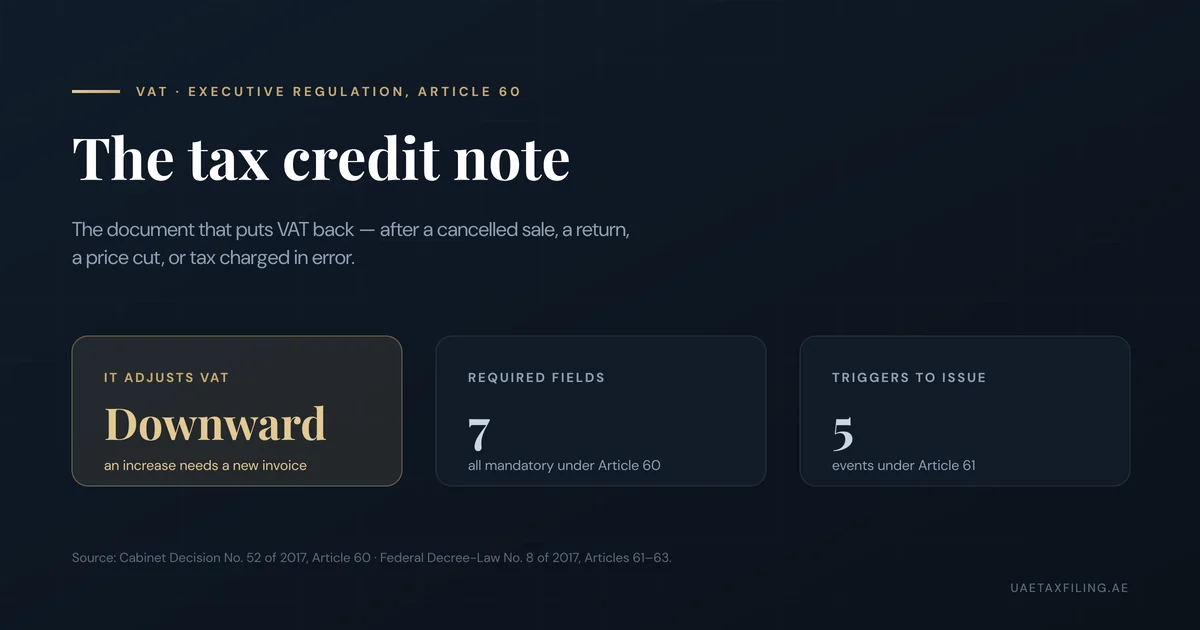
A tax credit note is the document a VAT-registered business issues to reduce the VAT on a supply after the invoice has gone out — when a sale is cancelled, goods are returned, the price is cut, or tax was charged in error. It must carry seven specific fields, and it only ever adjusts VAT downward. To increase the VAT, you issue a new tax invoice, not a credit note.
The credit note is the tax invoice’s mirror image. The invoice puts VAT onto a supply; the credit note takes some back off. Confuse it with a plain accounting credit and you break the trail the FTA relies on to let your customer keep their input tax.
The short version
- It reduces VAT after the invoice. Under Article 60 of the VAT Executive Regulation, a tax credit note corrects a supply’s VAT down.
- Five events trigger it. Cancellation, a change in the nature of the supply, a price reduction, a return, or tax charged in error.
- Seven fields are mandatory. Including the old value, the corrected value, the difference, and the tax on that difference in AED.
- It only goes down. If the VAT should rise, you issue a new tax invoice for the extra tax instead.
- Both sides adjust. You reduce your output tax; your customer reduces their input tax in the period they receive it.
What this covers
- What a tax credit note is
- When to issue one: the five triggers
- What a tax credit note must include
- Credit note vs new invoice
- The two-sided effect
- Recording it in your VAT return
- Bad debts: a different route
- Common credit-note mistakes
- Frequently asked questions
What a tax credit note is
A tax credit note is a document that formally reduces the value and VAT of a supply already invoiced. It is the corrective twin of the tax invoice: where the invoice records the tax due, the credit note records a reduction of that tax.
The two documents are governed together in the Executive Regulation and share a discipline. A tax credit note is not a customer-service gesture or an internal accounting entry; it is a legal document that changes the VAT position of both the supplier and the customer. Because it moves real tax, its form is prescribed just like a tax invoice, and a note that is missing required detail may not be effective to support the adjustment. A shop that gives store credit is doing something commercial; a registrant that issues a tax credit note is changing a VAT figure the FTA can check.
Key takeaway: A tax credit note is the legal document that reduces a supply’s VAT after invoicing. It is not the same as a goodwill credit or a refund receipt — it changes the tax on both sides.
When to issue one: the five triggers
A registrant must issue a tax credit note whenever an event after the sale reduces the VAT that should have been charged. Article 61 of the VAT law lists five such events, and any one of them requires the output tax to be adjusted.
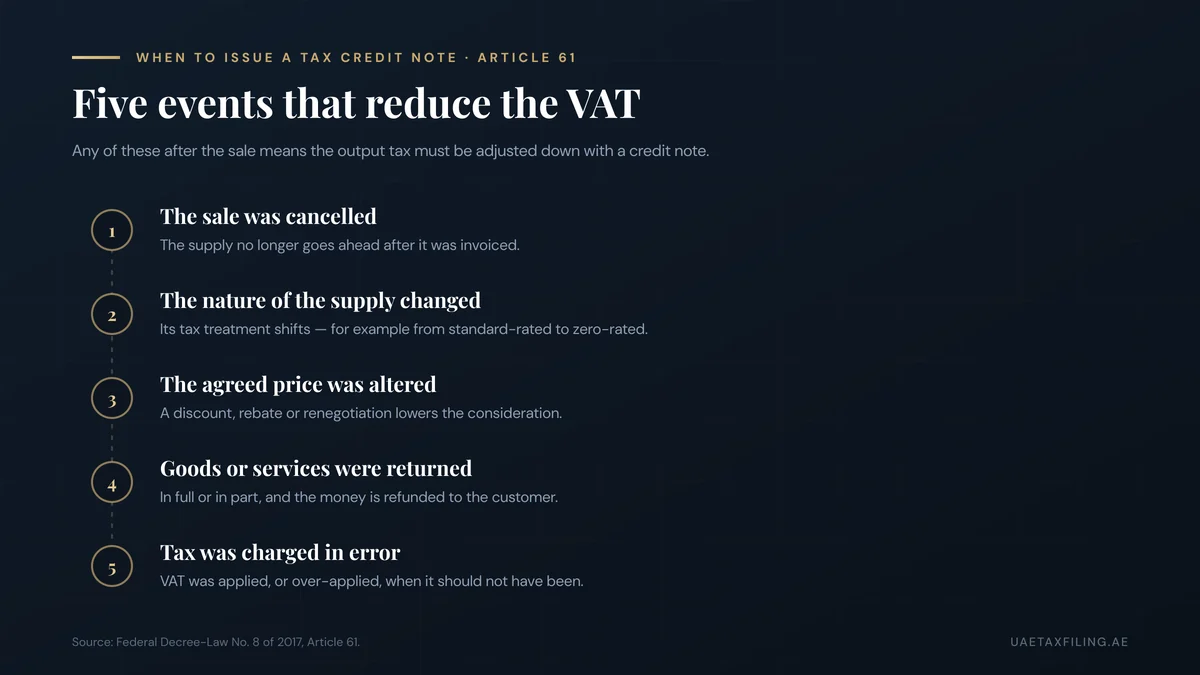
The five are: the supply was cancelled; its tax treatment changed because the nature of the supply changed; the agreed consideration was altered, such as a discount or renegotiation; the customer returned goods or services and the money was refunded; or tax was charged in error. A change in the nature of a supply can move it between rate categories — the boundary our guide to zero-rated vs exempt supplies maps out — and that shift is exactly the kind of event a credit note corrects. In each case the trigger is a real change to the supply, not a simple decision to give money back.
Key takeaway: Issue a tax credit note when a supply is cancelled, its nature changes, the price drops, goods are returned, or VAT was charged in error. These five events under Article 61 are the only triggers.
What a tax credit note must include
A valid tax credit note must contain seven particulars under Article 60, and the most important is the value line. Leaving one out can leave the adjustment open to challenge.

The seven fields are: the words “Tax Credit Note” clearly displayed; the supplier’s name, address and Tax Registration Number; the recipient’s name, address and TRN where they are registered; the date of issue; the value of the supply shown on the original invoice, the correct value, the difference between them, and the tax on that difference in AED; a brief explanation of the circumstances; and enough information to identify the original supply. The value line is where most notes fall short — showing only a net refund figure, rather than the before, after and VAT-difference the Regulation requires.
A tax credit note that just says “refund: AED 525” is not compliant. The Regulation wants the original value, the corrected value, and the tax on the difference — because those are the numbers that let both parties adjust their VAT correctly. The explanation and the link to the original invoice are what make the note auditable.
Key takeaway: A tax credit note needs all seven Article 60 fields, and the value line must show the original amount, the corrected amount and the VAT difference in AED — not just a single refund figure.
Credit note vs new invoice
A tax credit note is only used when VAT goes down; when VAT goes up, you issue a new tax invoice instead. Article 62 splits the two directions cleanly, and using the wrong document is a common error.
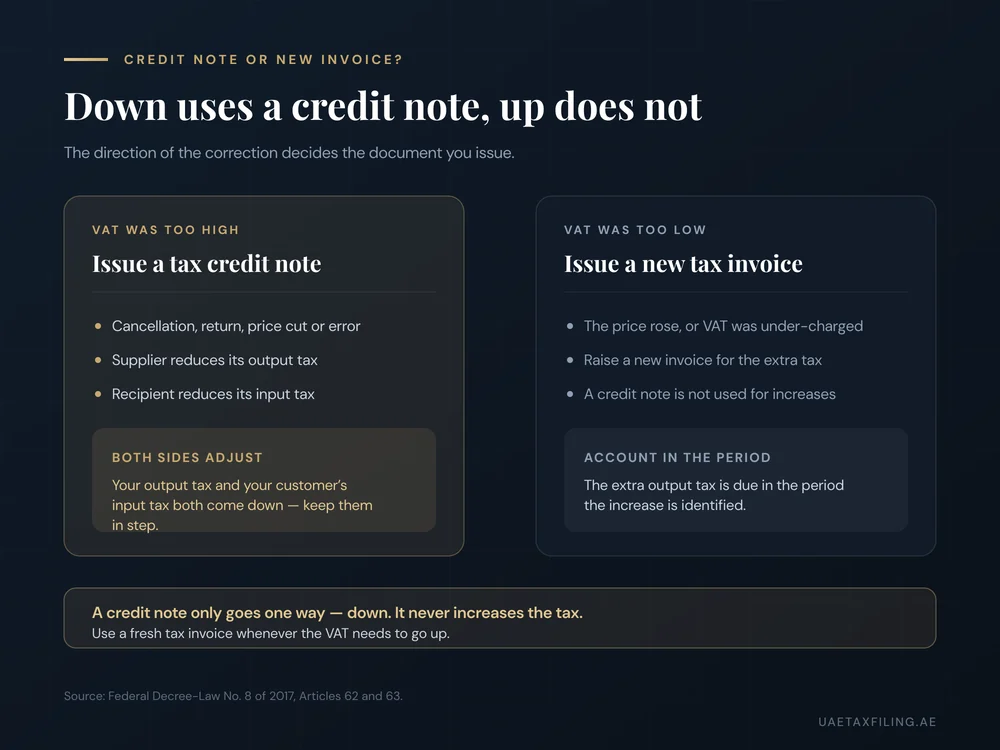
The rule follows the maths. If the output tax already charged was too high — a cancellation, return, price cut or error — you issue a tax credit note to bring it down. If the output tax was too low, because the price rose or VAT was under-charged, you issue a new tax invoice for the extra amount and account for it in the period you spot the increase. The table sets the two apart.
| Situation | Document to issue | Effect |
|---|---|---|
| VAT was too high (cancel, return, discount, error) | Tax credit note | Output tax and input tax both reduce |
| VAT was too low (price rose, under-charged) | New tax invoice | Additional output tax becomes due |
Key takeaway: Use a tax credit note only to reduce VAT. To increase it, raise a new tax invoice for the extra tax — a credit note never moves the figure upward.
The two-sided effect
A tax credit note changes the VAT position of both the supplier and the customer at the same time. Under Article 63, the tax shown on it reduces the supplier’s output tax and reduces the customer’s input tax.
This symmetry is the whole point of the document. The supplier who over-charged VAT gets to reduce the output tax it declared; the customer who over-claimed the matching input tax must reduce it in the period the credit note is received. If only one side adjusted, the two VAT returns would no longer reconcile, and the FTA would see a mismatch. That is why a credit note has to reach the customer — it is not enough to correct your own books. Picture a supplier that credits AED 500 of VAT: it cuts its output tax by AED 500, and the customer must cut its input tax by the same AED 500.
Key takeaway: A credit note works on both sides — the supplier’s output tax falls and the customer’s input tax falls by the same amount. It has to be delivered to the customer, not just recorded internally.
Recording it in your VAT return
A tax credit note is accounted for in the VAT return for the period in which it is issued, as a reduction of output tax. The customer records the matching input-tax reduction in the period it receives the note.
In practice the credit note flows into the same return machinery as your invoices. As the supplier, you reduce the output tax you report for the period, which lowers your net VAT payable or increases a refund. As the customer, you reduce the input tax you recover. Neither side amends the original period’s return; the adjustment lands in the current one. Keeping the credit note filed against the original invoice is what makes that return defensible — the same record discipline our guide to filing your quarterly VAT return sets out.
Key takeaway: Credit notes are reported in the current period, not by amending the old return — output tax down for the supplier, input tax down for the customer, each in the period the note is issued or received.
Bad debts: a different route
A bad debt is not corrected with a tax credit note; it uses a separate output-tax relief under Article 64. The distinction matters because an unpaid invoice is not one of the five credit-note triggers.
When a customer simply does not pay, the supply still happened and the VAT was correctly charged, so there is nothing to reverse with a credit note. Instead, a supplier that has paid the VAT and written the debt off in its accounts may reduce its output tax under the bad-debt rules, subject to conditions such as the debt being more than six months overdue and the customer being notified. It is relief for money you will not collect, not a correction of the original supply. Using a credit note for a bad debt would misstate the supply that genuinely took place.
Key takeaway: An unpaid invoice is a bad debt, not a credit-note event. Bad-debt relief under Article 64 is a separate mechanism with its own conditions, including writing off the debt and notifying the customer.
Common credit-note mistakes
Most credit-note problems are avoidable, and they cluster around a few recurring errors. Each one can undermine the adjustment or create a mismatch with the customer’s return — and a mismatch the FTA spots can draw the fines set out in the UAE VAT penalty regime.
Watch for these in particular:
- Using a credit note to increase VAT. An upward correction needs a new tax invoice, not a credit note.
- Showing only a net figure. The value line must give the original amount, the corrected amount and the VAT difference in AED.
- No link to the original invoice. The note must carry enough detail to identify the supply it corrects.
- Not sending it to the customer. Both sides have to adjust, so the customer needs the note to reduce its input tax.
- Treating an unpaid invoice as a credit-note event. That is a bad debt, handled separately.
Key takeaway: The frequent errors are wrong direction, a bare net figure, no invoice reference, not delivering the note, and confusing bad debts with corrections. A five-point check before issuing prevents nearly all of them.
Tell us what happened — a cancellation, a return, a price change or an error — and we will tell you whether you need a tax credit note or a new invoice, what it must show, and how to report it. Where you want your invoicing and VAT filing handled correctly, we match you with an FTA-registered partner agency that does it. Message the team on WhatsApp using the button below.
Frequently asked questions
What is a tax credit note in the UAE?
A tax credit note is a document a VAT-registered business issues to reduce the value and VAT of a supply it has already invoiced. It is used when the tax originally charged was too high, and it reduces both the supplier’s output tax and the customer’s input tax.
When should I issue a tax credit note?
You issue one when a supply is cancelled, the nature of the supply changes, the agreed price is reduced, goods or services are returned and refunded, or VAT was charged in error. These five events under Article 61 are the only triggers for a credit note.
What must a UAE tax credit note include?
Seven fields: the words “Tax Credit Note”, the supplier’s name, address and TRN, the recipient’s name, address and TRN where registered, the date of issue, the original and corrected values with the VAT difference in AED, a brief explanation, and enough detail to identify the original supply. The value line is the field most often done wrong.
What is the difference between a credit note and a debit note?
A tax credit note reduces the VAT on a supply. To increase the VAT — where the price rose or tax was under-charged — UAE VAT law has you issue a new tax invoice for the additional tax rather than a debit note. A credit note only ever moves the figure down.
Do I issue a credit note or a new invoice if the price goes up?
A new tax invoice. Under Article 62, if the output tax due exceeds what you calculated, you issue a new tax invoice for the additional amount and account for it in the period you identify the increase. A credit note is only for reductions.
Does my customer have to adjust their VAT when they receive a credit note?
Yes. Under Article 63, the customer must reduce its recoverable input tax by the amount on the credit note, in the tax period it receives the note. This mirrors the supplier reducing its output tax, so both returns stay consistent.
Can I issue a tax credit note electronically?
Yes. Article 60 permits electronic tax credit notes provided you can store a copy securely and guarantee the authenticity of origin and integrity of content. This is the same standard that applies to electronic tax invoices.
Is a tax credit note the same as a refund?
No. A refund is the movement of money back to the customer; a tax credit note is the VAT document that reduces the tax on the supply. A refund may accompany a credit note, but the note is what adjusts the VAT for both parties.
How do I record a credit note in my VAT return?
As the supplier, you reduce your output tax in the return for the period the credit note is issued. As the customer, you reduce your input tax in the period you receive it. You do not amend the original period’s return — the adjustment lands in the current one.
How we verified this: the required fields come from Article 60 of Cabinet Decision No. 52 of 2017 (as amended by Cabinet Decision No. 100 of 2024); the triggers, direction and two-sided effect come from Articles 61, 62 and 63 of Federal Decree-Law No. 8 of 2017. Confirm current text in the FTA VAT Decree-Law. This article is general information, not tax advice.
Last updated: 20 August 2026 · Reviewed by Jazim, CEO, UAE Tax Filing LLC (Dubai)